
Paper:
Behavior Verification of a Smartphone-Based Fall Risk Alert System and Visually Impaired Users on a Station Platform
Daigo Katayama*1,*2
 , Kazuo Ishii*1,*3, Shinsuke Yasukawa*1,*3
, Yuya Nishida*1,*3, Satoshi Nakadomari*4
, Koichi Wada*4, Akane Befu*4, Chikako Yamada*4, and Atsushi Harata*4
, Kazuo Ishii*1,*3, Shinsuke Yasukawa*1,*3
, Yuya Nishida*1,*3, Satoshi Nakadomari*4
, Koichi Wada*4, Akane Befu*4, Chikako Yamada*4, and Atsushi Harata*4
*1Center for Social Implementation of Future Robots, Kyushu Institute of Technology
2-4 Hibikino, Wakamatsu-ku, Kitakyushu, Fukuoka 808-0196, Japan
*2Department of Intelligent Robotics, Kobe City College of Technology
8-3 Gakuen-higashimachi, Nishi-ku, Kobe, Hyogo 651-2194, Japan
*3Department of Life Science and Systems Engineering, Kyushu Institute of Technology
2-4 Hibikino, Wakamatsu-ku, Kitakyushu, Fukuoka 808-0196, Japan
*4NEXT VISION Public Interest Incorporated Association
Kobe Eye Center 2F, 2-1-8 Minatojima-minamimachi, Chuo-ku, Kobe, Hyogo 650-0047, Japan

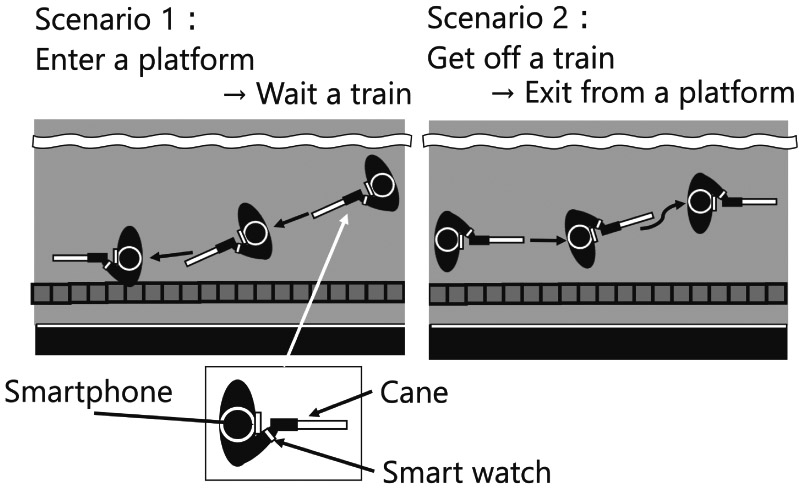
We have been working on a system that alerts visually impaired people who get closer to fall risk areas, such as platform edges and stairs, in their walking direction to reduce accidental falls. This system, known as electronic travel aid (ETA), is usually attached to a white cane and assists the user to avoid collisions and falling down. Utilizing recent advancements in information technology, we have introduced a smartphone as an ETA. The proposed fall risk alert system detects fall risk areas in the walking direction of the user based on a depth image obtained by a smartphone. The system calculates the fall risk based on the shortest distance to the edge of a platform and generates an alert as vibration from the smartphone or smartwatch. We conduct verification experiments using the smartphone-based fall risk alert system on a train platform in collaboration with visually impaired persons, who walk according to scenarios expected in daily life. The experimental results demonstrate that the system generates fall risk alerts on station platforms. Based on the walking paths and questionnaire answers, the proposed system is considered to provide similar information with tactile paving.
Behavioral verification of an alert system
- [1] Z. Han et al., “Simulating the obstacle avoidance behavior day and night based on the visible-infrared MoS2/Ge heterojunction field-effect phototransistor,” Nano Res., Vol.16, No.8, pp. 11296-11302, 2023. https://doi.org/10.1007/s12274-023-5816-6
- [2] M. Hosoda, W. Yoshida, and S. Kajikawa, “Analysis on gait trajectory influenced by forced head rotation,” Proc. of the 2024 JSME Conf. on Robotics and Mechatronics, 1A1-Q06, 2024 (in Japanese). https://doi.org/10.1299/jsmermd.2024.1A1-Q06
- [3] R. Yasumoto and T. Ikeda, “Predictive information presentation for aligning human and system intentions in cooperative wheelchair navigation,” Proc. of the 2024 JSME Conf. on Robotics and Mechatronics, 2P2-D03, 2024 (in Japanese). https://doi.org/10.1299/jsmermd.2024.2P2-D03
- [4] T. Asakawa and H. Saeki, “Risk factor attitude survey and step of road detection method about wheelchair of elderly person,” J. Robot. Mechatron., Vol.35, No.1, pp. 171-179, 2023. https://doi.org/10.20965/jrm.2023.p0171
- [5] X. Kong et al., “Three-states-transition method for fall detection algorithm using depth image,” J. Robot. Mechatron., Vol.31, No.1, pp. 88-94, 2019. https://doi.org/10.20965/jrm.2019.p0088
- [6] D. Katayama et al., “Fall risk estimation for visually impaired using iPhone with LiDAR,” J. of Robotics, Networking and Artificial Life, Vol.9, No.4, pp. 349-357, 2023. https://doi.org/10.57417/jrnal.9.4_349
- [7] D. Katayama et al., “Grid map correction for fall risk alert system using smartphone,” J. Robot. Mechatron., Vol.35, No.3, pp. 867-878, 2023. https://doi.org/10.20965/jrm.2023.p0867
- [8] D. Katayama et al., “Verification of the walking behavior of visually impaired when they use a travel aid application that alerts fall risk,” Proc. of the 31th Conf. on Rehabilitation of the Visually Impaired, O2-1, 2023 (in Japanese).
- [9] D. Katayama et al., “Demonstration experiment on a station platform of a fall risk alert system for visually impaired using a smartphone,” Proc. of the 2024 JSME Conf. on Robotics and Mechatronics, 1P2-E10, 2024 (in Japanese). https://doi.org/10.1299/jsmermd.2024.1P2-E10
- [10] U. Vijetha and V. Geetha, “Obs-tackle: An obstacle detection system to assist navigation of visually impaired using smartphones,” Mach. Vis. Appl., Vol.35, No.2, Article No.20, 2024. https://doi.org/10.1007/s00138-023-01499-8
- [11] M. T. Paratore and B. Leporini, “Exploiting the haptic and audio channels to improve orientation and mobility apps for the visually impaired,” Univers. Access Inf. Soc., Vol.23, No.2, pp. 1-11, 2023. https://doi.org/10.1007/s10209-023-00973-4
- [12] A. S. Raina, R. R. Mohanty, A. Bhuvanesh, D. Prabha, M. Swaminathan, and V. R. Krishnamurthy, “Pointing tasks using spatial audio on smartphones for people with vision impairments,” J. Comput. Inf. Sci. Eng., Vol.24, No.2, Article No.021011, 2024. https://doi.org/10.1115/1.4062426
- [13] M. Zhang, H. Liu, Y. Zhou, C. Chen, P. Huang, and J. Zhao, “Don’t confuse! Redrawing GUI navigation flow in mobile apps for visually impaired users,” IEEE Trans. on Software Engineering, Vol.50, No.12, pp. 3351-3368, 2024. https://doi.org/10.1109/TSE.2024.3485225
- [14] J. Song et al., “Mixture reality-based assistive system for visually impaired people,” Displays, Vol.78, Article No.102449, 2023. https://doi.org/10.1016/j.displa.2023.102449
- [15] Y. Kaniwa et al., “ChitChatGuide: Conversational interaction using large language models for assisting people with visual impairments to explore a shopping mall,” Proc. ACM Hum. Comput. Interact., Vol.8, No.MHCI, Article No.247, 2024. https://doi.org/10.1145/3676492
- [16] I.-J. Jeong, K. Kim, J. Jung, and J. Cho, “YOLOv8-based XR smart glasses mobility assistive system for aiding outdoor walking of visually impaired individuals in South Korea,” Electronics, Vol.14, No.3, Article No.425, 2025. https://doi.org/10.3390/electronics14030425
- [17] S. Cai et al., “Navigating real-world challenges: A quadruped robot guiding system for visually impaired people in diverse environments,” Proc. of the CHI Conf. on Human Factors in Computing Systems, Article No.44, 2024. https://doi.org/10.1145/3613904.3642227
- [18] M. Kuribayashi, K. Uehara, A. Wang, S. Morishima, and C. Asakawa, “WanderGuide: Indoor Map-less Robotic Guide for Exploration by Blind People,” Proc. of the 2025 CHI Conf. on Hum. Factors in Computing Systems, Article No.676, 2025. https://doi.org/10.1145/3706598.3713788
- [19] S. Pundlik, P. Shivshanker, T. Traut-Savino, and G. Luo, “Field evaluation of a mobile app for assisting blind and visually impaired travelers to find bus stops,” Transl. Vis. Sci. Technol., Vol.13, No.1, 2024. https://doi.org/10.1167/tvst.13.1.11
- [20] K. Iwamatsu and M. Nihei, “Combined analysis of information gathering behavior in skilled powered wheelchair users through gaze and thought processes,” Proc. of the 2024 JSME Conf. on Robotics and Mechatronics, 1P2-F09, 2024 (in Japanese).
- [21] Y. Doi, H. Kunii, K. Morimoto, and Y. Mori, “Stair climbing units with portable ramps for manual wheelchair users,” Proc. of the 2024 JSME Conf. on Robotics and Mechatronics, 1P2-F05, 2024 (in Japanese). https://doi.org/10.1299/jsmermd.2024.1P2-F05
- [22] M.-Y. Xu et al., “Development of an ankle assistive robot with instantly gait-adaptive method,” J. Robot. Mechatron., Vol.35, No.3, pp. 669-683, 2023. https://doi.org/10.20965/jrm.2023.p0669
- [23] Y. Wang, W. Chao, D. Garg, B. Hariharan, M. Campbell, and K. Q. Weinberger, “Pseudo-LiDAR from visual depth estimation: Bridging the gap in 3D object detection for autonomous driving,” Proc. of the IEEE/CVF Conf. on Computer Vision and Pattern Recognition (CVPR), pp. 8445-8453, 2019. https://doi.org/10.1109/CVPR.2019.00864
- [24] D. Ternes and K. E. MacLean, “Designing large sets of haptic icons with rhythm,” Haptics: Perception, Devices and Scenarios, pp. 199-208, 2008. https://doi.org/10.1007/978-3-540-69057-3_24
- [25] J. Brooke et al., “SUS-A quick and dirty usability scale,” Usability Evaluation in Industry, Vol.189, No.194, pp. 4-7, 1996.
- [26] N. Doe, S. Scharoba, M. Reichenbach, and C. Herglotz, “Comparison of Bluetooth low energy (BLE), Wi-fi, serial and 5G in IoMT,” Proc. of the 18th Int. Joint Conf. on Biomedical Engineering Systems and Technologies, pp. 859-866, 2025. https://doi.org/10.5220/0013321500003911
- [27] C. Y. Wong, R. A. Ananto, T. Akiyama, J. P. Nemargut III, and A. Moon, “Perspectives on robotic systems for the visually impaired,” Companion of the 2024 ACM/IEEE Int. Conf. on Human-Robot Interaction, pp. 1134-1138, 2024. https://doi.org/10.1145/3610978.3640698
- [28] M. Agmon, A. Sa’ar, and T. Araten-Bergman, “The person in the disabled body: A perspective on culture and personhood from the margins,” Int. J. Equity Health, Vol.15, No.1, Article No.147, 2016. https://doi.org/10.1186/s12939-016-0437-2
- [29] H. L. Tan, T. Aplin, H. Gullo, and T. McAuliffe, “Training and learning support to use smartphones and apps for people with vision impairment (PVI): A multi-site qualitative study on trainers’ perspectives from Australia, Canada, and Singapore,” Br. J. Vis. Impair., Vol.42, No.3, pp. 754-768, 2024. https://doi.org/10.1177/02646196231183891
- [30] Ministry of Land, Infrastructure, Transport and Tourism in Japan, “Information on safety of railway transportation (fy2023).” https://www.mlit.go.jp/tetudo/content/001973720.pdf [Accessed April 18, 2025]
- [31] Apple Inc., “WKHapticType.” https://developer.apple.com/documentation/watchkit/wkhaptictype [Accessed July 29, 2025]
- [32] S. Yamauchi, “SUS: System Usability Score,” (in Japanese). https://s-yamauchi.w.waseda.jp/ResEthics/SUS/SUS.html [Accessed July 30, 2025]
This article is published under a Creative Commons Attribution-NoDerivatives 4.0 Internationa License.