
Research Paper:
Structured Representation and Traceability of Upgrade Processes in Gaming Simulations
Akinobu Sakata*,†
 , Takamasa Kikuchi**
, Masaaki Kunigami***
, and Takao Terano***
*Waseda University
3-4-1 Okubo, Shinjuku-ku, Tokyo 169-8555, Japan
†Corresponding author
**Kanto Gakuin University
1-50-1 Mutsuura-higashi, Kanazawa-ku, Yokohama, Kanagawa 236-8501, Japan
***Chiba University of Commerce
1-3-1 Konodai, Ichikawa, Chiba 272-8512, Japan

This paper proposes a structured traceability-based representation format for documenting operational-phase upgrade processes in gaming simulations. The proposed format links external feedback, requirement elements, layer-wise design changes, work processes, and deliverables within a unified structure, and introduces explicit layer-decision rules for classifying design modifications across the Concept, Model, Interface, and Operation layers. Compared with conventional traceability approaches, which mainly focus on artifact-to-artifact links, the proposed format explicitly incorporates the domain-specific layer structure of gaming simulations and the work processes through which design changes are implemented. This enables reviewers to inspect not only requirement coverage but also cross-layer propagation and requirement–deliverable alignment in practical design review and quality-assurance settings. We examined the applicability of the format through a literature-based reconstruction of the extension from the Beer Game to the Cash Beer Game. The resulting relationship map and integrated traceability table clarified how financial-flow requirements were translated into model changes, interface deliverables, and operational materials. The case also showed how potential Model–Interface and Concept–Operation inconsistencies can be identified through the proposed representation. The proposed format is expected to support systematic documentation, review, and quality control of gaming simulation upgrades, and to contribute to more transparent and reusable design knowledge in simulation and gaming research.
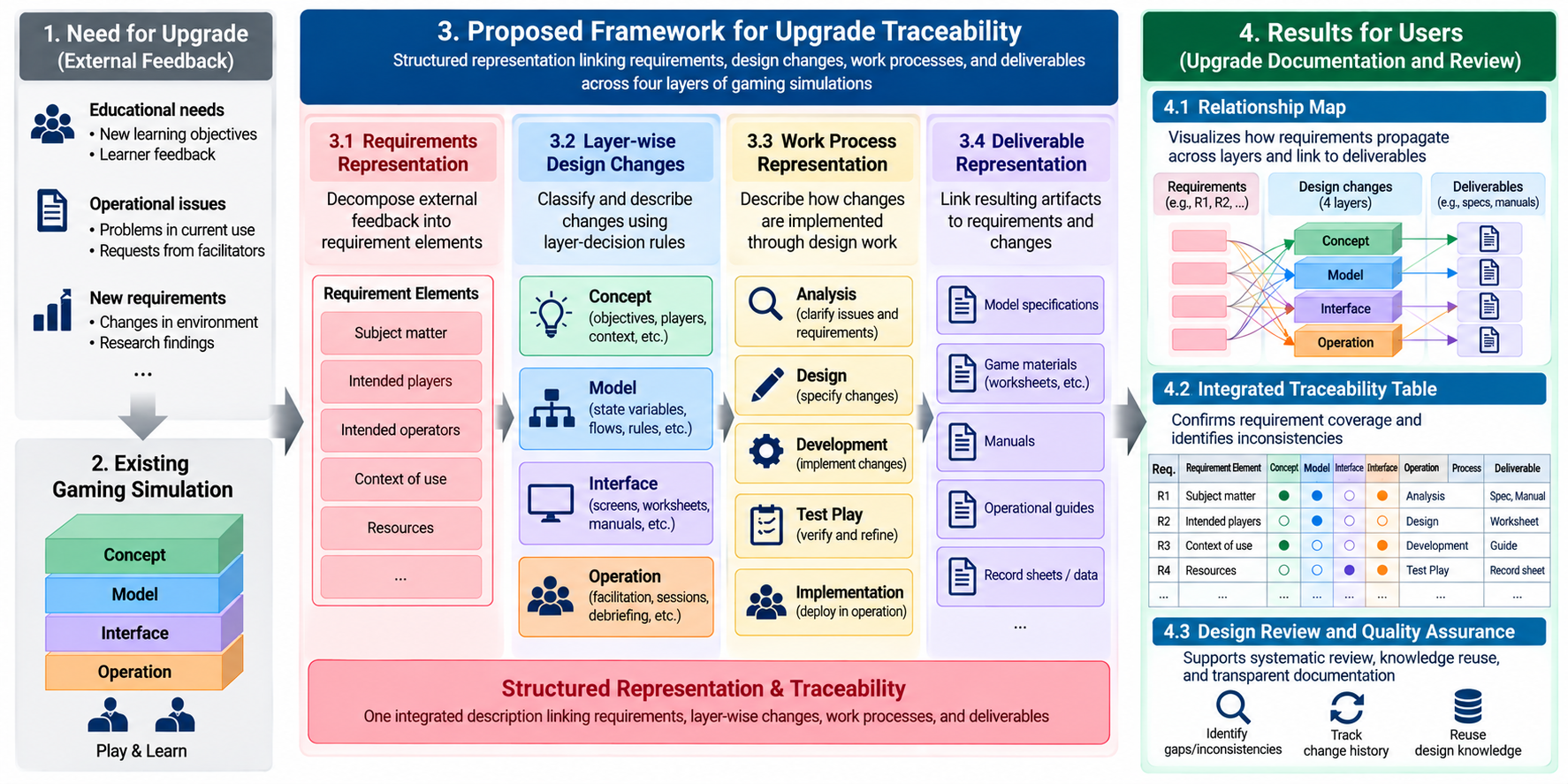
Structured traceability of game upgrades
1. Introduction
Gaming simulations are widely used in education, training, and decision-support contexts 1,2,3,4. Their design often involves multiple interrelated components, including conceptual structures, simulation models, interfaces, and operational procedures 5,6. In practice, these systems are not static artifacts but are continuously modified in response to changes in educational objectives, operational environments, and external requirements. Sakata et al. define such modifications as upgrades, in which core specifications of a gaming simulation are reconfigured to accommodate external feedback 5.
Despite the practical importance of upgrades, existing game design methodologies have primarily focused on initial development processes, such as concept definition, model design, representation design, prototyping, and testing 6,7,8,9,10. While some studies acknowledge maintenance activities during the operational phase, these are typically limited to incremental adjustments, such as bug fixes or minor functional improvements 11,12,13. When external feedback necessitates changes to core elements—particularly at the conceptual and model levels—designers often lack systematic support for organizing and documenting such changes.
| Aspect | Previous upgrade framework 5 | Conventional requirements traceability matrix (RTM)-based traceability 18,19 | Proposed format in this paper |
| Primary focus | Conceptual framework for gaming simulation upgrades | Trace links among requirements and artifacts | Structured representation of operational-phase upgrade processes in gaming simulations |
| Design structure | Four layers: Concept, Model, Interface, and Operation | Not domain-specific; layer structure is not usually explicit | Uses the four layers as explicit categories for tracing design transformations |
| Trace units | Feedback, layers, and work processes are conceptually related | Requirements, design documents, implementation components, and tests | External feedback, requirement elements, layer-wise changes, work processes, and deliverables |
| Classification criteria | Layer assignment is conceptually described | Depends on project-specific artifact definitions | Adds if–then layer-decision rules for assigning changes to layers |
| Work processes | Included in the conceptual framework | Often outside the main traceability matrix | Explicitly linked to requirement elements and deliverables |
| Main contribution | Provides the conceptual basis for upgrades | Provides general traceability among artifacts | Operationalizes a domain-specific representation format for representing and inspecting gaming simulation upgrades |
In operational-phase upgrades, three major challenges arise. First, it is often unclear how modifications should propagate across interdependent design structures, since changes introduced in one layer frequently affect other components. Second, designers lack systematic methods for representing how modifications are realized through work processes and reflected in implementation artifacts such as specifications, interfaces, manuals, and operational procedures. Third, without explicit linkage structures among requirements, layer-wise design changes, work processes, and resulting deliverables, it becomes difficult to verify the consistency and completeness of upgrade processes across interconnected components. Prior work on gaming simulation upgrades has pointed out that conventional design and maintenance methodologies do not sufficiently support core specification changes and reconstruction in response to external feedback 5. In addition, gaming simulations may be designed ad hoc to answer particular questions, which can be problematic for their intended impact if they are not carefully designed 14. These observations indicate the need to explicitly represent how external feedback is translated into requirements, layer-wise design changes, work processes, and deliverables.
To address these issues, Sakata et al. proposed an upgrade framework that links (i) feedback from the external environment, (ii) a four-layer structure of gaming simulations—Concept, Model, Interface, and Operation—and (iii) corresponding work processes 5. This framework provides a conceptual basis for identifying which layers should be modified in response to specific types of feedback. However, the framework has primarily been illustrated through hypothetical examples and does not yet provide a concrete method for instantiating the linkage among requirements, layer-wise changes, work processes, and deliverables in a concrete upgrade case.
The objective of this paper is to propose a traceability-based representation format for operational-phase upgrades of gaming simulation systems and to illustrate its application in a concrete case. Specifically, we focus on the extension of the Beer Game (BG), a well-established supply chain simulation 15, to the Cash Beer Game (CBG), which incorporates financial flows and working capital constraints into the simulation structure 16,17. In this study, external feedback is represented as upgrade requirements, which are systematically decomposed and linked to layer-wise design changes, work processes, and resulting deliverables.
The contributions of this paper are as follows. Building on the four-layer upgrade framework proposed by Sakata et al. 5, this paper does not propose the four-layer framework itself, but operationalizes it as a traceability-based representation format for operational-phase upgrades. First, it introduces requirement elements as intermediate trace units that connect external feedback to layer-wise design changes. Second, it proposes explicit layer-decision rules that support the consistent assignment of design changes to the Concept, Model, Interface, and Operation layers. Third, it integrates requirement elements, layer-wise changes, work processes, and deliverables into a traceability table and illustrates its use through the BG-to-CBG case. These elements were not concretely instantiated in the previous framework 5.
Compared with conventional requirements traceability matrices (RTMs), which mainly record relationships among requirements and downstream artifacts, the proposed format explicitly incorporates the domain-specific layer structure of gaming simulations and the work processes through which design changes are implemented. Thus, the novelty of this study lies in the concrete operationalization of the previous upgrade framework as a method for documenting and inspecting upgrade processes, rather than in the proposal of the four-layer structure itself. Table 1 summarizes the positioning of the proposed format.
The remainder of this paper is organized as follows. Section 2 reviews related work on traceability and positions the need for a domain-specific description of gaming simulation upgrades. Section 3 summarizes the basic specification of the BG and clarifies the differences between BG and CBG. Section 4 summarizes the upgrade framework and introduces layer-decision rules. Section 5 presents the traceable upgrade description. Section 6 discusses implications for quality control and systematic inspection. Finally, Sections 7 and 8 present limitations, future work, and conclusions.
3. Target Game and Overview of the Upgrade
This paper uses the extension of the BG to the CBG as a case to illustrate the proposed representation format. The BG-to-CBG case in this paper is not an observed upgrade project involving actual stakeholders. Rather, it is a literature-based reconstruction of an upgrade case constructed from the existing CBG design 16,17. The case is used as a worked example to illustrate how the proposed traceability-based format can represent the transition from an existing game specification to an upgraded specification. Because the proposed format aims to trace changes from the original game to the upgraded game, this section first summarizes the basic specification of BG and then describes the differences between BG and CBG.
3.1. Basic Specification of the BG
The BG is a role-play simulation of a multi-stage supply chain consisting of four roles: retailer, wholesaler, distributor, and factory 15. Each player manages one stage of the supply chain and repeatedly makes ordering decisions over multiple rounds. Customer demand enters the retailer, order information flows upstream from the retailer to the factory, and products are shipped downstream from the factory to the retailer. Both order transmission and product delivery involve delays, which prevent each player from immediately observing the effects of their own and others’ decisions.
In each round, players observe local information such as incoming orders, incoming shipments, current inventory, and backlog. Based on this information, each player decides an order quantity to be sent to the upstream stage. The main state variables include inventory, backlog, incoming orders, outgoing orders, incoming shipments, and outgoing shipments. The main decision variable is the order quantity. The cost structure typically consists of inventory holding cost and backlog cost, and the objective of each player is to minimize the accumulated cost while satisfying downstream demand.
A typical round proceeds through the following steps: receiving incoming shipments, updating inventory and backlog, receiving orders from the downstream stage, deciding and placing an order to the upstream stage, shipping available products downstream, and calculating inventory and backlog costs. Through this process, participants experience how local decisions, limited information, feedback delays, and ordering adjustments can amplify demand fluctuations across the supply chain. Thus, BG is used to teach supply chain dynamics, delayed feedback, local decision-making, and the bullwhip effect.
3.2. CBG as an Extension of BG
The CBG extends BG by explicitly introducing financial flows and working capital constraints into the simulation structure 16,17. In addition to the material and information flows represented in BG, CBG includes cash balance, receipts, payments, borrowing under cash shortage, and interest on surplus cash. This extension links inventory decisions with financial outcomes and enables participants to examine how operational decisions interact with liquidity and financing conditions. In this study, the extension from BG-to-CBG is treated as an upgrade driven by a new requirement: the need to explicitly address financial flows in supply chain education.
For clarity, the financial extension can be represented using a simplified cash-balance notation. Let \(C_t\) denote the cash balance at round \(t\). In each round, cash is updated by adding receipts, subtracting payments, and applying cash-related costs or returns. When \(C_t \geq 0\), surplus cash may generate interest at a rate \(r\). When \(C_t < 0\), the negative balance is treated as borrowing and incurs a borrowing cost at rate \(d\). The condition \(d>r\) represents an imperfect financial market in which borrowing is more costly than the return on surplus cash. This simplified notation is not intended to provide a full CBG specification, but to clarify how receipts, payments, borrowing, interest, and the \(d/r\) condition extend the original BG structure.
3.3. Differences Between BG and CBG
| Diff. ID | Aspect | BG | CBG | Requirement / layer |
| D1 | Learning objective | Understand supply chain dynamics, delayed feedback, local ordering decisions, and the bullwhip effect | Understand the interaction between inventory decisions and working-capital/liquidity constraints | R1 / Concept |
| D2 | State variables | Inventory, backlog, incoming orders, outgoing orders, incoming shipments, and outgoing shipments | Adds cash balance, receipts, payments, borrowing, and cash-related cost variables | R2 / Model |
| D3 | Decision variable | Order quantity is the main decision variable | Order quantity remains the main decision variable, but the decision context includes cash status and financing consequences | R2, R3 / Model |
| D4 | Flows | Information flow upstream and material flow downstream | Adds financial flow, including receipts, payments, surplus cash, and borrowing | R2 / Model |
| D5 | Delay structure | Delays in order transmission and product delivery | Adds timing relations for receipts and payments corresponding to sales and purchases | R2, R3 / Model |
| D6 | Cost structure | Inventory holding cost and backlog cost | Separates physical costs from cash-related costs such as borrowing cost and interest income | R3 / Model |
| D7 | Player observation | Local operational information such as inventory, backlog, incoming orders, and shipments | Adds financial information such as cash balance, receipts, payments, and borrowing status | R4 / Interface |
| D8 | Round procedure | Receive shipments, update inventory/backlog, receive orders, decide order quantity, ship products, and calculate costs | Adds receipt/payment processing, cash-balance updating, and borrowing treatment within each round | R3, R4 / Model and Interface |
| D9 | Deliverables and operation | Record sheets, manuals, and debriefing mainly focus on inventory/backlog dynamics | Record sheets, manuals, briefing, and debriefing also address cash flow, working capital, and the inventory–cash trade-off | R4, R5 / Interface and Operation |
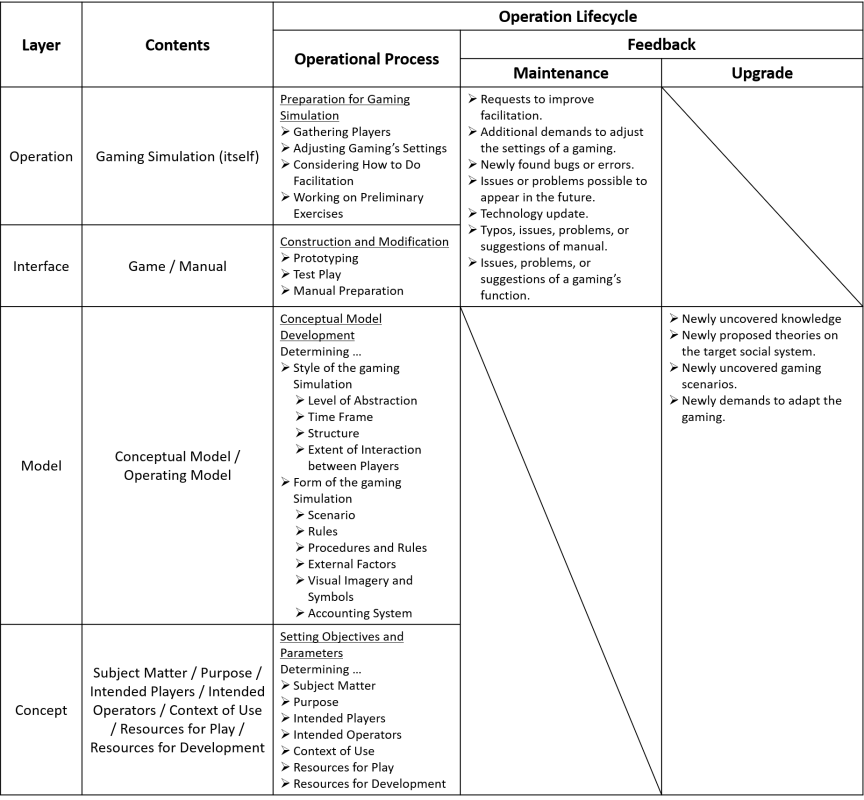
Fig. 1. Four-layer upgrade framework used in this study, based on 5.
Table 2 summarizes the differences between BG and CBG and links them to the requirement elements used in the traceability table. The purpose of this table is not to provide a full design specification of CBG, but to clarify which elements of the original BG are maintained, added, or modified in the upgrade. This table provides the “before–after” basis for tracing how the upgrade propagates across layers.
Because the difference items are linked to requirement elements (R1–R5), they provide a basis for subsequently tracing how the BG-to-CBG changes are reflected in layer-wise design changes, work processes, and deliverables.
4. Upgrade Framework and Layer-Decision Rules
This section summarizes the minimum elements of Sakata et al.’s upgrade framework 5 required for the traceable description presented in this paper. The framework is used as a conceptual basis for linking external feedback, layer-wise design changes, work processes, and deliverables. The framework is not evaluated in this paper, but used as a basis for constructing a traceable description.
4.1. Four-Layer Structure
Gaming simulations are described using a four-layer structure consisting of Concept, Model, Interface, and Operation 5 (Fig. 1). These layers serve as categories for identifying and organizing design changes during upgrades. Concept specifies the subject matter, learning objectives, evaluation perspectives, and usage conditions. Model defines the system structure and operating logic, including flows, rules, constraints, and cost structures. Interface provides the means of implementation and representation, such as user interfaces, record formats, and manuals. Operation concerns how the simulation is conducted in practice, including facilitation and debriefing.
While the four-layer structure provides a conceptual categorization of design elements, it does not by itself specify how individual design changes should be consistently assigned to these layers in practice. In upgrade contexts, where changes often span multiple layers and involve overlapping concerns, the absence of explicit classification criteria can lead to ambiguity and inconsistency in documenting design changes. Therefore, it is necessary to introduce explicit rules that guide how changes are assigned to layers in a consistent and structured manner.
4.2. Layer-Decision Rules
To address the ambiguity in assigning design changes to layers, this paper introduces explicit layer-decision rules based on the four-layer framework. These rules operationalize the framework by providing if–then criteria for classifying changes according to their primary design function. The formulation of these rules is informed by the distinction between conceptual definition, system representation, implementation media, and operational practice in gaming simulation design, as reflected in prior design methodologies 6,7,8,9,10. The rules are not intended as an exhaustive theoretical taxonomy of gaming simulation design. Rather, they are introduced as operational criteria for reducing ambiguity in practical documentation.
-
Rule 1 (Concept):
If a change redefines the subject matter, learning objectives, evaluation perspectives, or usage conditions, it is classified into the Concept layer.
-
Rule 2 (Model: structure):
If a change modifies the system structure, such as state variables, flows, causality, or delays, it is classified into the Model layer.
-
Rule 3 (Model: logic):
If a change modifies operating logic, including decision rules, accounting mechanisms, constraints, calculation procedures, or cost structures, it is classified into the Model layer.
-
Rule 4 (Interface):
If a change modifies representation or implementation media, such as player-facing interfaces, record formats, worksheets, or manuals, it is classified into the Interface layer.
-
Rule 5 (Operation):
If a change modifies how the simulation is conducted, including facilitation, interventions, or debriefing, it is classified into the Operation layer.
The distinction between Rule 2 (Model: structure) and Rule 3 (Model: logic) does not mean that these changes are assigned to different top-level layers. Both are classified into the Model layer because they concern the internal representation of the simulation system. However, they are distinguished as subtypes within the Model layer because they imply different downstream effects in the traceability table. A structural change modifies the elements and relationships that constitute the simulated system, such as state variables, flows, causal links, and delays. A logical change modifies how the system operates, such as decision rules, accounting mechanisms, constraints, calculation procedures, or cost structures. For example, adding cash flow to BG is a Model-structure change because it adds a new flow and state variable to the system representation. In contrast, treating cash shortage as borrowing is a Model-logic change because it modifies the operating rule and accounting procedure. The former should be reflected in model diagrams and state variable definitions, whereas the latter should be reflected in formulas, procedures, record sheets, and manuals.
| Change in BG-to-CBG upgrade | Rule / Layer | Reason for classification | Main downstream deliverables |
| Add cash flow to the material and information flow structure | Rule 2 / Model: structure | Adds a new flow and state variable to the represented system | Model diagram, state-variable definition, record format |
| Introduce receipt/payment delay and cash-balance update | Rule 2 and Rule 3 / Model: structure and logic | Adds temporal relations and specifies how cash is updated in each round | Procedure specification, equations, record sheet, manual |
| Treat cash shortage as borrowing rather than a hard constraint | Rule 3 / Model: logic | Changes the accounting rule and decision environment | Rule description, calculation procedure, manual, debriefing prompts |
| Add cash balance, receipts, payments, and cash-related cost fields | Rule 4 / Interface | Modifies the player-facing representation and recording medium | Record sheet, online UI, examples, FAQ |
| Discuss the interaction between inventory decisions and working capital | Rule 5 / Operation | Modifies how the simulation is interpreted and debriefed | Briefing material, debriefing guide, facilitator prompts |
When a modification affects multiple layers, the proposed rules are applied according to the primary design function of the modification. Multi-layer changes are therefore not forced into a single layer only. Rather, the originating layer and the downstream reflected layers are recorded separately in the traceability table. For example, introducing working-capital management as a learning objective is classified as a Concept-layer change, whereas adding cash balance as a state variable is classified as a Model-layer change. Similarly, allowing cash shortage to be treated as borrowing is a Model-logic change, whereas adding a cash-shortage entry field to the record sheet is an Interface-layer change. These boundary examples clarify how the rules reduce ambiguity in assigning design changes to layers.
As shown in Table 3, the layer-decision rules do not merely assign each change to a layer. They also clarify the design function of each change and indicate which downstream deliverables should be checked. In this sense, the distinction between Model-structure and Model-logic contributes to traceability by making the propagation paths of model changes more explicit.
5. Upgrade Description: Instantiating the Framework in the BG-to-CBG Case
This section instantiates the proposed representation format by linking external feedback, requirement elements, layer-wise design changes, work processes, and deliverables in the BG-to-CBG case.
5.1. Overview of the Construction
The traceability structure is constructed through four steps: (A) defining external feedback, (B) decomposing it into requirement elements, (C) mapping requirement elements to layer-wise design changes using layer-decision rules, and (D) assigning work processes and deliverables.
These steps are defined at a level that allows independent reconstruction. External feedback is formulated as a requirement derived from prior literature; requirement elements are defined as explicit trace units corresponding to the four layers, and layer assignments are determined using explicit if–then rules. Work processes are assigned based on their role in realizing the design changes.
This construction defines a systematic procedure for instantiating upgrade descriptions. By explicitly structuring the transition from external feedback to requirement elements, and further to layer-wise changes, processes, and deliverables, the proposed format provides a basis for consistent and systematically structured documentation of upgrade processes, which will be evaluated in future work.
5.2. Definition of External Feedback and Requirement Elements
| Layer | Operation lifecycle | |
| Operational process | Feedback | |
| Operation |
Operation Design: Design the on-site run plan for briefing, progress, roles, interventions, and debriefing, including role assignment, number of rounds/time, timekeeping, and the workflow for collecting/aggregating records. Briefing / Facilitation Design: Clarify the CBG aim (inventory \(\times\) working capital), evaluation perspectives (physical cost + cash-related cost), key terms (cash, working capital, \(d/r\)), and the core rules (pay-at-order; cash shortage is handled as borrowing, not a hard constraint). Debriefing Design: Prepare prompts that connect inventory dynamics with financial states (e.g., how cash shortage changed orders; trade-off between inventory cost and borrowing cost; effect of \(d>r\) on the cost breakdown) and elicit decision rationales. |
Motivation (External Feedback): Operations management education often underrepresents financial flows; thus, a BG extension that explicitly includes cash/working capital is needed to discuss how financial states shape ordering decisions. |
| Interface |
Interface Design: Translate the nine-step procedure and cash rules (receipts/payments, delays, cost separation, deficit allowed) into player-facing media (procedure sheet, record sheet/online UI) with explicit input fields and update order. Display / Recording Design: Add fields to record and visualize receipts, payments (matured delays), and cash balance, and present physical cost and cash-related cost separately. Prototyping / Test Play: Use test play to identify error modes and iteratively revise layout/labels/examples/FAQ to reduce trial-and-error and keep decision-making focused on ordering (Step 9); automate inventory/backlog/cash calculations in online versions. |
|
| Model |
Conceptual Model: Integrate financial flows with material/information flows, capturing (i) cash changes via sales/purchases, (ii) incentive shifts under \(d>r\) (interest income vs. borrowing cost), and (iii) delay propagation in payments/receipts. Operating Model: Introduce net cash as a state variable; implement a nine-step round with Step 3 (receipts) and Step 8 (payments), align receipt/payment timing with order transmission, allow delayed cash transfer, and account costs as physical vs. cash-related; treat cash shortage as borrowing. |
|
| Concept |
Subject Matter: Inventory decisions under working-capital/liquidity constraints, highlighting the trade-off between inventory cost and financing (borrowing) cost in an imperfect market. Learning Objective (Purpose): Enable participants to explain why managing inventory and cash jointly matters and how cash shortage under \(d>r\) changes orders and supply-chain outcomes (inventory/backlog and cost composition). |
|
In this study, external feedback (FB-CBG) is defined as the requirement to explicitly incorporate financial flows and working-capital constraints into supply chain education 16,17.
This feedback is decomposed into five requirement elements (R1–R5), which serve as explicit trace units for tracing design changes across layers. R1 corresponds to Concept-level changes, R2–R3 to Model-level changes, R4 to Interface-level changes, and R5 to Operation-level changes. These elements capture the introduction of financial states, rules, procedures, and operational considerations required for the BG-to-CBG extension.
The requirement elements R1–R5 were extracted through the following procedure. First, the literature-based external feedback FB-CBG was interpreted as the need to incorporate financial flows and working-capital constraints into supply chain education. Second, the differences between BG and CBG were identified in terms of learning objectives, state variables, decision context, flows, delays, costs, player observations, procedures, and operational materials, as summarized in Table 2. Third, these differences were grouped according to the layer-decision rules in Section 4.2. Concept-level differences were summarized as R1, Model-level differences as R2 and R3, Interface-level differences as R4, and Operation-level differences as R5. Finally, each requirement element was linked to corresponding work processes and deliverables in the integrated traceability table.
5.3. Traceability Structure
The tables in this paper are used in a sequential manner. Table 2 first clarifies the before-and-after differences between BG and CBG. Table 4 then organizes the upgrade from an operational lifecycle perspective and shows how external feedback is related to changes across the four layers. Table 5 finally integrates the requirement elements, layer-wise changes, work processes, and deliverables into a traceability table. Thus, Table 2 supports the identification of differences, Table 4 supports layer-wise interpretation, and Table 5 supports consistency inspection. Instead of expanding each mapping in prose, Table 5 provides a compact representation of the upgrade chain, making explicit (i) why changes are required, (ii) what is changed and where, and (iii) how changes are realized through work processes and reflected in deliverables. During updates, consistency can be inspected by checking whether each difference item in Table 2 is reflected in the corresponding requirement element and whether each requirement element in Table 5 has corresponding layer-wise changes, work processes, and deliverables.
| Req. | Why | What/Where | How |
Deliverables (reflected in) |
| R1 | Extend subject matter & learning objectives & evaluation (joint inventory–cash management) | Concept: update subject matter, learning objectives, evaluation scope, and usage conditions | Basic concept design | Subject matter & Learning objectives definition; evaluation scope; usage conditions |
| R2 | Add state variables for financial flows | Model: define financial states (cash) and accounting items; add recording targets | Conceptual/operating model development | State list; accounting items; update specs |
| R3 | Add payment/receipt rules, delays, constraints | Model: timing & delay lengths; accounting rules; constraints; finance-related costs | Operating model development | Rule specs; accounting rules; constraints & costs |
| R4 | Prepare procedures, record formats/UI, manuals | Interface: record formats/UI; procedural guidance; manual revision; prototyping/validation | Prototyping/test play / manual preparation | Record sheets/UI; procedure guide; operator manual |
| R5 | Redesign debriefing focus (operation design) | Operation: update briefing/progress/intervention; debriefing questions/metrics | Operation design / manual preparation | Debrief questions; session plan; checklists |
5.4. Key Observations From the Instantiation
The traceability structure presented in Table 5 provides a compact representation of how requirement elements (R1–R5) are linked to layer-wise design changes, work processes, and deliverables.
First, the table makes explicit the association between requirement elements and layers. R1 is mapped to the Concept layer, R2–R3 to the Model layer, R4 to the Interface layer, and R5 to the Operation layer. This mapping clarifies where design changes are introduced in response to the external feedback.
Second, the linkage between requirement elements and work processes is explicitly represented. Each requirement element is associated with specific processes, such as conceptual design, model development, prototyping, and operation design, indicating how design changes are implemented.
Third, the correspondence between requirement elements and deliverables is made explicit. The table identifies the artifacts in which design changes are reflected, including subject matter definitions, model specifications, record formats, user interfaces, manuals, and debriefing materials.
Together, these relationships constitute an integrated structure that connects requirements, layers, processes, and deliverables. This structure serves as the basis for the analysis of traceability and systematic inspection discussed in the following section.
5.5. Role of the Traceability Tables
The traceability table is not intended to exhaustively specify all design details, but to provide a structured representation of the upgrade process that can be reconstructed and reviewed. In this sense, the table serves as a practical artifact for inspecting cross-layer consistency and requirement–deliverable alignment.
While the proposed format introduces additional documentation effort, this cost can be justified in cases where upgrades involve Concept or Model-level changes, multiple stakeholders, or requirements for systematic inspection. For smaller or time-critical updates, the same approach can be applied in a lightweight manner by focusing on minimal requirement-to-layer mappings and key deliverables.
Detailed specifications of the CBG design (e.g., equations, record formats, and numerical examples) are beyond the scope of this paper and can be developed as separate design deliverables.
6. Discussion
This section interprets the traceability structure presented in Section 5 and discusses its implications for systematic inspection and quality control in gaming simulation upgrades.
6.1. Traceability as a Structured Linkage
In this paper, traceability is defined as the property that links requirements, layer-wise design changes, work processes, and deliverables in a manner that can be systematically inspected by reviewers.
As shown in Table 5, this linkage is realized by explicitly connecting requirement elements (R1–R5) to specific layers, processes, and deliverables. By structuring the upgrade in this way, the rationale (why), implementation targets (where), and realization processes (how) of design changes are made explicit within a single representation.
Unlike conventional traceability approaches such as RTMs, which primarily capture artifact-to-artifact relationships, the proposed format explicitly incorporates layer-wise design structure and work processes. This enables not only coverage analysis but also inspection of how design changes originating from external feedback propagate across conceptual, structural, and operational levels.
In this sense, the proposed format extends traceability from artifact-level linkage to a structured representation of design transformations across abstraction levels, connecting external feedback to implementation outcomes through explicit intermediate units.
| Claim to be evaluated | Possible evaluation design | Example indicators |
| Reduction of omissions | Compare upgrade documentation created with and without the proposed format | Number of missing requirement–deliverable links; number of unreflected layer-wise changes |
| Reduction of cross-layer inconsistencies | Ask reviewers to inspect prepared upgrade cases containing seeded inconsistencies | Detection rate of inconsistencies; false-positive rate; inspection time |
| Improvement of inter-designer consistency | Ask multiple designers to classify the same set of design changes using the layer-decision rules | Inter-rater agreement; number of classification conflicts; reasons for disagreement |
| Practical usefulness | Conduct interviews or questionnaires with designers, facilitators, and/or domain experts after applying the format | Perceived clarity, perceived workload, perceived usefulness for communication and review |
6.2. Illustrative Inspection Using the Traceability Table
The proposed format is not empirically validated in this paper. However, the BG-to-CBG case can illustrate how the format supports inspection of omissions and cross-layer inconsistencies. Consider the requirement elements R2 and R3, which introduce cash-related state variables and operating logic into the Model layer. These changes require corresponding Interface deliverables, such as record fields for cash balance, receipts, payments, borrowing, and cash-related costs. If the traceability table contains the Model-layer change “introduce cash-balance update and borrowing rule” but the corresponding Interface deliverables include no record field or manual description for cash-shortage treatment, reviewers can identify a Model–Interface inconsistency. The omission can be detected because the chain from the requirement element to the layer-wise change and deliverable is incomplete.
The difference from a conventional RTM can be illustrated using R3. In a simple RTM, R3 may be linked to artifacts such as “rule specification,” “record sheet,” and “manual.” Such a matrix can show whether these artifacts are covered, but it does not explicitly indicate whether R3 is a Model-logic change, which work process realizes it, or how it should propagate to Interface and Operation deliverables. In contrast, the proposed traceability table records R3 as a Model-logic change, links it to operating model development, and shows its reflection in rule specifications, accounting rules, constraints, cost-calculation descriptions, record sheets, and manuals. Therefore, the proposed format supports not only requirement–artifact coverage checking but also inspection of cross-layer propagation and process–deliverable alignment.
A second example concerns R1 and R5. If the Concept-layer learning objective is extended from inventory/backlog management to the interaction between inventory and working capital, but the Operation-layer debriefing material only asks participants about inventory oscillation and backlog, the table reveals a Concept–Operation inconsistency. In this case, the upgraded learning objective is not reflected in the debriefing prompts. These examples show that the proposed format supports inspection by making the expected relationships among requirements, layers, processes, and deliverables explicit.
The scope of this demonstration is limited. The case is a single literature-based reconstruction of the BG-to-CBG extension, rather than an empirical evaluation with multiple designers or actual stakeholders. Therefore, this paper claims that the proposed format provides an inspectable representation of upgrade processes, but it does not claim that the format has already been empirically validated. Future work should evaluate whether the format reduces omissions, improves inter-designer consistency, and supports review efficiency in actual upgrade projects. Table 6 summarizes possible evaluation designs corresponding to these claims.
Although the present paper illustrates inspection through the BG-to-CBG case, it does not yet provide a formal inspection procedure. A possible extension of the proposed format is to develop a checklist-based inspection procedure in which reviewers sequentially examine whether each requirement element has corresponding layer-wise changes, whether each layer-wise change is linked to appropriate work processes, and whether each work process is reflected in concrete deliverables. Such a procedure would make the inspection of omissions, cross-layer inconsistencies, and requirement–deliverable misalignments more systematic. Developing and evaluating this procedure remains future work.
6.3. Role of Layer-Decision Rules
The layer-decision rules introduced in Section 4 provide a minimal basis for consistently classifying design changes. In particular, they help distinguish between modifications to operating logic (Model) and modifications to representation or implementation (Interface), which is a common source of ambiguity in practice. By reducing ambiguity in layer classification, these rules support consistent interpretation across designers and stakeholders.
6.4. Implications for Systematic Inspection
The proposed representation format supports systematic inspection by making the requirement-layer-process-deliverable linkage explicit. Rather than serving as a checklist of performed processes, the structure enables verification of whether deliverables have been updated in accordance with the underlying requirements.
In this sense, the format provides a practical basis for systematic inspection, allowing reviewers to trace design changes back to their originating requirements and to examine their consistency across layers.
In gaming simulation contexts, upgrades often involve simultaneous changes in learning objectives, system representation, and facilitation practices. This multidimensional nature makes simple change logs insufficient, highlighting the need for a structured, cross-layer traceability approach such as the one proposed in this study.
The proposed format does not directly trace participant behavior. Rather, it clarifies the design intent and the expected relationships among learning objectives, model behavior, interface representations, and operational procedures. Therefore, when participant behavior is analyzed using separate gameplay logs or debriefing records, the proposed format can provide contextual information for interpreting which design elements may be related to the observed behavior. In addition, the proposed structure can assist facilitators in understanding and communicating design intent. By explicitly linking learning objectives in the Concept layer with model behavior, interface representations, and operational procedures, the format supports the inspection of alignment among intended learning outcomes, designed gameplay structures, and facilitation practices.
6.5. Scope and Applicability
The proposed format is particularly applicable to simulation environments where conceptual changes trigger cascading modifications across multiple layers. This includes human-in-the-loop systems in which learning objectives, system dynamics, and operational procedures are tightly coupled.
By providing a structured representation of these interdependencies, the format supports both design-time reasoning and post hoc review of upgrade processes. However, the applicability of the proposed format may be limited in contexts where design changes do not propagate across multiple layers or where simulation structure is weakly coupled with operational practices. Further studies are needed to examine its applicability across different types of simulation systems.
The format is also particularly useful in collaborative design contexts where multiple stakeholders, such as designers, facilitators, and domain experts, need to share and review design decisions. By providing a structured representation of how changes are derived and implemented, it supports communication and coordination across roles. In practice, the format is most suitable for medium- to large-scale upgrades where changes span multiple layers, while lightweight variants may be sufficient for smaller updates.
7. Limitations and Future Work
This paper instantiated Sakata et al.’s upgrade framework using the BG-to-CBG case and constructed a traceable and structured description of the chain: external feedback (FB-CBG) requirement elements (R1–R5) layer-level changes work processes deliverables. However, the proposed format was not empirically evaluated in terms of (i) practical usefulness, such as reducing omissions or rework, (ii) reproducibility across designers, or (iii) effects on design quality or learning outcomes. Here, reproducibility refers to the extent to which independent designers produce consistent requirement elements, layer classifications, and traceability structures from the same feedback description. The requirements in this paper were derived from the literature and may not represent real-world elicitation and negotiation processes. In addition, layer classification may vary with description granularity; thus, the effectiveness of the proposed if–then rules remains untested.
Future work should systematically evaluate the proposed format along three dimensions: reproducibility across designers, effectiveness in systematic inspection, and impact on design quality. To assess reproducibility under uncertainty, multiple designers should independently extract requirement elements from the same feedback description and construct the four-layer mapping, including links to work processes and deliverables. Agreement in layer classification can be evaluated using Krippendorff’s alpha or pairwise Cohen’s kappa, while agreement in extracted requirement elements can be evaluated by comparing extracted units with a reference set using precision, recall, and F-measure. Agreement in link construction can also be evaluated by comparing the generated trace links with a reference traceability structure. Disagreements should be qualitatively analyzed to identify ambiguous rules and refine the layer-decision criteria and documentation guidelines.
Future work should also evaluate whether the format improves systematic inspection. For example, reviewers could compare upgrade descriptions prepared with and without the proposed format and measure the number of omissions, cross-layer inconsistencies, and process–deliverable mismatches identified during review. In addition, the format should be tested with other types of external feedback and other gaming simulation cases to examine its generalizability. Minimal templates and review checklists, such as requirement sheets, layer-wise difference tables, process logs, and updated manuals, should also be developed to operationalize traceability with controllable documentation cost.
8. Conclusion
This paper does not propose the four-layer upgrade framework itself; rather, it operationalizes the framework proposed by Sakata et al. 5 as a traceability-based representation format for operational-phase upgrades of gaming simulations. Through the literature-based BG-to-CBG reconstruction, the paper demonstrated how external feedback can be decomposed into requirement elements and linked to layer-wise design changes, work processes, and deliverables. The case also illustrated how the resulting traceability table can support inspection of possible omissions and cross-layer inconsistencies. However, the practical usefulness, reproducibility across designers, and effects on actual design quality have not yet been empirically validated. These issues remain important targets for future evaluation.
We defined the external feedback as FB-CBG, fixed it as the upgrade input, and decomposed it into five requirement elements (R1–R5). We integrated the corresponding layer-level changes, assigned work processes, and deliverables into a relationship map and a traceability table. We also specified explicit if–then rules to reduce ambiguity in layer classification, especially between the Model and Interface layers. Together, these artifacts provide a basis for checking omissions and cross-layer inconsistencies and for supporting systematic inspection.
Empirical validation (usefulness, reproducibility, learning outcomes) and a complete package of design deliverables (detailed specifications and templates) remain as future work. Further studies should test the proposed format and standardize minimal templates and review checklists to operationalize structured upgrade management.
- [1] J. Chang, “Use of business simulation games in Hong Kong,” Simul. Gaming, Vol.34, No.3, pp. 358-366, 2003. https://doi.org/10.1177/1046878103255876
- [2] F. Mili, J. Barr, M. Harris, and L. Pittiglio, “Nursing training: 3D game with learning objectives,” Proc. 1st Int. Conf. on Advances in Computer-Human Interaction, pp. 236-242, 2008. https://doi.org/10.1109/ACHI.2008.55
- [3] S. Han, H. Su, Y. Zhao, and C. Ma, “Design of railway simulation training system based on WebGL,” J. Phys.: Conf. Ser., Vol.2850, No.1, Article No.012001, 2024. https://doi.org/10.1088/1742-6596/2850/1/012001
- [4] A. Padovano, F. Longo, L. Manca, and R. Grugni, “Improving safety management in railway stations through a simulation-based digital twin approach,” Comput. Ind. Eng., Vol.187, Article No.109839, 2024. https://doi.org/10.1016/j.cie.2023.109839
- [5] A. Sakata, T. Kikuchi, M. Kunigami, and T. Terano, “A framework to support upgrading gaming simulations in response to feedback from the external environment,” Proc. 2025 IEEE/ACIS 23rd Int. Conf. on Software Engineering Research, Management and Applications (SERA), pp. 456-463, 2025. https://doi.org/10.1109/SERA65747.2025.11154581
- [6] C. S. Greenblat, “Designing Games and Simulations: An Illustrated Handbook,” SAGE Publications, 1988.
- [7] F. G. M. Silva, “Practical methodology for the design of educational serious games,” Information, Vol.11, No.1, Article No.14, 2019. https://doi.org/10.3390/info11010014
- [8] D. Avila-Pesantez, R. Delgadillo, and L. A. Rivera, “Proposal of a conceptual model for serious games design: A case study in children with learning disabilities,” IEEE Access, Vol.7, pp. 161017-161033, 2019. https://doi.org/10.1109/ACCESS.2019.2951380
- [9] S. Verschueren, C. Buffel, and G. Vander Stichele, “Developing theory-driven, evidence-based serious games for health: Framework based on research community insights,” JMIR Serious Games, Vol.7, No.2, Article No.e11565, 2019. https://doi.org/10.2196/11565
- [10] F. de Rosa and A. De Gloria, “Design methodology of analytical games for knowledge acquisition,” Int. J. Serious Games, Vol.8, No.4, pp. 3-23, 2021. https://doi.org/10.17083/ijsg.v8i4.456
- [11] E. Pacheco-Velazquez, V. Rodes-Paragarino, L. Rabago-Mayer, and A. Bester, “How to create serious games? Proposal for a participatory methodology,” Int. J. Serious Games, Vol.10, No.4, pp. 55-73, 2023. https://doi.org/10.17083/ijsg.v10i4.642
- [12] S. Aslan and O. Balci, “GAMED: Digital educational game development methodology,” Simulation, Vol.91, No.4, pp. 307-319, 2015. https://doi.org/10.1177/0037549715572673
- [13] I. Marfisi-Schottman, “Méthodologie, modèles et outils pour la conception de Learning Games,” Doctoral dissertation, INSA de Lyon, 2012.
- [14] J. van den Hoogen and S. Meijer, “Lessons on the design of gaming simulations for convergence and divergence in volatile innovation environments,” Proc. 2015 Winter Simulation Conf. (WSC), pp. 1044-1055, 2015. https://doi.org/10.1109/WSC.2015.7408232
- [15] J. D. Sterman, “Modeling managerial behavior: Misperceptions of feedback in a dynamic decision-making experiment,” Manag. Sci., Vol.35, No.3, pp. 321-339, 1989. https://doi.org/10.1287/mnsc.35.3.321
- [16] K. Shang, “Cash Beer Game,” Found. Trends Technol. Inf. Oper. Manag., Vol.12, Nos.2-3, pp. 173-188, 2019. https://doi.org/10.1561/0200000088
- [17] K. Shang, “Cash Beer Game description.” https://sites.duke.edu/shang/teaching/ [Accessed June 25, 2026]
- [18] B. Ramesh and M. Jarke, “Toward reference models for requirements traceability,” IEEE Trans. Softw. Eng., Vol.27, No.1, pp. 58-93, 2001. https://doi.org/10.1109/32.895989
- [19] J. Cleland-Huang, O. Gotel, and A. Zisman (Eds.), “Software and Systems Traceability,” Springer, 2012.
- [20] M. Ruiz, J. Y. Hu, and F. Dalpiaz, “Why don’t we trace? A study on the barriers to software traceability in practice,” Requir. Eng., Vol.28, No.4, pp. 619-637, 2023. https://doi.org/10.1007/s00766-023-00408-9
- [21] S. Kent, “Model driven engineering,” Proc. Int. Conf. on Integrated Formal Methods, pp. 286-298, Springer, 2002. https://doi.org/10.1007/3-540-47884-1
- [22] S. A. Bohner and R. S. Arnold (Eds.), “Software Change Impact Analysis,” IEEE Computer Society Press, 1996.
- [23] W. Kunz and H. W. J. Rittel, “Issues as elements of information systems,” Institute of Urban and Regional Development, University of California, Berkeley, Working Paper No.131, 1970.
- [24] A. MacLean, R. M. Young, V. M. E. Bellotti, and T. P. Moran, “Questions, options, and criteria: Elements of design space analysis,” T. P. Moran and J. M. Carroll (Eds.), “Design Rationale: Concepts, Techniques, and Use,” pp. 53-105, CRC Press, 2020. https://doi.org/10.1201/9781003064053-4
- [25] R. S. Martins, F. Raulino, A. Burlamaqui, and A. Burlamaqui, “SGDDEdu: A model of short game design document for digital educational games,” Int. J. Innov. Educ. Res., Vol.7, No.2, pp. 167-180, 2019. https://doi.org/10.31686/ijier.vol7.iss2.1335
- [26] O. O. Doma, V. Wanick, and Y. Yin, “HLDD STRIDES: A conceptual framework for instructional serious games,” Proc. Games and Learning Alliance, pp. 484-490, Springer Nature Switzerland, 2026. https://doi.org/10.1007/978-3-032-11043-5
- [27] R. M. Branch, “Instructional Design: The ADDIE Approach,” Springer, 2009. https://doi.org/10.1007/978-0-387-09506-6
- [28] M. W. Allen and R. Sites, “Leaving ADDIE for SAM: An Agile Model for Developing the Best Learning Experiences,” ASTD Press, 2012.
- [29] S. Barab and K. Squire, “Design-based research: Putting a stake in the ground,” J. Learn. Sci., Vol.13, No.1, pp. 1-14, 2004. https://doi.org/10.1207/s15327809jls1301_1
- [30] D. Jaccard, L. Suppan, E. Sanchez, A. Huguenin, and M. Laurent, “The co.LAB generic framework for collaborative design of serious games: Development study,” JMIR Serious Games, Vol.9, No.3, Article No.e28674, 2021. https://doi.org/10.2196/28674
- [31] L. Bunt, J. Greeff, and E. Taylor, “Enhancing serious game design: Expert-reviewed, stakeholder-centered framework,” JMIR Serious Games, Vol.12, Article No.e48099, 2024. https://doi.org/10.2196/48099
- [32] M. Carrión-Toro, M. Santorum, P. Acosta-Vargas, J. Aguilar, and M. Pérez, “iPlus: A user-centered methodology for serious games design,” Appl. Sci., Vol.10, No.24, Article No.9007, 2020. https://doi.org/10.3390/app10249007
- [33] A. Sakata, T. Kikuchi, R. Okumura, M. Kunigami, A. Yoshikawa, M. Yamamura, and T. Terano, “Methodology for extracting knowledge from a gaming simulation using data envelopment analysis,” Int. J. on Adv. Softw., Vol.14, Nos.1-2, pp. 107-121, 2021.
- [34] A. Sakata, T. Kikuchi, M. Kunigami, A. Yoshikawa, M. Yamamura, and T. Terano, “Extracting branch factors of scenarios from a gaming simulation using log-cluster analysis,” J. Adv. Comput. Intell. Intell. Inform., Vol.27, No.2, pp. 223-234, 2023. https://doi.org/10.20965/jaciii.2023.p0223
- [35] A. Sakata, “Agent-based scenario analysis in gaming simulation: Towards facilitation support with gaming log data,” G. Gaa, B. Zürn, M. Schaal, A. Zimmer, T. Alf, and F. Trautwein (Eds.), “Worldwide Perspectives: Looking Back on the First Global S&G Award 2026,” ZMS Schriftenreihe, Band 16, pp. 74-87, 2026. https://doi.org/10.5281/zenodo.20428610
This article is published under a Creative Commons Attribution-NoDerivatives 4.0 Internationa License.