
Research Paper:
High-Speed Railway Train Delay Prediction Based on Improved CTGAN Generative Data Fusion
Qingyun Fu*,**
 , Tao Zhang*,**
, Shuxin Ding*,**,†
, Yanhao Sun*,**
, and Zhiming Yuan*,**
*Signal and Communication Research Institute, China Academy of Railway Sciences Co., Ltd.
No.2 Daliushu Road, Haidian District, Beijing 100081, China
**Traffic Management Laboratory for High-Speed Railway, National Engineering Research Center of System Technology for High-Speed Railway and Urban Rail Transit, China Academy of Railway Sciences Co., Ltd.
No.2 Daliushu Road, Haidian District, Beijing 100081, China
†Corresponding author

To address the issues of imbalanced and insufficient delay samples in training datasets for high-speed railway (HSR) delay prediction, this study proposes an HSR train delay prediction method based on improved Conditional Tabular Generative Adversarial Network (CTGAN) data fusion. This method employs an enhanced CTGAN for delay data generation, in which a transformer is integrated into the generator to better capture the spatiotemporal correlation features constructed from train operation scenarios. The quality of the generated delay data was rigorously analyzed using statistical and distribution similarity metrics, thereby validating the rationality of fusing the generated samples with the original data. Subsequently, a training delay prediction model based on CBLA (CNN-BiLSTM-Attention) was constructed and trained on the augmented dataset derived from data fusion. The output performance of the trained model was tested, and the optimal data fusion ratio was determined. Experimental results demonstrate that incorporating CTGAN-generated data significantly enhances the prediction accuracy. Specifically, when the generated data were fused at an optimal ratio of 4:1, the mean absolute error was reduced by approximately 38% and the root mean square error by approximately 78%.
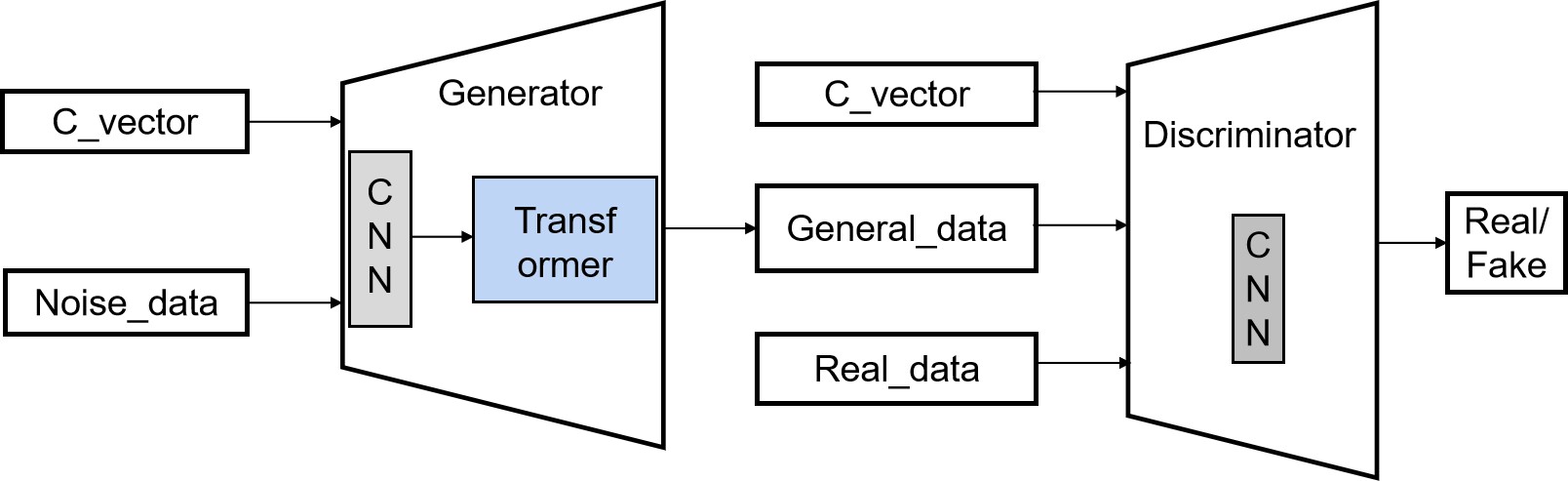
The overall network architecture of the transformer-enhanced CTGAN
- [1] X. Zhou et al., “Research on multiple rules flexible configuration method for default arrival and departure tracks in intelligent CTC system,” Railw. Signal. Commun., Vol.61, No.10, pp. 9-15, 2025 (in Chinese). https://doi.org/10.13879/j.issn.1000-7458.2025-10.25002
- [2] L. Liu et al., “Research on intelligent operation and maintenance system of centralized traffic control system based on edge-cloud collaboration,” Railw. Signal. Commun., Vol.62, No.3, pp. 8-14, 2026 (in Chinese). https://doi.org/10.13879/j.issn.1000-7458.2026-03.25308
- [3] J. Wang, “Study on intelligent centralized traffic control system,” Railw. Signal. Commun., Vol.58, No.7, pp. 7-12, 2022 (in Chinese). https://doi.org/10.13879/j.issn.1000-7458.2022-07.21395
- [4] Z. Fu, Z. Wang, Y. Song, and W. Xu, “Research on optimization scheme of station information acquisition technology for TDCS/CTC systems,” Railw. Signal. Commun., Vol.61, No.11, pp. 26-33, 2025 (in Chinese). https://doi.org/10.13879/j.issn.1000-7458.2025-11.25052
- [5] S. Ding, T. Zhang, R. Wang, and Z. Yuan, “Research on rescheduling of arrival and departure tracks at high-speed railway passenger station,” Railw. Signal. Commun., Vol.58, No.8, pp. 32-36, 2022 (in Chinese). https://doi.org/10.13879/j.issn.1000-7458.2022-08.21484
- [6] M. M. Dessouky and R. C. Leachman, “A simulation modeling methodology for analyzing large complex rail networks,” Simulation, Vol.65, No.2, pp. 131-142, 1995. https://doi.org/10.1177/003754979506500205
- [7] Q. Lu, M. Dessouky, and R. C. Leachman, “Modeling train movements through complex rail networks,” ACM Trans. Model. Comput. Simul., Vol.14, No.1, pp. 48-75, 2004. https://doi.org/10.1145/974734.974737
- [8] A. Moeinaddini, Y. Shafahi, and R. M. Hasany, “A simulation model for train movements in the rail network,” Proc. Inst. Civ. Eng. Transp., Vol.172, No.3, pp. 152-163, 2019. https://doi.org/10.1680/jtran.16.00082
- [9] E. R. Petersen and A. J. Taylor, “A structured model for rail line simulation and optimization,” Transp. Sci., Vol.16, No.2, pp. 192-206, 1982. https://doi.org/10.1287/trsc.16.2.192
- [10] S. F. Hallowell and P. T. Harker, “Predicting on-time performance in scheduled railroad operations: Methodology and application to train scheduling,” Transp. Res. A: Policy Pract., Vol.32, No.4, pp. 279-295, 1998. https://doi.org/10.1016/S0965-8564(97)00009-8
- [11] P. Murali, M. Dessouky, F. Ordóñez, and K. Palmer, “A delay estimation technique for single and double-track railroads,” Transp. Res. E: Logist. Transp. Rev., Vol.46, No.4, pp. 483-495, 2010. https://doi.org/10.1016/j.tre.2009.04.016
- [12] M. del Álamo, J. Heusel, and D. Narezo Guzmán, “Synthetic data generation for condition monitoring of railway switches,” Dependable Computing – EDCC 2022 Workshops, pp. 76-88, 2022. https://doi.org/10.1007/978-3-031-16245-9_6
- [13] S. Qiu et al., “Automated detection of railway defective fasteners based on YOLOv8-FAM and synthetic data using style transfer,” Autom. Constr., Vol.162, Article No.105363, 2024. https://doi.org/10.1016/j.autcon.2024.105363
- [14] G. D’Amico et al., “TrainSim: A railway simulation framework for LiDAR and camera dataset generation,” IEEE Trans. Intell. Transp. Syst., Vol.24, No.12, pp. 15006-15017, 2023. https://doi.org/10.1109/TITS.2023.3297728
- [15] G. Salierno, L. Leonardi, and G. Cabri, “A big data architecture for digital twin creation of railway signals based on synthetic data,” IEEE Open J. Intell. Transp. Syst., Vol.5, pp. 342-359, 2024. https://doi.org/10.1109/OJITS.2024.3412820
- [16] B. Yan et al., “Semantic segmentation of railway infrastructure based on virtual model synthetic data,” IEEE 26th Int. Conf. Intell. Transp. Syst. (ITSC), pp. 3831-3836, 2023. https://doi.org/10.1109/ITSC57777.2023.10422077
- [17] I. Goodfellow et al., “Generative adversarial networks,” Commun. ACM, Vol.63, No.11, pp. 139-144, 2020. https://doi.org/10.1145/3422622
- [18] L. Xu and K. Veeramachaneni, “Synthesizing tabular data using generative adversarial networks,” arXiv:1811.11264, 2018. https://doi.org/10.48550/arXiv.1811.11264
- [19] L. Xu, M. Skoularidou, A. Cuesta-Infante, and K. Veeramachaneni, “Modeling tabular data using conditional GAN,” Adv. Neural Inf. Process. Syst., Vol.32, pp. 7335-7345, 2019.
- [20] N. L. Agu, S. M. Haider, G. G. Pillai, I. Bashir, and G. Lacey, “Power transformer DGA data augmentation using conditional tabular generative adversarial network,” 59th Int. Univ. Power Eng. Conf. (UPEC), 2024. https://doi.org/10.1109/UPEC61344.2024.10892386
- [21] A. Alzahrani, “Early detection of lung cancer using predictive modeling incorporating CTGAN features and tree-based learning,” IEEE Access, Vol.13, pp. 34321-34333, 2025. https://doi.org/10.1109/ACCESS.2025.3543215
- [22] W. Li et al., “EID-GAN: Generative adversarial nets for extremely imbalanced data augmentation,” IEEE Trans. Ind. Inform., Vol.19, No.3, pp. 3208-3218, 2023. https://doi.org/10.1109/TII.2022.3182781
- [23] R. Liu et al., “Anomaly-GAN: A data augmentation method for train surface anomaly detection,” Expert Syst. Appl., Vol.228, Article No.120284, 2023. https://doi.org/10.1016/j.eswa.2023.120284
This article is published under a Creative Commons Attribution-NoDerivatives 4.0 Internationa License.