
Research Paper:
Structured Representation and Traceability of Upgrade Processes in Gaming Simulations
Akinobu Sakata*,†
 , Takamasa Kikuchi**
, Masaaki Kunigami***
, and Takao Terano***
*Waseda University
3-4-1 Okubo, Shinjuku-ku, Tokyo 169-8555, Japan
†Corresponding author
**Kanto Gakuin University
1-50-1 Mutsuura-higashi, Kanazawa-ku, Yokohama, Kanagawa 236-8501, Japan
***Chiba University of Commerce
1-3-1 Konodai, Ichikawa, Chiba 272-8512, Japan

This paper proposes a structured traceability-based representation format for documenting operational-phase upgrade processes in gaming simulations. The proposed format links external feedback, requirement elements, layer-wise design changes, work processes, and deliverables within a unified structure, and introduces explicit layer-decision rules for classifying design modifications across the Concept, Model, Interface, and Operation layers. Compared with conventional traceability approaches, which mainly focus on artifact-to-artifact links, the proposed format explicitly incorporates the domain-specific layer structure of gaming simulations and the work processes through which design changes are implemented. This enables reviewers to inspect not only requirement coverage but also cross-layer propagation and requirement–deliverable alignment in practical design review and quality-assurance settings. We examined the applicability of the format through a literature-based reconstruction of the extension from the Beer Game to the Cash Beer Game. The resulting relationship map and integrated traceability table clarified how financial-flow requirements were translated into model changes, interface deliverables, and operational materials. The case also showed how potential Model–Interface and Concept–Operation inconsistencies can be identified through the proposed representation. The proposed format is expected to support systematic documentation, review, and quality control of gaming simulation upgrades, and to contribute to more transparent and reusable design knowledge in simulation and gaming research.
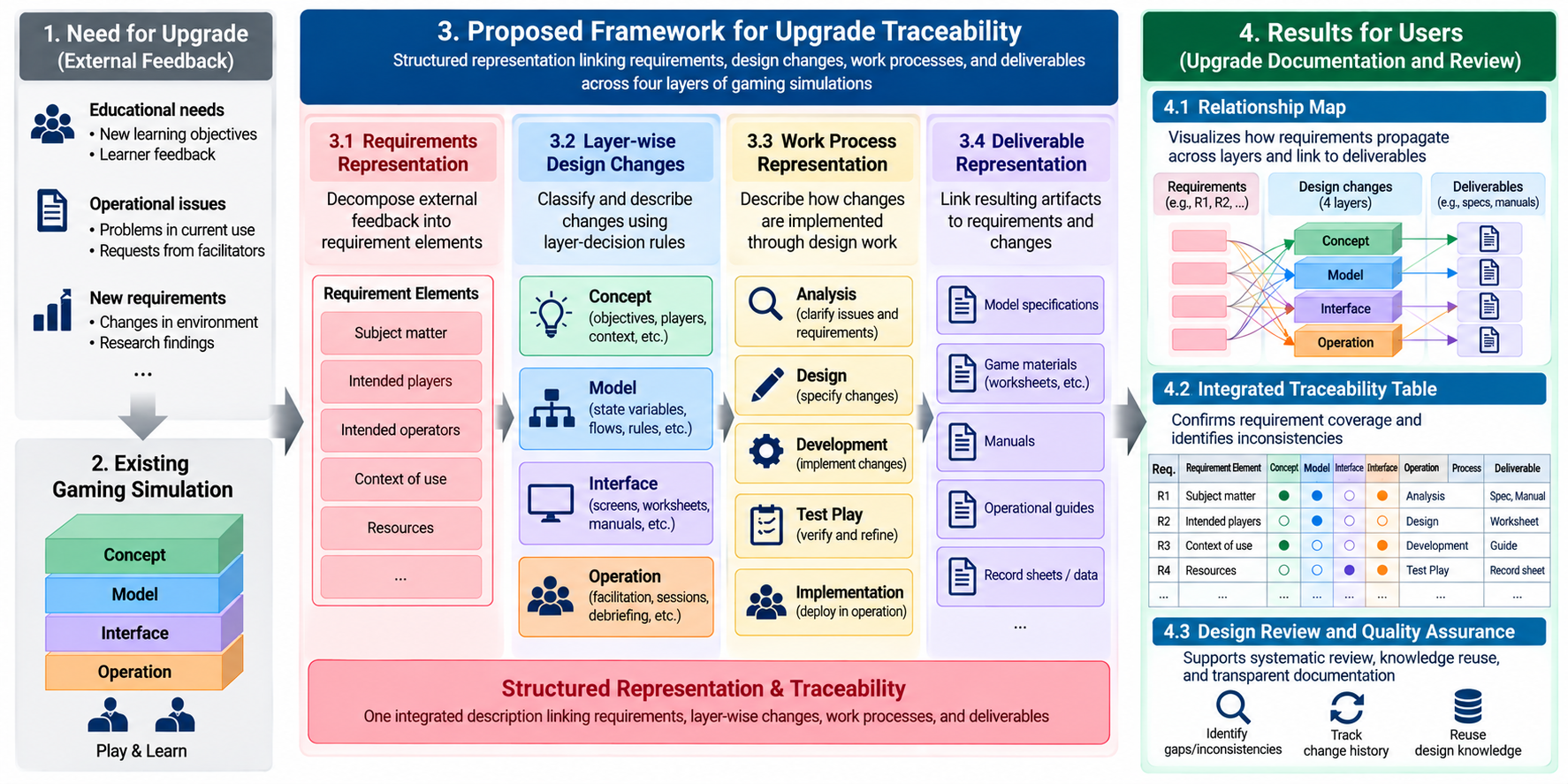
Structured traceability of game upgrades
- [1] J. Chang, “Use of business simulation games in Hong Kong,” Simul. Gaming, Vol.34, No.3, pp. 358-366, 2003. https://doi.org/10.1177/1046878103255876
- [2] F. Mili, J. Barr, M. Harris, and L. Pittiglio, “Nursing training: 3D game with learning objectives,” Proc. 1st Int. Conf. on Advances in Computer-Human Interaction, pp. 236-242, 2008. https://doi.org/10.1109/ACHI.2008.55
- [3] S. Han, H. Su, Y. Zhao, and C. Ma, “Design of railway simulation training system based on WebGL,” J. Phys.: Conf. Ser., Vol.2850, No.1, Article No.012001, 2024. https://doi.org/10.1088/1742-6596/2850/1/012001
- [4] A. Padovano, F. Longo, L. Manca, and R. Grugni, “Improving safety management in railway stations through a simulation-based digital twin approach,” Comput. Ind. Eng., Vol.187, Article No.109839, 2024. https://doi.org/10.1016/j.cie.2023.109839
- [5] A. Sakata, T. Kikuchi, M. Kunigami, and T. Terano, “A framework to support upgrading gaming simulations in response to feedback from the external environment,” Proc. 2025 IEEE/ACIS 23rd Int. Conf. on Software Engineering Research, Management and Applications (SERA), pp. 456-463, 2025. https://doi.org/10.1109/SERA65747.2025.11154581
- [6] C. S. Greenblat, “Designing Games and Simulations: An Illustrated Handbook,” SAGE Publications, 1988.
- [7] F. G. M. Silva, “Practical methodology for the design of educational serious games,” Information, Vol.11, No.1, Article No.14, 2019. https://doi.org/10.3390/info11010014
- [8] D. Avila-Pesantez, R. Delgadillo, and L. A. Rivera, “Proposal of a conceptual model for serious games design: A case study in children with learning disabilities,” IEEE Access, Vol.7, pp. 161017-161033, 2019. https://doi.org/10.1109/ACCESS.2019.2951380
- [9] S. Verschueren, C. Buffel, and G. Vander Stichele, “Developing theory-driven, evidence-based serious games for health: Framework based on research community insights,” JMIR Serious Games, Vol.7, No.2, Article No.e11565, 2019. https://doi.org/10.2196/11565
- [10] F. de Rosa and A. De Gloria, “Design methodology of analytical games for knowledge acquisition,” Int. J. Serious Games, Vol.8, No.4, pp. 3-23, 2021. https://doi.org/10.17083/ijsg.v8i4.456
- [11] E. Pacheco-Velazquez, V. Rodes-Paragarino, L. Rabago-Mayer, and A. Bester, “How to create serious games? Proposal for a participatory methodology,” Int. J. Serious Games, Vol.10, No.4, pp. 55-73, 2023. https://doi.org/10.17083/ijsg.v10i4.642
- [12] S. Aslan and O. Balci, “GAMED: Digital educational game development methodology,” Simulation, Vol.91, No.4, pp. 307-319, 2015. https://doi.org/10.1177/0037549715572673
- [13] I. Marfisi-Schottman, “Méthodologie, modèles et outils pour la conception de Learning Games,” Doctoral dissertation, INSA de Lyon, 2012.
- [14] J. van den Hoogen and S. Meijer, “Lessons on the design of gaming simulations for convergence and divergence in volatile innovation environments,” Proc. 2015 Winter Simulation Conf. (WSC), pp. 1044-1055, 2015. https://doi.org/10.1109/WSC.2015.7408232
- [15] J. D. Sterman, “Modeling managerial behavior: Misperceptions of feedback in a dynamic decision-making experiment,” Manag. Sci., Vol.35, No.3, pp. 321-339, 1989. https://doi.org/10.1287/mnsc.35.3.321
- [16] K. Shang, “Cash Beer Game,” Found. Trends Technol. Inf. Oper. Manag., Vol.12, Nos.2-3, pp. 173-188, 2019. https://doi.org/10.1561/0200000088
- [17] K. Shang, “Cash Beer Game description.” https://sites.duke.edu/shang/teaching/ [Accessed June 25, 2026]
- [18] B. Ramesh and M. Jarke, “Toward reference models for requirements traceability,” IEEE Trans. Softw. Eng., Vol.27, No.1, pp. 58-93, 2001. https://doi.org/10.1109/32.895989
- [19] J. Cleland-Huang, O. Gotel, and A. Zisman (Eds.), “Software and Systems Traceability,” Springer, 2012.
- [20] M. Ruiz, J. Y. Hu, and F. Dalpiaz, “Why don’t we trace? A study on the barriers to software traceability in practice,” Requir. Eng., Vol.28, No.4, pp. 619-637, 2023. https://doi.org/10.1007/s00766-023-00408-9
- [21] S. Kent, “Model driven engineering,” Proc. Int. Conf. on Integrated Formal Methods, pp. 286-298, Springer, 2002. https://doi.org/10.1007/3-540-47884-1
- [22] S. A. Bohner and R. S. Arnold (Eds.), “Software Change Impact Analysis,” IEEE Computer Society Press, 1996.
- [23] W. Kunz and H. W. J. Rittel, “Issues as elements of information systems,” Institute of Urban and Regional Development, University of California, Berkeley, Working Paper No.131, 1970.
- [24] A. MacLean, R. M. Young, V. M. E. Bellotti, and T. P. Moran, “Questions, options, and criteria: Elements of design space analysis,” T. P. Moran and J. M. Carroll (Eds.), “Design Rationale: Concepts, Techniques, and Use,” pp. 53-105, CRC Press, 2020. https://doi.org/10.1201/9781003064053-4
- [25] R. S. Martins, F. Raulino, A. Burlamaqui, and A. Burlamaqui, “SGDDEdu: A model of short game design document for digital educational games,” Int. J. Innov. Educ. Res., Vol.7, No.2, pp. 167-180, 2019. https://doi.org/10.31686/ijier.vol7.iss2.1335
- [26] O. O. Doma, V. Wanick, and Y. Yin, “HLDD STRIDES: A conceptual framework for instructional serious games,” Proc. Games and Learning Alliance, pp. 484-490, Springer Nature Switzerland, 2026. https://doi.org/10.1007/978-3-032-11043-5
- [27] R. M. Branch, “Instructional Design: The ADDIE Approach,” Springer, 2009. https://doi.org/10.1007/978-0-387-09506-6
- [28] M. W. Allen and R. Sites, “Leaving ADDIE for SAM: An Agile Model for Developing the Best Learning Experiences,” ASTD Press, 2012.
- [29] S. Barab and K. Squire, “Design-based research: Putting a stake in the ground,” J. Learn. Sci., Vol.13, No.1, pp. 1-14, 2004. https://doi.org/10.1207/s15327809jls1301_1
- [30] D. Jaccard, L. Suppan, E. Sanchez, A. Huguenin, and M. Laurent, “The co.LAB generic framework for collaborative design of serious games: Development study,” JMIR Serious Games, Vol.9, No.3, Article No.e28674, 2021. https://doi.org/10.2196/28674
- [31] L. Bunt, J. Greeff, and E. Taylor, “Enhancing serious game design: Expert-reviewed, stakeholder-centered framework,” JMIR Serious Games, Vol.12, Article No.e48099, 2024. https://doi.org/10.2196/48099
- [32] M. Carrión-Toro, M. Santorum, P. Acosta-Vargas, J. Aguilar, and M. Pérez, “iPlus: A user-centered methodology for serious games design,” Appl. Sci., Vol.10, No.24, Article No.9007, 2020. https://doi.org/10.3390/app10249007
- [33] A. Sakata, T. Kikuchi, R. Okumura, M. Kunigami, A. Yoshikawa, M. Yamamura, and T. Terano, “Methodology for extracting knowledge from a gaming simulation using data envelopment analysis,” Int. J. on Adv. Softw., Vol.14, Nos.1-2, pp. 107-121, 2021.
- [34] A. Sakata, T. Kikuchi, M. Kunigami, A. Yoshikawa, M. Yamamura, and T. Terano, “Extracting branch factors of scenarios from a gaming simulation using log-cluster analysis,” J. Adv. Comput. Intell. Intell. Inform., Vol.27, No.2, pp. 223-234, 2023. https://doi.org/10.20965/jaciii.2023.p0223
- [35] A. Sakata, “Agent-based scenario analysis in gaming simulation: Towards facilitation support with gaming log data,” G. Gaa, B. Zürn, M. Schaal, A. Zimmer, T. Alf, and F. Trautwein (Eds.), “Worldwide Perspectives: Looking Back on the First Global S&G Award 2026,” ZMS Schriftenreihe, Band 16, pp. 74-87, 2026. https://doi.org/10.5281/zenodo.20428610
This article is published under a Creative Commons Attribution-NoDerivatives 4.0 Internationa License.