
Research Paper:
Simulating Electoral Behaviour with Mixture Models
Jose M. Pavía*,†
 , Rocío de Andrés Calle**
, and Patrizia Pérez-Asurmendi***
*GIPEyOP Research Group, Universitat de València
Av. Tarongers, s/n, València 46022, Spain
†Corresponding author
**Research Excellence Unit GECOS and Multidisciplinary Institute of Enterprise (IME), Universidad de Salamanca
Building FES, Campus Miguel de Unamuno, s/n, Salamanca 37007, Spain
***PRESAD Research Group and IMUVA, Department of Economic Analysis, Universidad Complutense de Madrid
Ctra. de Húmera, s/n, Pozuelo de Alarcón, Madrid 28223, Spain

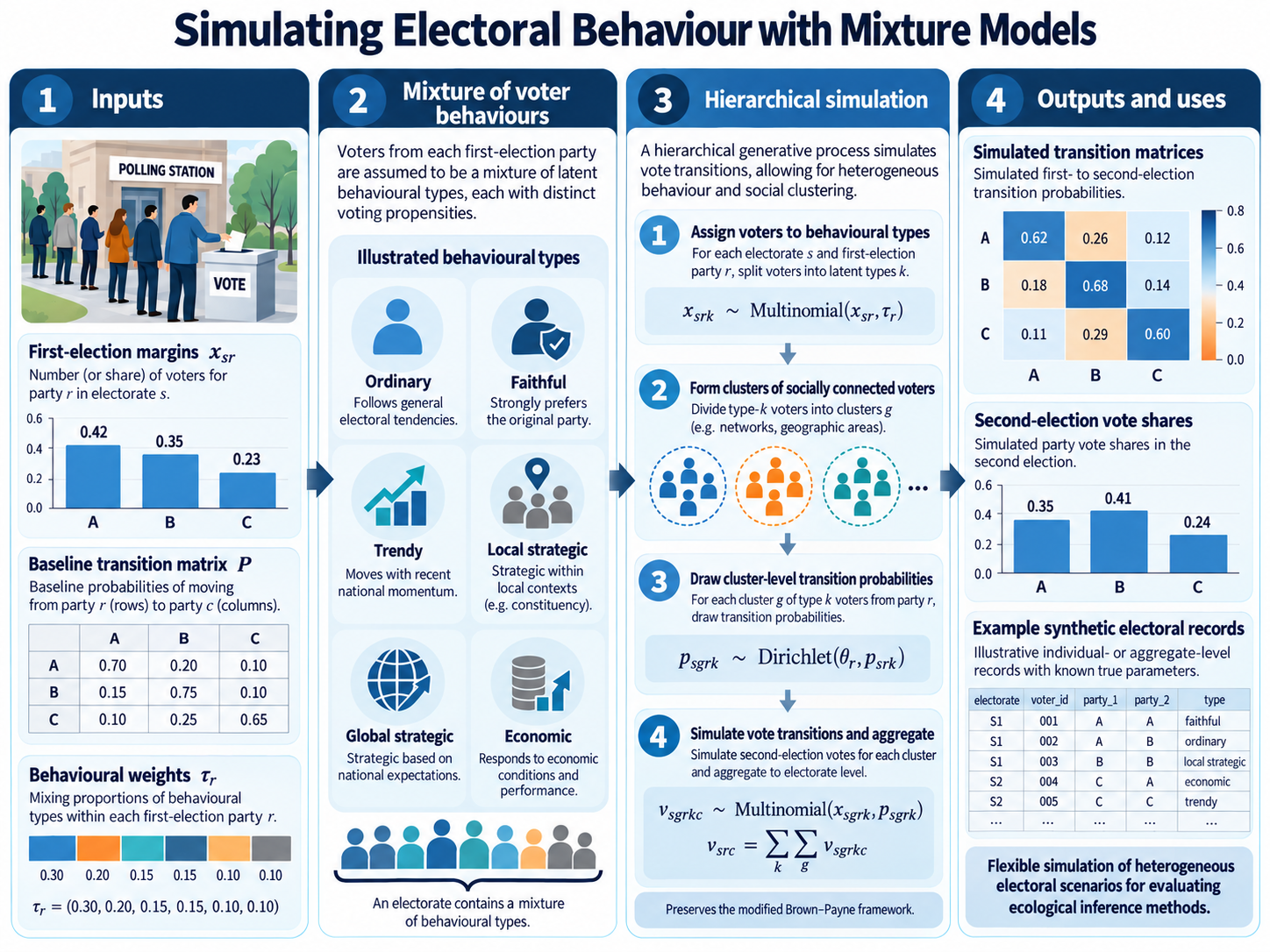
Simulation plays an essential role in methodological research on electoral behaviour and ecological inference. Artificial datasets allow researchers to analyse the performance of statistical estimators in controlled settings where the underlying vote transitions are known. This paper introduces simula_mixture, a new function implemented in the R package eiCircles, designed to generate synthetic electoral data under a flexible mixture of voter behaviours. The simulation framework builds on the overdispersed multinomial modified Brown–Payne model and extends earlier simulation tools available in eiCircles. The proposed approach allows the electorate to consist of multiple latent behavioural types, including ordinary voters, strongly loyal voters, trendy voters, several forms of strategic voters, and economically motivated voters. Each behavioural type modifies baseline transition probabilities through behaviour-specific mechanisms that depend on local electoral conditions, global results, or contextual economic indicators. By combining behavioural mixtures with the cluster-based structure of the modified Brown–Payne model, the proposed framework enables the generation of highly heterogeneous electoral scenarios while preserving second-order moments. The resulting simulation environment provides researchers with a versatile tool for studying voting dynamics and evaluating ecological inference methods under complex behavioural settings.
Simulating electoral behaviour
- [1] J. M. Pavía and R. Romero, “Symmetry estimating R×C vote transfer matrices from aggregate data,” J. of the Royal Statistical Society, Series A – Statistics in Society, Vol.187, No.4, pp. 919-943, 2024. https://doi.org/10.1093/jrsssa/qnae013
- [2] J. M. Pavía, P. Pérez-Asurmendi, and R. de Andrés Calle, “Ecological inference for electoral analysis: A computational perspective on human decision-making,” V. Torra, Y. Narukawa, and J. Domingo-Ferrer (Eds.), “Modeling Decisions for Artificial Intelligence, MDAI 2025, Lecture Notes in Computer Science, Vol.15957,” Springer, pp. 15-26, 2026. https://doi.org/10.1007/978-3-032-00891-6_2
- [3] T. Abou-Chadi and L. Stoetzer, “How parties react to voter transitions,” American Political Science Review, Vol.114, No.3, pp. 940-945, 2020. https://doi.org/10.1017/S0003055420000155
- [4] A. Penadés and J. M. Pavía, “An ecological inference approach to the origins of proportional representation,” Social Science Information, Vol.63, No.2, pp. 168-192, 2024. https://doi.org/10.1177/05390184241250179
- [5] A. Klima, P. W. Thurner, C. Molnar, T. Schlesinger, and H. Küchenhoff, “Estimation of voter transitions based on ecological inference: An empirical assessment of different approaches,” AStA-Advances in Statistical Analysis, Vol.100, No.2, pp. 133-159, 2016. https://doi.org/10.1007/s10182-015-0254-8
- [6] J. M. Pavía and A. Forcina, “Simulating electoral behavior,” V. Torra, Y. Narukawa, and J. Domingo-Ferrer (Eds.), “Modeling Decisions for Artificial Intelligence, MDAI 2025, Lecture Notes in Computer Science, Vol.15957,” Springer, pp. 54-65, 2026. https://doi.org/10.1007/978-3-032-00891-6_5
- [7] M. Barreto, L. Collingwood, S. Garcia-Rios, and K. A. R. Oskooii, “Estimating candidate support in voting rights act cases: Comparing iterative EI and EI-R_C methods,” Sociological Methods & Research, Vol.51, No.1, pp. 271-304, 2022. https://doi.org/10.1177/0049124119852394
- [8] J. M. Pavía and R. Romero, “Improving estimates accuracy of voter transitions. Two new algorithms for ecological inference based on linear programming,” Sociological Methods & Research, Vol.53, No.4, pp. 1491-1533, 2024. https://doi.org/10.1177/00491241221092725
- [9] A. Forcina and J. M. Pavía, “eiCircles: Ecological Inference of RxC Tables by Overdispersed-Multinomial Models,” R-package, version 0.0.1-14, CRAN, 2026. https://doi.org/10.32614/CRAN.package.eiCircles
- [10] A. Forcina, M. Gnaldi, and B. Bracalente, “A revised Brown and Payne model of voting behaviour applied to the 2009 elections in Italy,” Statistical Methods & Applications, Vol.21, pp. 109-119, 2012. https://doi.org/10.1007/s10260-011-0184-x
- [11] P. J. Brown and C. D. Payne, “Aggregate data, ecological regression, and voting transitions,” J. of the American Statistical Association, Vol.81, No.394, pp. 452-460, 1986. https://doi.org/10.2307/2289235
- [12] A. Forcina and J. M. Pavía, “From Corrado Gini’s early contributions to overdispersion to modern models of voting behaviour,” Statistical Science, Vol.11, No.1, pp. 201-210, 2026. https://doi.org/10.1214/24-STS960
- [13] C. Pattie and R. Johnston, “‘People who talk together vote together’: An exploration of contextual effects in Great Britain,” Annals of the Association of American Geographers, Vol.90, No.1, pp. 41-66, 2000. https://doi.org/10.1111/0004-5608.00183
- [14] H. Schmitt, P. Segatti, and C. van der Ejik, “Consequences of Context: How Social, Political and Economic Environments Affect Voting,” ECPR Press, 2021.
- [15] A. Forcina and J. M. Pavía, “Estimating vote transition counts in Ecological Inference,” Statistics and Public Policy, Vol.13, No.2654396, 2026. https://doi.org/10.1080/2330443X.2026.2654396
- [16] G. J. McLachlan and D. Peel, “Finite Mixture Models,” Wiley, 2000.
- [17] M. S. Lewis-Beck and M. Paldam, “Economic voting: an introduction” Electoral Studies, Vol.19, Nos.2-3, pp. 113-121, 2000. https://doi.org/10.1016/S0261-3794(99)00042-6
This article is published under a Creative Commons Attribution-NoDerivatives 4.0 Internationa License.