
Paper:
The Historical Process of Institutionalizing Collaborative Disaster Victim Support: Changes in the Role of the Third Sector in Disaster Response in Japan
Taku Sugano

Graduate School of Literature and Human Sciences, Osaka Metropolitan University
2-1-132 Morinomiya, Joto-ku, Osaka, Osaka 536-8525, Japan

This paper provides a brief history of the third sector in Japan’s disaster response and assesses its current status. The Great Hanshin–Awaji Earthquake of 1995 led to the institutionalization of disaster volunteer centers, and the year drew attention as the “first year of volunteerism.” This was followed by the enactment of the Act on Promotion of Specified Non-Profit Activities in 1998 and the development of the third sector, with a considerable delay compared with other advanced countries. Volunteers and third-sector organizations involved in disaster response developed institutionally differently from those involved in other fields owing to the unique characteristics of disasters, which occur only occasionally and in specific areas. In addition, a collaborative mechanism was institutionalized to support disaster victims in rebuilding their lives. This mechanism also helped address the incompatibility between the peacetime care regime, based on a quasi-market system involving private organizations, and the emergency care regime, which relies on direct government intervention. Given this history, it seems likely that Japanese society has begun to consider incorporating mechanisms into its peacetime systems to mobilize as much peacetime expertise as possible in the event of a disaster, as well as making special preparations in case of disasters to supplement any areas where this is insufficient.
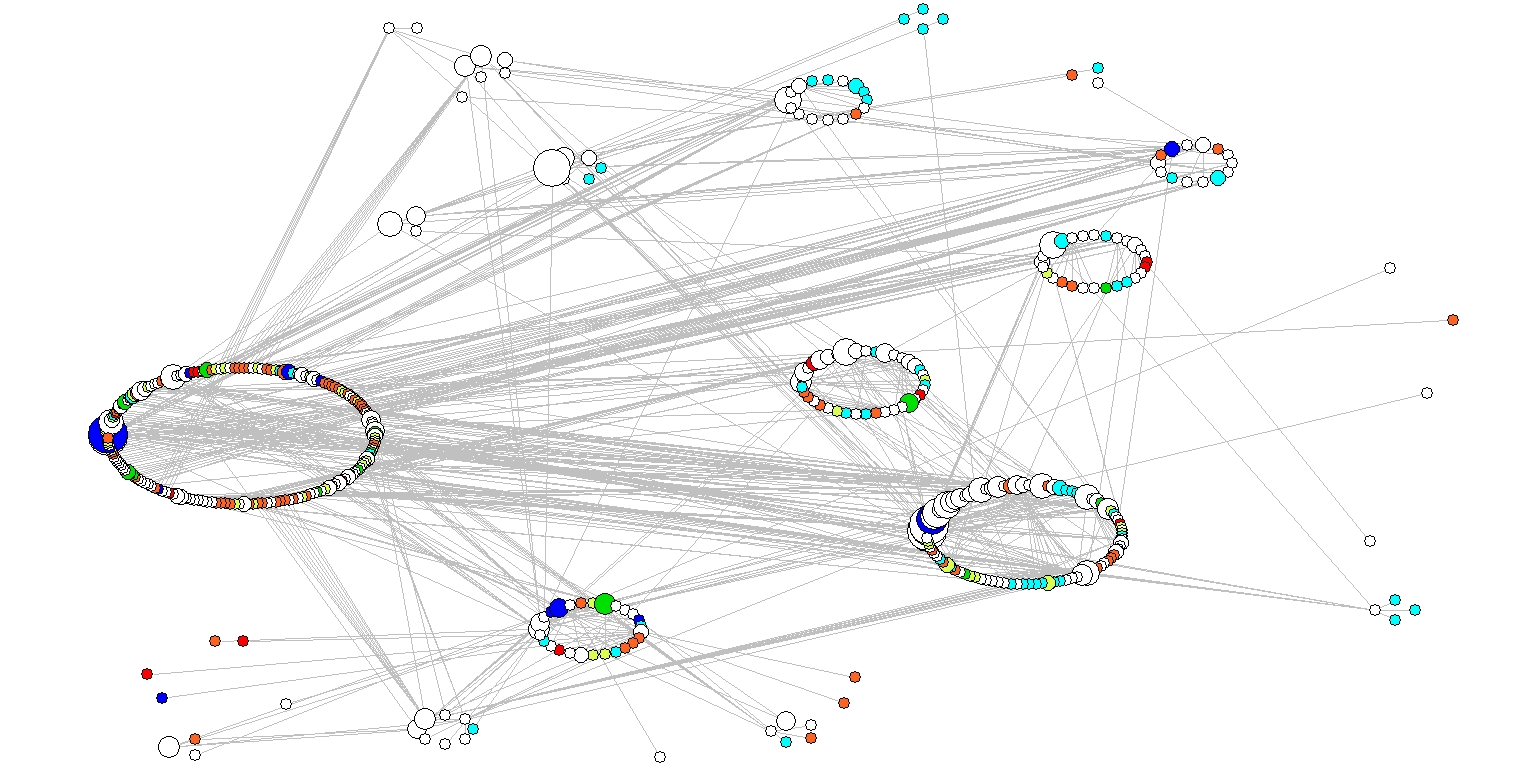
Social network of key persons involved in the third sector
1. Uniqueness of the Recent Spread of Volunteerism and Third-Sector Disaster Response in Japan
In Japan, volunteers and third-sector organizations are increasingly undertaking disaster response. The term “third sector” refers to an economic sector consisting of autonomous private organizations that engage in activities for public and mutual benefit, such as non-profit organizations (NPOs). This is known as the “non-profit sector” in the United States, the “voluntary sector” in the United Kingdom, and the “third sector” in continental Europe. In the aftermath of the Great East Japan Earthquake, the country’s Cabinet Office actively attempted to promote collaboration between volunteers, NPOs, and the government. Thus, national and local governments are expected to respond to disasters in collaboration with diverse actors, including volunteers and third-sector organizations.
Notably, this arrangement is unique to Japan. 1995, when the Great Hanshin–Awaji Earthquake occurred, is known as the “first year of volunteerism,” marking the emergence of volunteers and third-sector organizations in the aftermath of the disaster. Over the past 30 years, volunteers and third-sector organizations from outside disaster struck zones have commonly participated in disaster response, especially to support victims. Japan is an exception among high-income industrial countries in that it does not take for granted the third sector, which has long been established as part of modern society in these countries. As a result, Japan treats volunteers—generally individuals rather than organizations—who typically participate in the programs of third-sector organizations, as distinct policy targets.
This paper provides an overview of the history of the third sector in Japanese society, which is not limited to disaster response. By doing so, it aims to elucidate how the third sector developed in the aftermath of the Great Hanshin–Awaji Earthquake. This paper provides an overview of the history and activities of disaster volunteer centers that were institutionalized as a unique feature of the disaster field. Based on this, this study infers that many third-sector organizations began to participate in disaster victim support in the aftermath of the Great East Japan Earthquake. Furthermore, during peacetime (as opposed to an emergency), many care services are supplied by a quasi-market system involving private organizations, including for-profit companies and the third sector. This study highlights the need to implement a mechanism for disaster victim support in collaboration with the third sector and address the disruption of disaster victim support provided directly by the government.
2. Japan’s Late-Developing Third Sector
First, this study briefly reviews the history of the third sector in various fields in Japan, which is not limited to disaster responses. Only a few third-sector organizations specialize in disaster response; others engage in other activities during peacetime and participate in disaster response during times of need. Therefore, to accurately understand the general trends in the field, it is necessary to consider the entire third sector.
In Japanese society, third-sector organizations, such as NPOs, are considered to have grown and developed since the 1990s—much later than in Western countries. In the United Kingdom, as part of efforts to combat poverty during the modernization process, the statute of charitable uses—the prototype of the current Charity Act—was enacted in 1601 alongside the Elizabethan Poor Law. France was relatively late among Western countries in establishing a legal basis for the third sector. This is because the 1789 Declaration of the Rights of Man and of the Citizen rejected all intermediary bodies other than the nation-state, as indicated by the absence of “freedom of association.” France granted freedom of association to NPOs (associations) in 1901 1. By contrast, in Japan, the third sector was not recognized until 1998, when the Act on Promotion of Specified Non-Profit Activities (NPO Act) was implemented.
During Japan’s modernization, no legal entity was envisioned for what is now called the third sector. The Civil Code, enacted in 1896, established a for-profit corporation system based on the notification doctrine but did not include a non-profit corporation system. Meanwhile, a public-service corporation system requiring a government license or permit was established as a “competent authority system” based on the “public-service state monopoly doctrine” 2,3. While Christianity and charity played important roles in the modern history of the West, Japan, at that time, pursued modernization without recognizing the concept of the third sector.
This situation persisted for many years. Even Japan’s defeat in World War II did not trigger the establishment of a non-profit corporate system that operated without the need for licenses or permits. For example, as described by Sugano 4, regarding a regional city, citizen movements and initiatives seeking organizations to address pollution, consumer issues, and international conflicts existed nationwide by the late 1960s, yet a lack of legal status persisted. It was the Great Hanshin–Awaji Earthquake of 1995—a year that became known as the “first year of volunteerism”—that drew society’s attention to the need for such a system.
Influenced by the Great Hanshin–Awaji Earthquake, the NPO Act was enacted in 1998. However, this kind of legislation, which linked the establishment of a corporation with favorable tax treatment, was unique compared with the Western systems. Subsequently, with the 2006 reform of the public-interest corporation system, the relevant provisions of the Civil Code were revised for the first time in 110 years, and the “competent authority system” was abolished. Although this progress occurred considerably later than in other advanced countries, Japan finally established a legal status for the third sector, allowing non-profit corporations to be formed freely.
This reform was followed by the rapid emergence and expansion of third-sector organizations. As a typical example, approximately 15 years after the system was implemented, the number of specified non-profit corporations exceeded 50,000. As of 2023, the regional distribution ranged from 72.8 corporations per 100,000 people in the Tokyo metropolitan area to 20.2 corporations per 100,000 people in Kumamoto Prefecture. However, most regions in Japan had 30–50 corporations per 100,000 people, and there was no significant difference in the distribution between urban areas (cities and special wards) and rural districts (towns and villages). Furthermore, based on their registration numbers, third-sector organizations utilizing the legal status created by the reform of the public-interest corporation system are thought to be more numerous than those utilizing the specific non-profit corporation status. In other words, the third sector quickly became a common feature of Japanese society.
Owing to institutional factors, the third sector developed later in Japan than in the West but spread rapidly. This history has been overlooked, likely leading to unique inconsistencies in the Japanese disaster field, as discussed below.
The government’s overall third-sector policies began changing in 2010. Until then, third-sector policies at the national level were limited to legal status and taxation. However, in some fields, significant financial support was provided—although not necessarily through third-sector policies—which directly affected the third sector’s response to the Great East Japan Earthquake. Specifically, in some regions, infrastructure for intermediary support organizations assisting third-sector organizations was developed through the designated manager system and other measures implemented as part of decentralization reforms. The infrastructure for international NGOs was strengthened through reforms in development cooperation, such as the establishment of the “Japan NGO Grant Assistance Program.” NPOs in welfare and child support developed and expanded as a result of social security reforms, such as the enactment of the Long-Term Care Insurance Act and the Services and Supports for Persons with Disabilities Act. Since 2010, “financial support” has been provided in the form of “new public support projects,” measures related to the Great East Japan Earthquake, and the “utilization of dormant deposits,” all of which clearly took the entire third sector into account. The Great East Japan Earthquake, which brought third-sector disaster response to the forefront, can be considered a defining event in this trend 5.
The Great East Japan Earthquake also revealed that policies supporting disaster victims had not kept pace with changes in the care regime brought about by the social security reforms of the 1990s and 2000s 6,7. A care regime refers to the framework within which the state, market, family, and community share responsibility for care tasks, such as childcare and eldercare, in a given society. Japan’s care regime has shifted from government-centered service provision to a quasi-market system. In this system, for-profit companies and third-sector organizations compete to provide services. However, policy-based support for disaster victims continues to be provided directly by the government. Thus, it is difficult for the government to collaborate with actors who supply peacetime care services to support disaster victims 8.
3. Institutionalization of Disaster Volunteer Centers in the Aftermath of the Great Hanshin–Awaji Earthquake
Let us examine the unique inconsistency in the collaboration between the government and the third sector in disaster response. This issue concerns volunteers who respond to disasters.
As exemplified in Article 5-3 of the Basic Act on Disaster Management, the Cabinet Office uses the term “volunteer,” which typically refers to individuals, to refer to third-sector organizations. This unusual usage can only be understood in light of Japan’s historical background—namely, the late development of the third sector in the country owing to the abovementioned legislation. Volunteers generally work through non-profit associations such as churches and third-sector organizations. This is also true in Japan, except in the field of disaster relief, where the impact of the “first year of volunteerism” led to the formation of a unique framework that coordinates the dispatch of volunteers without involving third-sector organizations. This framework involves disaster volunteer centers, which have been institutionalized since 1995.
As mentioned above, 1995, the year of the Great Hanshin–Awaji Earthquake, was called the “first year of volunteerism.” At the time, volunteerism was attracting attention as a social phenomenon, and many people participated in voluntary disaster relief activities. As a result, the word “volunteer” lost its image as a special activity for a select few—often with negative connotations of self-sacrifice and service—and acquired a positive image as an activity in which anyone could easily participate 9.
Accordingly, society came to recognize the role of volunteers who pursue diverse activities based on principles that differ from those of the government. The government, which is legally responsible for disaster response, represents one facet of society that responds to disasters; volunteers, who work voluntarily based on the needs of victims of major disasters, represent another. In the aftermath of the Great Hanshin–Awaji Earthquake, the idea of volunteer involvement in major natural disasters became so firmly entrenched in society that it was established as common knowledge within the government. This led to the institutionalization of disaster volunteer centers. Specifically, local governments and local social welfare councils (public–private organizations established in municipalities and prefectures, as well as at the national level, to promote private social welfare activities under the Social Welfare Act) concluded agreements to establish disaster volunteer centers. These centers would coordinate volunteer initiatives according to the needs of disaster victims. The establishment of these centers has become common practice, and many local governments have included them in their disaster prevention plans.
Unlike traditional mutual aid based on local relationships, on-site disaster volunteer work involves a one-way relationship between an unspecified number of volunteers, who are always on the giving side, and disaster victims, who are always on the receiving side. As a result, mutual aid among disaster relief volunteers took the form of “giving back” to other disaster-stricken areas. As victims who received support later volunteered to provide support in subsequent disasters, relief activities were repeated, and the mechanism improved each time.
Whenever disaster strikes, numerous volunteers participate in relief efforts. The challenge lies in coordinating supply and demand by matching the needs of disaster victims with volunteer support. Even before the Great Hanshin–Awaji Earthquake of 1995, local social welfare councils were responsible for coordinating the supply of and demand for volunteers in their communities, particularly for peacetime welfare activities. They used a method known as “volunteer coordination,” in which prospective volunteers were registered and matched with individuals requesting support. The Great Hanshin–Awaji Earthquake of 1995 led to the development of a disaster specific coordination method that eliminated the registration process and left the selection of activity sites to prospective volunteers, thus enhancing flexibility. Disaster volunteer centers are the result of the refinement and institutionalization of this approach after each major disaster or accident.
In the aftermath of the Great Hanshin–Awaji Earthquake, the focus was on the development of infrastructure for disaster volunteer centers. Specifically, the following issues had to be addressed. If disaster volunteer centers could not gain the trust of disaster victims in the affected areas, they would not communicate their needs. In such cases, even if volunteers were available, the center would not be able to dispatch them to places where they were needed. Conversely, it would be difficult to obtain a large number of volunteers to work for a center that could not provide physical resources for their activities. As disaster volunteer centers became institutionalized, their aim was not only to fulfill the function of matching volunteers with needs but also to develop two forms of infrastructure: “creating mechanisms to move people” and “securing the physical resources necessary for activities.” At the same time, effective management was required to coordinate with other agencies in the community to build trust so that needs could be met, as well as to oversee the entire process up to the closure of the centers 9.
The private sector and the government established various mechanisms to support the stable operation of the disaster volunteer centers that were set up after disasters, and these centers gradually became institutionalized. For example, in 1998, the Central Community Chest of Japan (a public–private organization that provides subsidies based on donations under the Social Welfare Act) established a disaster reserve fund to support the activities of disaster volunteer centers, and a system was established for social welfare councils to support one another’s employees. In 2005, the Japan Business Federation, the Central Community Chest of Japan, the Japan National Council of Social Welfare, and other organizations established the “Verification Project Conference on Support for Disaster Volunteer and Citizen Activities.” This served as the basis for the “Project Conference on Disaster Volunteer Activity Support (Support P),” an initiative that dispatches experts to support the operation of disaster volunteer centers 10.
In response to private-sector activities, the government has steadily pursued the institutionalization of disaster volunteer activities. For example, in 1995, when the Great Hanshin–Awaji Earthquake occurred, Article 8, Paragraph 2, Item 13 of the Basic Act on Disaster Management stipulated that the government should undertake measures to improve the environment for disaster prevention volunteers. Furthermore, in 2004, when the Niigata Chuetsu Earthquake occurred, the Cabinet Office established a study group on disaster prevention volunteers. This trend toward institutionalization has been maintained in recent years. For example, after the torrential rains in July 2020, the Cabinet Office allowed the payment of personnel expenses for disaster volunteer center operations under the Disaster Relief Act. The importance of cooperation between the government and disaster volunteers has been emphasized in every major disaster, and this mechanism is steadily being formalized.
Thus, disaster volunteer centers have undergone a unique process of institutionalization that is comparable not only with other countries but also with the rest of the voluntary third sector operating outside the disaster field in Japan.
4. Third-Sector Participation in Disaster Response in the Aftermath of the Great East Japan Earthquake
The author believes that the most important impact of the Great Hanshin–Awaji Earthquake was not the institutionalization of disaster volunteer centers but the enactment of the NPO Act in 1998. This Act enabled the establishment of non-profit corporations, leading to the development of the third sector. In fact, after 1995, the use of the term “volunteer,” which implies an individual, rapidly declined, and the use of the term “NPO,” which implies an organization, became more common in newspapers 11. The third sector subsequently came to the forefront of Japanese society. The Great East Japan Earthquake of 2011 highlighted the development of a third sector in the disaster field. In addition, the spread of corporate social responsibility—a concept that requires companies to incorporate considerations of social fairness and the environment into their corporate activities; act responsibly toward employees, investors, local communities, and other stakeholders; and ensure accountability—contributed to the full-scale support for reconstruction efforts by for-profit companies. As the foundation for diverse actors to participate in disaster response was established, disaster volunteer centers were institutionalized in a manner unique to the disaster field in Japan. As a result, a rather unusual framework emerged in the disaster field, which the government has described as a “tripartite collaboration” between “the government, social welfare councils (disaster volunteer centers), and NPOs,” or, more generally, among the government, volunteers, and the third sector. In other countries and outside the disaster field in Japan, the term “tripartite” usually refers to the government (first sector), for-profit companies (second sector), and third-sector organizations. This study examines the activities and challenges of the third sector based on the Great East Japan Earthquake, which highlighted the development of this sector.
As mentioned above, with the enactment of the NPO Act in 1998 and the Great East Japan Earthquake in 2011, the third sector—which mainly operates in the fields of intermediary support, international cooperation, and social security—expanded in terms of both the number of organizations and their business scale of each organization. This growth was also influenced by administrative reforms in each policy area, as was evident after the Great East Japan Earthquake of 2011.
The organizations that were able to scale up their activities were international NGOs that had developed their operational capabilities during peacetime through international collaboration and institutional reforms in the social security field, as well as NPOs assisting people in need in fields such as welfare and education. For example, in the first three years after the disaster, international NGOs accounted for half of all third-sector spending on disaster victim support and reconstruction assistance. NPOs supporting those in need played a major role in the development of “Disaster Case Management,” a new method to help victims rebuild their lives, as discussed below 4. The search for ways to provide intermediary support to third-sector organizations in disaster response led to discussions on “disaster intermediary support organizations” (organizations that assist third-sector organizations and appropriately coordinate with other sectors in disaster response), as exemplified by the Japan Voluntary Organizations Active in Disaster.
Based on Sugano’s study 4, this section provides an overview of the disaster-response activities of third-sector organizations during the Great East Japan Earthquake. This overview reveals the shift from an era in which only the government responded to disasters to one in which residents themselves established their own organizations. Various actors within and outside the disaster area were involved in disaster response and continuously participated in reconstruction and subsequent community development.
The survey identified and listed 1,420 third-sector organizations that conducted reconstruction support activities, but the actual number may be even higher. The activities of these organizations were diverse and flexible, while maintaining financial independence. In the wake of the Great East Japan Earthquake, third-sector organizations spent approximately JPY 120 billion on reconstruction support over three years. Most of this sum came from sources other than public funds, such as donations and private grants. The third-sector organizations that responded voluntarily were mainly nonprofit corporations, voluntary associations, and organizations established as general corporations after the enactment of the NPO Act. After the Great East Japan Earthquake, new organizations were established in affected areas to address various issues arising from the earthquake. However, two-thirds of all activity funds were spent by aid organizations in the Kanto region, which is not a primary disaster area, mainly because of the distribution of international NGOs with large activity funds per organization.
Although they focused on disaster victim support, third-sector organizations were active in diverse fields and did not necessarily specialize in disaster relief. Their activities have changed flexibly in response to diverse issues. After October 2013, activities related to community development and welfare, which do not necessarily qualify as disaster response, became prevalent. While most of the response expenditures were made in the three affected prefectures, a large amount of funds were spent at the municipal level in coastal cities and towns along the Sanriku coast and in Sendai, the only city in Tohoku with a population of one million. However, in the former case, most expenditures were undertaken by organizations outside the three most affected prefectures, whereas in the latter case, 90% of the expenditures were undertaken by local organizations.
Third-sector organizations became increasingly prominent not only at the municipal level but also in smaller communities in the form of community development councils and other organizations that formed a consensus among residents. Third-sector organizations did not replace the existing local community organizations that were closely connected to local governments, but instead coexisted with them as actors that participated in and catalyzed local self-governance.
In other words, the third sector participating in disaster response consisted of new organizations established after the NPO Act was enacted in 1998. These organizations existed on all spatial scales—from the global, national, and local levels to smaller communities—playing specific roles in responding to issues and providing solutions. At the same time, regional differences emerged in these responses.
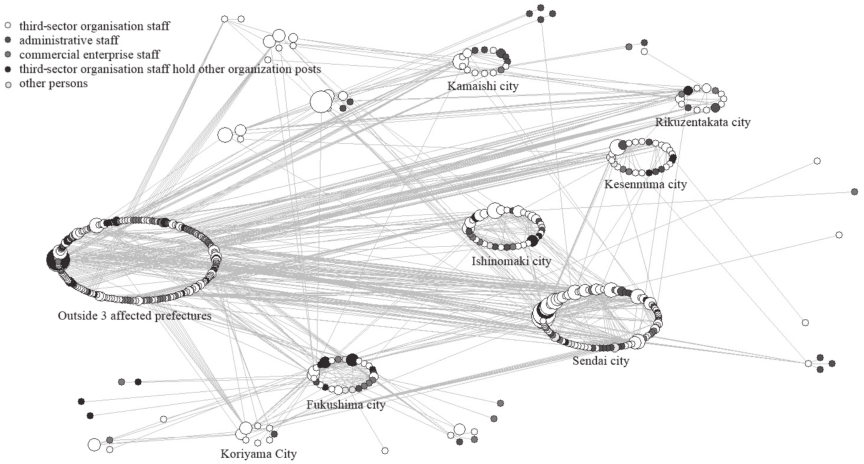
Source: Sugano 4
Fig. 1. Social network of key persons involved in the third sector (as of June 23, 2016). This figure presents connections between 459 people, with a maximum of 10 key persons identified from the 80 third sector interviewees extracted using snowball sampling. One circle represents one person, and the size of the circle reflects the number of times a person was named. The circles are arranged elliptically by region. The lines connecting the circles represent the social network.
Source: Sugano 4
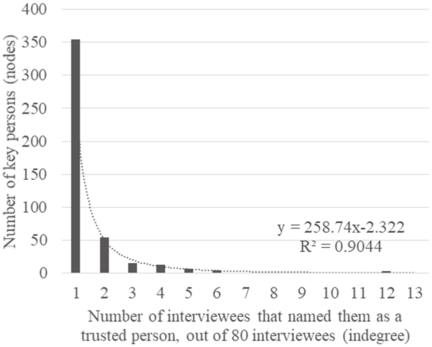
Fig. 2. Histogram of key persons by number of interviewees that named them as a trusted person (as of June 23, 2016).
The most important factor in determining these regional differences was the region’s position within the nationwide third-sector social network (Fig. 1). The third-sector social network itself spontaneously formed as a “scale-free network” with a very small number of hubs and many connections, enabling resources and information to propagate efficiently (Fig. 2). Scale-free networks are robust to random attacks because the connections are concentrated in a few hubs and the network structure enables rapid information propagation 12. The Internet is a typical example of a scale-free network. Because of these characteristics, search engines with numerous links (such as Google) serve as hubs, allowing users to reach a desired website from among more than one billion websites worldwide in a few clicks. Even if some websites are unavailable owing to server errors or other causes, the overall Internet structure is maintained. The existence of hubs such as Google and Amazon, with their vast array of links, is the deciding factor in the usefulness of the Internet. At the same time, it is easy to imagine the chaos that would ensue if a popular search engine became unavailable owing to malicious hacking. If such hubs are selectively removed, the structural characteristics of fast information propagation are lost. The third-sector social network has a structure similar to that of the Internet, with hubs that allow rapid information propagation and efficient sharing of knowledge and resources. In other words, hubs are key to mobilizing knowledge and resources by connecting people in response to problems. Social network hubs include the people who facilitate the clarification of problems and creation of solutions by linking the knowledge and resources of various individuals and organizations.
Regions that successfully find solutions to disaster response issues while attracting many resources often have several people acting as network hubs, with many connections to the local third sector, government, and for-profit companies, as well as to the national third sector. Government support for third-sector intermediary organizations and other collaborative government initiatives during peacetime is important for social network hubs to develop within the community. Conversely, regions that perform poorly are those in which social network hubs do not exist and where coordination among various sectors is not possible. These regions fail to identify issues, fail to attract resources to solve them, or approach issues without collaboration between sectors. Individuals who act as hubs play a key role in utilizing the characteristics of the community’s third sector to address issues by sharing resources and information through social networks. They mediate between various organizations and coordinate at a high level to ensure that organizations share a common understanding of issues.
After the activities of the third sector came to the fore following the Great East Japan Earthquake of 2011, Article 5-3 of the Basic Act on Disaster Management stipulated that national and local governments should make efforts to collaborate with volunteers. At the same time, an unusual situation emerged: the concept of “volunteer,” which primarily refers to individuals, was used to indicate the third sector, which includes organizations. This situation can be understood in light of Japan’s unique historical background in the field of disaster management, where the institutionalization of disaster volunteer centers preceded the late development of the third sector and its participation in the disaster response.
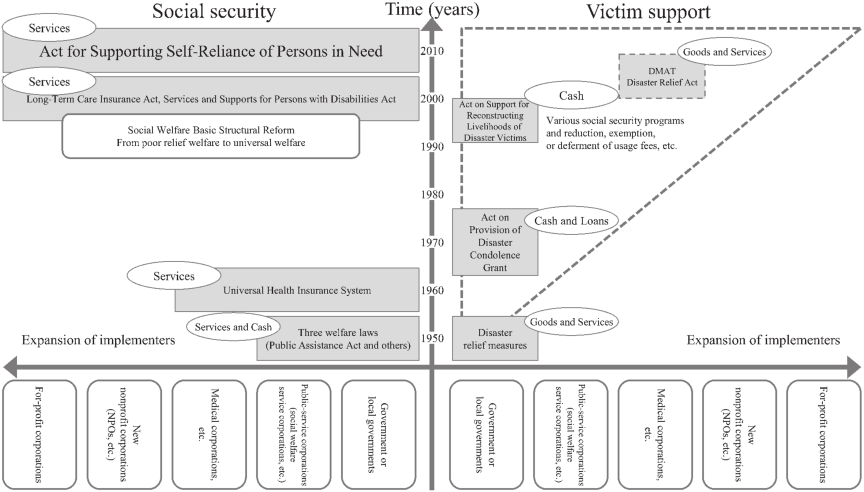
Source: Sugano 8
Fig. 3. Historical development of implementers in basic social security and disaster victim support.
5. Response to Incompatibility Between Peacetime and Emergency Care Regimes
After the Great East Japan Earthquake of 2011, collaboration with the third sector was institutionalized not only through policy measures targeting the third sector itself, such as establishing disaster volunteer centers and disaster intermediary support organizations, but also via policy-based disaster victim support. When providing disaster victim support on-site, there is no time to consider the institutional design. In the aftermath of the Great East Japan Earthquake, the government and the third sector sought to collaborate to provide disaster victim support on site. Based on this practice, a Japanese version of “Disaster Case Management” was developed and institutionalized to help disaster victims rebuild their lives.
Since the 2000s, Japan’s peacetime care regime has shifted from government-centered service provision to a quasi-market system in which for-profit companies and third-sector organizations compete to provide services. However, disaster victim support continues to be provided directly by the government, leading to an incompatibility between peacetime and emergency care regimes. This section examines the roots of this incompatibility and the factors leading to the institutionalization of Disaster Case Management. Disaster Case Management assists disaster victims in rebuilding their lives and is implemented jointly by the government and the third sector.
The Disaster Relief Act of 1947 provides the foundation for basic disaster victim support, such as the operation of evacuation centers and the provision of emergency temporary housing. This act was implemented in occupied Japan after the World War II, when the Japanese Constitution, Local Autonomy Act, and Public Assistance Act—fundamental legal systems for society—were established. The Protection Division of the Social Affairs Bureau of the Ministry of Health and Welfare, which had jurisdiction over the Public Assistance Act, was also granted jurisdiction over the Disaster Relief Act, indicating that the Act was formulated based on the idea of providing assistance to vulnerable people to guarantee their right to life. The functions of the two acts were divided as follows. During peacetime, the Public Assistance Act offered assistance based on means testing. In an emergency, when there would be no time for such testing, the Disaster Relief Act rendered anyone eligible for relief. In other words, disaster victim support was initially conceived as part of social security (Fig. 3).
The original draft of the Disaster Relief Act was presented to the Japanese government by the Supreme Commander of the Allied Powers to avoid a general wartime mobilization system. It was based on four principles: (1) national responsibility, (2) local autonomy, (3) utilization of private charity, and (4) anti-control. The draft was passed into law almost unchanged. However, although the government accepted principle (1), national responsibility, it rejected principle (2), local autonomy, because it envisioned disaster relief as something to be carried out by prefectures under the direction of the national government in a situation where local autonomy had not taken root. In addition, because of the widely agreed-upon principle of (4), anti-control, there was no control over involvement in private charity. Although the Act stipulated that disaster relief should be conducted in collaboration with private charity under the advice of the occupying forces and the American Red Cross, wartime military control was devastating for the private charity itself, and there was no recognition or social mechanism establishing that private charity should be coordinated under a certain level of government involvement. Therefore, (3) utilization of private charity, which is stipulated in Article 15 of the current act as “the duty of the Japanese Red Cross Society to cooperate,” was not accepted by society. Consequently, a fundamental division of roles in disaster relief emerged, whereby disaster relief was the responsibility of the national government, prefectures provided disaster relief under the direction of the national government, and private organizations did not participate, which was not necessarily in accordance with the letter of the law.
In the 1960s, a systematic disaster prevention policy was established for the first time. Typhoon Vera (Ise-wan Taifu), which struck in 1959 and caused more than 5,000 deaths, led to the enactment of the Basic Act on Disaster Management in 1961 and the Act on Special Financial Support to Deal with the Designated Disaster of Extreme Severity in 1962. This framework emphasized the development of physical infrastructure for disaster prevention. Furthermore, in the case of a major disaster, the framework obliged the national government to provide a large amount of reconstruction funds to affected municipalities.
The emphasis was on physical infrastructure development, and disaster victim support was given only a relatively minor position. The Universal Health Insurance System, in 1961, was established around the same time. However, its implications as a form of social security for disaster victims were not fully considered. As a response to the infrastructure-oriented approach, there were calls for “individual disaster relief” after each disaster. Lawmakers’ response to these calls for legislation came in the form of the 1973 Act on Provision of Disaster Condolence Grant. However, this Act provided cash benefits in the form of condolence grants. These benefits were based on a different idea of social security than what was common at the time. Social security mainly consists of service benefits provided by the government and social welfare corporations, except for the Public Assistance Act, which provided cash benefits.
After the 1995 Great Hanshin–Awaji Earthquake and the 2011 Great East Japan Earthquake, disaster victim support emerged as a field completely separate from social security. After the Great Hanshin–Awaji Earthquake, the Disaster Victim Certificate classification served as the main criterion for victim support, reflecting the damage to the house in which the victims lived regardless of whether they owned or rented it. Similar to the Act on Provision of Disaster Condolence Grant, the 1998 Act on Support for Reconstructing Livelihoods of Disaster Victims, which was presented by lawmakers as an “individual disaster relief” bill, also provided cash benefits based on the Disaster Victim Certificate classification. Although there was no clear legal basis for issuing Disaster Victim Certificates, the revision of the Basic Act on Disaster Management (Article 90-2) enacted after the Great East Japan Earthquake obliged municipalities to issue such certificates. The circumstances of disaster victims who struggle to rebuild their lives are similar to those of individuals who receive social security services and benefits due to old age, disability, and poverty. However, a criterion that is separate from social security—namely, damage to the house in which the victim happened to live—was introduced in the field of disaster victim support. In addition, despite Japan’s declining birthrate and aging population, the Disaster Relief Act included no provisions for welfare support. Instead, in 2013, the Disaster Relief Act was transferred from the Ministry of Health, Labour and Welfare to the Cabinet Office, effectively separating it from social security.
Conversely, at the same time, the social security system was undergoing a major transformation. Initially serving as a poverty relief system for individuals and families who could not support themselves, it was now a universal system that everyone could use, similar to the long-term care insurance system. The Long-Term Care Insurance Act of 1997 and the Services and Supports for Persons with Disabilities Act of 2005 changed the social security system. While the government had previously been primarily responsible for providing services to those in need, users can now choose private services through contracts, and the government covers the costs. In addition, circumstances that were not previously considered eligible for social security were included through laws such as the 2001 Act on the Prevention of Spousal Violence and the Protection of Victims, the 2002 Act on Special Measures Concerning Assistance in Self-Support of Homeless Persons, and the Basic Act on Suicide Prevention 2006. However, disaster victims were not explicitly included among the eligible recipients.
Disaster Case Management expanded in the wake of the Great East Japan Earthquake and subsequent disasters in response to institutional support for disaster victims, which developed separately from social security.
Disaster survivors face various difficulties, including the loss of family members, destruction of their homes, unemployment, loss of access to medical and welfare services, and debt. These challenges cover all aspects of life and differ among individuals. In addition, disasters often exacerbate existing vulnerabilities such as disability, old age, and poverty.
However, as discussed above, the current legal support for disaster victims is not designed to respond adequately to the diverse difficulties experienced by individuals. The basic criterion for disaster victim support is the Disaster Victim Certificate classification, which reflects the damage to the house in which the victims lived, regardless of whether they owned or rented the house. Evidently, the Disaster Victim Certificate classification does not necessarily reflect the various difficulties faced by survivors, which may exacerbate existing vulnerabilities such as disability, old age, and poverty. Thus, under current legislation, disaster victim support is provided irrationally.
The distinctive features of Disaster Case Management are (1) the provision of dedicated, comprehensive support required by individual households, and (2) the combination of diverse support activities, including peacetime measures, through the cooperation of various entities. In other words, Disaster Case Management connects peacetime social security with disaster victim support to assist victims in rebuilding their lives while attending to those who have fallen through the system’s cracks.
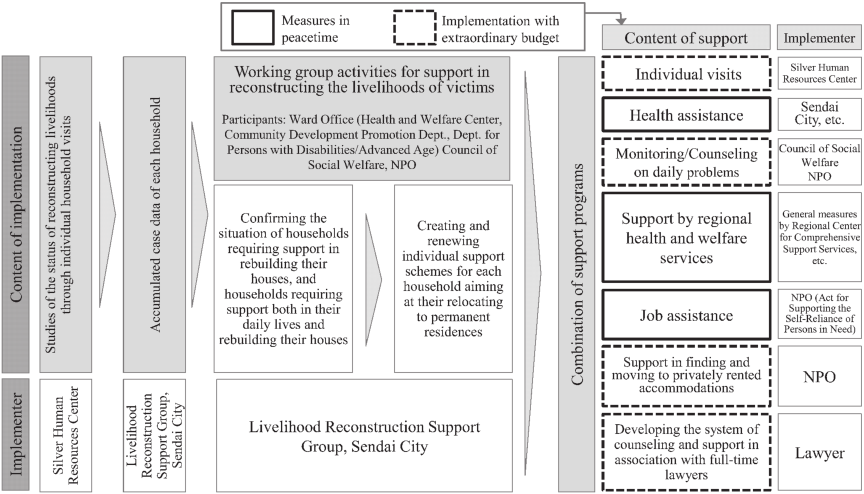
In Sendai, where Disaster Case Management began to spread, disaster victim support was implemented as follows (Fig. 4). Based on case data for each household gathered through door-to-door visits, households were classified into four categories according to two criteria: livelihood capacity, such as the need for welfare support, and rebuilding capacity, such as prospects for financial recovery and the ability to rebuild their homes. Based on these data, a committee called the “Working Group for Supporting Disaster Victims in Rebuilding Their Lives” developed individual support plans for each household, focusing on those deemed to have low rebuilding capacity and eligible for intensive support.
Source: Sugano 8
Fig. 4. Disaster Case Management in Sendai City.
The Working Group for Supporting Disaster Victims in Rebuilding Their Lives was formed with the participation of entities involved in providing support, such as Sendai municipal departments, the Sendai City Council of Social Welfare, and the Personal Support Center, an NPO specializing in supporting those in need. Support goals were set, the necessary range of support was determined for each household, and each entity responsible for providing support was assigned a role and began its activities. The group met regularly to update each household’s support plan and facilitate reconstruction efforts. Diverse support activities were undertaken, including door-to-door visits, referrals to private rental housing, legal counsel, and other disaster-specific services, as well as peacetime welfare measures, such as support under the Long-Term Care Insurance Act and employment assistance for those in need. For example, consultation support based on the Act for Supporting the Self-Reliance of Persons in Need was utilized for victims who experienced the greatest difficulty in rebuilding their lives because of unemployment, low income, and personal problems that were not easily solved 8.
Disaster Case Management-type support for disaster victims expanded during the response to subsequent disasters. Disaster Case Management-type support is characterized by (1) the provision of dedicated, comprehensive support required by individual households, and (2) the combination of diverse support activities, including peacetime measures, through the cooperation of various entities. For example, advanced local governments such as those in Tottori Prefecture, Tokushima Prefecture, and Okazaki City in Aichi Prefecture issued ordinances that stipulated the implementation of this approach. The Cabinet Office also formulated a “collection of case studies” and “implementation guidelines,” and in 2023 stipulated the same in the Basic Plan for Disaster Prevention. Furthermore, the Basic Act on Disaster Management and the Disaster Relief Act will be revised in 2025 to promote Disaster Case Management-type support for disaster victims as well as support in collaboration with private organizations. Specifically, the “provision of welfare services” was added to Article 4 of the Disaster Relief Act as a type of relief effort—the latest such addition in 72 years. And through both laws, a registration system for “groups providing help to disaster victims” was established. By utilizing this system, local governments can quickly share the personal information of disaster victims with private organizations without individual consent, enabling coordinated disaster relief efforts. In other words, the development of disaster victim support methods in which the government and the third sector collaborate at the disaster site has led to a reconsideration of the incompatibility between peacetime and emergency care regimes.
6. A New Disaster Prevention Framework as a Consequence of Institutionalized Collaboration
As described above, in the aftermath of the Great Hanshin–Awaji Earthquake of 1995, disaster volunteer centers were institutionalized in a way unique to the Japanese disaster field. The NPO Act, enacted in 1998, led to the development of the third sector in Japanese society, which was considerably delayed compared with other high-income industrial countries. In addition to institutionalization focused on third-sector disaster response, disaster victim support was institutionalized through collaboration between the government and the third sector to address the incompatibility between peacetime and emergency care regimes.
However, the institutionalization of disaster volunteer centers is unique to the field of disaster management in Japan and may, in some cases, cause conflicts with other fields. For example, while local social welfare councils often operate disaster volunteer centers, two different approaches compete for resources such as personnel and time: one is expanding and continuing community welfare activities conducted during peacetime through Disaster Case Management; the other is establishing disaster volunteer centers on a temporary basis in the event of a disaster.
In the author’s view, it is difficult for individuals and organizations to respond to disaster-related social problems, which occur only occasionally, solely with a cost-intensive, special-preparation approach. Rather, a more promising approach would be to integrate peacetime systems—such as organizational structures and institutions, regardless of public or private sector—as a mechanism for mobilizing as much peacetime expertise as possible in the event of a disaster. This is how Disaster Case Management has addressed the incompatibility between peacetime and emergency care regimes. Building interventions based on this approach and making special preparations to supplement its limitations may represent the disaster prevention framework that Japanese society has been seeking since the Great East Japan Earthquake.
- [1] G. Takamura, “Freedom for association: The logic of the republic,” Keiso Shobo, 2007 (in Japanese).
- [2] E. Hoshino, “Recommendation on the civil code,” Iwanami Shoten, 1998 (in Japanese).
- [3] I. Hatsutani, “NPO policy theory and development,” Osaka University Press, 2001 (in Japanese).
- [4] T. Sugano, “Networks creating innovation: Inter-regional emergence through the third sector,” Nakanishiya Shuppan, 2020 (in Japanese).
- [5] T. Sugano, “Late development and policies of the third sector: Collaboration or subcontracting, social movements or return to institutions, policy and citizens,” K. Tsuchiyama and M. Fukao (Eds.), Minerva Shobo, (in press) (in Japanese).
- [6] A. Anttonen and J. Sipilä, “European social care services: Is it possible to identify models?,” J. of European Social Policy, Vol.6, No.2, pp. 87-100, 1996. https://doi.org/10.1177/095892879600600201
- [7] “Care work: The quest for security,” M. E. Daly (Ed.), Int. Labour Office, 2002.
- [8] T. Sugano, “Disaster response governance: Ending chaos in disaster victim support,” Nakanishiya Shuppan, 2021 (in Japanese).
- [9] M. Suga, “Logic and systems for volunteer disaster relief activities in Japan: Current situations and challenges 15 years after the ‘Volunteer Year One’,” J. of Societal Safety Sciences, No.1, pp. 55-66, 2011 (in Japanese).
- [10] M. Suga, “Disaster volunteer centers, supplemented and revised chronological table: Volunteer, NPO, and citizen activities in Japan,” Y. Ishida et al. (Eds.), Akashi Shoten, 2014 (in Japanese).
- [11] N. Nihei, “The Birth and demise of ‘volunteerism’: The sociology of knowledge in the ‘Paradox of Giving’,” The University of Nagoya Press, 2011 (in Japanese).
- [12] A. L. Barabási and R. Albert, “Emergence of scaling in random networks,” Science, Vol.286, No.5439, pp. 509-512, 1999. https://doi.org/10.1126/science.286.5439.509
This article is published under a Creative Commons Attribution-NoDerivatives 4.0 Internationa License.