
Paper:
Comparing Perspectives on Artificial Island Development: Surveys from Majuro General Population and College of the Marshall Islands Students
Jennifer Seru*, Mylast Bilimon*, and Mikiyasu Nakayama**,†

*College of the Marshall Islands
PO Box 1258, Majuro 96960, Republic of the Marshall Islands
**Global Infrastructure Fund Research Foundation Japan
Tokyo, Japan
†Corresponding author

This comparative cross-sectional survey study examines perceptions of climate change adaptation in the Republic of the Marshall Islands (RMI) by comparing College of the Marshall Islands (CMI) students (n=99) with general RMI citizens (n=150). Perceptions were assessed using 37 survey items addressing current satisfaction, migration attitudes, perceptions of artificial islands, and policy preferences. Using Mann–Whitney U tests, the analysis revealed statistically significant differences in 16 items (43.2%, p<0.05), with notable effect sizes (rank-biserial correlation, r) indicating distinct generational and educational perspectives. CMI students demonstrated significantly higher expectations for lifestyle continuity on artificial islands (r=0.42), greater satisfaction with healthcare quality (r=0.40) and government climate measures (r=0.31), stronger community involvement as part of identity (r=0.30), and more positive views toward emigration and cultural retention abroad. In contrast, citizens reported feeling more constrained by family and community obligations, held stronger expectations for return migration (r=-0.27), and showed greater support for “Right to Stay” policies, reflecting deeper place attachment and social responsibility considerations. Despite these differences, both groups converged on supporting diverse adaptation strategies. These findings elucidate the complexity of climate adaptation planning in small island states, highlighting the need for differentiated communication strategies and balanced policy portfolios that address technological solutions, migration preparedness, cultural preservation, and varying generational perspectives. Effective adaptation policies must acknowledge these perceptual differences while building on areas of consensus. Such policies should serve to unite rather than fragment Marshallese society as it faces existential climate threats.
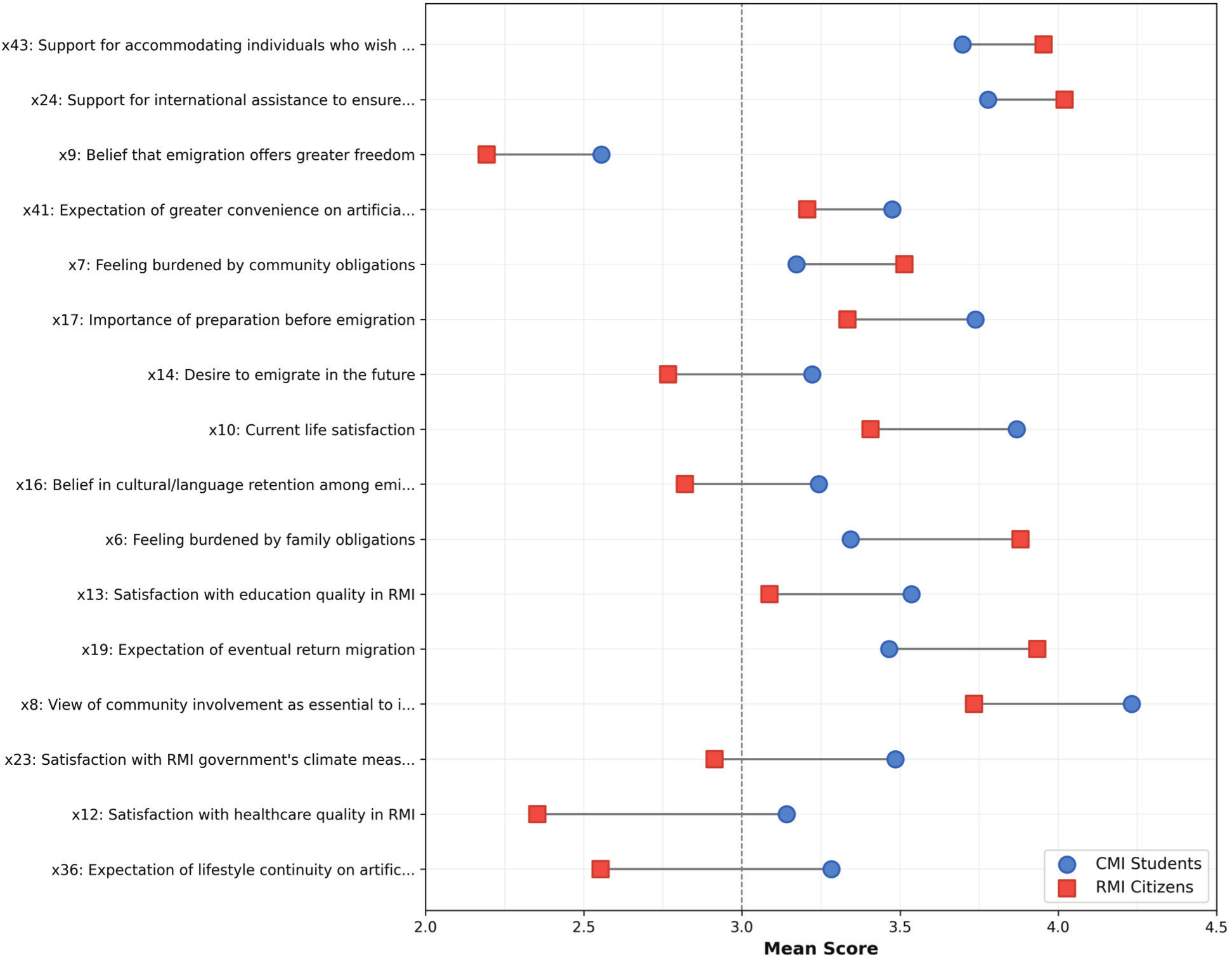
Student-citizen differences in 16 items
1. Introduction
1.1. The Climate Change Crisis in Atoll Nations
The Republic of the Marshall Islands (RMI) stands at the forefront of the global climate change crisis. This low-lying Pacific atoll nation, consisting of 29 coral atolls and five isolated islands scattered across approximately 1.9 million km\(^2\) of the ocean, faces an existential threat from rising sea levels. With a mean elevation of just 2 m above sea level and no point in the country exceeding 10 m, the RMI is among the world’s most vulnerable nations to climate change impacts 1,2.
Current projections indicate that sea level rise, combined with increased storm surge frequency and intensity, could render significant areas uninhabitable within the current century 2. The capital, Majuro, which houses approximately half of the nation’s population of 59,000, is particularly vulnerable. The narrow land strips of the atoll, in some places less than 100 m wide, face threats from both ocean-side wave action and lagoon-side flooding. In addition to physical inundation, saltwater intrusion threatens freshwater resources, whereas warming waters endanger coral reef ecosystems that provide natural coastal protection, fishery resources, and cultural significance 3.
The climate crisis facing the Marshall Islands transcends environmental concerns and presents a direct threat to national sovereignty, cultural identity, and fundamental rights to the homeland. Unlike many climate change impacts that unfold gradually and allow for incremental adaptation, the prospect of losing habitable land poses an acute challenge that requires immediate and comprehensive responses.
1.2. Climate-Induced Displacement and the Small Island Developing States Context
The Marshall Islands is part of a broader group of Small Island Developing States (SIDS) confronting similar climate change challenges. Pacific Island nations, including Kiribati, Tuvalu, and the Maldives, face comparable threats of submergence, raising profound questions about territorial sovereignty, cultural preservation, and human rights in the context of climate-induced displacement 4,5.
Climate-induced migration from atoll nations has already begun, with significant Marshallese populations residing in the United States, particularly Arkansas, Hawaii, and Washington. The Compact of Free Association (COFA) between the RMI and the United States grants Marshallese citizens the right to live and work in the United States without visas, providing a unique migration pathway unavailable to most climate-vulnerable populations 3. However, this migration occurs within a complex framework of push and pull factors, including not only climate concerns but also economic opportunities, access to education, and availability of healthcare.
Despite the growing recognition of climate change as a driver of displacement, the concept of “climate refugees” remains legally undefined and politically contested. The 1951 Refugee Convention does not recognize climate or environmental change as grounds for refugee status, leaving climate migrants in legal limbo. This gap has prompted calls for new international frameworks to address climate displacement, including proposals for “climate passports” and recognition of the “right to migrate” as a climate adaptation strategy 6,7.
Simultaneously, many atoll nation communities assert their “right to stay” — the principle that climate adaptation assistance should enable communities to remain in their homelands rather than force displacement 5,8. The tension between migration as an adaptation and resistance to displacement-oriented solutions reflects deeper questions about agency, cultural preservation, and the responsibility of high-emissions nations to support adaptation in vulnerable countries.
1.3. Artificial Islands as Climate Adaptation Infrastructure
Among proposed climate adaptation strategies for atoll nations, artificial island construction has emerged as a potentially transformative yet controversial approach 9,10. Nakayama et al. 9 evaluated land reclamation and raising as one of four adaptation alternatives for the Marshall Islands, while recent research has begun investigating the feasibility and social acceptability of artificial islands as instruments for the “right to stay” 10. Brown et al. 11 demonstrated how structural adaptation through land reclamation and island raising can be utilized within an adaptation pathway approach, enabling atoll nations, such as the Maldives, to persist and prosper for centuries despite rising sea levels.
In the Maldives, the government constructed Hulhumalé, an artificial island designed to address both congestion in the capital city and rising sea levels 12. Studies of Hulhumalé residents have examined life satisfaction among migrants from Malé and other atolls 13 as well as the motivations driving voluntary migration to this artificial island in the context of climate change 14. These studies provide valuable insights into how artificial island development may occur in other atoll contexts.
There are several precedents for large-scale artificial island construction. The Netherlands has extensive experience in land reclamation, including the Flevopolder project, which created over 970 km\(^2\) of new land. Singapore expanded its territory by more than 20% through land reclamation. More recently, island nations, including the Maldives, have constructed artificial islands such as Hulhumalé to address land scarcity and provide alternatives to overpopulated capital islands 15.
In the Pacific region, the development of artificial islands faces unique challenges. Unlike land reclamation in continental coastal areas, artificial atoll islands must be constructed in deeper waters with limited sediment sources. Engineering challenges include ensuring structural stability during extreme weather events; preventing erosion; maintaining adequate elevation above future sea levels; and providing essential infrastructure, including freshwater systems, sewage treatment, and renewable energy generation 16.
Marshallese culture maintains deep connections between people and land, with specific atolls and islands having cultural and historical significance tied to ancestral heritage and matrilineal lineage systems. The prospect of relocating to “artificial” land, disconnected from ancestral ties and traditional land tenure systems, challenges fundamental aspects of Marshallese identity and social organization 17.
Previous research on Marshallese attitudes toward artificial islands has yielded mixed findings. Some studies have suggested that openness to artificial island solutions is warranted if they enable people to remain in their nation’s territorial waters and maintain sovereignty 10. Simultaneously, Marshallese literature and poetry articulate the profound spiritual and emotional connections between people and their ancestral lands, connections that may be difficult to replicate on artificial substrates 18. Others highlight concerns about losing traditional land connections, uncertainty about whether culture and communities can be transplanted into new substrates, and skepticism about whether artificial islands can truly replicate the complex ecosystems and social systems of natural atolls 19.
1.4. The Role of Education and Generational Differences in Climate Adaptation Perceptions
Climate change adaptation planning requires an understanding of how different demographic groups perceive risks, evaluate adaptation options, and make decisions regarding migration versus stay. Education and age are potentially critical factors shaping these perceptions. However, they remain understudied in the context of the Pacific Islands.
Educational attainment may influence climate adaptation perspectives through multiple pathways. Higher education typically increases scientific literacy, potentially leading to a better understanding of climate-change mechanisms and adaptation technologies. Education may also increase exposure to global perspectives and international migration narratives, potentially reducing place attachment and increasing the willingness to relocate. Conversely, education in the Pacific Islands context often includes cultural studies emphasizing traditional knowledge and cultural preservation, which may strengthen cultural identity and commitment to the homeland 20.
Generational differences in climate adaptation attitudes reflect both life-stage factors and cohort effects. Younger individuals with longer time horizons for experiencing climate impacts may perceive greater urgency in adaptation planning. They also face different opportunity structures, with education and international labor markets potentially offering migration pathways unavailable to older generations. However, younger people may also lack the deep experiential knowledge of climate variability and the traditional adaptation practices that older community members possess 21.
The College of the Marshall Islands (CMI) is a crucial institution for higher education in the RMI, offering associate degrees and certificate programs, while also providing developmental education and workforce training. The CMI students represent an educated, younger demographic segment whose future decisions about staying or migrating will significantly shape the nation’s demographic trajectory. Understanding their perceptions of climate adaptation options and how these differ from the broader citizenry provides essential insights for adaptation planning.
1.5. Research on Climate Change Perceptions and Adaptation Preferences in the Pacific
A growing body of research has examined climate change perceptions and adaptation preferences in the Pacific Island nations, although significant gaps remain. Studies have documented a high awareness of climate change impacts among Pacific Islanders, with most communities observing environmental changes, including coastal erosion, changing rainfall patterns, and increased storm intensity 8,21.
Research on migration intention has revealed complex patterns. Some studies find that many Pacific Islanders prefer to remain in their homelands despite climate risks, citing cultural attachments, family obligations, and concerns about losing identity and traditional livelihoods 5,22. Other research has identified significant migration aspirations, particularly among younger, more educated individuals, driven by a perceived lack of economic opportunities and climate concerns 3.
Studies on adaptation preferences typically find support for diverse strategies rather than single solutions. Communities generally favor a portfolio approach combining engineering solutions (seawalls, land reclamation), ecosystem-based adaptation (mangrove restoration, coral reef protection), improved water and food security, and enhanced disaster preparedness, alongside migration preparedness 23,24.
However, most existing research treats Pacific Island populations as relatively homogeneous, with limited attention paid to systematic differences across demographic subgroups. Few studies directly compare perceptions and preferences between students and the general population, despite the policy relevance of understanding how educated youths, who will lead future adaptation efforts, view adaptation options compared to current community members.
1.6. Social and Cultural Context of the Marshall Islands
Understanding climate adaptation attitudes in the Marshall Islands requires an appreciation of the distinctive social and cultural contexts that shape Marshallese perspectives on land, community, and change.
Kinship and Social Organization: Marshallese society is organized around matrilineal clans, with land rights traditionally passing through maternal lines. Extended family networks (jowis) not only create strong mutual support systems but also generate significant social obligations. Individuals are expected to contribute to family needs, participate in communal activities, and maintain relationships across geographical distances. These obligations create support networks that facilitate migration and constraints that may inhibit individual mobility 17.
Land Tenure and Spiritual Connections: Land holds profound significance in Marshallese culture, serving not only as a property but also as a source of identity, spiritual connection, and social status. Specific land parcels are linked to historical narratives, ancestral graves, and lineages. The concept of “land” in Marshallese encompasses not just terrestrial space but also surrounding marine areas, creating an integrated view of territory that might be challenging to replicate on artificial substrates 25.
Historical Experience with Displacement: The Marshall Islands experienced multiple waves of forced displacement, most notably during the U.S. nuclear testing program (1946–1958), which rendered the Bikini and Enewetak atolls uninhabitable and displaced their populations. This historical trauma has shaped contemporary attitudes toward displacement and relocation, with many Marshallese viewing relocation proposals through the lens of this painful history 26.
COFA Migration Dynamics: The Compact of Free Association enables free migration between the RMI and the United States, creating established Marshallese diaspora communities. This migration pathway distinguishes the Marshall Islands from many climate-vulnerable nations where migration faces significant legal barriers. However, the COFA migration has created its own challenges, including brain drain, family separation, and concerns about cultural dilution in diaspora communities 3.
Contemporary Challenges: Beyond climate change, the Marshall Islands face multiple developmental challenges, including limited economic opportunities, healthcare and educational resource constraints, infrastructure limitations, and geographic isolation. These factors create complex decision-making contexts, in which climate adaptation considerations interact with economic and social concerns.
1.7. Research Gap and Study Objectives
Despite the existential nature of climate threats facing the Marshall Islands and the policy urgency of understanding adaptation preferences, significant research gaps remain. Most importantly, few studies have systematically compared climate adaptation perceptions across demographic subgroups, particularly between the educated youth and the general population. This gap is problematic because different demographic groups may have divergent priorities, risk perceptions, and adaptation preferences that require acknowledgment in policy design. This study addresses this gap by conducting a systematic comparative analysis of the climate change adaptation perceptions of CMI students and RMI citizens. Specifically, we examine the following points:
-
Differences in satisfaction with current conditions: How do students and citizens evaluate existing services, government performance, and overall quality of life?
-
Migration attitudes and expectations: Do students and citizens differ in their desire to emigrate, beliefs about the benefits of migration, and expectations regarding return migration?
-
Artificial island perceptions: How do the two groups differ in their willingness to relocate to artificial islands, and their expectations regarding lifestyle continuity, safety, and environmental impacts?
-
Climate adaptation policy preferences: Do students and citizens differ in their support for various adaptation approaches, including engineering solutions, international assistance, and migration support?
-
Social obligations and place attachment: How do feelings of family and community obligations differ between students and citizens, and how might these affect adaptation choices?
Understanding these differences has direct policy relevance. Climate adaptation planning that fails to acknowledge divergent perspectives across demographic groups risks creating policies that satisfy neither younger educated segments nor the broader population. Conversely, identifying areas of consensus can guide the development of adaptive strategies with broad social acceptance.
Furthermore, understanding how educated youth view adaptation options provides insights into the likely direction of future attitudes as current students move into leadership positions and education levels rise across the population. If significant gaps exist between student and citizen perspectives, it suggests the potential for either generational conflict or attitudinal evolution as demographic transitions unfold.
The Marshall Islands are facing adaptation decisions with unprecedented complexity and consequences. These decisions must be made through a comprehensive understanding of how different segments of society perceive risk, evaluate options, and envision acceptable futures. This study contributes to this understanding by providing the first systematic comparison of climate adaptation perceptions between CMI students and the general RMI citizens, offering evidence to inform more nuanced and demographically aware adaptation plans.
1.8. Climate Change Adaptation Policy Framework in the RMI
The RMI has articulated its national approach to climate change adaptation through the National Adaptation Plan (NAP) 27, which provides an overarching policy framework for addressing climate risks while safeguarding national sovereignty, cultural identity, and the right of Marshallese people to remain in their homeland. The NAP emphasizes a portfolio-based adaptation strategy that combines in-situ adaptation measures, ecosystem-based approaches, infrastructure development, disaster risk reduction, and migration preparedness, rather than relying on any single solution.
Within this framework, large-scale infrastructural measures such as land reclamation, elevation of existing islands, and the potential development of artificial islands are positioned as part of broader in-situ adaptation efforts aimed at enabling the “Right to Stay.” At the same time, the NAP explicitly recognizes that migration, both internal and international, may remain a necessary component of adaptation for some individuals and households and therefore calls for policies that support safe, dignified, and well-prepared mobility.
Artificial island development, while not a stand-alone policy objective, can thus be understood as a complementary adaptation option within the NAP’s multilayered strategy. Its feasibility and social acceptability depend not only on technical and financial considerations but also on public perceptions, expectations, and cultural values. Understanding how different demographic groups perceive artificial islands and related adaptation measures is, therefore, essential for aligning national adaptation policies with societal priorities and ensuring broad-based legitimacy in policy implementation.
2. Methods
2.1. Study Design and Participants
This study employed a cross-sectional survey design to compare the perceptions of climate change adaptation strategies between two populations in the RMI: students at the CMI and the general public.
CMI2024 Survey: The first survey (CMI2024) was conducted among CMI students from July to October 2024 using a web-based questionnaire in which students entered their responses online. A total of 99 valid responses were collected, representing approximately 18% of the CMI’s total student population. Inclusion criteria were: (1) current enrollment in the CMI, (2) age 18 years or older, and (3) ability to provide informed consent. The student population represents younger and more educated individuals who are likely to face long-term impacts of climate change and consider migration options.
RMI2025 Survey: The second survey (RMI2025) targeted general RMI citizens residing in Majuro and collected 150 valid responses through face-to-face questionnaire interviews conducted between November 2024 and March 2025. The inclusion criteria were as follows (1) RMI citizenship, (2) age 18 years or older, (3) residence in Majuro, and (4) ability to provide informed consent. The sample represents 0.6% of Majuro’s estimated adult population (aged 18 years or older). Participants were recruited through convenience sampling at various public locations; this proportion reflects the study’s coverage of the target population rather than a conventional response rate calculated from a defined sampling frame. The survey was designed to capture diverse perspectives across Marshallese society.
The two surveys were conducted sequentially, with no major climate-related disasters, policy changes, or other significant events occurring in the Marshall Islands during or between the survey periods, which could have differentially affected the two samples.
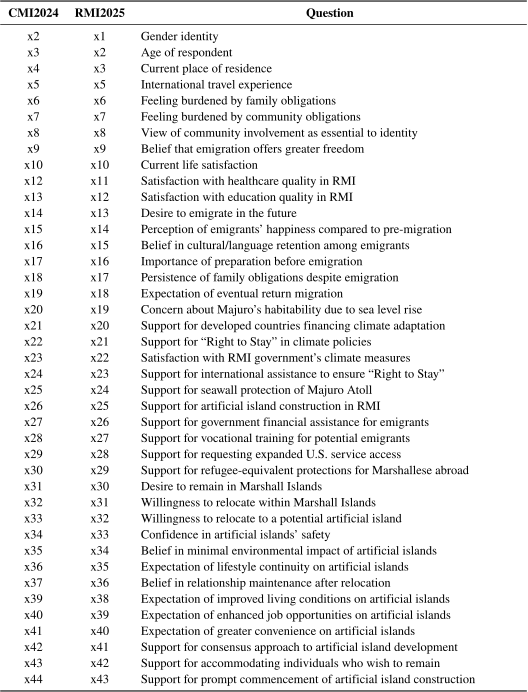
Survey questions are presented in Appendix A.
2.2. Survey Instrument
Both surveys utilized a standardized questionnaire with identical or equivalent questions covering multiple domains:
-
Demographic characteristics: Gender, age, place of residence, and international travel experience; social and familial obligations: perceptions of burdens related to family and community responsibilities.
-
Life satisfaction and service quality: Current life satisfaction and satisfaction with healthcare and education services in the RMI.
-
Migration attitudes: Desire to emigrate, beliefs about emigration benefits, and expectations regarding return migration
-
Climate change concerns: Worry about sea level rise impacts on Majuro’s habitability
-
Climate adaptation policy preferences: Support for various adaptation measures, including seawall protection, artificial island construction, and international assistance
-
Artificial island perceptions: Willingness to relocate, expectations regarding lifestyle continuity, and beliefs about safety and environmental impacts
Questions, except those related to demographic characteristics, were measured on a 5-point Likert scale, with responses ranging from 1 (strongly disagree or very dissatisfied) to 5 (strongly agree or very satisfied).
Of the 41 items shown in “Questions applied for surveys” in Appendix A, 37 items (x6–x43 for RMI2025; x6–x44 for CMI2024) were included in the comparative analysis after standardization to the common 5-point Likert format. Demographic items were excluded. This approach preserved the common metric for direct group comparisons, while maximizing the number of comparable items (90.2% of the total survey content). All 37 retained items had conceptually equivalent wording and identical response anchors, supporting valid cross-group statistical comparisons.
2.3. Statistical Analysis
We conducted comparative statistical analyses to identify significant differences between CMI students and RMI citizens across 37 common survey items. Four demographic items (gender, age, place of residence, and international travel experience) were collected in both surveys but were not measured on the 5-point Likert scale, and were therefore excluded from the analysis.
Non-parametric testing: Given the ordinal nature of the Likert scale data and without assumptions about a normal distribution, we employed the Mann–Whitney \(U\) test as the primary statistical method for comparing distributions between the two independent groups. This test is robust and appropriate for ordinal survey data.
Effect size calculation: To assess the magnitude of differences beyond statistical significance, we calculated the rank-biserial correlation (\(r\)) as a measure of effect size, which is an appropriate non-parametric effect size measure for the Mann–Whitney \(U\) test. The rank-biserial correlation was computed using the formula \(r=\) \(2{U}/({n}1\times{n}2)-1\), where \(U\) is the Mann–Whitney \(U\) statistic. Effect sizes were interpreted using conventional thresholds for correlation coefficients: small (\(\vert{r}\vert=0.1-0.3\)), medium (\(\vert{r}\vert=0.3-0.5\)), and large (\(\vert{r}\vert\ge 0.5\)).
Significance levels: Statistical significance was evaluated at two levels: \(\alpha=0.05\) (5%) and \(\alpha=0.01\) (1%). Items with p values below these thresholds were considered statistically significant.
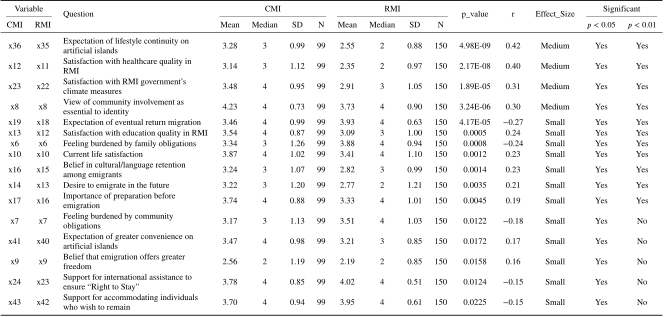
Table 1. Statistical results for the 16 items showing significant differences between CMI students and RMI citizens.
Descriptive statistics: For each item, we calculated the mean, median, and standard deviation for both groups to provide comprehensive descriptive information on the distributions.
To address the issue of multiple comparisons across 37 items, we applied both Bonferroni correction (adjusted \(\alpha=0.05/37=0.00135\)) and the Benjamini–Hochberg False Discovery Rate (FDR) procedure. The results are reported at both uncorrected and corrected significance levels to allow readers to evaluate the robustness of the findings.
All statistical analyses were performed using Python 3.12 with the SciPy (version 1.16.3) statistical library. The Mann–Whitney \(U\) tests and rank-biserial correlation calculations were computed using scipy.stats.mannwhitneyu. Data management was performed using Pandas (version 2.3.3), numerical computations using NumPy (version 2.3.5), and visualization using Matplotlib (version 3.10.7).
3. Results
3.1. Overview of Statistical Differences
Of the 37 survey items analyzed, 16 (43.2%) showed statistically significant differences between CMI students and RMI citizens at the \(\alpha=0.05\) level, with 11 (29.7%) reaching the more stringent \(\alpha=0.01\) threshold. The remaining 21 items (56.8%) showed no significant differences between the two groups.
Regarding effect sizes, 4 items (10.8%) demonstrated medium effects (\(0.3\le \vert{r}\vert<0.5\)), 12 items (32.4%) showed small effects (\(0.1\le \vert{r}\vert<0.3\)), and no items exhibited large effects (\(\vert{r}\vert\ge 0.5\)). Table 1 presents the complete statistical results for all 16 items, showing significant differences between CMI students and RMI citizens. The table includes descriptive statistics (means, medians, and standard deviations), Mann–Whitney \(U\) test p-values, and rank-biserial correlation (\(r\)) as effect sizes and significance levels for both groups. Items are ordered by effect size magnitude, with medium effects (\(\vert{r}\vert\ge 0.3\)) listed first (items 1–4), followed by small effects (\(0.1\le \vert{r}\vert<0.3\), items 5–16).
After applying Bonferroni correction for multiple comparisons (adjusted \(\alpha=0.00135\)), 8 of the 16 originally significant items remained statistically significant. Notably, all four items with medium effect sizes retained significance after correction: expectations of lifestyle continuity on artificial islands (\(p <0.000001\)), satisfaction with healthcare quality (\(p <0.000001\)), satisfaction with governmental climate measures (\(p=0.000019\)), and community involvement being essential to identity (\(p=0.000003\)). The less conservative FDR correction (Benjamini–Hochberg procedure) retained 15 of the 16 significant items. Eight items that were significant at the uncorrected \(\alpha=0.05\) level did not survive Bonferroni correction: cultural/language retention among emigrants, desire to emigrate, importance of preparation before emigration, community obligation burden, international support for “Right to Stay,” belief that emigration offers freedom, expectations for convenience on artificial islands, and support for accommodating those who wish to stay. Therefore, these findings should be interpreted with caution.
Source: Developed by authors
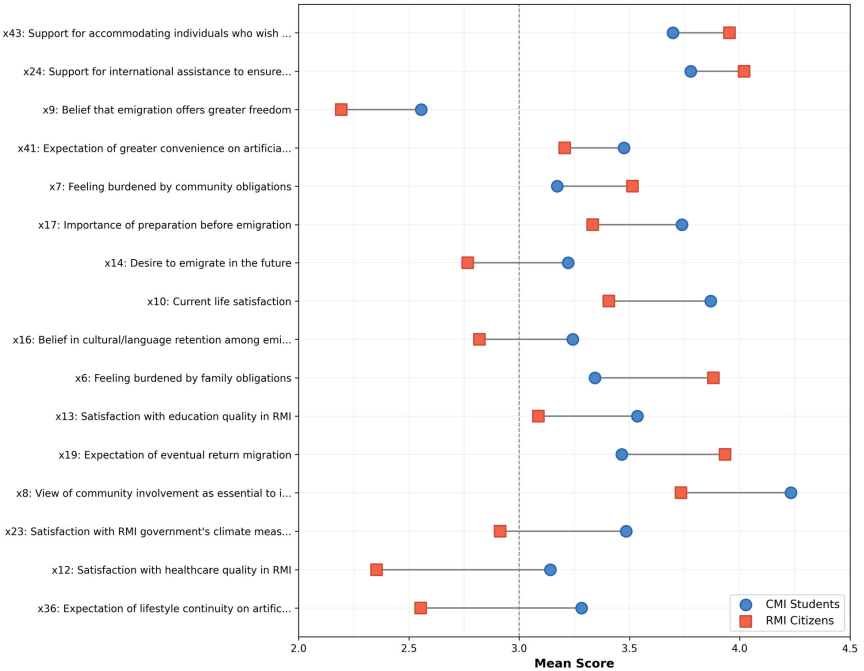
Fig. 1. Comparison of mean scores for significant items.
3.2. Items with Medium Effect Sizes: Most Pronounced Differences
Four items exhibited medium effect sizes, representing the most substantial differences between the two populations.
-
Expectations of lifestyle continuity on artificial islands (CMI: M \(=3.28\), SD \(=0.99\); RMI: M \(=2.55\), SD \(=0.88\); \(p <0.000001\), \(r=0.42\)). CMI students expressed significantly higher expectations than citizens that their lifestyles would remain unchanged on artificial islands. This was the largest effect size observed in this study.
-
Satisfaction with healthcare quality in the RMI (CMI: M \(=3.14\), SD \(=1.12\); RMI: M \(=2.35\), SD \(=0.97\); \(p <0.000001\), \(r=0.40\)). Students reported substantially higher satisfaction with the current healthcare services than citizens.
-
Satisfaction with the RMI government’s climate measures (CMI: M \(=3.48\), SD \(=0.95\); RMI: M \(=2.91\), SD \(=1.05\); \(p=0.000019\), \(r=0.31\)). Students expressed greater satisfaction with the government’s climate change adaptation efforts.
-
Community involvement was essential for identity (CMI: M \(=4.23\), SD \(=0.73\); RMI: M \(=3.73\), SD \(=0.90\); \(p=0.000003\), \(r=0.30\)). Students strongly agreed that community involvement was an essential part of their identity.
Source: Developed by authors
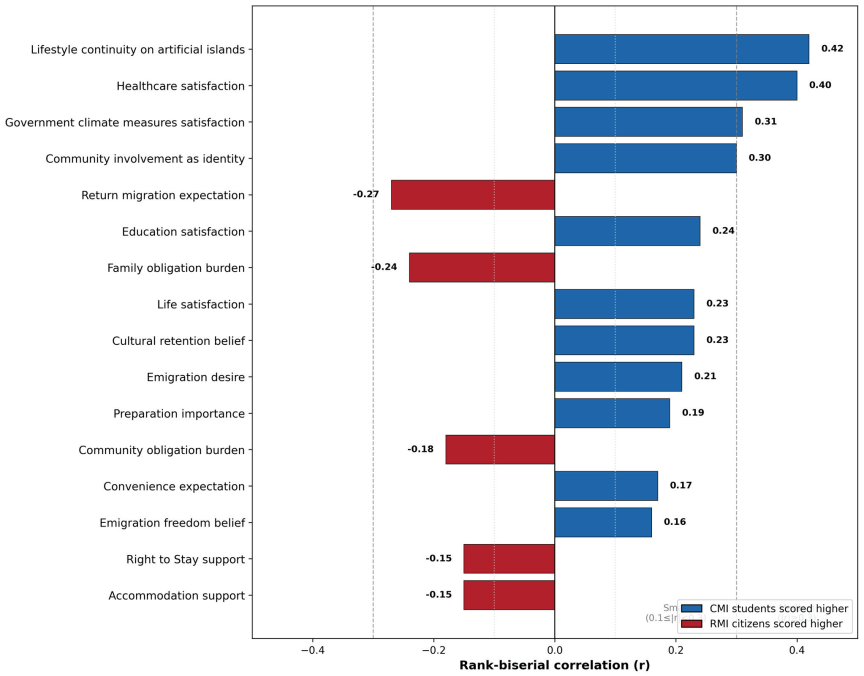
Fig. 2. Effect sizes (rank-biserial correlation) for statistically significant items (\(p <0.05\), \(n=16\)).
Figure 1 presents a comprehensive visual comparison of the mean scores of all 16 statistically significant items. Blue circles represent CMI student responses and red squares represent RMI citizen responses. The horizontal lines connecting the symbols illustrate the magnitude and direction of differences between the two groups. Items were arranged vertically by effect size (rank-biserial correlation, \(r\)), with the smallest differences at the top and the largest at the bottom. The vertical dashed line at 3.0 represents the neutral midpoint on the 5-point Likert scale.
Figure 2 displays the effect sizes (rank-biserial correlation, \(r\)) for all 16 statistically significant items ordered by magnitude. The blue bars indicate domains where CMI students scored higher than RMI citizens, and the red bars indicate areas where citizens scored higher than students. Dotted vertical lines indicate the threshold for a small effect size (\(\vert{r}\vert=0.1\)) and dashed vertical lines indicate the threshold for a medium effect size (\(\vert{r}\vert=0.3\)). Four items exceeding the medium effect threshold demonstrated the most substantial perceptual differences between the two populations.
Source: Developed by authors.
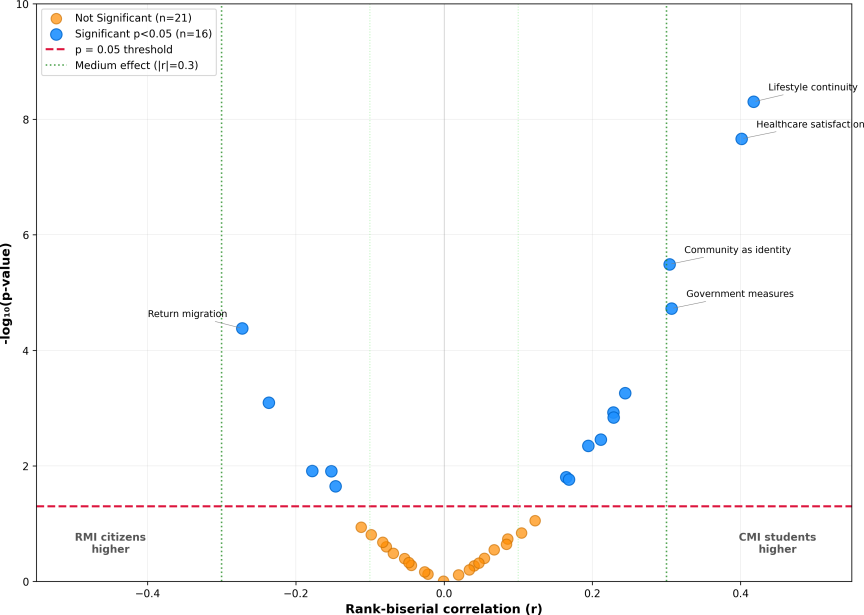
Fig. 3. Effect size (rank-biserial correlation, \(r\)) vs. statistical significance. Blue points represent statistically significant \(p <0.05\) (\(n=16\)) and orange points represent non-significant items (\(n=21\)). The red dashed line indicates the \(p=0.05\) threshold and green dotted lines indicate the medium effect size threshold (\(\vert{r}\vert=0.3\)).
3.3. Items with Small Effect Sizes: Significant Differences
Twelve additional items showed statistically significant differences with small effect sizes:
-
Migration-related perceptions: Citizens showed significantly higher expectations for return migration (CMI: M \(=3.46\); RMI: M \(=3.93\); \(p=0.000042\), \(r=-0.27\)), representing the item with the largest effect size, where citizens scored higher than students. Students expressed stronger beliefs in cultural/language retention among emigrants (CMI: M \(=3.24\); RMI: M \(=2.82\); \(p=0.001444\), \(r=0.23\)), higher desire to emigrate in the future (CMI: M \(=3.22\); RMI: M \(=2.77\); \(p=0.003489\), \(r=0.21\)), greater emphasis on the importance of preparation before emigration (CMI: M \(=3.74\); RMI: M \(=3.33\); \(p=0.004513\), \(r=0.19\)), and stronger belief that emigration offers greater freedom (CMI: M \(=2.56\); RMI: M \(=2.19\); \(p=0.015771\), \(r=0.16\)).
-
Satisfaction and life quality domains: Students reported higher satisfaction with education quality (CMI: M \(=3.54\); RMI: M \(=3.09\); \(p=0.000548\), \(r=0.24\)) and greater current life satisfaction (CMI: M \(=3.87\); RMI: M \(=3.41\); \(p=0.001185\), \(r=0.23\)).
-
Artificial island expectations: Students held higher expectations for greater convenience on artificial islands (CMI: M \(=3.47\); RMI: M \(=3.21\); \(p=0.017211\), \(r=0.17\)).
-
Obligations and support for staying: Citizens reported feeling more burdened by family obligations (CMI: M \(=3.34\); RMI: M \(=3.88\); \(p=0.000801\), \(r=-0.24\)) and community obligations (CMI: M \(=3.17\); RMI: M \(=3.51\); \(p=0.012234\), \(r=-0.18\)). Citizens also showed stronger support for international assistance to ensure “Right to Stay” (CMI: M \(=3.78\); RMI: M \(=4.02\); \(p=0.012375\), \(r=-0.15\)) and greater support for accommodating individuals who wish to remain (CMI: M \(=3.70\); RMI: M \(=3.95\); \(p=0.022525\), \(r=-0.15\)).
3.4. Items Without Significant Differences
Twenty-one items showed no statistically significant differences between groups (\(p \ge\) 0.05). These included support for developed countries financing climate adaptation, support for “Right to Stay” in climate policies, support for seawall protection, support for artificial island construction, support for government financial assistance for emigrants, support for vocational training, desire to remain in the Marshall Islands, willingness to relocate within the Marshall Islands, willingness to relocate to an artificial island, confidence in artificial islands’ safety, belief in minimal environmental impact of artificial islands, belief in relationship maintenance after relocation, expectation of improved living conditions on artificial islands, expectation of enhanced job opportunities on artificial islands, support for consensus approach to artificial island development, and support for prompt commencement of artificial island construction.
Figure 3 provides a comprehensive overview of all 37 analyzed items, plotting the effect size (rank-biserial correlation, \(r\)) against statistical significance (\(-\log_{10}\) \(p\)-value). Blue points represent statistically significant differences (\(p <0.05\)), whereas orange points indicate non-significant items. The horizontal dashed line corresponds to \(p=0.05\). The vertical dotted lines indicate the thresholds for medium effect size (\(\vert{r}\vert=0.3\)). The vertical line at zero separates items that RMI citizens scored higher (left quadrant) from those that CMI students scored higher (right quadrant). This visualization demonstrates that statistical significance and effect size are related but distinct concepts: some items show statistical significance with small practical differences, whereas the most meaningful differences (medium effect sizes) consistently achieve high statistical significance. Clustering of significant items in the right quadrants indicated that CMI students generally expressed higher scores across multiple domains, with notable exceptions in the left quadrants, where citizens showed stronger responses regarding obligations and return-migration expectations.
3.5. Summary of Comparative Findings
In sum, the comparative analysis revealed a complex pattern of similarities and differences between CMI students and RMI citizens. While 43% of items (16 of 37) showed statistically significant differences, the remaining 57% demonstrated consensus across both groups, particularly regarding core adaptation policy preferences. Among the significant items, four exhibited medium effect sizes (\(\vert{r}\vert\ge 0.3\)) and twelve showed small effect sizes (\(0.1\le \vert{r}\vert <0.3\)). The significant differences were clustered into five key domains: expectations for technological adaptation solutions (artificial islands), satisfaction with current services and governance, migration attitudes and freedom perceptions, social obligations, and support for “Right to Stay” policies. These patterns suggest that distinct generational and educational perspectives must be considered in climate adaptation planning, while broad areas of agreement provide a foundation for unified policy development.
4. Discussion
4.1. Principal Findings
The comparative analysis revealed significant perceptual differences between CMI students and general RMI citizens in terms of climate change adaptation strategies, migration attitudes, and current life satisfaction. The most pronounced differences center on expectations of artificial islands as a climate adaptation solution, satisfaction with current services and government climate measures, and the role of the community in personal identity. Four items exhibited medium effect sizes (\(\vert{r}\vert\ge 0.3\)), while twelve showed small effect sizes (\(0.1\le \vert{r}\vert< 0.3\)).
4.2. Generational and Educational Divides in Climate Adaptation Perceptions
An important interpretive caveat must be acknowledged: CMI students differ from general citizens in terms of both age and educational attainment, and our cross-sectional design cannot disentangle these confounded factors. The observed differences may reflect generational effects (younger cohorts holding different values shaped by distinct historical experiences), age effects (life stage differences in priorities and constraints), educational effects (higher education fostering different perspectives), or a combination of these factors. Taking this limitation into account, the finding that CMI students express substantially higher expectations of lifestyle continuity on artificial islands (\(r=0.42\)) suggests what we tentatively interpret as a generational divide in climate adaptation optimism, while acknowledging that educational exposure may also contribute to this pattern. Students who represent younger and more educated segments of Marshallese society may possess greater confidence in technological solutions to climate change or hold more optimistic views on maintaining cultural practices in new settings. This optimism may be informed by their educational exposure to climate adaptation technologies or may reflect a developmental stage characterized by greater openness to change.
Conversely, citizens’ lower expectations for lifestyle continuity may reflect a more realistic or cautious assessment of the lived experiences. Older community members have deeper roots in traditional places and may better understand the intricate connections among land, culture, and identity, which can be disrupted by relocation to artificial structures.
4.3. Satisfaction Paradox: Students’ Higher Ratings Despite Known Limitations
The finding that students report higher satisfaction with healthcare (\(r=0.40\)) and education (\(r=0.24\)) quality, as well as government climate measures (\(r=0.31\)), presents an apparent paradox. RMI’s healthcare and education systems face well-documented challenges, including limited resources, infrastructure constraints, and workforce shortages. Students, as primary users of the education system and likely users of healthcare services, are expected to be critical of these systems.
Several explanations may account for this pattern:
-
Limited external reference points: Many students may have limited exposure to the healthcare and education systems in other countries and may lack comparative benchmarks. Their satisfaction ratings may reflect evaluations of local rather than international standards.
-
Institutional loyalty: As current beneficiaries of CMI education, students may exhibit in-group bias and rate services more favorably because of their institutional affiliation and investment in their educational success.
-
Future-oriented perspective: Students’ higher ratings of government climate measures may reflect greater optimism about future improvements or greater receptiveness to government messaging about climate initiatives.
-
Age-related differences in service utilization: Citizens, particularly older adults, may have more extensive experience with healthcare services and, thus, more bases for dissatisfaction.
These findings suggest that satisfaction metrics should be interpreted cautiously, considering respondents’ reference points and potential biases.
4.4. Migration Attitudes: A Push-Pull Dynamic
The pattern of migration-related attitudes revealed complex push-pull dynamics. Students expressed a greater desire to emigrate (\(r=0.21\)), stronger belief that emigration offers greater freedom (\(r=0.16\)), and more optimism about cultural retention abroad (\(r=0.23\)). These attitudes suggest that educated youth perceive migration as offering expanded opportunities and possibilities for self-determination while maintaining their cultural identity.
However, citizens’ significantly higher expectations of return migration (\(r=-0.27\)) introduce an important countervailing perspective. This may be attributed to several factors.
-
Cultural values regarding homeland connections: Marshallese culture emphasizes land connections and ancestral ties. Citizens may project these values onto emigrants, expecting a deep-rooted cultural attachment to eventually draw people home.
-
Observation of circular migration patterns: Many Marshallese people have engaged in circular migration, particularly to the United States, under the provisions of the Compact of Free Association. Citizens may base their expectations on the observed patterns of temporary migration followed by return.
-
Wishful thinking: The expectation of return migration may partly reflect citizens’ desire to maintain community cohesion and family connections rather than a realistic assessment of migrants’ likely behaviors.
4.5. Community Obligations and the Right to Stay
Citizens’ stronger feelings of burden related to family (\(r=-0.24\)) and community obligations (\(r=-0.18\)), coupled with their greater support for international assistance ensuring “Right to Stay” (\(r=-0.15\)), paint a picture of a population more constrained by social responsibilities and more invested in maintaining current residence patterns.
This pattern suggests that climate adaptation policies cannot focus solely on technical solutions such as artificial islands or managed migration programs. The social fabric of the Marshallese society, characterized by strong kinship networks and collective obligations, must be central to adaptation planning. Policies supporting “Right to Stay” resonate more strongly with citizens because they align with existing social structures and obligations.
Students’ relatively lower sense of obligation may reflect their life stage (many may not yet have children or elder care responsibilities) or the individualizing effects of higher education. However, their strong sense of community involvement as being essential to identity (\(r=0.30\)) suggests that education enhances rather than diminishes cultural identification, even while potentially reducing the sense of obligation burden.
4.6. Convergence on Core Adaptation Policies
Notably, students and citizens showed no significant differences in many core climate adaptation policy items, including support for seawall protection, artificial island construction (support in principle as opposed to expectations about outcomes), government assistance for emigrants, vocational training, and willingness to relocate to artificial islands. This convergence suggests a broad consensus regarding the need for diverse adaptation strategies.
The lack of significant differences in the willingness to relocate to artificial islands, despite students’ higher expectations of lifestyle continuity, indicates that willingness to accept a climate adaptation measure does not necessarily correlate with optimism regarding its outcomes. Citizens may be willing to relocate to artificial islands despite their skepticism about lifestyle continuity, perhaps viewing this as a necessary adaptation measure.
4.7. Implications for Climate Adaptation Policy
These findings are directly relevant to the implementation of the Republic of the Marshall Islands National Adaptation Plan (NAP). The observed divergence between the CMI students and general citizens suggests that a “one-size-fits-all” communication or policy approach may be insufficient for effective adaptive governance.
First, students’ relatively high expectations of lifestyle continuity on artificial islands and greater satisfaction with government climate measures indicate openness to technologically oriented, future-focused adaptation pathways. For this group, NAP measures related to innovative infrastructure, skill development, and long-term economic opportunities may resonate strongly, particularly if framed in terms of national resilience and global engagement.
In contrast, citizens’ stronger support for “Right to Stay” policies, combined with heavier perceived family and community obligations, underscores the importance of NAP measures that prioritize in-situ adaptation, community-based planning, and the preservation of social and cultural continuity. For these groups, artificial island development may be more acceptable when explicitly presented not as a relocation-driven solution but as a means of sustaining existing communities within the Marshallese territory.
Second, the convergence between students and citizens on support for a diverse set of adaptation measures aligns closely with the NAP’s portfolio approach. This consensus suggests that policy legitimacy can be strengthened by clearly communicating how artificial islands, coastal protection, livelihood support, and migration preparedness function as mutually reinforcing components rather than competing alternatives.
Finally, the findings highlight the importance of different engagement strategies in NAP implementation. Transparent discussions of the realistic benefits and limitations of artificial islands, grounded in empirical evidence and aligned with national policy goals, may help manage expectations among younger, more optimistic groups while addressing the concerns of citizens who prioritize cultural continuity and social responsibility. In this sense, public perception studies, such as the present one, can serve as an evidence base for refining the participatory processes embedded within the NAP and tailoring policy instruments to diverse societal perspectives.
Several limitations should be considered when interpreting these findings:
-
Sampling methodology: This study employed convenience sampling rather than probability sampling, which may limit its generalizability. The student sample was inherently biased toward younger and more educated individuals. Additionally, different survey modes (web-based for CMI2024 and face-to-face for RMI2025) may have introduced mode effects, although the finding that students reported higher satisfaction despite the greater anonymity of online surveys suggests that the social desirability bias does not fully account for the observed difference.
-
Temporal differences: The two surveys were conducted at different time points (CMI2024: July–October 2024; RMI2025: November 2024–March 2025). As noted in the Methods section, no major events occurred during this period, which were expected to systematically influence the responses. However, unmeasured seasonal or contextual factors cannot be entirely excluded.
-
Cultural factors in survey responses: Marshallese cultural norms regarding politeness and avoiding direct criticism may influence satisfaction ratings, potentially inflating positive responses.
-
Limited demographic controls: While we identified significant differences between students and citizens, we could not control for other potential confounders such as age, income, or specific residential location, owing to data limitations.
-
Self-selection bias: Survey respondents were self-selected, potentially biasing the results toward individuals with stronger opinions about climate change adaptation.
-
Translation and interpretation: Any challenges in translation or interpretation could systematically affect certain items more than others.
-
Multiple comparisons: Statistical tests were conducted using 37 items. To address potential inflation of Type I error rates, we applied both Bonferroni correction (adjusted \(\alpha=0.00135\)) and FDR correction (Benjamini–Hochberg procedure). While eight items remained significant after the conservative Bonferroni correction and 15 items after FDR correction, the eight items that did not survive the Bonferroni correction (although most survived the FDR correction) should be interpreted with caution as potentially reflecting chance findings.
-
Survey mode differences: Different survey modes (web-based for the CMI2024 and face-to-face for the RMI2025) represent methodological limitations that warrant careful consideration. Social desirability bias (SDB) typically inflates positive responses in face-to-face interviews compared with anonymous online surveys. However, our findings run counter to this expected pattern: CMI students who completed anonymous online surveys reported higher satisfaction with healthcare, education, and government climate measures than those interviewed face-to-face. If SDB was driving our results, we would expect the opposite pattern: higher satisfaction among face-to-face respondents. This “reverse direction” pattern provides indirect evidence that the observed differences reflect genuine attitudinal variations rather than methodological artifacts. Conversely, web-based surveys may introduce a self-selection bias toward more engaged or technologically literate respondents, which could partially account for students’ optimistic attitudes. Nevertheless, without a within-population mode comparison (e.g., administering both online and face-to-face surveys to a subset of the same population), we cannot definitively rule out mode effects, and this limitation should be considered when interpreting our findings.
-
Confounded comparison groups: Students at CMI differed from general citizens in terms of both age and educational attainment. Our design cannot determine whether the observed differences reflect generational effects, age-related life-stage factors, or educational effects, as these variables are confounded across the comparison groups. However, supplementary age-stratified analysis within the RMI citizen sample (Young: 18–25, \(n=49\); Middle: 26–39, \(n=49\); Older: 40\(+\), \(n=52\)) revealed that the key items showing the largest effect sizes in our main analysis—expectations for lifestyle continuity on artificial islands, satisfaction with healthcare, satisfaction with government climate measures, and community involvement as identity—did not differ significantly across age groups (all \(p >0.05\), Kruskal–Wallis tests). Notably, even the youngest citizen cohort (18–25 years) reported substantially lower scores than CMI students for these items (e.g., lifestyle continuity expectations: young citizens M \(=2.65\) vs. CMI students M \(=3.28\)). This pattern suggests that the observed differences between CMI students and citizens in these key items are unlikely to be attributable solely to age effects, pointing instead to factors associated with being a student, such as educational experience or institutional affiliation. In contrast, items related to family and community obligation burdens showed significant age effects within the citizen sample (\(p <0.05\)), suggesting that the differences between CMI students and citizens in these items may partially reflect age-related life-stage factors.
4.8. Future Research Directions
Several avenues for future research emerge from these findings:
-
Longitudinal studies: Following students over time as they transition to post-graduate life would reveal whether their attitudes and expectations change with age and increased life responsibilities.
-
Qualitative investigation: In-depth interviews can explore the reasons behind satisfaction ratings and differences in expectations, providing a richer context for quantitative findings.
-
Expanded demographic analysis: Future studies should collect more comprehensive demographic data to enable multivariate analyses that control for age, income, educational level, and other potential confounders.
-
Cross-cultural comparisons: Comparing Marshallese attitudes with those of other Pacific Island nations facing similar climate challenges could help identify culturally specific versus universal patterns.
-
Policy intervention studies: Research evaluating the effects of specific climate adaptation interventions on attitudes and expectations will provide evidence for policy refinement.
-
Economic analysis: Investigating the economic factors underlying migration decisions and satisfaction ratings complemented the attitudinal data presented here.
5. Conclusions
This comparative analysis of climate change adaptation perceptions between the CMI students and RMI citizens revealed significant attitudinal differences across multiple domains, with 43% of the items showing statistically significant differences. The most pronounced disparities concern expectations for artificial islands as climate adaptation solutions, satisfaction with current services and government measures, and migration perspectives.
The CMI students emerged as more optimistic about technological adaptation solutions, more satisfied with the current conditions despite objective limitations, and more oriented toward migration as an opportunity for greater freedom and self-determination. They maintain a strong cultural identification while carrying a lighter sense of familial and community obligations.
RMI citizens demonstrated greater caution about climate adaptation solutions, particularly regarding lifestyle continuity on artificial islands, while simultaneously expressing a stronger commitment to staying in the Marshall Islands. They carry heavier social obligations and show greater support for policies that enable people to remain in their homeland.
Importantly, both groups converged to support a diverse portfolio of adaptation strategies, suggesting that an optimal policy balances multiple approaches rather than relying on a single solution. The findings underscore the need for differentiated approaches to climate adaptation planning that acknowledge diverse perspectives across demographic groups while building on areas of consensus.
Climate-induced displacement and adaptation involve not only technical challenges requiring engineering solutions but also complex social processes that intersect with cultural values, intergenerational differences, educational experiences, and social obligations. An effective climate adaptation policy for the Marshall Islands must address this complexity, providing options that allow individuals to make choices aligned with their circumstances, values, and aspirations, while maintaining the social fabric that binds Marshallese communities together.
As the Marshall Islands face the existential threat of climate change, understanding these perceptual differences and commonalities becomes crucial for developing adaptation strategies that are not only technically feasible but also socially acceptable and culturally appropriate. The challenge lies in creating pathways that honor both students’ aspirations for opportunity and citizens’ commitments to place and community, ensuring that climate adaptation serves rather than fragments Marshallese society.
Appendix A. Question Items Used in the Surveys
Acknowledgments
This study was supported by the JSPS Bilateral Program, Grant Number JPJSBP120249945 and JSPS KAKENHI Grant Number 24K03174.
- [1] L. A. Nurse et al., “Small islands,” V. R. Barros et al. (Eds.), “Climate Change 2014: Impacts, adaptation, and vulnerability. Part B: Regional aspects,” Contribution of Working Group II to the Fifth Assessment Report of the Intergovernmental Panel on Climate Change, pp. 1613-1654, Cambridge University Press, 2014.
- [2] C. D. Storlazzi et al., “Most atolls will be uninhabitable by the mid-21st century because of sea-level rise exacerbating wave-driven flooding,” Science Advances, Vol.4, No.4, Article No.eaap9741, 2018. https://doi.org/10.1126/sciadv.aap9741
- [3] M. Hess, S. Moorhead, and M. Gaver, “Marshallese COFA migrants in Arkansas,” Northwestern Arkansas Council, 2020.
- [4] J. Barnett and S. J. O’Neill, “Islands, resettlement and adaptation,” Nature Climate Change, Vol.2, No.1, pp. 8-10, 2012. https://doi.org/10.1038/nclimate1334
- [5] C. Farbotko and H. Lazrus, “The first climate refugees? Contesting global narratives of climate change in Tuvalu,” Global Environmental Change, Vol.22, Issue 2, pp. 382-390, 2012. https://doi.org/10.1016/j.gloenvcha.2011.11.014
- [6] M. Burkett, “The nation ex-situ: On climate change, deterritorialized nationhood and the post-climate era,” Climate Law, Vol.2, No.3, pp. 345-374, 2011. https://doi.org/10.1163/cl-2011-040
- [7] J. McAdam, “Climate change, forced migration, and international law,” Oxford University Press, 2012. https://doi.org/10.1093/acprof:oso/9780199587087.001.0001
- [8] K. E. McNamara and C. Gibson, “‘We do not want to leave our land’: Pacific ambassadors at the United Nations resist the category of ‘climate refugees’,” Geoforum, Vol.40, Issue 3, pp. 475-483, 2009. https://doi.org/10.1016/j.geoforum.2009.03.006
- [9] M. Nakayama et al., “Alternatives for the Marshall Islands to cope with the anticipated sea level rise by climate change,” J. Disaster Res., Vol.17, No.3, pp. 315-326, 2022. https://doi.org/10.20965/jdr.2022.p0315
- [10] M. Nakayama, J. Seru, C. Vila, M. Bilimon, R. Fujikura, A. Sakamoto, and M. Sato, “Artificial island construction as an instrument for the right to stay: Case of the Marshall Islands,” J. Disaster Res., Vol.20, No.1, pp. 44-52, 2025. https://doi.org/10.20965/jdr.2025.p0044
- [11] S. Brown et al., “Pathways to sustain atolls under rising sea levels through land claim and island raising,” Environmental Research: Climate, Vol.2, No.1, Art No.015005, 2023. https://doi.org/10.1088/2752-5295/acb4b3
- [12] A. Sakamoto, K. Nishiya, X. Guo, A. Sugimoto, W. Nagasaki, and K. Doi, “Mitigating impacts of climate change induced sea level rise by infrastructure development: Case of the Maldives,” J. Disaster Res., Vol.17, No.3, pp. 327-334, 2022. https://doi.org/10.20965/jdr.2022.p0327
- [13] A. Sakamoto et al., “Life satisfaction and migration motivations of the residents of Hulhumalé from malé and other atolls,” J. Disaster Res., Vol.20, No.1, pp. 15-24, 2025. https://doi.org/10.20965/jdr.2025.p0015
- [14] M. Maekawa, R. A. Raheem, A. Khalid, A. Sakamoto, M. Nakayama, D. Sasaki, and H. Okaniwa, “Motivations for voluntary migration to Hulhumalé in the context of climate change,” J. Disaster Res., Vol.20, No.1, pp. 25-36, 2025. https://doi.org/10.20965/jdr.2025.p0025
- [15] S. Brown, M. P. Wadey, R. J. Nicholls, A. Shareef, Z. Khaleel, J. Hinkel, D. Lincke, and M. V. McCabe, “Land raising as a solution to sea–level rise: An analysis of coastal flooding on an artificial island in the Maldives,” J. of Flood Risk Management, Vol.13, Issue S1, Article No.e12567, 2020. https://doi.org/10.1111/jfr3.12567
- [16] J. Barnett and W. N. Adger, “Climate dangers and atoll countries,” Climatic Change, Vol.61, No.3, pp. 321-337, 2003. https://doi.org/10.1023/B:CLIM.0000004559.08755.88
- [17] J. A. Tobin, “Land tenure in the Marshall Islands,” J. A Tobin, J. L. Fischer, and R. G. Emerick (Eds.), “Land tenure patterns: Trust Territory of the Pacific Islands (Vol. 1),” Office of the High Commissioner, Trust Territory of the Pacific Islands, 1958.
- [18] K. Jetnil-Kijiner, “Iep jāltok: Poems from a Marshallese daughter,” University of Arizona Press, 2014.
- [19] J. Campbell, “Climate-change migration in the Pacific,” The Contemporary Pacific, Vol.26, No.1, pp. 1-28, 2014. https://doi.org/10.1353/cp.2014.0023
- [20] H. Lazrus, “Sea change: Island communities and climate change,” Annual Review of Anthropology, Vol.41, pp. 285-301, 2012. https://doi.org/10.1146/annurev-anthro-092611-145730
- [21] P. D. Nunn, A. Kohler, and R. Kumar, “Linked migrations and disasters: Lessons from the Pacific,” Asian and Pacific Migration J., Vol.23, Issue 4, pp. 441-465, 2014. https://doi.org/10.1177/011719681402300404
- [22] J. Campbell and R. Bedford, “Migration and climate change in Oceania,” E. Piguet and F. Laczko (Eds.), “People on the move in a changing climate: The regional impact of environmental change on migration,” pp. 177-204, Springer, 2014. https://doi.org/10.1007/978-94-007-6985-4_8
- [23] J. T. Locke, “Climate change-induced migration in the Pacific region: Sudden crisis and long-term developments,” The Geographical J., Vol.175, No.3, pp. 171-180, 2009. https://doi.org/10.1111/j.1475-4959.2008.00317.x
- [24] J. Barnett and J. Campbell, “Climate change and small island states: Power, knowledge and the South Pacific,” Earthscan, 2010. https://doi.org/10.4324/9781849774895
- [25] L. M. Carucci, “Nuclear nativity: Rituals of renewal and empowerment in the Marshall Islands,” Northern Illinois University Press, 1997.
- [26] H. M. Barker, “Bravo for the Marshallese: Regaining control in a post-nuclear, post-colonial world,” Wadsworth Cengage Learning, 2012.
- [27] Republic of the Marshall Islands, “Republic of the Marshall Islands National Adaptation Plan,” Office of the President, 2023. https://rmigov.com/RMI-NAP-2023.pdf [Accessed January 5, 2026]
This article is published under a Creative Commons Attribution-NoDerivatives 4.0 Internationa License.