
Paper:
Association of Urban and Economic Foundations with Post-Migration Life Satisfaction in the Maldives: Evidence from Voluntary Migrants to Hulhumalé
Akiko Sakamoto*,†
 , Aishath Laila**, Ayaka Naganuma*
, Taku Nishimura*
, and Shafraz Rasheed***
, Aishath Laila**, Ayaka Naganuma*
, Taku Nishimura*
, and Shafraz Rasheed***
*Global Infrastructure Fund Research Foundation Japan (GIF Japan)
Shiodome City Center 5F, 1-5-2 Higashi Shimbashi, Minato-ku, Tokyo 105-7105, Japan
†Corresponding author
**Housing Development Corporation (HDC)
Malé, Maldives
***Green Climate Network
Hulhumalé, Maldives

Understanding the factors associated with post-migration life satisfaction is critical for small island states pursuing climate adaptation and population consolidation strategies. This study examines how urban and economic foundations are associated with subjective well-being among voluntary, working-age migrants (aged 18–60) from islands outside the Greater Malé Region who relocated to Hulhumalé, a planned artificial island in the Maldives. Using data from an original questionnaire survey conducted between December 2024 and April 2025, changes in life satisfaction were assessed using paired t-tests, and an ordinary least squares regression model was utilized to examine associations between current satisfaction and evaluations of urban and economic foundations. The results present a significant increase in average life satisfaction following migration. Regression analysis indicates that although employment, income, housing, and the living environment are positively associated with current life satisfaction, social service-related factors—specifically human capital investment factors such as education and medical care—presented no significant independent association. Furthermore, pre-migration satisfaction is not a significant predictor once current conditions are accounted for. This pattern indicates a stronger connection between post-migration well-being and destination-based foundations than retrospective assessments of prior conditions. Although social services are highly rated, they function as essential background conditions rather than independent predictors of satisfaction. Thus, success in planned resettlement for economically active migrants depends on providing stable economic opportunities and livable residential foundations for populations with characteristics similar to this sample.
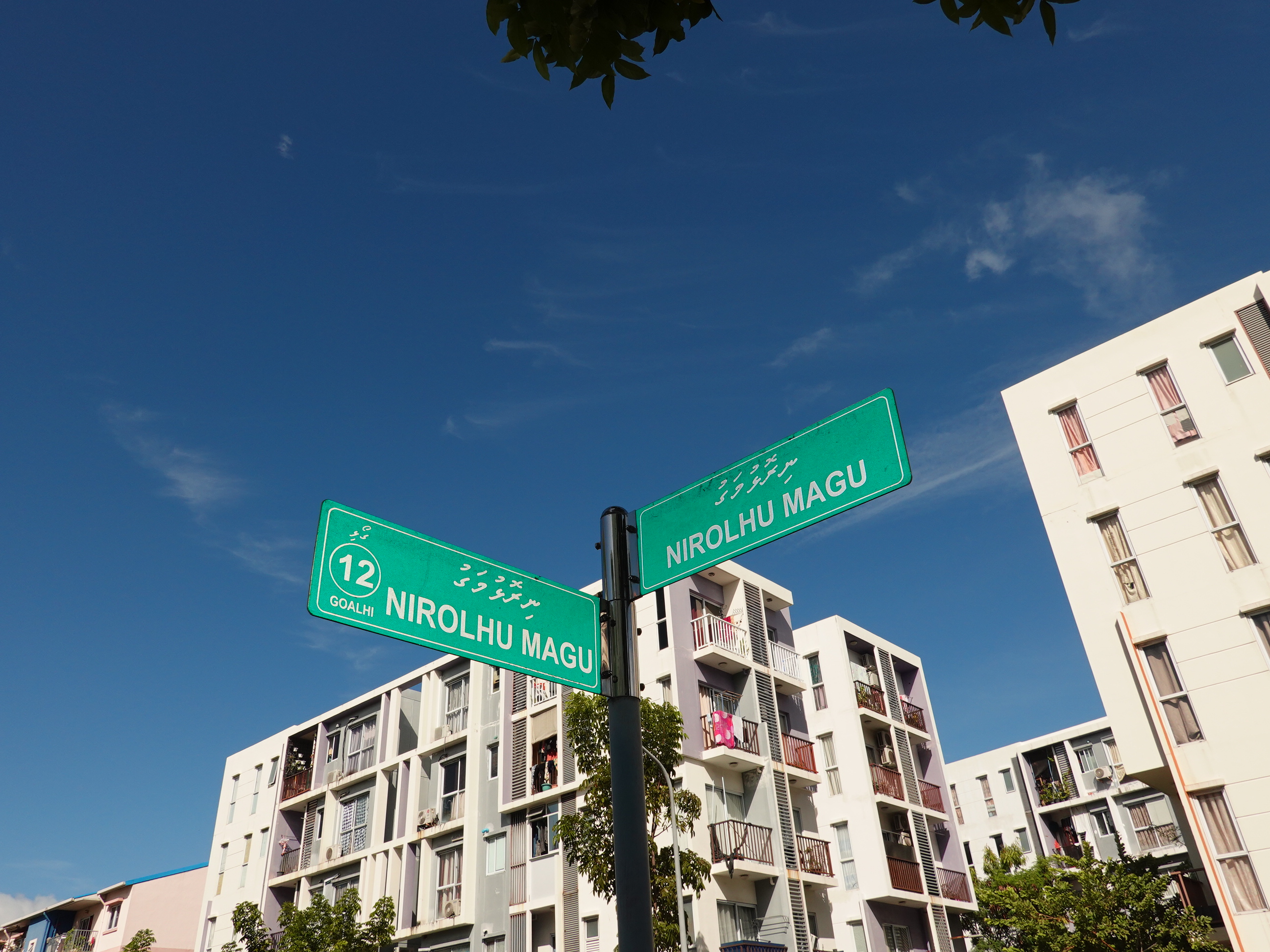
Street signs on Hulhumalé Maldives
- [1] Z. Brown, K. Kendall, E. O’Donnell, L. Tavasi, and N. Seddon, “Nature-based solutions for climate adaptation in small island developing states: A systematic review,” Front. Environ. Sci., Vol.13, Article No.1706713, 2026. https://doi.org/10.3389/fenvs.2025.1706713
- [2] Housing Development Corporation, “Housing Development Corporation (HDC) – Building sustainable communities.” https://www.hdc.mv/ [Accessed January 22, 2026]
- [3] M. M. Husny, “Climate induced migration in Maldives: Preliminary analysis and recommendations,” UNDP, 2021.
- [4] M. Abdul Mohit and M. Azim, “Residents’ satisfaction with public housing in Hulhumale’ area of Male’, Maldives,” Asian J. Environ.-Behav. Stud., Vol.3, No.9, pp. 125-135, 2018. https://doi.org/10.21834/aje-bs.v3i9.302
- [5] A. Sakamoto, M. Maekawa, A. Aslam, A. Laila, K. Kikuchi, T. Kaku, K. Kataoka, M. Matsuda, K. Taiko, and M. Nakayama, “Life satisfaction and migration motivations of the residents of Hulhumalé from Malé and other atolls,” J. Disaster Res., Vol.20, No.1, pp. 15-24, 2025. https://doi.org/10.20965/jdr.2025.p0015
- [6] M. Mohamed, “Historical changes in human-nature interactions in island communities of the Maldives,” Rural South Asian Studies, Vol.1, No.1, pp. 22-36, 2015.
- [7] L. A. Sjaastad, “The costs and returns of human migration,” J. Polit. Econ., Vol.70, No.5, pp. 80-93, 1962. https://doi.org/10.1086/258726
- [8] G. S. Becker, “Human Capital: A Theoretical and Empirical Analysis, With Special Reference to Education,” 2nd ed., University of Chicago Press, 1983.
- [9] A. E. Clark and A. J. Oswald, “Well-being in Panels,” University of Warwick, 2002. http://www2.warwick.ac.uk/fac/soc/economics/staff/academic/oswald/revwellbeinginpanelsclarkosdec2002.pdf [Accessed January 29, 2026]
- [10] B. Kimhur, “How to apply the capability approach to housing policy? Concepts, theories and challenges,” Hous. Theory Soc., Vol.37, No.3, pp. 257-277, 2020. https://doi.org/10.1080/14036096.2019.1706630
- [11] E. S. Lee, “A theory of migration,” Demography, Vol.3, No.1, pp. 47-57, 1966. https://doi.org/10.2307/2060063
- [12] M. Urbański, “Comparing push and pull factors affecting migration,” Economies, Vol.10, Issue 1, Article No.21, 2022. https://doi.org/10.3390/economies10010021
- [13] S. Dias, B. Cruz, S. Luís, P. J. da Palma, and M. P. Lopes, “Professional factors influencing internal migration: A systematic review,” J. Popul. Res., Vol.42, Article No.39, 2025. https://doi.org/10.1007/s12546-025-09390-1
- [14] B. Nowok, M. van Ham, A. M. Findlay, and V. Gayle, “Does migration make you happy? A longitudinal study of internal migration and subjective well-being,” Environ. Plan. A: Economy and Space, Vol.45, No.4, pp. 986-1002, 2013. https://doi.org/10.1068/a45287
- [15] A. Ferrer-i-Carbonell and P. Frijters, “How important is methodology for the estimates of the determinants of happiness?,” Econ. J., Vol.114, No.497, pp. 641-659, 2004. https://doi.org/10.1111/j.1468-0297.2004.00235.x
- [16] G. Norman, “Likert scales, levels of measurement and the ‘laws’ of statistics,” Adv. Health Sci. Educ., Vol.15, pp. 625-632, 2010. https://doi.org/10.1007/s10459-010-9222-y
This article is published under a Creative Commons Attribution-NoDerivatives 4.0 Internationa License.