
Paper:
Comparing Perspectives on Artificial Island Development: Surveys from Majuro General Population and College of the Marshall Islands Students
Jennifer Seru*, Mylast Bilimon*, and Mikiyasu Nakayama**,†

*College of the Marshall Islands
PO Box 1258, Majuro 96960, Republic of the Marshall Islands
**Global Infrastructure Fund Research Foundation Japan
Tokyo, Japan
†Corresponding author

This comparative cross-sectional survey study examines perceptions of climate change adaptation in the Republic of the Marshall Islands (RMI) by comparing College of the Marshall Islands (CMI) students (n=99) with general RMI citizens (n=150). Perceptions were assessed using 37 survey items addressing current satisfaction, migration attitudes, perceptions of artificial islands, and policy preferences. Using Mann–Whitney U tests, the analysis revealed statistically significant differences in 16 items (43.2%, p<0.05), with notable effect sizes (rank-biserial correlation, r) indicating distinct generational and educational perspectives. CMI students demonstrated significantly higher expectations for lifestyle continuity on artificial islands (r=0.42), greater satisfaction with healthcare quality (r=0.40) and government climate measures (r=0.31), stronger community involvement as part of identity (r=0.30), and more positive views toward emigration and cultural retention abroad. In contrast, citizens reported feeling more constrained by family and community obligations, held stronger expectations for return migration (r=-0.27), and showed greater support for “Right to Stay” policies, reflecting deeper place attachment and social responsibility considerations. Despite these differences, both groups converged on supporting diverse adaptation strategies. These findings elucidate the complexity of climate adaptation planning in small island states, highlighting the need for differentiated communication strategies and balanced policy portfolios that address technological solutions, migration preparedness, cultural preservation, and varying generational perspectives. Effective adaptation policies must acknowledge these perceptual differences while building on areas of consensus. Such policies should serve to unite rather than fragment Marshallese society as it faces existential climate threats.
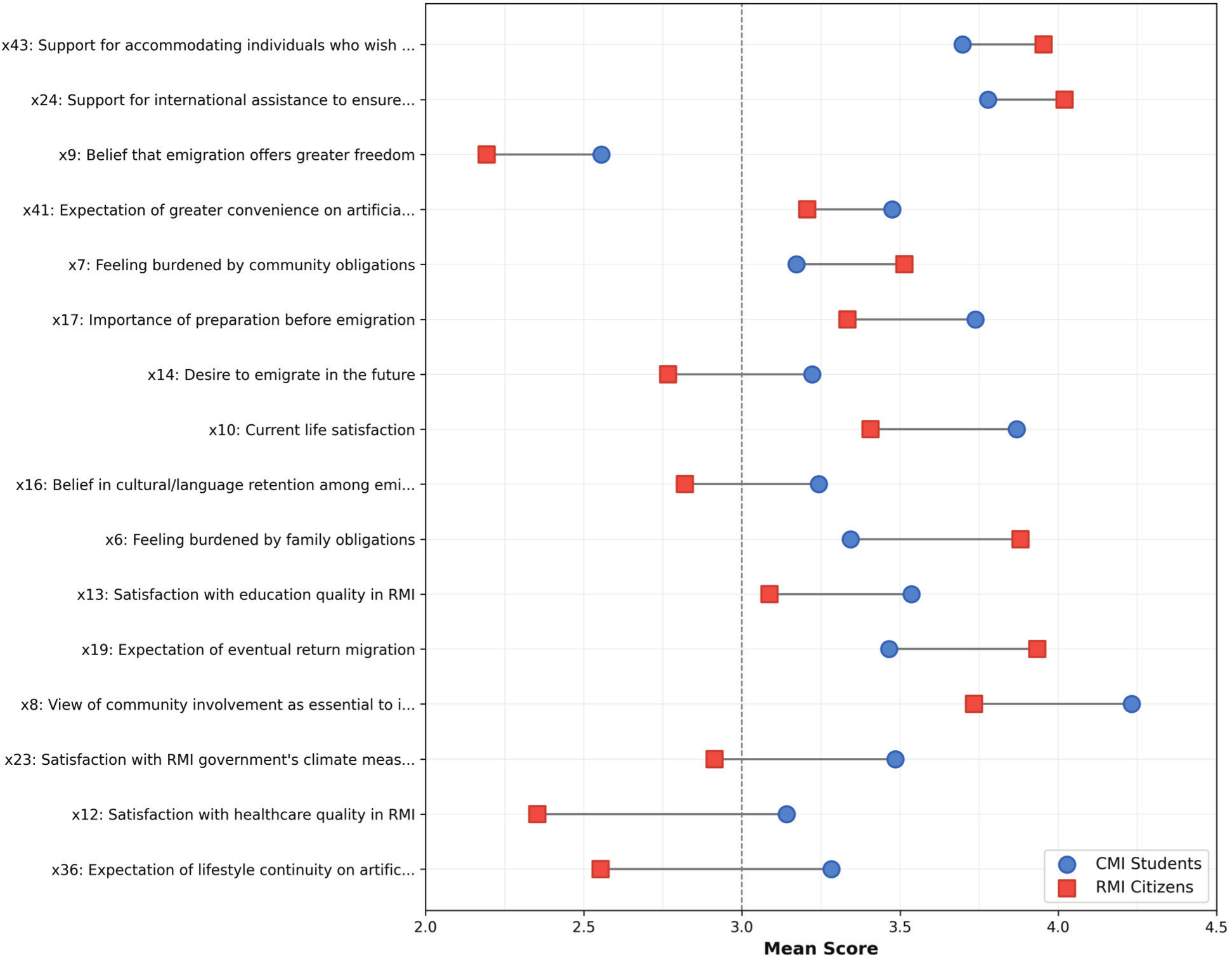
Student-citizen differences in 16 items
- [1] L. A. Nurse et al., “Small islands,” V. R. Barros et al. (Eds.), “Climate Change 2014: Impacts, adaptation, and vulnerability. Part B: Regional aspects,” Contribution of Working Group II to the Fifth Assessment Report of the Intergovernmental Panel on Climate Change, pp. 1613-1654, Cambridge University Press, 2014.
- [2] C. D. Storlazzi et al., “Most atolls will be uninhabitable by the mid-21st century because of sea-level rise exacerbating wave-driven flooding,” Science Advances, Vol.4, No.4, Article No.eaap9741, 2018. https://doi.org/10.1126/sciadv.aap9741
- [3] M. Hess, S. Moorhead, and M. Gaver, “Marshallese COFA migrants in Arkansas,” Northwestern Arkansas Council, 2020.
- [4] J. Barnett and S. J. O’Neill, “Islands, resettlement and adaptation,” Nature Climate Change, Vol.2, No.1, pp. 8-10, 2012. https://doi.org/10.1038/nclimate1334
- [5] C. Farbotko and H. Lazrus, “The first climate refugees? Contesting global narratives of climate change in Tuvalu,” Global Environmental Change, Vol.22, Issue 2, pp. 382-390, 2012. https://doi.org/10.1016/j.gloenvcha.2011.11.014
- [6] M. Burkett, “The nation ex-situ: On climate change, deterritorialized nationhood and the post-climate era,” Climate Law, Vol.2, No.3, pp. 345-374, 2011. https://doi.org/10.1163/cl-2011-040
- [7] J. McAdam, “Climate change, forced migration, and international law,” Oxford University Press, 2012. https://doi.org/10.1093/acprof:oso/9780199587087.001.0001
- [8] K. E. McNamara and C. Gibson, “‘We do not want to leave our land’: Pacific ambassadors at the United Nations resist the category of ‘climate refugees’,” Geoforum, Vol.40, Issue 3, pp. 475-483, 2009. https://doi.org/10.1016/j.geoforum.2009.03.006
- [9] M. Nakayama et al., “Alternatives for the Marshall Islands to cope with the anticipated sea level rise by climate change,” J. Disaster Res., Vol.17, No.3, pp. 315-326, 2022. https://doi.org/10.20965/jdr.2022.p0315
- [10] M. Nakayama, J. Seru, C. Vila, M. Bilimon, R. Fujikura, A. Sakamoto, and M. Sato, “Artificial island construction as an instrument for the right to stay: Case of the Marshall Islands,” J. Disaster Res., Vol.20, No.1, pp. 44-52, 2025. https://doi.org/10.20965/jdr.2025.p0044
- [11] S. Brown et al., “Pathways to sustain atolls under rising sea levels through land claim and island raising,” Environmental Research: Climate, Vol.2, No.1, Art No.015005, 2023. https://doi.org/10.1088/2752-5295/acb4b3
- [12] A. Sakamoto, K. Nishiya, X. Guo, A. Sugimoto, W. Nagasaki, and K. Doi, “Mitigating impacts of climate change induced sea level rise by infrastructure development: Case of the Maldives,” J. Disaster Res., Vol.17, No.3, pp. 327-334, 2022. https://doi.org/10.20965/jdr.2022.p0327
- [13] A. Sakamoto et al., “Life satisfaction and migration motivations of the residents of Hulhumalé from malé and other atolls,” J. Disaster Res., Vol.20, No.1, pp. 15-24, 2025. https://doi.org/10.20965/jdr.2025.p0015
- [14] M. Maekawa, R. A. Raheem, A. Khalid, A. Sakamoto, M. Nakayama, D. Sasaki, and H. Okaniwa, “Motivations for voluntary migration to Hulhumalé in the context of climate change,” J. Disaster Res., Vol.20, No.1, pp. 25-36, 2025. https://doi.org/10.20965/jdr.2025.p0025
- [15] S. Brown, M. P. Wadey, R. J. Nicholls, A. Shareef, Z. Khaleel, J. Hinkel, D. Lincke, and M. V. McCabe, “Land raising as a solution to sea–level rise: An analysis of coastal flooding on an artificial island in the Maldives,” J. of Flood Risk Management, Vol.13, Issue S1, Article No.e12567, 2020. https://doi.org/10.1111/jfr3.12567
- [16] J. Barnett and W. N. Adger, “Climate dangers and atoll countries,” Climatic Change, Vol.61, No.3, pp. 321-337, 2003. https://doi.org/10.1023/B:CLIM.0000004559.08755.88
- [17] J. A. Tobin, “Land tenure in the Marshall Islands,” J. A Tobin, J. L. Fischer, and R. G. Emerick (Eds.), “Land tenure patterns: Trust Territory of the Pacific Islands (Vol. 1),” Office of the High Commissioner, Trust Territory of the Pacific Islands, 1958.
- [18] K. Jetnil-Kijiner, “Iep jāltok: Poems from a Marshallese daughter,” University of Arizona Press, 2014.
- [19] J. Campbell, “Climate-change migration in the Pacific,” The Contemporary Pacific, Vol.26, No.1, pp. 1-28, 2014. https://doi.org/10.1353/cp.2014.0023
- [20] H. Lazrus, “Sea change: Island communities and climate change,” Annual Review of Anthropology, Vol.41, pp. 285-301, 2012. https://doi.org/10.1146/annurev-anthro-092611-145730
- [21] P. D. Nunn, A. Kohler, and R. Kumar, “Linked migrations and disasters: Lessons from the Pacific,” Asian and Pacific Migration J., Vol.23, Issue 4, pp. 441-465, 2014. https://doi.org/10.1177/011719681402300404
- [22] J. Campbell and R. Bedford, “Migration and climate change in Oceania,” E. Piguet and F. Laczko (Eds.), “People on the move in a changing climate: The regional impact of environmental change on migration,” pp. 177-204, Springer, 2014. https://doi.org/10.1007/978-94-007-6985-4_8
- [23] J. T. Locke, “Climate change-induced migration in the Pacific region: Sudden crisis and long-term developments,” The Geographical J., Vol.175, No.3, pp. 171-180, 2009. https://doi.org/10.1111/j.1475-4959.2008.00317.x
- [24] J. Barnett and J. Campbell, “Climate change and small island states: Power, knowledge and the South Pacific,” Earthscan, 2010. https://doi.org/10.4324/9781849774895
- [25] L. M. Carucci, “Nuclear nativity: Rituals of renewal and empowerment in the Marshall Islands,” Northern Illinois University Press, 1997.
- [26] H. M. Barker, “Bravo for the Marshallese: Regaining control in a post-nuclear, post-colonial world,” Wadsworth Cengage Learning, 2012.
- [27] Republic of the Marshall Islands, “Republic of the Marshall Islands National Adaptation Plan,” Office of the President, 2023. https://rmigov.com/RMI-NAP-2023.pdf [Accessed January 5, 2026]
This article is published under a Creative Commons Attribution-NoDerivatives 4.0 Internationa License.