
Paper:
From Resistance to Community Gratitude: The Case of the Leyte Tide Embankment Project, Philippines
Ladylyn L. Mangada†

University of the Philippines Tacloban College
Magsaysay Boulevard, Tacloban, Leyte 6500, Philippines
†Corresponding author

Coastal communities in the Philippines remain highly vulnerable to climate-induced hazards, as demonstrated by the devastation of Super Typhoon Haiyan (Yolanda) in 2013. In Leyte, one of the worst-affected provinces, the state-led construction of the tide embankment became a focal point of post-disaster rehabilitation. This study explored how survivors living along the embankment interpreted and reinterpreted its meaning over time, tracing a shift from resistance to conditional gratitude. Drawing on key informant interviews conducted from September to December 2024 with fisherfolk, small business owners, and community leaders in Tacloban and the surrounding municipalities, the study identified early sources of resistance: limited information, lack of consultation, scientific disconnect, and fears of displacement and livelihood loss. Initially perceived as an exclusionary structure imposed without community input, the embankment later gained legitimacy as it reduced flooding, restored confidence, and signaled state recognition. However, gratitude remained rooted in tangible improvements to safety and livelihoods. The findings demonstrate that disaster infrastructures are not neutral technical solutions but evolving social and political objects. They gain legitimacy through lived experience, as communities reinterpret them within narratives of safety, recovery, and resilience. This study contributes to the debate on disaster governance by showing how infrastructures embody infrastructural citizenship and the politics of resilience, where trust is earned rather than given. Policy implications highlight the need for inclusive consultation, accessible risk communication, and livelihood-sensitive planning to ensure that protective infrastructures are both effective and socially legitimate.
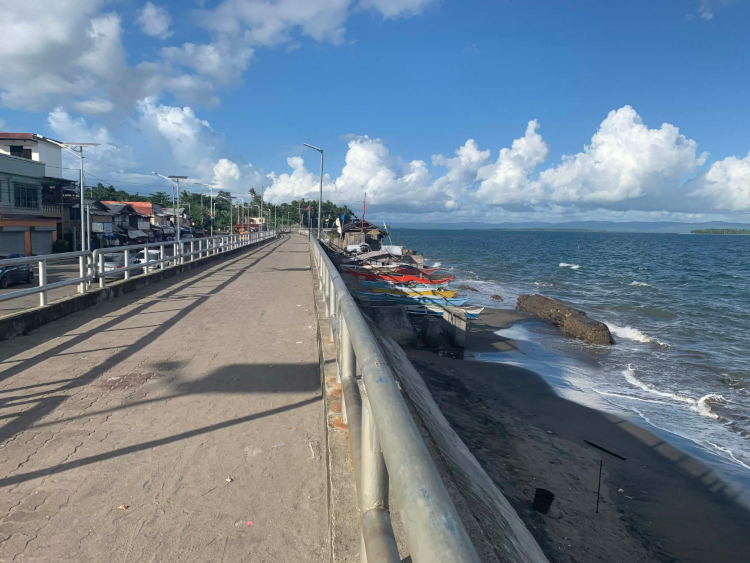
From Risk to Resilience
1. Introduction
The Philippines, an archipelagic nation highly exposed to climate hazards, has long relied on both community-based adaptation strategies and state-led infrastructures to mitigate risks. Among the most vulnerable areas is Leyte, whose coastal communities bore the brunt of Super Typhoon Haiyan (Yolanda), one of the strongest recorded tropical cyclones, in 2013. The disaster not only resulted in massive loss of lives and property but also reshaped discourses on disaster risk governance, infrastructural resilience, and community–state relations. In the aftermath, the construction of large-scale protective infrastructures, such as the tide embankment in Leyte, became a central feature of state-led rehabilitation efforts 1,2,3.
However, post-disaster infrastructures are rarely welcomed uncritically. Scholarship on disaster politics and critical infrastructure highlights how protective structures operate not only as technical interventions but also as political and cultural artifacts that reorganize space, authority, and everyday life 4,5. In Leyte, the tide embankment initially provoked resistance from residents, which was linked to fears of displacement, livelihood disruption, and technocratic decision-making. Local studies underscore that many post-Haiyan reconstruction efforts in Tacloban and nearby towns prioritized engineering solutions and rapid implementation over community consultation, reproducing tensions between state agencies and affected populations 1,2,3.
Long-term research on the post-Haiyan recovery has shown that community perceptions of state-led interventions evolved over time. Drawing on a longitudinal study of low-income households at relocation sites, Iuchi demonstrated how residents gradually developed adaptive strategies that reshaped their sense of security, mobility, and relationship with state planning 6. This perspective resonates with the present study’s focus on how coastal survivors re-signified the tide embankment from an initially threatening imposition to a source of conditional protection through everyday experience and adjustment.
While several scholars have examined post-disaster reconstruction and residential satisfaction among relocated communities in Tacloban North and neighboring municipalities, such as Hadlos on participation and satisfaction 7 and Pormon et al. on living conditions in resettlement areas, these works primarily assessed the experiences of households moving inland 8. By contrast, this study focused on coastal households that remained in place and were directly affected by the construction of large-scale protective infrastructure. Rather than evaluating relocation outcomes, this study foregrounded how such residents interpreted, contested, and eventually accepted state-sponsored infrastructure situated within their living spaces, a dimension not yet fully explored in the existing literature.
The tide embankment carried layered meanings for the survivors of Haiyan in Tacloban. To some extent, it symbolized exclusion, as families were relocated away from coastal areas central to their livelihoods. To others, it represented state authority imposed with limited community input. However, as the years passed and recurrent flooding was mitigated, many residents began to reinterpret the structure as a protective shield. Expressions of gratitude have emerged alongside lingering ambivalence, reflecting the complex ways survivors negotiate memory, risk, and belonging 2,9. This shift from resistance to gratitude illustrates the dynamic interplay between risk perception, state authority, and local agencies.
Philippine research on resilience narratives suggests that disaster-affected communities adaptively reinterpret infrastructure by incorporating it into local imaginaries of safety, hope, and recovery 2,9. Today, the tide embankment stands not only as a barrier against storm surges but also as a foundation for renewed hope. Fishermen who once feared the sea now feel more secure, store owners venture to expand their businesses, and entrepreneurs discover opportunities where there was once only risk. In this manner, the structure became a quiet partner in community resilience. In many instances, gratitude is shaped by tangible outcomes. No longer merely a wall, the tide embankment has become a witness to recovery, a platform for growth, and a symbol of what governance can achieve when it adaptively responds to protect its people.
This study examined Leyte’s tide embankment as a site of negotiation between state-driven post-disaster recovery initiatives and community responses. Specifically, it traced the transition from contestation to recognition, situating local narratives within broader theoretical discussions on disaster risk governance, infrastructural citizenship, and resilience politics. By foregrounding community voices, this study contributes to a deeper understanding of how disaster infrastructure is contested, re-signified, and eventually embedded in the collective imaginaries of safety and recovery.
Building on these insights, this study employed key informant interviews with survivors residing along the tide embankment in Tacloban and nearby coastal communities. Their narratives illuminate how perceptions of the embankment evolved over time, moving from initial resistance rooted in displacement and exclusion to emerging expressions of gratitude linked to security and recovery. To capture this shift, the analysis was organized into two thematic sections: Resistance and Gratitude.
2. Methodology
Key informant interviews were conducted with survivors living along the tide embankment, including fisherfolk, small business owners, and community leaders. This method was selected to foreground residents’ lived experiences and meaning-making processes, providing depth and nuance beyond policy documents or official narratives.
2.1. Research Design
This research employed a qualitative case study design to examine community perceptions of the tide embankment in Tacloban and nearby municipalities. A case study approach was chosen because it allowed for an in-depth exploration of how a specific disaster infrastructure, such as the tide embankment, was interpreted, contested, and re-signified by affected residents. Qualitative methods enable researchers to capture narratives and meaning-making processes that are not always visible in policy reports or technical assessments.
2.2. Data Collection
Primary data were collected through key informant interviews (KIIs) and focus group discussions (FGDs) conducted between September and December 2024 in Tacloban City and adjacent municipalities, where segments of the tide embankment traverse coastal barangays.(1) Thirty KIIs were completed with fisherfolk, small business owners, barangay officials, and community leaders. The participants represented a broad range of age groups (25–70 years) and included 17 women and 13 men, enabling the study to capture gendered and generational perspectives on the embankment.
To complement the individual interviews, four FGDs were conducted—two in Tacloban, one in Palo, and one in Tanauan—with 38 participants. Each FGD comprised 8–12 participants, including mixed groups of men, women, and youths. These group discussions generated collective reflections on shared experiences of displacement fear, livelihood adjustments, and changes in perceptions of flooding and safety.
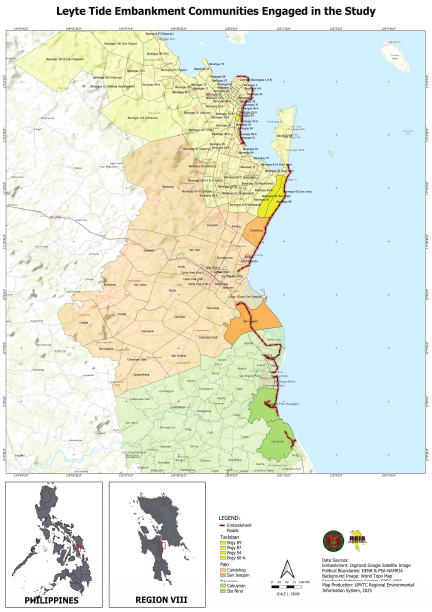
Participants were identified through purposive sampling with referrals from local leaders and civil society networks to ensure representation across livelihood groups, genders, and age cohorts. Interviews were conducted in Waray-Waray or Filipino, depending on participant preferences, and were later transcribed and translated into English. Ethical protocols were observed throughout the study. Informed consent was obtained from all respondents, confidentiality was maintained, and selected participants were invited for member checking to validate the interpretations. Fig. 1 presents a map of the Tacloban–Palo–Tanauan coastal corridor, marking the barangays where FGDs and KIIs were conducted: Barangay 54, Barangay 60A, Barangay 87, and Barangay 89 for Tacloban; Candahug and San Joaquin for Palo; and Sto. Niño and Cabuynan for Tanauan.
 Source: University of the Philippines Visayas Tacloban College-Regional Environmental Information System
Fig. 1. Map of the Tacloban–Palo–Tanauan coastal corridor.
2.3. Data Analysis
The interview transcripts were coded thematically using an inductive–deductive approach. The initial coding categories reflected the conceptual framing of the study, particularly resistance and gratitude. Within these categories, the following subthemes emerged:
-
Resistance: Lack of consultation, information vacuum, scientific disconnect, displacement fears, livelihood disruption, and distrust of state promises.
-
Gratitude: Reduced flooding, safer nights, restored confidence in reinvestment, symbolic recognition by the state, and resilience narratives.
Coding was conducted manually. Transcripts were reviewed multiple times, with codes recorded in analytic memos and organized into clusters of related themes. This iterative process allowed for the identification of both divergence and convergence across participant groups while preserving the narrative richness of survivor accounts. Patterns were examined not only for recurrence but also for how participants explained shifts in meaning over time from initial resistance to conditional gratitude.
2.4. Trustworthiness and Limitations
Several strategies were employed to ensure research rigor. Triangulation was achieved by comparing the perspectives of fisherfolk, business owners, relocated families, and local leaders. Member checking with a subset of participants validated the credibility of the interpretations. Reflexivity was maintained by documenting the researcher’s positionality and potential biases, particularly given the sensitivity of the post-disaster narratives.
This study has some limitations. The findings are context specific and reflect the experiences of communities adjacent to the tide embankment. They may not be generalizable to other disaster infrastructures in the Philippines. Nonetheless, the depth of the qualitative evidence provides insights into the evolving politics of disaster governance and contributes to comparative debates on resilience and infrastructural citizenship.
3. Framework for Analysis
This study examined the evolving community perceptions of the tide embankment in Leyte, Philippines, initially marked by resistance and later characterized by gratitude, through the intersecting lenses of disaster governance, infrastructural citizenship, and resilience politics. These concepts provide a framework for understanding how protective infrastructure, not merely a technical intervention, is a deeply political artifact that shapes state–citizen relations, community identity, and safety performance.
3.1. Disaster Governance of the Politics of Protection
Disaster risk governance refers to the institutions, policies, and practices through which hazards and vulnerabilities are managed 10. In the Philippine context, governance has often relied on technocratic, engineering-centric approaches that prioritize physical protection while marginalizing community participation 1,11. Although such interventions may reduce exposure to hazards, they can also generate new forms of risk and tension, particularly when communities are displaced or livelihoods are disrupted.
Existing research provides an important foundation for understanding these dynamics. Blanco 12 highlighted persistent coordination challenges and institutional fragmentation in Philippine disaster governance, emphasizing the political struggles that shape post-disaster interventions. Similarly, natural hazard governance in the Philippines reflected overlapping mandates, uneven local capacities, and the predominance of centralized decision-making 13. Later work examined the Office of the Presidential Adviser for Reconstruction and Rehabilitation (OPARR) as a case of post-Haiyan recovery governance, demonstrating how institutional learning and bureaucratic negotiations shaped reconstruction outcomes 14.
While these studies foreground institutional arrangements and national-to-local governance challenges, this study offers a distinct perspective by shifting the analytical attention to a community-level interpretation of large-scale protective infrastructure. Rather than focusing solely on coordination or policy design, this study examined how the tide embankment, conceived as a technical intervention, became a political object in everyday life. This grounded, perception-based lens reveals how residents negotiate the “politics of protection”: how they judge legitimacy, interpret state intent, and reassess risk over time.
The tide embankment exemplifies this dynamic: Initially conceived as a technical solution to storm surges, it has become a site of contestation, revealing how protective infrastructure embodies unequal power relations and competing visions of safety 5. Resistance emerged not only in response to material impacts but also as a critique of exclusionary governance practices. This phase underscores the political nature of disaster infrastructure, in which legitimacy is questioned when communities are excluded from decision-making processes.
3.2. Infrastructural Citizenship
Infrastructures are more than physical systems; they are instruments of political and social ordering 15. The concept of infrastructural citizenship captures how infrastructure mediates the ways in which people claim rights, express grievances, and negotiate belonging 16,17. In Leyte, community resistance to the tide embankment functioned as a demand for recognition and the assertion of voice, local knowledge, and participatory rights.
Over time, as the embankment demonstrated protective value, gratitude emerged as a form of conditional recognition. Communities began to affirm the state’s role not because of its authority but because the infrastructure delivered tangible security. This shift illustrates how infrastructure has become an arena of negotiation, where legitimacy is earned through lived outcomes rather than through top-down governance. Thus, infrastructural citizenship provides a lens through which to understand how the embankment transitioned from being a symbol of exclusion to a partner in resilience.
3.3. Resilience Politics and Conditional Gratitude
Resilience, once celebrated as a normative goal in disaster studies, has been increasingly criticized for its political implications. Scholars argue that resilience often reflects contested values and power relations, placing the burden of adaptation on communities without addressing structural vulnerabilities 18,19,20,21. However, resilience can also be a site of negotiation in which communities reinterpret risk and governance through their lived experiences.
In Leyte, survivor gratitude was pragmatic, contingent, and dependent on the embankment’s capacity to reduce flooding, restore confidence, and support livelihoods. This aligns with Gibson’s account of “narratives of resilience” in Tacloban, where communities evaluated interventions based on tangible improvements to daily life. Gratitude, in this context, was political; it signaled the acceptance of governance only when outcomes aligned with community needs 9.
By situating gratitude within the politics of resilience, this study emphasizes that infrastructure gains legitimacy not at the moment of construction but through the ongoing performance of protection. Communities assess governance through outcomes that materially shape their recovery, and reframe infrastructures as both technical and symbolic resources in the pursuit of safety and belonging.
4. Findings
4.1. Resistance to the Tide Embankment
At its inception, the tide embankment was introduced as a crucial state-led defense against future storm surges. However, for many coastal survivors in Tacloban and neighboring barangays, the project was received less as a promise of safety than as an unwelcome intrusion. Far from being perceived as a safeguard, the structure was initially viewed as a top-down intervention planned, decided, and executed without the participation of those whose lives it would most affect.
Four interrelated sources of resistance emerged from the narratives of residents and fisherfolk: (1) information vacuum and scientific disconnect, (2) procedural exclusion, (3) disruption of livelihoods and cultural ties to the sea, and (4) lingering doubts about protection and state promises. Resistance did not take a uniform form. Although skepticism was widespread during the construction phase, its intensity and framing varied across livelihood groups and local positions. Fisherfolk emphasized disruptions to daily work and access to the coast; small business owners highlighted economic uncertainty and reduced customer flow; and barangay officials often expressed ambivalence, attempting to reconcile technical assurances from government agencies with community anxieties. These differentiated experiences underscore that resistance was shaped by uneven exposure to disruption and by residents’ positional relationships with both the project and state.
4.1.1. Information Vacuum and Scientific Disconnect
Residents repeatedly emphasized that the lack of accessible and understandable information about the embankment’s design and function deepened their mistrust. Technical explanations were often delivered through engineering drawings and jargon that were difficult for lay audiences to interpret. In the absence of clear communication, rumors circulated regarding displacement, environmental damage, and land loss, thereby amplifying fear and uncertainty. As one community elder reflected:
“They showed us papers with drawings, but we did not understand. Nobody explained how this wall will really stop another Yolanda. It was hard to trust.”
This information gap created a scientific disconnect between technical experts and residents, weakening confidence in official safety assurances and reinforcing perceptions of exclusion from decision-making.
4.1.2. Procedural Exclusion and the Lack of Consultation
Procedural exclusion further intensified the resistance. Many survivors described being “informed, not engaged,” with consultations occurring after key decisions had already been made. Residents felt sidelined by processes that directly reshaped their homes, mobility, and livelihoods.
A fisherfolk respondent expressed the following:
“We were not asked. One day they said there will be a wall, and then they started building. For us who live by the sea, it felt like our lives were decided without us.”
This experience reinforces the existing mistrust of government interventions, particularly among households recovering from earlier post-Haiyan relocation efforts. Resistance thus functioned as a demand for recognition and inclusion, rather than a rejection of protection itself.
4.1.3. Livelihood and Cultural Disruptions
Livelihood disruption added material weight to residents’ opposition. Fisherfolk reported restricted access to traditional fishing areas and difficulties in drying nets, whereas small vendors described a decline in foot traffic and income during construction. For many families, these disruptions were not merely economic but also cultural, severing long-standing ties to the coast.
As one resident lamented:
“My father and grandfather fished here. Now we are told we cannot dry our nets near the shore. The wall is not just concrete—it blocks our way of life.”
A store owner similarly observed the economic toll:
“Before, people would pass through the coastal road to buy goods. During construction, our sales dropped. It felt like the government cared more about the wall than about the people who live here.”
These accounts highlight how infrastructure designed to reduce hazard exposure can simultaneously produce new vulnerabilities, particularly when livelihood concerns are insufficiently addressed.
4.1.4. Lingering Doubts About State Protection and Promises
Even among residents who did not openly resist the project, quiet anxieties persisted. The trauma of Super Typhoon Haiyan remained vivid, shaping how people evaluated the protective claims about the embankment.
As one survivor reflected:
“They said this will save us from another Yolanda, but who can guarantee that? We lost everything once. A wall cannot erase that fear.”
Taken together, these narratives show that resistance was less a rejection of safety than a critique of governance, an expression of disenchantment with a process that silenced community voices while claiming to protect them. The tide embankment became not merely a physical structure but also a political artifact that materialized the distance between state authority and citizens’ experience. As Howe et al. noted, infrastructure carries political weight not only through what it builds but also through the social fractures it produces 4. In Tacloban, early resistance reflected this tension: protection without participation, and safety promised without trust.
4.2. Gratitude Toward the Tide Embankment
Narratives of gratitude toward the tide embankment did not emerge immediately after its construction. Instead, appreciation developed gradually through repeated encounters with storm events, during which residents observed reduced flooding and calmer coastal conditions. These experiences prompted a reassessment of earlier skepticism, particularly among households that had directly experienced improved safety and stability. Importantly, expressions of gratitude remained uneven and conditional, reflecting differences in livelihood exposure and ongoing concerns about the durability and long-term effectiveness of the embankment.
The residents frequently described the embankment as restoring peace of mind. Whereas heavy rain once meant sleepless nights and constant vigilance, the structure offered a renewed sense of security.
“I am grateful that the embankment was built. For us who live right by the sea, it offers great protection whenever the weather turns bad. Even during storms, the shoreline sand is pushed back toward the sea, so when the waves reach us, they are no longer as strong.”
“The tide embankment means a lot to us. Even when storms come, it keeps our houses safe—the sea water and debris no longer enter our community like before.”
“I’m very happy that we now have a tide embankment here because it really helps us who live along the shoreline.”
For fisherfolk, reduced wave impacts meant safer nights and more predictable routines. For small business owners, protection translated into confidence in reinvesting and expanding.
“When the wall was finished, I added a small extension to my store. I thought maybe now it would be safe to invest again.”
“The waves don’t reach our area directly anymore. It can control waves and prevent a storm surge.” (Barangay chair)
However, gratitude was expressed with caution. Many residents emphasized that appreciation depended on the continued effectiveness of the embankments.
“The tide embankment really helps us a lot. When there’s a storm now, it doesn’t damage the houses or business structures anymore, since debris from other places can’t get into our area.”
Gratitude also had important conditional qualities. Residents remained aware of the wall’s limitations, emphasizing that gratitude depended on its ability to continue delivering protection and stability. As one community leader observed, gratitude was tied to visible outcomes, not official rhetoric. People would trust the wall only as long as it proved itself against future risks.
“The tide embankment is good because it really helps us avoid problems when there’s a storm or flooding. It protects us.”
“The waves don’t hit our area directly anymore. Before the tide embankment was built, the waves would easily reach and even cross the highway. Now, they don’t.” (Barangay health workers)
Gratitude toward the tide embankment was thus pragmatic and negotiated, rooted in what the structure enabled rather than what it symbolized. Survivors articulated their thanks not in abstract terms of government benevolence but in recognition of the tangible benefits: safer nights, reduced flooding, and renewed confidence in rebuilding homes and businesses.
“We are thankful not because the government said we should be, but because now we can sleep soundly when the rain is strong.” (Residents, Tacloban)
“The tide embankment is a great help because it takes away our fear. My only concern is whether it is truly strong enough—so far it has held, and I hope it remains durable.”
“It is actually better now because there is already a designated place for pulling in the boats.” (Pedicab driver and fisherman)
Over time, as the tide embankment demonstrated its protective function, the residents began to reframe their relationship to the embankment. For many, gratitude was rooted in outcomes such as reduced flooding, greater peace of mind, and renewed confidence in rebuilding their lives.
“Before, every strong rain kept us awake, watching the sea. Now, with the wall, I can finally sleep without fear that the water will reach us in the night.” (Fisherfolk, Tacloban)
“I am in favor of the tide embankment because it ensures our safety here. Without it, seawater would likely already be flooding the road. I support it since it provides us significant protection, especially during high tides and strong waves.” (Fisherman and construction worker)
Small business owners also recognized how protection from storm surges enabled them to take risks in expanding their livelihoods. The structure symbolized stability and opportunity rather than loss.
“When the wall was finished, I added a small extension to my store. I thought, maybe now it is safe to invest again. I see the embankment as a partner—it gives me courage.” (Store owner)
“When I see the wall, I don’t just see cement. I see a chance for us to move forward. It means the government remembered us.” (Young entrepreneur)
In some cases, gratitude was expressed as cautious optimism, balancing the memories of Haiyan with the recognition of the present safety:
“Of course, we can never forget what happened. But at least this wall shows that something has changed. It protects us, and that protection gives us hope.” (Community leader, coastal barangay)
“For those of us living right along the roadside, the tide embankment is a great help. During bad weather, when the sea becomes rough, without the seawall the water would likely already reach our homes.” (Barangay official)
These narratives illustrate that gratitude is pragmatic, rather than symbolic. Residents did not frame appreciation as deference to state authority but as recognition of tangible outcomes—reduced flooding, safer homes, and renewed confidence to remain in place. These accounts reveal how gratitude emerged as the embankment became embedded in everyday practices of living, working, and planning for the future. As Gibson argues, infrastructure accrues meaning through experience; in this case, the tide embankment shifted from being a contested project to a symbol of recovery, protection, and adaptive governance 9.
Discussion on Gratitude
The shift from resistance to gratitude reflects a negotiated meaning-making process rather than a simple change in opinion. As residents observed the embankment’s performance over time, many recalibrated their expectations regarding safety and governance. Gratitude emerged from experiential validation rather than from initial trust. Expressions of gratitude emerged, but this gratitude was not unconditional; it was earned through outcomes. Residents came to value the embankment because it tangibly reduced flooding, restored their sense of safety, and created the conditions for livelihood recovery. In this sense, gratitude functioned less as an expression of compliance with state authority and more as a pragmatic recognition of protection that works.
This outcome-driven gratitude reflects what Gibson 9 calls narratives of resilience, wherein disaster survivors reinterpret infrastructure through lived experiences rather than official rhetoric. For fisherfolk, the embankment meant nights of uninterrupted sleep; for small business owners, it meant confidence to reinvest; and for community leaders, it symbolized a fragile but real shift toward safety. However, memories of Haiyan remained, reminding residents that no infrastructure could fully guarantee safety 22.
The conditional nature of gratitude emphasizes the political nature of resilience. As scholars argue, resilience is not a neutral state but a negotiated process shaped by power relations, governance practices, and community expectations 18,19,20,21. In Leyte, residents granted legitimacy to the tide embankment only when it aligned with their daily aspirations for security and survival. This highlights an important dimension of infrastructural citizenship: communities respond not only to the promises of governance but also to the material outcomes that infrastructures deliver 15.
In this sense, gratitude toward the tide embankment represents the active resignification of an imposed structure. The embankment was no longer perceived solely as an external project of governance but became embedded in everyday practices of living, working, and planning for the future. Through lived outcomes, residents localized their meaning, transforming a contested intervention into a conditional partner in resilience.
5. Integrative Discussion
The case of the tide embankment in Tacloban City and its neighboring communities illustrates how perceptions of protective infrastructure evolve from resistance rooted in distrust and exclusion to gratitude grounded in safety and adaptation. This transformation reflects both the material and symbolic dimensions of disaster governance: infrastructures as contested artifacts of power and, eventually, as instruments of everyday resilience.
During the early phase of the project, residents expressed strong opposition to the construction of the tide embankment. Their resistance stemmed less from a rejection of safety than from perceived political and procedural inequities in its implementation. Many described the project as imposed from above, with minimal consultation or consideration of coastal livelihoods. This pattern aligns with the disaster politics framework of Pelling and Dill, which highlights how post-disaster interventions often become arenas where state authorities and community agency collide 23.
Fears of relocation and restricted sea access framed the embankment as a site of infrastructural contestation 15. It symbolized the asymmetries of disaster governance—visible protection for the city yet disruption for those most exposed. Thus, resistance functioned both as a practical defense of livelihood and as a political critique of technocratic governance, asserting that resilience could not be engineered through coercion or exclusion.
However, over time, the meaning attached to the embankment shifted. Residents began to appreciate its protective function, particularly during typhoons and high tides. One resident stated, “I am grateful that the embankment was built. For us who live right by the sea, it offers great protection whenever the weather turns bad.” Another added, “It takes away our fear. My only concern is whether it is truly strong enough.”
These narratives exemplify the politics of resilience, in which communities adapt to and internalize state-led risk management in daily life. The embankment’s physical permanence redefined it from boundary to shield, suggesting the state could reduce risk. Gratitude, however, remained conditional—pragmatic trust tempered by uncertainty about the structure’s durability 20,21.
Importantly, this finding aligns with an earlier study indicating that, although inclusive consultation is essential, it remains difficult to implement in post-disaster settings due to time pressures, institutional fragmentation, and uneven capacities 24. The tide embankment offers a clear example; despite exclusionary beginnings, legitimacy was gradually constructed through outcomes rather than procedures. This reinforces the notion that effective recovery governance must combine participatory ideals with the recognition of real-world constraints while still striving to minimize the democratic deficits that sow mistrust.
These evolving sentiments reflect infrastructural citizenship 25,26. Recognizing the embankment as protection became an act of belonging; citizens acknowledged the state’s presence not through formal participation but through the lived experience of safety. Gratitude thus signaled a reconfigured state–citizen relationship in which protection substituted for consultation, and infrastructure mediated both material and emotional security.
The shift from resistance to gratitude reflects the politics of adaptation. Initially a site of disaster politics where power and exclusion were contested, the embankment evolved into a locus of resilient politics, where adaptation and recognition prevailed. However, grievances persisted before acceptance. Communities recalibrated relations with the state, transforming distrust into pragmatic trust and opposition into cautious appreciation.
Therefore, the tide embankment operates as a symbolic hinge between coercion and care, exclusion, and protection. This embodies the layered realities of post-disaster governance in the Philippines, where infrastructure must deliver safety and legitimacy. Resilience, as this study suggests, is not merely technical but deeply political and affective, produced through the ways citizens interpret and live with the state’s infrastructural presence.
The transition from resistance to gratitude reveals the dynamic, negotiated character of disaster infrastructure. In their early stages, such projects are often resisted when they embody exclusionary governance: silencing voices, withholding information, and generating social and economic disruptions. However, over time, infrastructures can acquire legitimacy when they prove their value through tangible outcomes, such as reduced risk, restored livelihoods, and renewed confidence.
At Leyte, the tide embankment passed through both phases. Initially a symbol of exclusion, it gradually became a source of conditional gratitude. This shift underscores that infrastructures are not static artifacts but living social objects whose meanings evolve as communities engage with them. They embody what Larkin terms the poetics of infrastructure: forms that carry both material power and symbolic resonance, shaping how citizens relate to the state and to one another 15.
The integrative lesson is clear: disaster infrastructures must be understood as social contracts. Their legitimacy is coproduced through technical and community recognition. In the Philippines, where vulnerability to climate hazards remains acute, the tide embankment illustrates that building trust is as essential as building walls.
Resistance around the tide embankment underscores that infrastructures are not neutral objects of protection but political projects embedded in social relations. Critical scholarship emphasizes that large-scale interventions often provoke contestation when communities perceive them as externally imposed or misaligned with local priorities 4,17. In this case, opposition was not a rejection of safety per se but a critique of the processes by which safety was defined and delivered.
First, the lack of meaningful consultations reveals tensions between technocratic governance and participatory expectations. Residents described being informed of project plans rather than being actively engaged in decision-making. This top-down approach resonates with what Bankoff and Hilhorst identify as the politics of risk in the Philippines, where disaster management policies often privilege state authority and technical expertise at the expense of community voice 1. Therefore, resistance functioned as a form of infrastructural citizenship, wherein communities asserted their right to be consulted in shaping projects that directly reconfigured their spaces and livelihoods 16,17,25.
Second, the information vacuum and scientific disconnect intensified mistrust. Technical designs for the embankment were presented in inaccessible terms with no translation into a locally understandable language or visual simulations illustrating how the protection would work. In the absence of transparent communication, rumors of displacement, environmental damage, and land loss circulated widely. As Donovan argues, the failure to render infrastructure intelligible to the affected public creates space for fear and resistance, particularly in disaster-prone areas where uncertainty is already high 27.
Third, concerns regarding livelihood disruption and displacement revealed how protective measures could generate new vulnerabilities. For fishermen and small businesses, the embankment represented not only a physical barrier but also a disruption of everyday practices tied to sea and coastal commerce. Similar patterns have been documented globally, where post-disaster reconstruction projects designed for protection also act as instruments of exclusion, privileging state-defined risk management to local socio-economic needs 3,11.
Taken together, these dynamics highlight the paradox of disaster infrastructures: while designed to mitigate risk, they can simultaneously produce social and political fractures when constructed without inclusive processes. Resistance to the tide embankment should therefore be understood not as a rejection of resilience but as a claim for recognition—an insistence that protection must be co-produced with the communities it seeks to safeguard.
The contrast between resistance and gratitude underscores the evolving relationship between communities and the tide embankment. What began as a symbol of exclusion, marked by silence, displacement fears, and disrupted livelihoods, was gradually reinterpreted as a resilient partner once it delivered safety and opportunities for recovery. This transformation highlights that community perceptions of disaster infrastructure are not static; they are negotiated over time, shaped first by governance processes that can generate mistrust and later by outcomes that either validate or undermine state promises of protection. In Leyte’s case, gratitude was not free; it was conditional, pragmatic, and deeply tied to lived experience. The movement from resistance to gratitude, therefore, reflects not only a change in opinion but also a dynamic process of meaning-making, wherein infrastructures acquire legitimacy only when communities experience them as both protective and enabling.
6. Conclusion
The tide embankment in Leyte demonstrates that disaster infrastructure is never neutral. From its inception, the project elicited strong resistance among coastal residents, who viewed it as a state-imposed intervention that disrupted livelihoods, excluded community voices, and symbolized disconnection from ancestral ties to the sea. These narratives reveal the political character of disaster governance; protective structures, while designed to reduce risk, can simultaneously deepen social fractures when implemented without meaningful participation.
However, over time, these perceptions shifted. As the embankment visibly reduced flooding and storm surges, the survivors gradually reinterpreted its presence. Expressions of gratitude emerged, tied not to abstract notions of governance but to concrete outcomes—peace of mind, safer homes, revitalized businesses, and renewed opportunities for livelihood. Once perceived as intrusive, the embankment was reframed as a partner in terms of recovery and resilience.
This transition from resistance to gratitude underscores the dynamic interplay among state authority, community agency, and the lived experience of risk. This highlights that infrastructures acquire meaning beyond their technical functions; they become sites where memory, identity, and governance intersect. In Leyte, the tide embankment evolved from a contested wall to a symbol of protection and adaptive governance, reminding us that the legitimacy of disaster interventions depends not only on their physical capacity to protect but also on their ability to be embraced by the communities they are meant to serve.
By foregrounding survivors’ narratives, this study contributes to a more nuanced understanding of disaster risk governance in the Philippines. This suggests that resilience is not simply the product of engineering solutions but emerges from ongoing negotiations between protective infrastructure and community meaning-making. Insights from this case also resonate with the emerging concept of sociotechnical resilience, which emphasizes that resilience is produced through the interaction of social systems, technologies, and governance arrangements, rather than through engineering solutions alone 28,29. The embankment’s legitimacy grew not simply because of its structural design but also because residents integrated it into their daily routines, recalibrated their expectations of safety, and embedded it within local practices of rebuilding. This sociotechnical lens reveals that protective infrastructure becomes resilient only when it works with communities materially, socially, and symbolically.
Ultimately, the story of the tide embankment is not only about walls against the sea but also about the fragile, evolving trust between citizens and the state in the face of recurring disasters.
7. Implications for Policy
The tide embankment case offers several lessons for inclusive and legitimate disaster risk governance in the Philippines.
1. Prioritize inclusive consultation.
Resistance was rooted not in the rejection of protection but in exclusion from decision-making. Government agencies must move beyond one-way information campaigns and adopt participatory planning to empower communities to shape the infrastructure that affects their lives.
2. Ensure accessible and transparent communication.
The information vacuum and scientific disconnect at Leyte reveal the need to translate hazard maps, engineering designs, and risk simulations into languages and formats that are understandable to local residents. Clear communication builds trust and reduces the uncertainty that fuels resistance.
3. Integrate livelihood and social concerns.
For coastal communities, access to the sea is not only economic but also cultural. Therefore, infrastructure planning should include livelihood support, relocation assistance, and compensation mechanisms to mitigate disruptions and sustain local well-being.
4. Recognize that legitimacy is earned through outcomes.
The emergence of conditional gratitude highlights the fact that community trust develops when infrastructures deliver tangible protection and stability. Policymakers must view infrastructures not only as technical interventions but also as social contracts that require both functional performance and relational trust.
By embedding these principles, disaster governance in the Philippines can become more participatory, transparent, and adaptive—strengthening resilience that is not only technically sound but also socially grounded and politically inclusive.
Acknowledgments
The author expresses sincere gratitude to the Asian Civil Engineering Coordinating Council–TC21 for inspiring this study. Appreciation is extended to the informants who generously shared their time and reflections as well as to the anonymous support received throughout the research process. This study was conducted at the University of the Philippines Tacloban College, whose academic environment continues to nurture engaged and socially responsive research.
Footnotes
(1) Barangay is the basic political unit in the Philippines.
- [1] G. Bankoff and D. Hilhorst, “The politics of risk in the Philippines: Comparing state and NGO perceptions of disaster management,” Disasters, Vol.33, No.4, pp. 686-704, 2009. https://doi.org/10.1111/j.1467-7717.2009.01104.x
- [2] R. T. Gonzales, “Post-Haiyan reconstruction and the urban politics of coastal resettlement in Tacloban City, Philippines,” Int. Development Planning Review, Vol.39, No.3, pp. 223-244, 2017.
- [3] A. A. C. Ortega, “Neoliberalizing Spaces in the Philippines: Suburbanization, Transnational Migration, and Dispossession,” Lexington Books, 2016.
- [4] C. Howe, J. Lockrem, H. Appel, E. Hackett, D. Boyer, R. Hall, M. Schneider-Mayerson, and A. Ballestero, “Paradoxical infrastructures: Ruins, retrofit, and risk,” Science, Technology, and Human Values, Vol.44, No.1, pp. 3-21, 2019.
- [5] M. Schuller and J. K. Maldonado (Eds.), “Displacement and Resettlement in the Americas: Human Rights, Social Justice and Climate Change,” Palgrave Macmillan, 2016.
- [6] K. Iuchi, “Adaptability of low-income communities in post disaster relocation: A long-term study following Typhoon Haiyan,” J. of the American Planning Association, Vol.90, No.1, pp. 2-17, 2024. https://doi.org/10.1080/01944363.2022.2133781
- [7] A. Hadlos, “Determining the depth of households’ participation influencing the level of their residential satisfaction in a post-Haiyan resettlement,” Int. J. of Disaster Risk Reduction, Vol.64, Article No.102490, 2021. https://doi.org/10.1016/j.ijdrr.2021.102490
- [8] M. M. M. Pormon, D. K. P. Yee, and C. K. O. Gerona, “Households condition and satisfaction towards post-disaster resettlement: The case of typhoon Haiyan resettlement areas in Tacloban City,” Int. J. of Disaster Risk Reduction, Vol.91, Article No.103681, 2023. https://doi.org/10.1016/j.ijdrr.2023.103681
- [9] T. Gibson, “Narratives of resilience: Reframing post-disaster recovery in Tacloban City, Philippines,” Asian J. of Social Science, Vol.47, Nos.4-5, pp. 465-486, 2019.
- [10] UNISDR, “Sendai Framework for Disaster Risk Reduction 2015–2030,” United Nations Office for Disaster Risk Reduction, 2015.
- [11] J. C. Gaillard, “Disaster studies inside out,” Disasters, Vol.43, Issue S1, pp. s7-s17, 2019. https://doi.org/10.1111/disa.12110
- [12] D. V. Blanco, “Disaster governance in the Philippines: Issues, lessons learned, and future directions in the post-Yolanda super typhoon aftermath,” Int. J. Publ. Adm., Vol.38, No.10, pp. 743-756, 2015. https://doi.org/10.1111/disa.12323
- [13] K. Iuchi, Y. Jibiki, R. Solidum Jr., and R. Santiago, “Natural hazards governance in the Philippines,” Oxford Research Encyclopedia of Natural Hazard Science, 2019.
- [14] K. Iuchi, Y. Jibiki, and B. Tamayose, “Learning from a post-typhoon Haiyan/Yolanda recovery institution (OPARR): A new research agenda for recovery governance,” J. Disaster Res., Vol.15, No.7, pp. 845-854, 2020. https://doi.org/10.20965/jdr.2020.p0845
- [15] B. Larkin, “The politics and poetics of infrastructure,” Annual Review of Anthropology, Vol.42, pp. 327-343, 2013. https://doi.org/10.1146/annurev-anthro-092412-155522
- [16] A. von Schnitzler, “Democracy’s Infrastructure: Techno-Politics and Protest After Apartheid,” Princeton University Press, 2016. https://doi.org/10.23943/princeton/9780691170770.001.0001
- [17] N. Anand, “Hydraulic City: Water and the Infrastructures of Citizenship in Mumbai,” Durham: Duke University Press, 2017.
- [18] S. Davoudi, “Resilience: A bridging concept or a dead end?,” Planning Theory & Practice, Vol.13, No.2, pp. 299-333, 2012. https://doi.org/10.1080/14649357.2012.677124
- [19] D. Chandler, “Resilience: The Governance of Complexity,” Routledge, 2014. https://doi.org/10.4324/9781315773810
- [20] J. Joseph, “Resilience as embedded neoliberalism: A governmentality approach,” Resilience, Vol.1, No.1, pp. 38-52, 2013. https://doi.org/10.1080/21693293.2013.765741
- [21] K. Grove, “Resilience,” Routledge, 2018.
- [22] D. Fassin, “Humanitarian Reason: A Moral History of the Present,” University of California Press, 2012. https://doi.org/10.1111/j.1469-8676.2012.00213_7.x
- [23] M. Pelling and K. Dill, “Disaster politics: Tipping points for change in the adaptation of sociopolitical regimes,” Progress in Human Geography, Vol.34, No.1, pp. 21-37, 2010. https://doi.org/10.1177/0309132509105004
- [24] L. A. Johnson and R. B. Olshansky, “After Great Disasters: How Six Countries Managed Community Recovery,” Lincoln Institute of Land Policy Cambridge, 2016.
- [25] C. Lemanski, “Infrastructural citizenship: The everyday citizenships of adapting and contesting water services in South Africa,” J. of Development Studies, Vol.55, No.4, pp. 847-864, 2019.
- [26] N. Anand, A. Gupta, and H. Appel (Eds.), “The Promise of Infrastructure,” Duke University Press, 2018.
- [27] K. P. Donovan, “Experimental states: Aid and the politics of technological futures in Tanzania,” J. of Eastern African Studies, Vol.11, No.3, pp. 483-504, 2017.
- [28] S. Amir and V. Kant, “Sociotechnical resilience: A preliminary concept,” Risk Analysis, Vol.38, No.1, pp. 8-16, 2018. https://doi.org/10.1111/risa.12816
- [29] S. Amir, “The Sociotechnical Constitution of Resilience,” Nanyang Technological University, 2018.
This article is published under a Creative Commons Attribution-NoDerivatives 4.0 Internationa License.