
Paper:
Successful Disaster Recovery in Displaced Communities Through a Transdisciplinary Approach: Case of Sumber Mujur Village in Lumajang, Indonesia
Mambaus Suud*1,†, Kuniyoshi Takeuchi*2
 , Sumarmi*1
, Yoshihiro Katsuhama*3, Takashi Fukuwatari*4, I Komang Astina*5, Ardha Kusuma Wardana*6, and Syamsul Bachri*5
, Sumarmi*1
, Yoshihiro Katsuhama*3, Takashi Fukuwatari*4, I Komang Astina*5, Ardha Kusuma Wardana*6, and Syamsul Bachri*5
*1Department of Geography, Universitas Negeri Malang
Jl. Semarang 5, Malang, East Java 65145, Indonesia
†Corresponding author
*2University of Yamanashi
Kofu, Japan
*3Nippon Koei Co., Ltd.
Tokyo, Japan
*4Public Works Research Institute
Tsukuba, Japan
*5Department of Geography, Faculty of Social Science, Universitas Negeri Malang
Malang, Indonesia
*6East Java Provincial Disaster Management Agency
Sidoarjo, Indonesia

This study examines how the transdisciplinary approach (TDA) strengthens post-disaster recovery by integrating physical reconstruction with social and institutional rehabilitation. Using the case of the 2021 Mount Semeru eruption in Sumber Mujur Village, Lumajang, Indonesia, this study employs a qualitative phenomenological case study to analyze collaboration among government agencies, NGOs, and displaced communities. Data were collected through field observations, in-depth interviews, and document analysis, and interpreted within the TDA framework encompassing co-design, co-production, co-delivery, and co-implementation of the recovery processes. Findings reveal that recovery success emerged through adaptive coordination and collective learning among multiple actors. Government institutions established spatial and policy frameworks; NGOs supported livelihood recovery and capacity-building programs; and residents, through community forums and associations, co-designed housing modifications, managed local governance, and revitalized cultural practices. These interlinked actions transformed relocation from a technocratic intervention into a socially embedded governance system that balanced technical safety with social cohesion, livelihood adaptation, and cultural continuity. The study concludes that TDA operationalizes resilience and adaptive governance theories by bridging disciplinary and institutional boundaries through collaborative learning and participatory engagement. The Sumber Mujur experience demonstrates that rebuilding after disaster is not solely a technical endeavor but a process of creating resilient communities through shared scientific knowledge, culture, and institutional synergy.
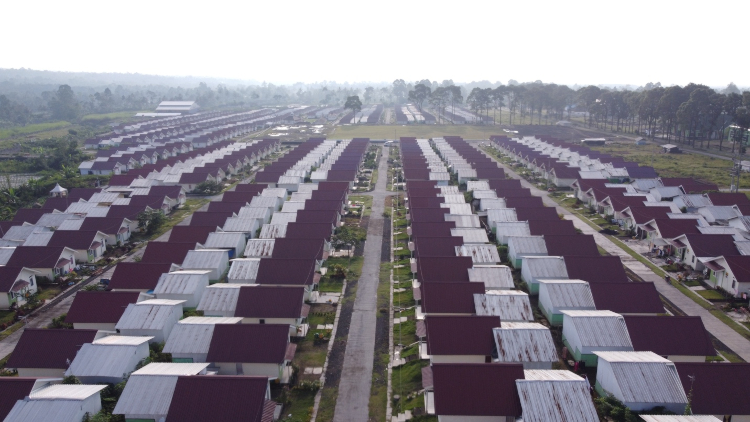
Relocation site for communities displaced by the 2021 Semeru eruption, March 2024.
- [1] F. Pfalzgraf, “Maintaining land and life in Vanuatu: Indigenous alter-natives of recovery following the Manaro eruption on Ambae, Vanuatu,” J. Environ. Media, Vol.2, Suppl.1, pp. 5.1-5.13, 2021. https://doi.org/10.1386/jem_00053_1
- [2] TC21-JSCE Editorial Group, “Transdisciplinary approach (TDA) for building societal resilience to disasters – Concepts and case study for practicing TDA –,” JSCE Publ., 2019.
- [3] K. Takeuchi, L. Mangada, M. Inoue, K. Kikuiri, K. Tsukahara, Y. Katsuhama, and M. Ishiwatari, “Challenges of transdisciplinary approach in disaster recovery management,” Nat. Hazards, Vol.120, No.13, pp. 12471-12489, 2024. https://doi.org/10.1007/s11069-024-06693-z
- [4] C. Monteil, P. Simmons, and A. Hicks, “Post-disaster recovery and sociocultural change: Rethinking social capital development for the new social fabric,” Int. J. Disaster Risk Reduct., Vol.42, Article No.101356, 2020. https://doi.org/10.1016/j.ijdrr.2019.101356
- [5] J. G. Avery, “The aftermath of a disaster. Recovery following the volcanic eruptions in Montserrat, West Indies,” West Indian Med. J., Vol.52, No.2, pp. 131-135, 2003.
- [6] S. Istiyanto and Y. T. Wijayanti, “Evaluation of community participation in restoration efforts following the Merapi Volcano eruptions in Muntilan, Magelang,” Proc. Int. Conf. Polit. Soc. Humanit. Sci. (ICPSH), Vol.8, No.3, pp. 311-322, 2023. https://doi.org/10.18502/kss.v8i3.12837
- [7] K. Iuchi and J. Mutter, “Governing community relocation after major disasters: An analysis of three different approaches and its outcomes in Asia,” Prog. Disaster Sci., Vol.6, Article No.100071, 2020. https://doi.org/10.1016/j.pdisas.2020.100071
- [8] B. L. Oo, R. Sunindijo, and F. Lestari, “Users’ long-term satisfaction with post-disaster permanent housing: a case study of 2010 Merapi Eruption, Indonesia,” MATEC Web Conf., Vol.192, Article No.02066, 2018. https://doi.org/10.1051/matecconf/201819202066
- [9] F. Anto and A. Haris, “Living a post-disaster life: The role of cultural adaptability, coping strategies, and spiritual support on resilience among families affected by the Semeru Eruption,” Indones. J. Islam. Psychol., Vol.6, No.2, pp. 108 136, 2024. https://doi.org/10.18326/ijip.v6i2.2431
- [10] J. A. Muir, M. R. Cope, J. E. Jackson, and L. R. Angeningsih, “To move home or move on? Investigating the impact of recovery aid on migration status as a potential tool for disaster risk reduction in the aftermath of volcanic eruptions in Merapi, Indonesia,” SocArXiv:qcm58_v1, 2019. https://doi.org/10.31235/osf.io/qcm58
- [11] J. Gaillard, “Post-disaster resettlement,” pp. 143-155, Springer Nature, 2015. https://doi.org/10.1057/9781137484291_10
- [12] J. A. Muir, M. R. Cope, L. R. Angeningsih, and R. B. Brown, “Community recovery after a natural disaster: Core data from a survey of communities affected by the 2010 Mt. Merapi eruptions in Central Java, Indonesia,” Data Brief., Vol.32, Article No.106040, 2020. https://doi.org/10.1016/j.dib.2020.106040
- [13] A. Oliver-Smith, “Successes and failures in post-disaster resettlement,” Disasters, Vol.15, No.1, pp. 12-23, 1991. https://doi.org/10.1111/j.1467-7717.1991.tb00423.x
- [14] E. Dube, “The build-back-better concept as a disaster risk reduction strategy for positive reconstruction and sustainable development in Zimbabwe: A literature study,” Int. J. Disaster Risk Reduct., Vol.43, Article No.101401, 2020. https://doi.org/10.1016/j.ijdrr.2019.101401
- [15] C. B. D. Samekto, “Evaluation of community-based settlement reconstruction program: Case study in post-disaster recovery of 2010 Merapi Volcano Eruption in Cangkringan District, Sleman Regency, Yogyakarta Province,” J. Public Adm. Stud., Vol.1, No.3, pp. 64-70, 2017.
- [16] B. Pratama, A. Muslim, B. A. Praja, M. Pratama, and E. Putra, “Life after natural disaster: The case of resettlement policy in Pagerjurang, Yogyakarta,” J. Publicuho, Vol.3, No.3, pp. 279-288, 2020. https://doi.org/10.35817/jpu.v3i3.12482
- [17] P. Bawole, “Community based resettlement program for the victims of natural disaster of Merapi Volcano eruption 2010,” J. Archit. Disc., Vol.13, pp. 114-127, 2015. https://doi.org/10.24167/tesa.v13i2.644
- [18] Y. Jibiki, D. Pelupessy, D. Sasaki, and K. Iuchi, “Implementation of post disaster needs assessment in Indonesia: Literature review,” J. Disaster Res., Vol.15, No.7, pp. 975-980, 2020. https://doi.org/10.20965/jdr.2020.p0975
- [19] C. Folke, “Resilience: The emergence of a perspective for social–ecological systems analyses,” Glob. Environ. Change, Vol.16, No.3, pp. 253-267, 2006. https://doi.org/10.1016/j.gloenvcha.2006.04.002
- [20] B. Nowell, T. Steelman, A.-L. K. Velez, and Z. Yang, “The structure of effective governance of disaster response networks: Insights from the field,” Am. Rev. Public Adm., Vol.48, No.7, pp. 699-715, 2018.
- [21] A. P. Wardani and B. Kusumasari, “Socio-cultural dynamics of resilience building: Lesson learned from Sleman, Indonesia,” J. Kebijak. Adm. Publ., Vol.23, No.1, pp. 63-76, 2019. https://doi.org/10.22146/JKAP.42391
- [22] M. J. Stablein et al., “Compound[ing] disasters in Puerto Rico: Pathways for virtual transdisciplinary collaboration to enhance community resilience,” Glob. Environ. Change, Vol.76, Article No.102558, 2022. https://doi.org/10.1016/j.gloenvcha.2022.102558
- [23] M. M. Suud, S. Bachri, Sumarmi, I. K. Astina, and A. Nadhiroh, “Double-Track Recovery Strategy to Address The Sustainable Recovery for Communities Impacted by The Semeru Eruption, Indonesia,” Plan. Malaysia, Vol.23, No.4, pp. 674-690, 2025. https://doi.org/10.21837/pm.v23i38.1819
- [24] A. Firdaus, F. Lestari, S. A. Afiff, and H. Herdiansyah, “Integration of knowledge and local wisdom for disaster resilience in Anak Krakatau volcano,” Jamba J. Disaster Risk Stud., Vol.15, No.1, pp. 1-12, 2023. https://doi.org/10.4102/jamba.v15i1.1457
- [25] M. Garcia-Fry, O. Murao, S. Bachri, and L. A. Moya, “Land-Use microsimulation model for livelihood diversification after the 2010 Merapi volcano eruptions,” Transp. Res. Part D Transp. Environ., Vol.104, Article No.103189, 2022. https://doi.org/10.1016/j.trd.2022.103189
- [26] Department for International Development (DFID), “Sustainable Livelihoods Guidance Sheets, Section 2.1,” DFID, 1999.
- [27] I. Karsai, T. Schmickl, and G. Kampis, “Resilience and stability of ecological and social systems,” Springer Nature, 2020. https://doi.org/10.1007/978-3-030-54560-4
- [28] United Nations Office for Disaster Risk Reduction (UNDRR), “Sendai Framework for Disaster Risk Reduction 2015–2030,” 2015.
- [29] M. Calipusan-Elnar and F. T. Abocejo, “Typhoon and flooding disasters’ lived experiences of loboc residents in Bohol, Philippines,” Indones. J. Soc. Environ. Issues, Vol.2, No.3, pp. 271-283, 2021. https://doi.org/10.47540/ijsei.v2i3.298
- [30] BPBD Lamajang, “Post Disaster Need Assessment of Semeru Eruption 2022–2025,” 2022.
- [31] Public Work Office, “Temporary Shelter (HUNTARA) Development Management,” 2022
- [32] B. Nowell, T. Steelman, and A.-L. Velez, “The structure of effective governance of transboundary disaster response networks,” Acad. Manag. Proc., 2015.
- [33] A. Ahmadi and U. Kulsum, “Resilience and family harmony after the Mount Semeru Eruption Disaster,” Int. J. Law Dyn. Rev., Vol.2, No.2, pp. 73-81, 2024. https://doi.org/10.62039/ijldr.v2i2.77
- [34] S. Panday, S. Rushton, J. Karki, J. Balen, and A. Barnes, “The role of social capital in disaster resilience in remote communities after the 2015 Nepal earthquake,” Int. J. Disaster Risk Reduct., Vol.55, Article No.102112, 2021. https://doi.org/10.1016/j.ijdrr.2021.102112
- [35] T. Haq, “Modeling of community relocation affected by the Semeru Volcanic Eruption in Lumajang Regency,” Airlangga Dev. J., Vol.8, No.1, pp. 21-38, 2024. https://doi.org/10.20473/adj.v8i1.59143
- [36] P. Sangasumana, “Post-disaster relocation issues: A case study of Samasarakanda Landslide in Sri Lanka,” Eur. Sci. J., Vol.14, No.32, Article No.1, 2018. https://doi.org/10.19044/ESJ.2018.V14N32P1
This article is published under a Creative Commons Attribution-NoDerivatives 4.0 Internationa License.