
Paper:
From Resistance to Community Gratitude: The Case of the Leyte Tide Embankment Project, Philippines
Ladylyn L. Mangada†

University of the Philippines Tacloban College
Magsaysay Boulevard, Tacloban, Leyte 6500, Philippines
†Corresponding author

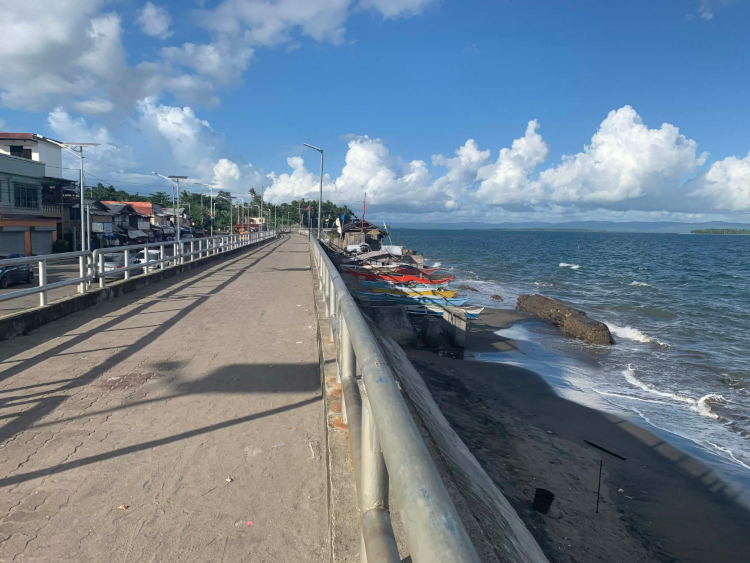
Coastal communities in the Philippines remain highly vulnerable to climate-induced hazards, as demonstrated by the devastation of Super Typhoon Haiyan (Yolanda) in 2013. In Leyte, one of the worst-affected provinces, the state-led construction of the tide embankment became a focal point of post-disaster rehabilitation. This study explored how survivors living along the embankment interpreted and reinterpreted its meaning over time, tracing a shift from resistance to conditional gratitude. Drawing on key informant interviews conducted from September to December 2024 with fisherfolk, small business owners, and community leaders in Tacloban and the surrounding municipalities, the study identified early sources of resistance: limited information, lack of consultation, scientific disconnect, and fears of displacement and livelihood loss. Initially perceived as an exclusionary structure imposed without community input, the embankment later gained legitimacy as it reduced flooding, restored confidence, and signaled state recognition. However, gratitude remained rooted in tangible improvements to safety and livelihoods. The findings demonstrate that disaster infrastructures are not neutral technical solutions but evolving social and political objects. They gain legitimacy through lived experience, as communities reinterpret them within narratives of safety, recovery, and resilience. This study contributes to the debate on disaster governance by showing how infrastructures embody infrastructural citizenship and the politics of resilience, where trust is earned rather than given. Policy implications highlight the need for inclusive consultation, accessible risk communication, and livelihood-sensitive planning to ensure that protective infrastructures are both effective and socially legitimate.
From Risk to Resilience
- [1] G. Bankoff and D. Hilhorst, “The politics of risk in the Philippines: Comparing state and NGO perceptions of disaster management,” Disasters, Vol.33, No.4, pp. 686-704, 2009. https://doi.org/10.1111/j.1467-7717.2009.01104.x
- [2] R. T. Gonzales, “Post-Haiyan reconstruction and the urban politics of coastal resettlement in Tacloban City, Philippines,” Int. Development Planning Review, Vol.39, No.3, pp. 223-244, 2017.
- [3] A. A. C. Ortega, “Neoliberalizing Spaces in the Philippines: Suburbanization, Transnational Migration, and Dispossession,” Lexington Books, 2016.
- [4] C. Howe, J. Lockrem, H. Appel, E. Hackett, D. Boyer, R. Hall, M. Schneider-Mayerson, and A. Ballestero, “Paradoxical infrastructures: Ruins, retrofit, and risk,” Science, Technology, and Human Values, Vol.44, No.1, pp. 3-21, 2019.
- [5] M. Schuller and J. K. Maldonado (Eds.), “Displacement and Resettlement in the Americas: Human Rights, Social Justice and Climate Change,” Palgrave Macmillan, 2016.
- [6] K. Iuchi, “Adaptability of low-income communities in post disaster relocation: A long-term study following Typhoon Haiyan,” J. of the American Planning Association, Vol.90, No.1, pp. 2-17, 2024. https://doi.org/10.1080/01944363.2022.2133781
- [7] A. Hadlos, “Determining the depth of households’ participation influencing the level of their residential satisfaction in a post-Haiyan resettlement,” Int. J. of Disaster Risk Reduction, Vol.64, Article No.102490, 2021. https://doi.org/10.1016/j.ijdrr.2021.102490
- [8] M. M. M. Pormon, D. K. P. Yee, and C. K. O. Gerona, “Households condition and satisfaction towards post-disaster resettlement: The case of typhoon Haiyan resettlement areas in Tacloban City,” Int. J. of Disaster Risk Reduction, Vol.91, Article No.103681, 2023. https://doi.org/10.1016/j.ijdrr.2023.103681
- [9] T. Gibson, “Narratives of resilience: Reframing post-disaster recovery in Tacloban City, Philippines,” Asian J. of Social Science, Vol.47, Nos.4-5, pp. 465-486, 2019.
- [10] UNISDR, “Sendai Framework for Disaster Risk Reduction 2015–2030,” United Nations Office for Disaster Risk Reduction, 2015.
- [11] J. C. Gaillard, “Disaster studies inside out,” Disasters, Vol.43, Issue S1, pp. s7-s17, 2019. https://doi.org/10.1111/disa.12110
- [12] D. V. Blanco, “Disaster governance in the Philippines: Issues, lessons learned, and future directions in the post-Yolanda super typhoon aftermath,” Int. J. Publ. Adm., Vol.38, No.10, pp. 743-756, 2015. https://doi.org/10.1111/disa.12323
- [13] K. Iuchi, Y. Jibiki, R. Solidum Jr., and R. Santiago, “Natural hazards governance in the Philippines,” Oxford Research Encyclopedia of Natural Hazard Science, 2019.
- [14] K. Iuchi, Y. Jibiki, and B. Tamayose, “Learning from a post-typhoon Haiyan/Yolanda recovery institution (OPARR): A new research agenda for recovery governance,” J. Disaster Res., Vol.15, No.7, pp. 845-854, 2020. https://doi.org/10.20965/jdr.2020.p0845
- [15] B. Larkin, “The politics and poetics of infrastructure,” Annual Review of Anthropology, Vol.42, pp. 327-343, 2013. https://doi.org/10.1146/annurev-anthro-092412-155522
- [16] A. von Schnitzler, “Democracy’s Infrastructure: Techno-Politics and Protest After Apartheid,” Princeton University Press, 2016. https://doi.org/10.23943/princeton/9780691170770.001.0001
- [17] N. Anand, “Hydraulic City: Water and the Infrastructures of Citizenship in Mumbai,” Durham: Duke University Press, 2017.
- [18] S. Davoudi, “Resilience: A bridging concept or a dead end?,” Planning Theory & Practice, Vol.13, No.2, pp. 299-333, 2012. https://doi.org/10.1080/14649357.2012.677124
- [19] D. Chandler, “Resilience: The Governance of Complexity,” Routledge, 2014. https://doi.org/10.4324/9781315773810
- [20] J. Joseph, “Resilience as embedded neoliberalism: A governmentality approach,” Resilience, Vol.1, No.1, pp. 38-52, 2013. https://doi.org/10.1080/21693293.2013.765741
- [21] K. Grove, “Resilience,” Routledge, 2018.
- [22] D. Fassin, “Humanitarian Reason: A Moral History of the Present,” University of California Press, 2012. https://doi.org/10.1111/j.1469-8676.2012.00213_7.x
- [23] M. Pelling and K. Dill, “Disaster politics: Tipping points for change in the adaptation of sociopolitical regimes,” Progress in Human Geography, Vol.34, No.1, pp. 21-37, 2010. https://doi.org/10.1177/0309132509105004
- [24] L. A. Johnson and R. B. Olshansky, “After Great Disasters: How Six Countries Managed Community Recovery,” Lincoln Institute of Land Policy Cambridge, 2016.
- [25] C. Lemanski, “Infrastructural citizenship: The everyday citizenships of adapting and contesting water services in South Africa,” J. of Development Studies, Vol.55, No.4, pp. 847-864, 2019.
- [26] N. Anand, A. Gupta, and H. Appel (Eds.), “The Promise of Infrastructure,” Duke University Press, 2018.
- [27] K. P. Donovan, “Experimental states: Aid and the politics of technological futures in Tanzania,” J. of Eastern African Studies, Vol.11, No.3, pp. 483-504, 2017.
- [28] S. Amir and V. Kant, “Sociotechnical resilience: A preliminary concept,” Risk Analysis, Vol.38, No.1, pp. 8-16, 2018. https://doi.org/10.1111/risa.12816
- [29] S. Amir, “The Sociotechnical Constitution of Resilience,” Nanyang Technological University, 2018.
This article is published under a Creative Commons Attribution-NoDerivatives 4.0 Internationa License.