
Paper:
Transdisciplinary Approaches to Urban Flood Risk and Green Infrastructure: Lessons from Asahata Reservoir in Shizuoka, Japan
Mikio Ishiwatari*,†
 and Syoji Tokuoka**
*School of Business Administration, Meiji University
1-1 Kandasurugadai, Chiyoda-ku, Tokyo 101-8301, Japan
†Corresponding author
**Japan Water Forum
Tokyo, Japan

Although the concept of green infrastructure co-benefits is widely recognized, few studies document how transdisciplinary governance mechanisms sustain multipurpose outcomes over several decades. This paper examines how sustained collaborative governance enabled the Asahata Reservoir in Shizuoka City, Japan, to transition from conventional flood infrastructure to multipurpose green infrastructure, providing environmental, social, and cultural benefits over four decades. Using project documents, government reports, and field visits, the study analyzes the governance arrangements and institutional mechanisms that maintained stakeholder engagement and achieved measurable outcomes in flood protection, biodiversity conservation, and social inclusion. The findings show that the transdisciplinary governance platform, the Nature Restoration Council, established in 2004, effectively coordinated multiple stakeholders, including government agencies, civil society organizations, healthcare institutions, and community groups, to support integrated management. The reservoir has maintained its flood storage capacity while supporting 214 bird species and 21 endangered plant species and providing vocational training and therapeutic programs for people with disabilities and older adults. This long-term collaborative approach created complementary relationships among flood protection, ecological restoration, and social services. The case study advances theoretical understanding of transdisciplinary governance by presenting concrete institutional mechanisms for sustained stakeholder coordination in managing multipurpose infrastructure. It offers policymakers transferable lessons for operationalizing collaborative approaches: establish stable multi-stakeholder platforms early in project development, combine public funding with community contributions to support long-term sustainability, and design adaptive management systems that address changing urban needs. The findings contribute to global discussions on aligning disaster risk reduction, climate adaptation, and social inclusion through innovative governance of green infrastructure.
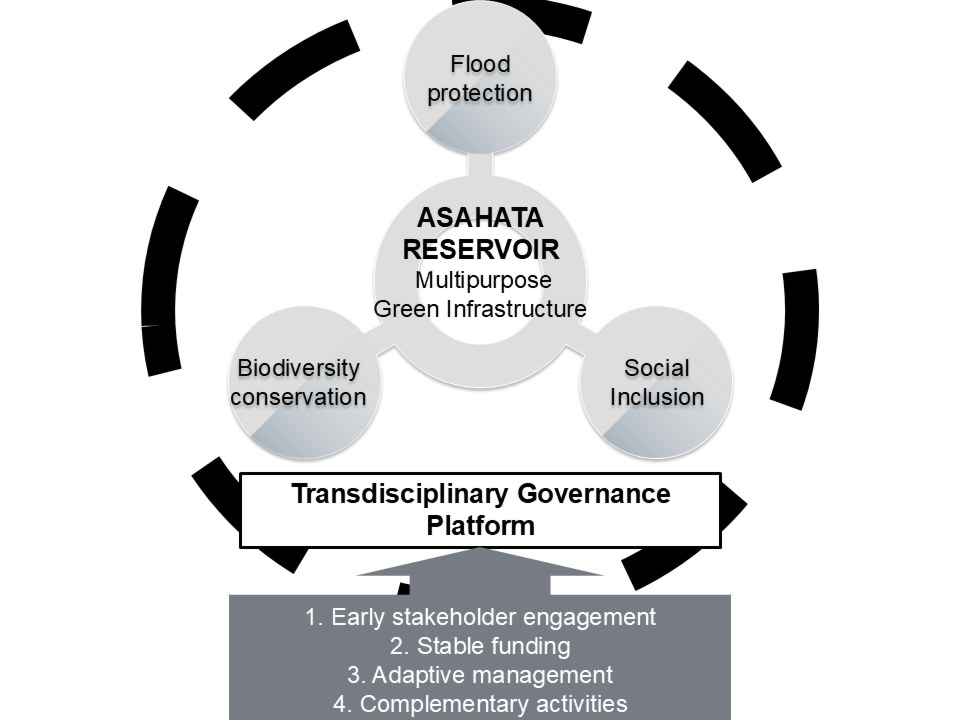
governance concept
1. Introduction
Contemporary flood management strategies increasingly recognize the additional benefits that green infrastructure provides beyond traditional flood protection measures 1,2,3. However, climate and socioeconomic changes worldwide increase flood risks 4,5. Countries are adopting integrated approaches that combine natural and engineered systems to deliver environmental services and address societal challenges. These co-benefits include biodiversity conservation, carbon sequestration, improved air quality, increased recreational opportunities, and enhanced social cohesion 6,7. Achieving these co-benefits requires careful design, appropriate management, and sustained financing mechanisms 8,9.
Green infrastructure for flood management demonstrates the need for transdisciplinary collaboration because of the complex interactions among hydrological systems, ecological processes, social dynamics, and governance structures involved 1,2. Transdisciplinary practice offers a framework to integrate different knowledge systems, producing solutions that are both scientifically robust and socially relevant 10,11.
Japan is implementing green infrastructure programs to reduce flood risks and address environmental challenges 12. Flood risks have increased because of urbanization during the high-growth era and continue to increase because of climate change. The country adopted integrated flood protection approaches to adapt to climate change 13. In addition, Japan’s ecosystems face significant conservation challenges because of urbanization, development activities, and agricultural modernization. Japan’s disaster risk reduction approach increasingly includes collaborative knowledge production, recognizing the value of traditional ecological knowledge and community-based practices 12. Although the co-benefits of green infrastructure are widely discussed conceptually, few studies document the long-term performance of multipurpose projects in Japan.
This paper proposes policies and approaches for managing multipurpose infrastructure. It examines the development and performance of Asahata Reservoir in the Tomoe River basin, Shizuoka City, Japan, from a transdisciplinary perspective. This study makes two main contributions. First, it extends the concept of green infrastructure by showing how long-term collaborative governance can integrate flood protection, biodiversity, and social inclusion. Second, it offers a transferable model for local governments and civil society to design and manage socially inclusive green infrastructure that achieves multiple benefits.
2. Green Infrastructure for Urban Flood Risk Management
This section reviews recent literature on how green infrastructure provides various solutions, including flood protection, particularly in urban areas. Evidence remains limited regarding the long-term application of green infrastructure concepts in real-world settings.
2.1. Theories of Green Infrastructure
Although the co-benefits of green infrastructure are widely recognized, few studies have empirically measured these benefits over multiple decades, particularly regarding flood-control reservoirs in Japan. Most existing research has concentrated on short-term demonstration projects or single interventions.
Green infrastructure is conceptualized as a network of natural and semi-natural areas that provide ecosystem services and increase resilience 14. Green infrastructure strategies for flood management are receiving more attention as alternatives to, or supplements for, traditional grey infrastructure 15. Recent research identifies the multifunctionality of green infrastructure (flood mitigation, biodiversity conservation, climate adaptation, recreation, and health promotion) as a major advantage over single-purpose facilities 16,17.
Green infrastructure is important in modern cities, as it provides ecosystem services and recreational opportunities that improve quality of life for residents 18,19. Integrating multiple functions within a single infrastructure system can increase resource efficiency and improve return on investment 20. The concept of multifunctional urban green infrastructure builds on the traditional model of parks by including productive landscapes, nature-based solutions, and community-centered spaces 21,22.
The co-benefits of green infrastructure for vulnerable populations are increasingly discussed. These spaces can benefit vulnerable groups, such as older adults, people with disabilities, and those in low-income communities, by providing accessible nature experiences 23,24. Such spaces can improve mental health and well-being, offer opportunities for physical activity, support social cohesion, and enable environmental education 25,26. In addition, integrating social services into the design of urban green spaces creates opportunities for inclusive programming and community development.
2.2. Collaborative and Transdisciplinary Governance
Empirical evidence on the evolution of governance platforms, sustained stakeholder participation, and long-term outcomes remains limited. Frantzeskaki 27 argues that effective green infrastructure implementation often depends on collaborative governance that involves multiple stakeholders in planning, implementation, and management. Balancing and coordinating diverse stakeholder interests is essential 28,29. Transdisciplinary approaches that integrate scientific expertise, local knowledge, practical experience, and varied value systems can connect different knowledge systems and organizational cultures 30,31.
3. Study Area and Methods
3.1. Methodology
This case study analysis uses project documentation, government reports, and field visits to examine the development, implementation, and outcomes of the Asahata Reservoir project. The analysis focuses on design philosophy, implementation mechanisms, governance arrangements, and measured outcomes for environmental, social, and flood protection objectives.
3.2. Asahata Reservoir in Shizuoka City
Shizuoka City is in the Pacific Belt, a major economic, industrial, and transport region of Japan. It is one hour from Tokyo and two hours from Osaka by bullet train. The city is known for specialty products such as tea, oranges, and shrimp. Industries including plastic model production, which has the highest shipment value in Japan, and Shimizu Port, an important international trade hub, are central to the city’s economy. Shizuoka City has a population of 670,000 and has experienced a steady population decline since the 1990s. Visitors can see white sands, green pines, and Mount Fuji from Miho no Matsubara.
Shizuoka has a history of frequent natural disasters, including earthquakes, tsunamis, floods, and landslides. The prefectural and city governments have prepared for large-scale earthquakes, tsunamis, and water-related disasters.
Asahata Reservoir is a key structure that protects Shizuoka City from frequent flooding in the Tomoe River. The river originates in the north of Shizuoka City, flows through the urban area, and empties into Shimizu Port (Fig. 1). It is approximately 18 km long and has a watershed area of 104.8 km\(^2\). The river’s gentle longitudinal gradient increases flood risk. The prefecture manages the Tomoe River, which is classified as a Class B river.
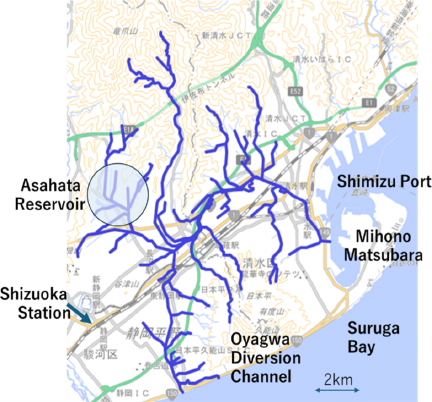 Source: River data set
Fig. 1. Tomoe River and Asahata Reservoir.
In 1974, torrential rain caused flooding in the Tomoe River and other rivers in Shizuoka Prefecture, leading to embankment collapses, landslides, and debris flows throughout the area. Approximately 80,000 homes were flooded, resulting in 44 deaths and 241 injuries 32. In response, the prefectural government began the Asahata Reservoir Project the following year to reduce flood risk in Shizuoka City.
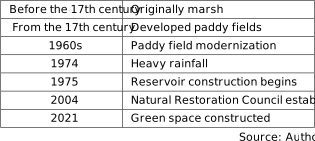
The Asahata Reservoir project area, originally marshland, was converted to paddy fields in the 17th century. After modernization and the Second World War, the area underwent further development, resulting in the disappearance of the marshes 33.
In 1982, Shizuoka Prefecture and Shizuoka City jointly developed an integrated risk management plan for the Tomoe River basin. The plan set safety levels for a 1-in-5-year flood at 800 m\(^3\)/s and included structural measures such as channel improvement, construction of a 6.3 km Oyagawa diversion channel, and the Asahata and Ouchi reservoirs 34. The plan also introduced river basin measures, including retardation and infiltration facilities in urban areas.
4. Case Study: Asahata Reservoir
The Asahata Reservoir serves as a multifunctional green infrastructure project, providing environmental, educational, and social benefits in addition to flood storage. Under normal conditions, the facility functions as a nature park, supporting habitat conservation, environmental education, recreational activities, and social services for people with disabilities. This section examines the effects of ecological restoration, the inclusive social services offered by the reservoir, and the governance mechanisms involved.
Table 1. History of project area.
4.1. Design and Flood Protection Function
The Asahata Reservoir was designed as a major flood protection structure in the Tomoe River Basin, with a planned storage capacity of 3.5 million m\(^3\) and an area of 200 ha. Together with the Oyagawa Diversion Channel, which was completed in 1999, the reservoir has reduced flood damage in Shizuoka City to fewer than 5,000 flooded houses on several occasions since the catastrophic 1974 flood.
Initially developed using engineering principles after the 1974 floods, the project expanded through ongoing stakeholder engagement to include ecological restoration, social services, and cultural preservation (Table 1). The reservoir, located approximately 5 km from downtown Shizuoka City, offers urban residents opportunities for nature interaction, physical activity, and mental health benefits commonly associated with urban parks and green spaces.
4.2. Ecological Restoration and Conservation
The project site, which was previously rice fields, was excavated for flood storage beginning in 1975, while ecological restoration was achieved by using seeds preserved in the existing soil 35. The formation of ponds and marshes increased open water areas and maintained terrestrial habitat zones.
The restoration has attracted diverse wildlife, including dragonflies, insects, and many bird species. Between 1983 and 2014, observers recorded 214 wild bird species at the site, which is about one third of the 600 wild bird species recorded throughout Japan 36. Rare bird species have also been confirmed, increasing the site’s popularity among birdwatchers and nature enthusiasts.
The reservoir is important for endangered species conservation. It supports 21 endangered plant species, and konotori storks occasionally visit the area. Native wetland plants, such as mizu-aoi, were successfully re-established, creating diverse habitats that support various species. Mizu-aoi populations at the reservoir are among Japan’s most successful wild growth sites. Other endangered species, including takonoashi, have established viable populations, which contribute to regional biodiversity conservation. The reservoir’s ecological success led to its designation as one of Japan’s “Wetland 500” important wetlands by the Ministry of the Environment in 2001.
In 2021, Shizuoka City developed “Asahata Green Space” as dedicated urban green infrastructure, allowing city residents to access recreational experiences within the reservoir complex. This green space includes recreational amenities such as play equipment for children, open fields for sports and gatherings, agricultural demonstration areas, and constructed streams for educational and aesthetic purposes.
The visitor center is a focal point for urban green space programming, regional promotion, and seasonal event organization. Local communities and civil society organizations conduct various programs, such as wetland maintenance, regular clean-up campaigns, environmental education, and family-oriented activities. A cultural preservation program at Asahata Marsh transmits the traditional “Shibage fishing” technique, which declined due to paddy field modernization in the 1960s, to new generations.
The reservoir experiences several environmental challenges, including the simplification of natural environments caused by vegetation succession, declining water quality, the introduction of invasive species, and wetland desiccation. To enhance habitats for fish and other aquatic life, civil society organizations have led projects that create deeper areas in the pond and marsh, and that install drainage channels for water management. Another project removes invasive species, such as the Mississippi red-eared slider turtle and alligator weed.
4.3. Inclusive Social Services
The reservoir serves as an urban green space that provides not only recreational benefits but also social services. Its strategic location near medical, educational, and welfare facilities allows integration of green space access with healthcare programming. This setting offers patients and older adults opportunities for outdoor therapy, rehabilitation activities, and mental health support through exposure to nature. Facilities near the reservoir include a prefectural hospital, an epilepsy and neurological medical center, educational facilities for people with disabilities, and special needs schools for children with disabilities.
Shizuoka Kita Special Needs School began the “Asa-katsu” or “Asahata-use” program in 2014 for elementary, junior high, and high school students with disabilities. As of June 2025, the school has 386 students. Elementary school pupils learn about the reservoir’s environment and history through play. Junior high school students study the reservoir’s ecosystem and present their findings. High school students research the ecosystem and participate in nine working sub-programs, such as clean-up campaigns, making handicrafts from cultivated plants, and recycling activities. These sub-programs use the site’s natural environment and conservation activities to support skills development. The “work instead of charity” philosophy provides meaningful employment opportunities and supports conservation goals.
In June 2025, a welfare farm held a rice-planting festival, followed by a harvest festival in October. More than 100 participants from special needs schools, childcare centers, and private companies attended these events. The farm supports collaboration between private companies and people with disabilities 37.
4.4. Governance
Established in 2004, the Nature Restoration Council of Asahata Reservoir coordinates stakeholder participation in reservoir management and conservation activities. The council seeks to restore a healthy aquatic environment, preserve native species, maintain ecological balance, build sustainable human–nature relationships, and connect community members. Council membership includes 7 academic researchers, 8 government offices, 88 organizations, and 32 individual members representing civil society organizations, experts, local communities, schools, hospitals, companies, research institutions, and community groups.
The council developed the concept of nature restoration in 2007, created the implementation plan in 2008, and began projects in 2010. The council also established the action plan in 2017 and revised it in 2024 36.
The council follows collaborative governance principles and operates through three subcommittees, each responsible for specific activities. The Nature Restoration Subcommittee conducts restoration and conservation work for rare plants, such as water hyacinths and water lilies, and organizes observation events to engage the public with these natural features. The Regional Revitalization Subcommittee uses traditional fishing methods to help preserve local culture. The Bethel Subcommittee promotes the therapeutic benefits of landscapes for healthcare institutions and provides support to vulnerable populations at nearby welfare facilities, schools, and hospitals.
The council provides subsidies of up to JPY 200,000 for each activity. In 2023, nine organizations received a total of approximately JPY 1.5 million (about USD 10,000) in funding for habitat restoration, environmental education, and community engagement programs 38. Prefecture and city governments each contribute JPY 7 million (about USD 47,000) to council budgets.
The Asahata Green Space Supporter Program began in 2023 in response to requests from park users who wanted to volunteer for management and operations. Supporters choose areas in which to assist, such as ecological surveys or park maintenance, and contribute based on their abilities. After agricultural activities were introduced, the number of registered supporters increased from 60 to 95.
5. Discussion
The Asahata Reservoir case demonstrates that multipurpose green infrastructure design can effectively integrate flood protection with environmental and social objectives in an urban area. This case supports theoretical arguments for ecosystem-based approaches by providing concrete examples of implementation mechanisms and performance outcomes. Additionally, its transformation from conventional flood infrastructure to multipurpose green space illustrates transdisciplinary development.
This study makes three interrelated contributions to the literature on disaster risk reduction and sustainable urban water management. This section discusses integrating river engineering with wetland and biodiversity conservation, social inclusion, and a transdisciplinary governance platform.
5.1. Flood–Nature Integration
The reservoir has provided effective flood protection by storing floodwater during precipitation events while supporting ecological functions and local residents’ use. Its multipurpose design has maintained flood protection performance, demonstrating that integrated approaches are feasible.
The green infrastructure approach has produced environmental benefits in addition to flood protection. The Asahata Reservoir supports diverse wildlife populations and provides ecosystem services, such as water quality improvement, carbon sequestration, and microclimate regulation. Its designation as one of Japan’s “Wetland 500” important wetlands confirms the project’s conservation value. The successful establishment of endangered species populations, including mizu-aoi and takonoashi, demonstrates effective habitat restoration and management.
Flood protection, environmental conservation, and green space utilization measures complement each other. Excavation works that increase flood capacity have also revived endangered species whose seeds were buried in the soil. Physical disturbance of vegetation and soil for habitat management creates openings in areas previously dominated by single species, allowing greater biodiversity. Activities such as grass cutting and soil tilling prevent sediment deposition and forest encroachment, which maintains flood storage capacity and preserves habitats. Educational and training programs have improved local capacity for environmental stewardship and disaster response.
The project’s transition from disaster management infrastructure to comprehensive community resources shows the potential of adaptive management in green infrastructure development. The 2021 addition of dedicated recreational facilities and programming at Asahata Green Space demonstrates that flood infrastructure can adapt to changing urban needs while maintaining its primary functions.
This urban green space improved quality of life for residents of Shizuoka City. In 2023, the facility served approximately 39,000 visitors, indicating strong demand for urban nature access. Recreational programs attracted a wide range of age groups, including families with children who used playground facilities and older adults who participated in gentle walking programs and birdwatching activities.
The integration of urban recreational infrastructure with wetland conservation offers a distinct model for multifunctional urban green space. Unlike traditional urban parks that focus mainly on recreation, Asahata Green Space combines passive recreation, such as birdwatching, rice planting, and nature walks, with active recreation, such as sports fields and playground activities.
The cultural preservation program for traditional “Shibage fishing” enables intergenerational knowledge transfer and supports cultural identity in urban areas. This provides distinct benefits that go beyond those of standard urban parks.
These programs increase environmental awareness and strengthen community connections between urban residents and natural ecosystems. Educational activities offer urban youth agricultural and environmental learning opportunities that are often not available in metropolitan areas.
Unlike traditional urban parks that require dedicated land allocation, the multipurpose model increases urban land efficiency and provides comprehensive green space benefits. This approach is especially valuable for urban areas with limited space and competing land use demands.
5.2. Social Inclusion
The integration of social services occurred through transdisciplinary collaboration among healthcare providers, educators, social workers, and environmental managers. Stakeholders did not treat the reservoir solely as a physical space; instead, they jointly developed programs that used nature for therapeutic, educational, and vocational purposes. This approach expands understanding of how co-benefits can result from bridging environmental management and social welfare disciplines.
Research shows that access to urban green spaces provides significant mental health and physical well-being benefits, especially for older adults and people with disabilities 26. The Asahata model achieves these benefits through intentional programming and accessible design, creating therapeutic environments that support medical and social service objectives while maintaining the functions of urban green spaces.
5.3. Transdisciplinary Governance
The Nature Restoration Council model demonstrates effective transdisciplinary governance for green infrastructure management. The combination of organizational subsidies, volunteer contributions, and government financial support creates sustainable mechanisms and maintains stakeholder engagement. Integrating multiple stakeholder types, such as civil society organizations, educational institutions, healthcare facilities, and local residents, provides diverse expertise and resources and builds broad community support for long-term sustainability. Organizational participation reflects community support and engagement in project success.
5.4. Implications for Policy and Practice
The findings show that multifunctional flood reservoirs provide significant co-benefits when supported by inclusive, transdisciplinary governance. For cities experiencing increased flood risks because of climate change, this case highlights the importance of integrating green infrastructure with existing infrastructure. Policy frameworks should encourage stakeholder involvement, secure long-term funding, and establish monitoring systems to assess co-benefits over time. Effective transfer requires adaptation to local ecological, social, and institutional contexts.
5.5. Limitations and Further Research
The Asahata case highlights several limitations that require acknowledgment. The governance model depends on voluntary participation and social capital, which may be affected by shifts in political priorities, demographic changes, or economic pressures. Future research should assess the resilience of governance under different political and economic conditions and compare collaborative models with other institutional arrangements to identify key factors for success.
Ongoing environmental challenges, such as invasive species management and declining water quality, show that even well-managed systems experience continuous adaptive pressures. Long-term monitoring studies are essential to assess sustainable management systems and ecological trajectories under different management regimes.
The economic analysis is incomplete, although the study reports management costs and visitor numbers. A comprehensive economic analysis could quantify several benefit streams, including flood damage reduction, provision of ecosystem services, recreational value, health benefits, and effects on property values.
6. Conclusion
The Asahata Reservoir case study demonstrates that multipurpose green infrastructure can provide diverse benefits while maintaining its primary role in flood protection. The project’s integration of environmental conservation, social services, cultural preservation, and community engagement offers a valuable model for sustainable urban flood management. Key contributions include evidence of co-benefit realization, validation of adaptive approaches to address various urban needs, and demonstration of an effective transdisciplinary approach. The case study expands theoretical understanding of green infrastructure’s potential and offers practical guidance for implementing similar projects. Transdisciplinary practice allows solutions to develop that no single discipline or sector could achieve independently.
This case suggests that Japan’s approach may inform international climate adaptation policy. These practices offer a model that other countries can replicate to integrate ecosystem-based adaptation into urban planning. This approach may also support faster progress toward achieving the Sendai Framework for Disaster Risk Reduction and Sustainable Development Goals 6, 11, and 13.
The Asahata model demonstrates how to translate policy goals—co-benefit realization, stakeholder participation, and adaptive management—into specific institutional and financial arrangements. For international policymakers, this case highlights the importance of establishing stable multi-stakeholder governance platforms, combining public funds with community contributions and volunteer schemes, and designing infrastructure that can adapt over time to changing social and ecological needs. These points indicate that green infrastructure serves not only as a technical solution but also as an institutional innovation.
This study identifies several priorities for future research. Comparative studies of similar multipurpose infrastructure projects in various cultural and institutional contexts could determine which governance mechanisms are transferable and which need local adaptation. A longitudinal economic evaluation comparing multipurpose and conventional flood infrastructure could provide stronger quantitative evidence to support policy decisions. Additionally, research on scaling mechanisms for local models is needed to inform regional or national policy frameworks.
Acknowledgments
This work was supported by the FRICS Research Grant.
- [1] E. Andersson, S. Barthel, S. Borgström, J. Colding, T. Elmqvist, C. Folke, and Å. Gren, “Reconnecting cities to the biosphere: Stewardship of green infrastructure and urban ecosystem services,” Ambio, Vol.43, Issue 4, pp. 445-453, 2014. https://doi.org/10.1007/s13280-014-0506-y
- [2] D. Green, E. O’Donnell, M. Johnson, L. Slater, C. Thorne, S. Zheng, R. Stirling, F. K. S. Chan, L. Li, and R. J. Boothroyd, “Green infrastructure: The future of urban flood risk management?,” Wiley Interdisciplinary Reviews: Water, Vol.8, Issue 6, Article No.e1560, 2021. https://doi.org/10.1002/wat2.1560
- [3] A. Pallathadka, J. Sauer, H. Chang, and N. B. Grimm, “Urban flood risk and green infrastructure: Who is exposed to risk and who benefits from investment? A case study of three U.S. cities,” Landscape and Urban Planning, Vol.223, Article No.104417, 2022. https://doi.org/10.1016/j.landurbplan.2022.104417
- [4] H. Tabari, P. Hosseinzadehtalaei, W. Thiery, and P. Willems, “Amplified drought and flood risk under future socioeconomic and climatic change,” Earth’s Future, Vol.9, Issue 10, Article No.e2021EF002295, 2021. https://doi.org/10.1029/2021EF002295
- [5] O. E. Wing, W. Lehman, P. D. Bates, C. C. Sampson, N. Quinn, A. M. Smith, J. C. Neal, J. R. Porter, and C. Kousky, “Inequitable patterns of US flood risk in the Anthropocene,” Nature Climate Change, Vol.12, Issue 2, pp. 156-162, 2022. https://doi.org/10.1038/s41558-021-01265-6
- [6] R. Lafortezza, J. Chen, C. Konijnendijk Van Den Bosch, and T. B. Randrup, “Nature-based solutions for resilient landscapes and cities,” Environmental Research, Vol.165, pp. 431-441, 2018. https://doi.org/10.1016/j.envres.2017.11.038
- [7] F. Taura, M. Ohme, and Y. Shimatani, “Collaborative development of green infrastructure: Urban flood control measures on small-scale private lands,” J. Disaster Res., Vol.16, No.3, pp. 457-468, 2021. https://doi.org/10.20965/jdr.2021.p0457
- [8] C. Davies and R. Lafortezza, “Transitional path to the adoption of nature-based solutions,” Land Use Policy, Vol.80, pp. 406-409, 2019. https://doi.org/10.1016/j.landusepol.2018.09.020
- [9] M. Ishiwatari and D. Sasaki, “Future perspectives of financing investment in disaster risk reduction and climate change adaptation,” M. Ishiwatari and D. Sasaki (Eds.), “Financing Investment in Disaster Risk Reduction and Climate Change Adaptation,” pp. 187-200, Springer, 2022. https://doi.org/10.1007/978-981-19-2924-3_12
- [10] D. J. Lang, A. Wiek, M. Bergmann, M. Stauffacher, P. Martens, P. Moll, M. Swilling, and C. J. Thomas, “Transdisciplinary research in sustainability science: Practice, principles, and challenges,” Sustainability Science, Vol.7, pp. 25-43, 2012. https://doi.org/10.1007/s11625-011-0149-x
- [11] C. Pohl, J. T. Klein, S. Hoffmann, C. Mitchell, and D. Fam, “Conceptualising transdisciplinary integration as a multidimensional interactive process,” Environmental Science & Policy, Vol.118, pp. 18-26, 2021. https://doi.org/10.1016/j.envsci.2020.12.005
- [12] M. Ishiwatari, “Climate change and flood risk reduction measures,” R. Shaw (Ed.), “Handbook on Climate Change and Disasters,” pp. 43-55, Edward Elgar Publishing, 2022. https://doi.org/10.4337/9781800371613.00012
- [13] T. Koike, “Evolution of Japan’s flood control planning and policy in response to climate change risks and social changes,” Water Policy, Vol.23, Issue S1, pp. 77-84, 2021. https://doi.org/10.2166/wp.2021.287
- [14] M. A. Benedict and E. T. McMahon, “Green infrastructure: Linking landscapes and communities,” Island Press, 2012.
- [15] E. C. O’Donnell, J. E. Lamond, and C. R. Thorne, “Recognising barriers to implementation of blue-green infrastructure: A Newcastle case study,” Urban Water J., Vol.14, Issue 9, pp. 964-971, 2017. https://doi.org/10.1080/1573062X.2017.1279190
- [16] M. R. Gilbert, H. Eakin, and T. McPhearson, “The role of infrastructure in societal transformations,” Current Opinion in Environmental Sustainability, Vol.57, Article No.101207, 2022. https://doi.org/10.1016/j.cosust.2022.101207
- [17] N. Kabisch, N. Frantzeskaki, S. Pauleit, S. Naumann, M. Davis, M. Artmann, D. Haase, S. Knapp, H. Korn, J. Stadler, K. Zaunberger, and A. Bonn, “Nature-based solutions to climate change mitigation and adaptation in urban areas: Perspectives on indicators, knowledge gaps, barriers, and opportunities for action,” Ecology and Society, Vol.21, No.2, Article No.39, 2016. https://doi.org/10.5751/ES-08373-210239
- [18] A. Alves, B. Gersonius, Z. Kapelan, Z. Vojinovic, and A. Sanchez, “Assessing the co-benefits of green-blue-grey infrastructure for sustainable urban flood risk management,” J. of Environmental Management, Vol.239, pp. 244-254, 2019. https://doi.org/10.1016/j.jenvman.2019.03.036
- [19] J. R. Wolch, J. Byrne, and J. P. Newell, “Urban green space, public health, and environmental justice: The challenge of making cities ‘just green enough’,” Landscape and Urban Planning, Vol.125, pp. 234-244, 2014. https://doi.org/10.1016/j.landurbplan.2014.01.017
- [20] Y. Kaluarachchi, “Potential advantages in combining smart and green infrastructure over silo approaches for future cities,” Frontiers of Engineering Management, Vol.8, pp. 98-108, 2021. https://doi.org/10.1007/s42524-020-0136-y
- [21] R. Hansen and S. Pauleit, “From multifunctionality to multiple ecosystem services? A conceptual framework for multifunctionality in green infrastructure planning for urban areas,” Ambio, Vol.43, Issue 4, pp. 516-529, 2014. https://doi.org/10.1007/s13280-014-0510-2
- [22] M. Korkou, A. K. M. Tarigan, and H. M. Hanslin, “The multifunctionality concept in urban green infrastructure planning: A systematic literature review,” Urban Forestry & Urban Greening, Vol.85, Article No.127975, 2023. https://doi.org/10.1016/j.ufug.2023.127975
- [23] V. Jennings, L. Larson, and J. Yun, “Advancing sustainability through urban green space: Cultural ecosystem services, equity, and social determinants of health,” Int. J. of Environmental Research and Public Health, Vol.13, Issue 2, Article No.196, 2016. https://doi.org/10.3390/ijerph13020196
- [24] V. Jennings, A. Rigolon, J. Thompson, A. Murray, A. Henderson, and R. S. Gragg, “The dynamic relationship between social cohesion and urban green space in diverse communities: Opportunities and challenges to public health,” Int. J. of Environmental Research and Public Health, Vol.21, Issue 6, Article No.800, 2024. https://doi.org/10.3390/ijerph21060800
- [25] G. N. Bratman et al., “Nature and mental health: An ecosystem service perspective,” Science Advances, Vol.5, Issue 7, Article No.eaax0903, 2019. https://doi.org/10.1126/sciadv.aax0903
- [26] M. Gascon, M. Triguero-Mas, D. Martínez, P. Dadvand, J. Forns, A. Plasència, and M. J. Nieuwenhuijsen, “Mental health benefits of long-term exposure to residential green and blue spaces: A systematic review,” Int. J. of Environmental Research and Public Health, Vol.12, Issue 4, pp. 4354-4379, 2015. https://doi.org/10.3390/ijerph120404354
- [27] N. Frantzeskaki, “Seven lessons for planning nature-based solutions in cities,” Environmental Science & Policy, Vol.93, pp. 101-111, 2019. https://doi.org/10.1016/j.envsci.2018.12.033
- [28] A. Gash, “Collaborative governance,” C. Ansell and J. Torfing (Eds.), “Handbook on Theories of Governance,” pp. 497-509, Edward Elgar Publishing, 2022. https://doi.org/10.4337/9781800371972.00053
- [29] M. Ishiwatari, M. Ohara, K. A. Razak, M. Inoue, X. Zheng, and R. Shaw, “Transdisciplinary approach: Toward innovative recovery and disaster risk reduction,” J. Disaster Res., Vol.19, No.3, pp. 534-538, 2024. https://doi.org/10.20965/jdr.2024.p0534
- [30] K. Takeuchi, L. Mangada, M. Inoue, K. Kikuiri, K. Tsukahara, Y. Katsuhama, and M. Ishiwatari, “Challenges of transdisciplinary approach in disaster recovery management,” Natural Hazards, Vol.120, Issue 13, pp. 12471-12489, 2024. https://doi.org/10.1007/s11069-024-06693-z
- [31] A. Taylor, L. Pretorius, A. McClure, K. N. Iipinge, B. Mwalukanga, and R. Mamombe, “Embedded researchers as transdisciplinary boundary spanners strengthening urban climate resilience,” Environmental Science & Policy, Vol.126, pp. 204-212, 2021. https://doi.org/10.1016/j.envsci.2021.10.002
- [32] Shizuoka Prefecture, “50 years from Tanabata heavy rain disaster,” 2024 (in Japanese). https://www.pref.shizuoka.jp/kensei/pr/johoshi/kenmin/1061761/1063717/1063721.html [Accessed March 5, 2026]
- [33] Shizuoka Civil Engineering Office, Shizuoka Prefecture, “Habitats revived in Asahata Reservoir” (in Japanese). https://asabata.org/wp-content/uploads/2013/10/panfuret.pdf [Accessed March 5, 2026]
- [34] Shizuoka Prefecture and Shizuoka City, “River management plan of Tomoe River,” 2010 (in Japanese). https://www.pref.shizuoka.jp/_res/projects/default_project/_page_/001/029/349/tomoegawaseibikeikaku.pdf [Accessed March 5, 2026]
- [35] Nature Restoration Council of Asahata Reservoir, “Implementation plan of nature restoration of Asahata Reservoir,” 2008 (in Japanese). https://asabata.org/wp-content/uploads/2013/10/zisshikeikaku.pdf [Accessed March 5, 2026]
- [36] Restoration and Utilization Council of Asahata Reservoir, “Action plan for restoration and utilization of Asahata Reservoir,” 2024 (in Japanese). https://asabata.org/wp-content/uploads/2025/08/ad1a528e7bbe85bcc17951ec24513898.pdf#page=1.00 [Accessed March 5, 2026]
- [37] Restoration and Utilization Council of Asahata Reservoir, “Material for the 21st general assembly,” 2025 (in Japanese). https://asabata.org/wp-content/uploads/2025/10/No21_soukai_shiryou.pdf [Accessed March 5, 2026]
- [38] Restoration and Utilization Council of Asahata Reservoir, “Material for the 17th general assembly,” 2024 (in Japanese). https://asabata.org/wp-content/uploads/2024/06/No17_soukai_shiryou.pdf [Accessed March 5, 2026]
This article is published under a Creative Commons Attribution-NoDerivatives 4.0 Internationa License.