
Paper:
Transdisciplinary Approaches to Urban Flood Risk and Green Infrastructure: Lessons from Asahata Reservoir in Shizuoka, Japan
Mikio Ishiwatari*,†
 and Syoji Tokuoka**
*School of Business Administration, Meiji University
1-1 Kandasurugadai, Chiyoda-ku, Tokyo 101-8301, Japan
†Corresponding author
**Japan Water Forum
Tokyo, Japan

Although the concept of green infrastructure co-benefits is widely recognized, few studies document how transdisciplinary governance mechanisms sustain multipurpose outcomes over several decades. This paper examines how sustained collaborative governance enabled the Asahata Reservoir in Shizuoka City, Japan, to transition from conventional flood infrastructure to multipurpose green infrastructure, providing environmental, social, and cultural benefits over four decades. Using project documents, government reports, and field visits, the study analyzes the governance arrangements and institutional mechanisms that maintained stakeholder engagement and achieved measurable outcomes in flood protection, biodiversity conservation, and social inclusion. The findings show that the transdisciplinary governance platform, the Nature Restoration Council, established in 2004, effectively coordinated multiple stakeholders, including government agencies, civil society organizations, healthcare institutions, and community groups, to support integrated management. The reservoir has maintained its flood storage capacity while supporting 214 bird species and 21 endangered plant species and providing vocational training and therapeutic programs for people with disabilities and older adults. This long-term collaborative approach created complementary relationships among flood protection, ecological restoration, and social services. The case study advances theoretical understanding of transdisciplinary governance by presenting concrete institutional mechanisms for sustained stakeholder coordination in managing multipurpose infrastructure. It offers policymakers transferable lessons for operationalizing collaborative approaches: establish stable multi-stakeholder platforms early in project development, combine public funding with community contributions to support long-term sustainability, and design adaptive management systems that address changing urban needs. The findings contribute to global discussions on aligning disaster risk reduction, climate adaptation, and social inclusion through innovative governance of green infrastructure.
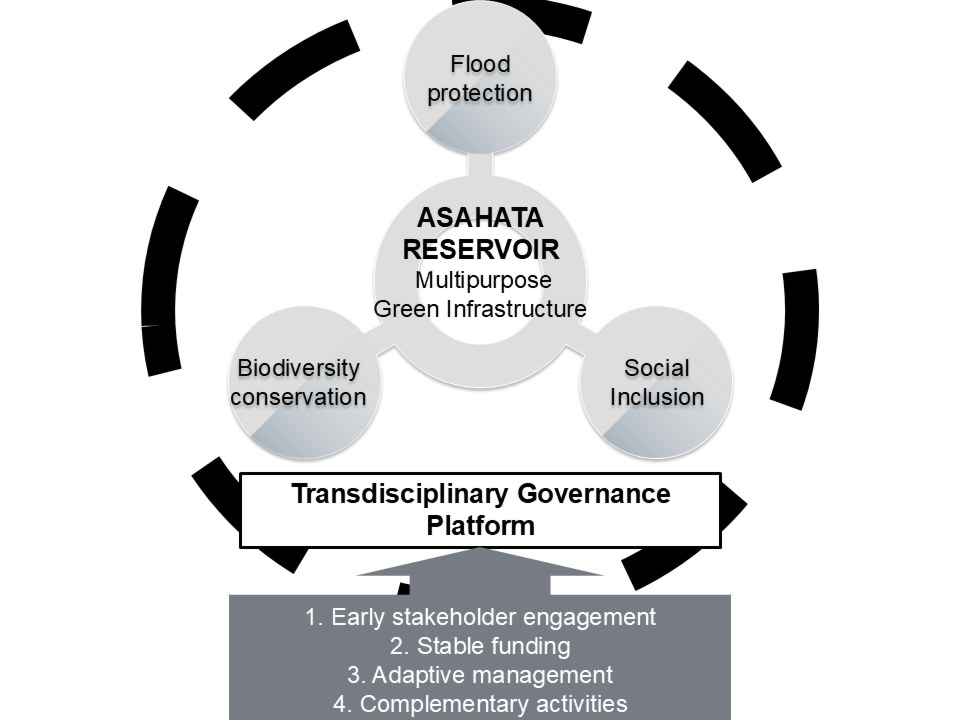
governance concept
- [1] E. Andersson, S. Barthel, S. Borgström, J. Colding, T. Elmqvist, C. Folke, and Å. Gren, “Reconnecting cities to the biosphere: Stewardship of green infrastructure and urban ecosystem services,” Ambio, Vol.43, Issue 4, pp. 445-453, 2014. https://doi.org/10.1007/s13280-014-0506-y
- [2] D. Green, E. O’Donnell, M. Johnson, L. Slater, C. Thorne, S. Zheng, R. Stirling, F. K. S. Chan, L. Li, and R. J. Boothroyd, “Green infrastructure: The future of urban flood risk management?,” Wiley Interdisciplinary Reviews: Water, Vol.8, Issue 6, Article No.e1560, 2021. https://doi.org/10.1002/wat2.1560
- [3] A. Pallathadka, J. Sauer, H. Chang, and N. B. Grimm, “Urban flood risk and green infrastructure: Who is exposed to risk and who benefits from investment? A case study of three U.S. cities,” Landscape and Urban Planning, Vol.223, Article No.104417, 2022. https://doi.org/10.1016/j.landurbplan.2022.104417
- [4] H. Tabari, P. Hosseinzadehtalaei, W. Thiery, and P. Willems, “Amplified drought and flood risk under future socioeconomic and climatic change,” Earth’s Future, Vol.9, Issue 10, Article No.e2021EF002295, 2021. https://doi.org/10.1029/2021EF002295
- [5] O. E. Wing, W. Lehman, P. D. Bates, C. C. Sampson, N. Quinn, A. M. Smith, J. C. Neal, J. R. Porter, and C. Kousky, “Inequitable patterns of US flood risk in the Anthropocene,” Nature Climate Change, Vol.12, Issue 2, pp. 156-162, 2022. https://doi.org/10.1038/s41558-021-01265-6
- [6] R. Lafortezza, J. Chen, C. Konijnendijk Van Den Bosch, and T. B. Randrup, “Nature-based solutions for resilient landscapes and cities,” Environmental Research, Vol.165, pp. 431-441, 2018. https://doi.org/10.1016/j.envres.2017.11.038
- [7] F. Taura, M. Ohme, and Y. Shimatani, “Collaborative development of green infrastructure: Urban flood control measures on small-scale private lands,” J. Disaster Res., Vol.16, No.3, pp. 457-468, 2021. https://doi.org/10.20965/jdr.2021.p0457
- [8] C. Davies and R. Lafortezza, “Transitional path to the adoption of nature-based solutions,” Land Use Policy, Vol.80, pp. 406-409, 2019. https://doi.org/10.1016/j.landusepol.2018.09.020
- [9] M. Ishiwatari and D. Sasaki, “Future perspectives of financing investment in disaster risk reduction and climate change adaptation,” M. Ishiwatari and D. Sasaki (Eds.), “Financing Investment in Disaster Risk Reduction and Climate Change Adaptation,” pp. 187-200, Springer, 2022. https://doi.org/10.1007/978-981-19-2924-3_12
- [10] D. J. Lang, A. Wiek, M. Bergmann, M. Stauffacher, P. Martens, P. Moll, M. Swilling, and C. J. Thomas, “Transdisciplinary research in sustainability science: Practice, principles, and challenges,” Sustainability Science, Vol.7, pp. 25-43, 2012. https://doi.org/10.1007/s11625-011-0149-x
- [11] C. Pohl, J. T. Klein, S. Hoffmann, C. Mitchell, and D. Fam, “Conceptualising transdisciplinary integration as a multidimensional interactive process,” Environmental Science & Policy, Vol.118, pp. 18-26, 2021. https://doi.org/10.1016/j.envsci.2020.12.005
- [12] M. Ishiwatari, “Climate change and flood risk reduction measures,” R. Shaw (Ed.), “Handbook on Climate Change and Disasters,” pp. 43-55, Edward Elgar Publishing, 2022. https://doi.org/10.4337/9781800371613.00012
- [13] T. Koike, “Evolution of Japan’s flood control planning and policy in response to climate change risks and social changes,” Water Policy, Vol.23, Issue S1, pp. 77-84, 2021. https://doi.org/10.2166/wp.2021.287
- [14] M. A. Benedict and E. T. McMahon, “Green infrastructure: Linking landscapes and communities,” Island Press, 2012.
- [15] E. C. O’Donnell, J. E. Lamond, and C. R. Thorne, “Recognising barriers to implementation of blue-green infrastructure: A Newcastle case study,” Urban Water J., Vol.14, Issue 9, pp. 964-971, 2017. https://doi.org/10.1080/1573062X.2017.1279190
- [16] M. R. Gilbert, H. Eakin, and T. McPhearson, “The role of infrastructure in societal transformations,” Current Opinion in Environmental Sustainability, Vol.57, Article No.101207, 2022. https://doi.org/10.1016/j.cosust.2022.101207
- [17] N. Kabisch, N. Frantzeskaki, S. Pauleit, S. Naumann, M. Davis, M. Artmann, D. Haase, S. Knapp, H. Korn, J. Stadler, K. Zaunberger, and A. Bonn, “Nature-based solutions to climate change mitigation and adaptation in urban areas: Perspectives on indicators, knowledge gaps, barriers, and opportunities for action,” Ecology and Society, Vol.21, No.2, Article No.39, 2016. https://doi.org/10.5751/ES-08373-210239
- [18] A. Alves, B. Gersonius, Z. Kapelan, Z. Vojinovic, and A. Sanchez, “Assessing the co-benefits of green-blue-grey infrastructure for sustainable urban flood risk management,” J. of Environmental Management, Vol.239, pp. 244-254, 2019. https://doi.org/10.1016/j.jenvman.2019.03.036
- [19] J. R. Wolch, J. Byrne, and J. P. Newell, “Urban green space, public health, and environmental justice: The challenge of making cities ‘just green enough’,” Landscape and Urban Planning, Vol.125, pp. 234-244, 2014. https://doi.org/10.1016/j.landurbplan.2014.01.017
- [20] Y. Kaluarachchi, “Potential advantages in combining smart and green infrastructure over silo approaches for future cities,” Frontiers of Engineering Management, Vol.8, pp. 98-108, 2021. https://doi.org/10.1007/s42524-020-0136-y
- [21] R. Hansen and S. Pauleit, “From multifunctionality to multiple ecosystem services? A conceptual framework for multifunctionality in green infrastructure planning for urban areas,” Ambio, Vol.43, Issue 4, pp. 516-529, 2014. https://doi.org/10.1007/s13280-014-0510-2
- [22] M. Korkou, A. K. M. Tarigan, and H. M. Hanslin, “The multifunctionality concept in urban green infrastructure planning: A systematic literature review,” Urban Forestry & Urban Greening, Vol.85, Article No.127975, 2023. https://doi.org/10.1016/j.ufug.2023.127975
- [23] V. Jennings, L. Larson, and J. Yun, “Advancing sustainability through urban green space: Cultural ecosystem services, equity, and social determinants of health,” Int. J. of Environmental Research and Public Health, Vol.13, Issue 2, Article No.196, 2016. https://doi.org/10.3390/ijerph13020196
- [24] V. Jennings, A. Rigolon, J. Thompson, A. Murray, A. Henderson, and R. S. Gragg, “The dynamic relationship between social cohesion and urban green space in diverse communities: Opportunities and challenges to public health,” Int. J. of Environmental Research and Public Health, Vol.21, Issue 6, Article No.800, 2024. https://doi.org/10.3390/ijerph21060800
- [25] G. N. Bratman et al., “Nature and mental health: An ecosystem service perspective,” Science Advances, Vol.5, Issue 7, Article No.eaax0903, 2019. https://doi.org/10.1126/sciadv.aax0903
- [26] M. Gascon, M. Triguero-Mas, D. Martínez, P. Dadvand, J. Forns, A. Plasència, and M. J. Nieuwenhuijsen, “Mental health benefits of long-term exposure to residential green and blue spaces: A systematic review,” Int. J. of Environmental Research and Public Health, Vol.12, Issue 4, pp. 4354-4379, 2015. https://doi.org/10.3390/ijerph120404354
- [27] N. Frantzeskaki, “Seven lessons for planning nature-based solutions in cities,” Environmental Science & Policy, Vol.93, pp. 101-111, 2019. https://doi.org/10.1016/j.envsci.2018.12.033
- [28] A. Gash, “Collaborative governance,” C. Ansell and J. Torfing (Eds.), “Handbook on Theories of Governance,” pp. 497-509, Edward Elgar Publishing, 2022. https://doi.org/10.4337/9781800371972.00053
- [29] M. Ishiwatari, M. Ohara, K. A. Razak, M. Inoue, X. Zheng, and R. Shaw, “Transdisciplinary approach: Toward innovative recovery and disaster risk reduction,” J. Disaster Res., Vol.19, No.3, pp. 534-538, 2024. https://doi.org/10.20965/jdr.2024.p0534
- [30] K. Takeuchi, L. Mangada, M. Inoue, K. Kikuiri, K. Tsukahara, Y. Katsuhama, and M. Ishiwatari, “Challenges of transdisciplinary approach in disaster recovery management,” Natural Hazards, Vol.120, Issue 13, pp. 12471-12489, 2024. https://doi.org/10.1007/s11069-024-06693-z
- [31] A. Taylor, L. Pretorius, A. McClure, K. N. Iipinge, B. Mwalukanga, and R. Mamombe, “Embedded researchers as transdisciplinary boundary spanners strengthening urban climate resilience,” Environmental Science & Policy, Vol.126, pp. 204-212, 2021. https://doi.org/10.1016/j.envsci.2021.10.002
- [32] Shizuoka Prefecture, “50 years from Tanabata heavy rain disaster,” 2024 (in Japanese). https://www.pref.shizuoka.jp/kensei/pr/johoshi/kenmin/1061761/1063717/1063721.html [Accessed March 5, 2026]
- [33] Shizuoka Civil Engineering Office, Shizuoka Prefecture, “Habitats revived in Asahata Reservoir” (in Japanese). https://asabata.org/wp-content/uploads/2013/10/panfuret.pdf [Accessed March 5, 2026]
- [34] Shizuoka Prefecture and Shizuoka City, “River management plan of Tomoe River,” 2010 (in Japanese). https://www.pref.shizuoka.jp/_res/projects/default_project/_page_/001/029/349/tomoegawaseibikeikaku.pdf [Accessed March 5, 2026]
- [35] Nature Restoration Council of Asahata Reservoir, “Implementation plan of nature restoration of Asahata Reservoir,” 2008 (in Japanese). https://asabata.org/wp-content/uploads/2013/10/zisshikeikaku.pdf [Accessed March 5, 2026]
- [36] Restoration and Utilization Council of Asahata Reservoir, “Action plan for restoration and utilization of Asahata Reservoir,” 2024 (in Japanese). https://asabata.org/wp-content/uploads/2025/08/ad1a528e7bbe85bcc17951ec24513898.pdf#page=1.00 [Accessed March 5, 2026]
- [37] Restoration and Utilization Council of Asahata Reservoir, “Material for the 21st general assembly,” 2025 (in Japanese). https://asabata.org/wp-content/uploads/2025/10/No21_soukai_shiryou.pdf [Accessed March 5, 2026]
- [38] Restoration and Utilization Council of Asahata Reservoir, “Material for the 17th general assembly,” 2024 (in Japanese). https://asabata.org/wp-content/uploads/2024/06/No17_soukai_shiryou.pdf [Accessed March 5, 2026]
This article is published under a Creative Commons Attribution-NoDerivatives 4.0 Internationa License.