
Research Paper:
Total Fresh Weight Estimation Model for Herbaceous Plant Based on Improved YOLOv5 and 3D Point Clouds
Yitong Han
 and Xiangyang Xu†
Department of Automation, Beijing Institute of Technology
No.5 Zhongguancun South Street, Haidian District, Beijing 100081, China
†Corresponding author

The real-time quantitative estimation of herbaceous plant growth status holds significant potential for investigating fertilization effects, predicting growth curves, and enhancing crop yield. This study constructed a growth quantification model using an improved YOLOv5 architecture integrated with 3D point cloud processing, with pak choi as an exemplar crop. To improve the recognition accuracy while reducing the number of parameters, we employed a lightweight YOLOv5 model enhanced with Atrous Spatial Pyramid Pooling and Ghost convolution modules for individual pak choi plant localization and growth stage classification. We also developed a segmentation method based on the HSV color space to segment leaves. To estimate the total fresh weight of individual plants, we first calculated the leaf surface area by generating a triangular mesh from the corresponding leaf point clouds and predicted the chlorophyll content using a stacking ensemble model. Subsequently, to address the leaf occlusion issues, the leaf pixel ratio in the images, leaf surface area, and mean leaf chlorophyll content were collectively used as independent variables. Finally, a multiple linear regression model was developed to accurately estimate the total fresh weight of individual pak choi plants. Experimental results demonstrate that the modified YOLOv5 architecture achieves a 3.5% improvement in mAP@0.5 (reaching 96%) and a 4.66% increase in F1-score (attaining 90.26%), while significantly reducing the computational complexity compared to the baseline model. Statistical tests verified that the fitted equation could explain 79% of the variation in the total fresh weight, with an average relative error of 12.16%. This enables non-contact and accurate measurement of the pak choi growth status.
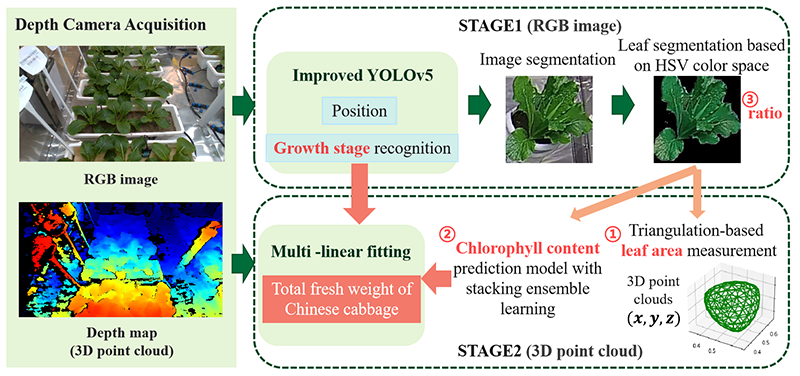
Pipeline of growth quantification
- [1] T. Fujinaga, S. Yasukawa, and K. Ishii, “Tomato growth state map for the automation of monitoring and harvesting,” J. Robot. Mechatron., Vol.32, No.6, pp. 1279-1291, 2020. https://doi.org/10.20965/jrm.2020.p1279
- [2] D. Lo Presti et al., “Plant growth monitoring: Design, fabrication, and feasibility assessment of wearable sensors based on fiber bragg gratings,” Sensors, Vol.23, No.1, Article No.361, 2023. https://doi.org/10.3390/s23010361
- [3] S. Joshi, T. R. Naik, R. Patkar, and M. S. Baghini, “Stomatal transpiration monitoring using a wearable leaf sensor,” 2020 IEEE Int. Conf. on Flexible and Printable Sensors and Systems, 2020. https://doi.org/10.1109/FLEPS49123.2020.9239465
- [4] S. Yulianto et al., “Spatial distribution of paddy growth stage using Sentinel-1 based on cart model,” 2021 IEEE Asia-Pacific Conf. on Geoscience, Electronics and Remote Sensing Technology, pp. 73-77, 2021. https://doi.org/10.1109/AGERS53903.2021.9617317
- [5] C.-Y. Song et al., “Detection of maize tassels for UAV remote sensing image with an improved YOLOX Model,” J. of Integrative Agriculture, Vol.22, No.6, pp. 1671-1683, 2023. https://doi.org/10.1016/j.jia.2022.09.021
- [6] S. Zhu, H. Qu, Q. Xia, W. Guo, and Y. Guo, “Parametric reconstruction method of wheat leaf curved surface based on three-dimensional point cloud,” Smart Agriculture, Vol.7, No.1, pp. 85-96, 2025 (in Chinese). https://doi.org/10.12133/j.smartag.SA202410004
- [7] M. Fu et al., “Comparative transcriptome analysis of purple and green flowering Chinese cabbage and functional analyses of BrMYB114 gene,” Int. J. of Molecular Sciences, Vol.24, No.18, Article No.13951, 2023. https://doi.org/10.3390/ijms241813951
- [8] F. Damayanti, S. Yudha S., and A. Falahudin, “Oil palm leaf ash’s effect on the growth and yield of Chinese cabbage (Brassica rapa L.),” AIMS Agriculture and Food, Vol.8, No.2, pp. 553-565, 2023. https://doi.org/10.3934/agrfood.2023030
- [9] S. A. Tsaftaris, M. Minervini, and H. Scharr, “Machine learning for plant phenotyping needs image processing,” Trends in Plant Science, Vol.21, No.12, pp. 989-991, 2016. https://doi.org/10.1016/j.tplants.2016.10.002
- [10] U. Meier, “Growth stages of mono- and dicotyledonous plants: BBCH monograph,” Blackwell, 1997.
- [11] J. Zhang et al., “High-throughput phenotyping of Chinese cabbage using multispectral drone imagery and deep learning for morphological, color, and nutritional traits across growth stages,” Scientia Horticulturae, Vol.346, Article No.114172, 2025. https://doi.org/10.1016/j.scienta.2025.114172
- [12] A. G. C. Gonzalez, G. Venture, I. Mizuuchi, and B. Indurkhya, “VGG-16-based map-less navigation architecture with temporal vision mosaic for autonomous ground robots,” Int. J. Automation Technol., Vol.19, No.4, pp. 651-665, 2025. https://doi.org/10.20965/ijat.2025.p0651
- [13] L.-Y. Zhou et al., “Reclining public chair behavior detection based on improved YOLOv5,” J. Adv. Comput. Intell. Intell. Inform., Vol.27, No.6, pp. 1175-1182, 2023. https://doi.org/10.20965/jaciii.2023.p1175
- [14] Z. Li, Y. Zhang, C. Wang, G. Tan, and Y. Yan, “Improved pedestrian detection algorithm based on YOLOv5s,” J. Adv. Comput. Intell. Intell. Inform., Vol.28, No.4, pp. 768-775, 2024. https://doi.org/10.20965/jaciii.2024.p0768
- [15] Q. Zhou and Y. Liu, “RCT-YOLOv8: A tuna detection model for distant-water fisheries based on improved YOLOv8,” J. Adv. Comput. Intell. Intell. Inform., Vol.28, No.6, pp. 1273-1283, 2024. https://doi.org/10.20965/jaciii.2024.p1273
- [16] E. Hamuda, B. Mc Ginley, M. Glavin, and E. Jones, “Automatic crop detection under field conditions using the HSV colour space and morphological operations,” Computers and Electronics in Agriculture, Vol.133, pp. 97-107, 2017. https://doi.org/10.1016/j.compag.2016.11.021
- [17] Q. Lei, J. Liu, M. Wu, and J. Wang, “Image clustering using active-constraint semi-supervised affinity propagation,” J. Adv. Comput. Intell. Intell. Inform., Vol.20, No.7, pp. 1035-1043, 2016. https://doi.org/10.20965/jaciii.2016.p1035
- [18] Q. Chen et al., “Evaluating goji berry (Lycium barbarum L.) quality change during storage using color and fluorescence imaging system,” J. of Food Composition and Analysis, Vol.141, Article No.107342, 2025. https://doi.org/10.1016/j.jfca.2025.107342
- [19] X. Zhang, H. Yu, J. Yan, and X. Meng, “Study on the detection of chlorophyll content in tomato leaves based on RGB images,” Horticulturae, Vol.11, No.6, Article No.593, 2025. https://doi.org/10.3390/horticulturae11060593
- [20] H. Song, W. Wen, S. Wu, and X. Guo, “Comprehensive review on 3D point cloud segmentation in plants,” Artificial Intelligence in Agriculture, Vol.15, No.2, pp. 296-315, 2025. https://doi.org/10.1016/j.aiia.2025.01.006
- [21] N. Yamaguchi, H. Okumura, O. Fukuda, W. L. Yeoh, and M. Tanaka, “Estimating tomato plant leaf area using multiple images from different viewing angles,” J. Adv. Comput. Intell. Intell. Inform., Vol.28, No.2, pp. 352-360, 2024. https://doi.org/10.20965/jaciii.2024.p0352
- [22] G. Zheng and L. M. Moskal, “Computational-geometry-based retrieval of effective leaf area index using terrestrial laser scanning,” IEEE Trans. on Geoscience and Remote Sensing, Vol.50, No.10, pp. 3958-3969, 2012. https://doi.org/10.1109/TGRS.2012.2187907
- [23] D. M. W. Powers, “Evaluation: From precision, recall and F-measure to ROC, informedness, markedness and correlation,” arXiv:2010.16061, 2020. https://arxiv.org/abs/2010.16061
- [24] M. Fang et al., “Small object detection algorithm based on improved attention mechanism and feature fusion of YOLOv8,” J. Adv. Comput. Intell. Intell. Inform., Vol.29, No.4, pp. 941-955, 2025. https://doi.org/10.20965/jaciii.2025.p0941
- [25] N. R. Draper and H. Smith, “Applied Regression Analysis,” John Wiley & Sons, 1998. https://doi.org/10.1002/9781118625590
- [26] J. Neter, W. Wasserman, and M. Kutner, “Applied Linear Statistical Models: Regression, Analysis of Variance, and Experimental Designs,” 3rd Edition, CRC Press, 1990.
- [27] K.-H. Yuan and P. M. Bentler, “ F F tests for mean and covariance structure analysis,” J. of Educational and Behavioral Statistics, Vol.24, No.3, pp. 225-243, 1999. https://doi.org/10.3102/10769986024003225
- [28] C. Wang, “Expectation and variance of Durbin Watson test statistic DW,” J. of Yanan University (Natural Science Edition), Vol.14, No.3, pp. 38-41, 1995 (in Chinese).
This article is published under a Creative Commons Attribution-NoDerivatives 4.0 Internationa License.