
Research Paper:
Evaluation Using AI-Based Approach of Pedicle Screw Stability Using Laser Resonance Frequency Analysis Prior to Surgical Insertion
Katsuhiro Mikami*1,†
 , Shogo Hashimoto*2, Tetsuya Matsuyama*2, Mitsutaka Nemoto*1
, Takashi Nagaoka*1
, Yuichi Kimura*3
, Takuto Hatakeyama*4
, Takeo Nagura*4,*5
, and Daisuke Nakashima*4,*5
, Shogo Hashimoto*2, Tetsuya Matsuyama*2, Mitsutaka Nemoto*1
, Takashi Nagaoka*1
, Yuichi Kimura*3
, Takuto Hatakeyama*4
, Takeo Nagura*4,*5
, and Daisuke Nakashima*4,*5
*1Faculty of Biology-Oriented Science and Technology, Kindai University
930 Nishi-mitani, Kinokawa, Wakayama 649-6493, Japan
†Corresponding author
*2Graduate School of Biology-Oriented Science and Technology, Kindai University
930 Nishi-mitani, Kinokawa, Wakayama 649-6493, Japan
*3Faculty of Informatics, Cyber Informatics Research Institute, Kindai University
3-4-1 Kowakae, Higashiosaka, Osaka 577-8502, Japan
*4Department of Orthopedic Surgery, Keio University School of Medicine
35 Shinano-machi, Shinjuku-ku, Tokyo 160-8582, Japan
*5Department of Clinical Biomechanics, Keio University School of Medicine
35 Shinano-machi, Shinjuku-ku, Tokyo 160-8582, Japan

In orthopedics, assessing the initial stability of pedicle screws is crucial for preventing failure after implantation. Traditional methods for determining stability are applicable only to post-screw insertion, complicating recovery in cases of inadequate strength. This study aimed to predict implant stability at the tapping stage prior to screw placement. Artificial bones with five distinct densities were utilized to measure tapping and screw insertion torques, facilitating a statistical evaluation of bone density and placement strength. A laser resonance frequency analysis (L-RFA) was conducted to obtain the vibration frequency spectra of the tap. Furthermore, linear approximation and support vector regression (SVR) were employed, utilizing spectral data and a 95% confidence interval to predict bone density. Significant differences in tapping and screw insertion torques were observed relative to bone density (p<0.01). Prediction based on a wide frequency range utilizing SVR improved the mean squared error from 26.9 to 8.08 when compared to traditional regression prediction, resulting in a coefficient of determination R2 of 0.843. The acquisition of bone density data at the tapping stage enables the prediction of expected screw stability. Bone density prediction using L-RFA has the potential to provide stability indicators prior to pedicle screw insertion.
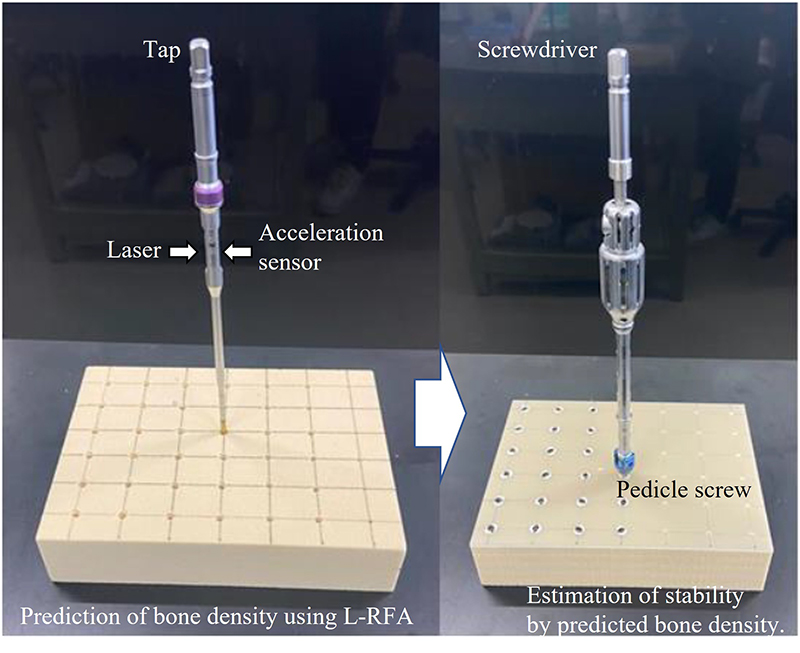
Prediction scheme for stability using L-RFA
- [1] R. A. Deyo, D. T. Gray, W. Kreuter, S. Mirza, and B. I. Martin, “United States trends in lumbar fusion surgery for degenerative conditions,” Spine, Vol.30, No.12, pp. 1441-1445, 2005. https://doi.org/10.1097/01.brs.0000166503.37969.8a
- [2] J. N. Weinstein, J. D. Lurie, P. R. Olson, K. K. Bronne, and E. S. Fisher, “United States’ trends and regional variations in lumbar spine surgery: 1992–2003,” Spine, Vol.31, No.23, pp. 2707-2714, 2006. https://doi.org/10.1097/01.brs.0000248132.15231.fe
- [3] J. Bredow, C. K. Boese, C. M. Werner, J. Siewe, L. Löhrer, K. Zarghooni, P. Eysel, and M. J. Scheyerer, “Predictive validity of preoperative CT scans and the risk of pedicle screw loosening in spinal surgery,” Arch. Orthop. Trauma. Surg., Vol.136, No.8, pp. 1063-1067, 2016. https://doi.org/10.1007/s00402-016-2487-8
- [4] M. Yagi, C. P. Ames, M. Keefe, N. Hosogane, J. S. Smith, C. I. Shaffrey, F. Schwab, V. Lafage, R. S. Bess, M. Matsumoto, K. Watanabe, and International Spine Study Group (ISSG), “A cost-effectiveness com-parisons of adult spinal deformity surgery in the United States and Japan,” Eur. Spine J. Vol.27, No.3, pp. 678-684, 2017. https://doi.org/10.1007/s00586-017-5274-5
- [5] A. W. Kwok, J. A. Finkelstein, T. Woodside, T. C. Hearn, and R. W. Hu, “Insertional torque and pull-out strengths of conical and cylindrical pedicle screws in cadaveric bone,” Spine, Vol.21, No.21, pp. 2429-2434, 1996. https://doi.org/10.1097/00007632-199611010-00004
- [6] T. L. Mueller, G. H. van Lenthe, M. Stauber, C. Gratzke, F. Eckstein, and R. Müller, “Regional, age and gender differences in architectural measures of bone quality and their correlation to bone mechanical competence in the human radius of an elderly population,” Bone, No.45, Vol.5, pp. 882-891, 2009. https://doi.org/10.1016/j.bone.2009.06.031
- [7] W. Lei and W. Zixiang, “Biomechanical evaluation of an expansive pedicle screw in calf vertebrae,” Eur. Spine J., Vol.15, No.3, pp. 321-326, 2006. https://doi.org/10.1007/s00586-004-0867-1
- [8] R. Ab-Lazid, E. Perilli, M. K. Ryan, J. J. Costi, and K. J. Reynolds, “Does cancellous screw insertion torque depend on bone mineral density and/or microarchitecture?,” J. Biomech., Vol.47, No.2, pp. 347-353, 2014. https://doi.org/10.1016/j.jbiomech.2013.11.030
- [9] L. Sennerby and N. Meredith, “Implant stability measurements using resonance frequency analysis: Biological and biomechanical aspects and clinical implications,” Periodontol 2000, Vol.47, pp. 51-66, 2008. https://doi.org/10.1111/j.1600-0757.2008.00267.x
- [10] P. Valderrama, T. W. Oates, A. A. Jones, J. Simpson, J. D. Schoolfield, and D. L. Cochran, “Evaluation of two different resonance frequency devices to detect implant stability: A clinical trial,” J. Periodontol., Vol.78, No.2, pp. 262-272, 2007. https://doi.org/10.1902/jop.2007.060143
- [11] K. Mikami, D. Nakashima, S. Kikuchi, T. Kitamura, N. Hasegawa, T. Nagura, and M. Nishikino, “Stability diagnosis of orthopedic implants based on resonance frequency analysis with fiber transmission of nanosecond laser pulse and acceleration sensor,” Proc. SPIE, Vol.11233, Article No.112330O, 2020. https://doi.org/10.1117/12.2544793
- [12] D. Nakashima, K. Mikami, S. Kikuchi, M. Nishikino, T. Kitamura, N. Hasegawa, M. Matsumoto, M. Nakamura, and T. Nagura, “Laser resonance frequency analysis of pedicle screw stability: A cadaveric model bone study,” J. Orthop. Res., Vol.39, No.11, pp. 2474-2484, 2021. https://doi.org/10.1002/jor.24983
- [13] S. Kikuchi, K. Mikami, D. Nakashima, T. Kitamura, N. Hasegawa, M. Nishikino, A. Kanaji, M. Nakamura, and T. Nagura, “Laser resonance frequency analysis: A novel measurement approach to evaluate acetabular cup stability during surgery,” Sensors, Vol.19, No.22, Article No.4876, 2019. https://doi.org/10.3390/s19224876
- [14] K. Mikami, M. Nemoto, A. Ishinoda, T. Nagura, M. Nakamura, M. Matsumoto, and D. Nakashima, “Improvement of machine learning-based prediction of pedicle screw stability in laser resonance frequency analysis via data augmentation from micro-CT images,” Appl. Sci., Vol.13, No.15, Article No.9037, 2023. https://doi.org/:10.3390/app13159037
- [15] K. Mikami, M. Nemoto, T. Nagura, M. Nakamura, M. Matsumoto, and D. Nakashima, “Machine learning-based diagnosis in laser resonance frequency analysis for implant stability of orthopedic pedicle screws,” Sensors, Vol.21, No.22, Article No.7553, 2021. https://doi.org/:10.3390/s21227553
- [16] D. Nakashima, K. Ishii, Y. Nishiwaki, H. Kawana, M. Jinzaki, M. Matsumoto, M. Nakamura, and T. Nagura, “Quantitative CT-based bone strength parameters for the prediction of novel spinal implant stability using resonance frequency analysis: A cadaveric study involving experimental micro-CT and clinical multislice CT,” Eur. Radiol. Exp., Vol.3, No.1, Article No.1, 2019. https://doi.org/10.1186/s41747-018-0080-3
- [17] R. H. Putra, N. Yoda, M. Iikubo, Y. Kataoka, K. Yamauchi, S. Koyama, U. Cooray, E. R. Astuti, T. Takahashi, and K. Sasaki, “Influence of bone condition on implant placement accuracy with computer-guided surgery,” Int. J. Implant. Dent., Vol.6, No.1, Article No.62, 2020. https://doi.org/10.1186/s40729-020-00249-z
- [18] J. T. Hsu, C. H. Chang, H. L. Huang, M. E. Zobitz, W. P. Chen, K. A. Lai, and K. N. An, “The number of screws, bone quality, and friction coefficient affect acetabular cup stability,” Med. Eng. Phys., Vol.29, No.10, pp. 1089-1095, 2017. https://doi.org/:10.1016/j.medengphy.2006.11.005
- [19] T. Hatakeyama, D. Nakashima, K. Mikami, A. Oya, A. Fujie, A. Sujino, M. Nakamura, and T. Nagura, “Evaluation of bone integrity around the acetabular cup using noninvasive laser resonance frequency analysis,” J. Orthop. Res., Vol.42, No.11, pp. 2552-2561, 2024. https://doi.org/:10.1002/jor.25925
- [20] R. K. Lippmann, “The use of auscultatory percussion for the examination of fractures,” The J. of Bone & Joint Surgery, Vol.14, No.1, pp. 118-126, 1932.
- [21] V. Vapnik, “Pattern recognition using generalized portrait method,” Autom. Remote Control, Vol.24, pp. 774-780, 1963.
- [22] B. E. Boser, I. M. Guyon, and V. N. Vapnik, “A training algorithm for optimal margin classifiers,” Proc. 5th Annu. Workshop Comput. Learn Theory, pp. 144-152, 1992. https://doi.org/:10.1145/130385.130401
- [23] K. Mikami, A. Ishinoda, and M. Nemoto, “Characterization of laser-induced photothermal vibration for young’s modulus imaging toward computer-aided detection,” Appl. Sci., Vol.13, No.6, Article No.3639, 2023. https://doi.org/:10.3390/app13063639
- [24] L. D. Carbonare and S. Giannini, “Bone microarchitecture as an important determinant of bone strength,” J. Endocrinol Invest., Vol.27, No.1, pp. 99-105, 2004. https://doi.org/:10.1007/BF03350919
- [25] D. Nakashima, K. Ishii, M. Matsumoto, M. Nakamura, and T. Nagura, “A study on the use of the Osstell apparatus to evaluate pedicle screw stability: An in-vitro study using micro-CT,” PLoS One, Vol.13, No.6, Article No.e0199362, 2018. https://doi.org/10.1371/journal.pone.0199362
- [26] J. Xie, T. Sun, J. Zhang, and W. Zhang, “A new hybrid method for parameter optimization of SVR,” J. Adv. Comput. Intell. Intell. Inform., Vol.22, No.2, pp. 271-279, 2018. https://doi.org/10.20965/jaciii.2018.p0271
This article is published under a Creative Commons Attribution-NoDerivatives 4.0 Internationa License.