
Research Paper:
Influence of Supporters’ Purposeful Movement on Effectiveness of Propaganda
Jiateng Pan*,†
 , Atsushi Yoshikawa*,**
, and Masayuki Yamamura*
, Atsushi Yoshikawa*,**
, and Masayuki Yamamura*
*School of Computing, Institute of Science Tokyo
4259 Nagatsuta-cho, Midori-ku, Yokohama, Kanagawa 226-8501, Japan
†Corresponding author
**College of Science and Engineering, Kanto Gakuin University
1-50-1 Mutsuura-higashi, Kanazawa-ku, Yokohama 236-8501, Japan

Conventional wisdom holds that growing a supporter base strengthens propaganda via the bandwagon effect; yet, real-world outcomes often show the opposite. We investigate why larger bases can coincide with lower conversion rates among undecided individuals. Using an agent-based simulation that incorporates a Schelling-style movement rule, we run nine scenarios across three competitive regimes (balanced, competitor-strong, propagandist-strong) with supporter shares ranging from 10%–33%. We find: (1) purposeful movement (preference-driven relocation) induces spatial clustering that reduces cross-type exposure, leading clustered supporters to consistently underperform dispersed supporters; (2) when supporters on both sides exhibit purposeful movement, a numerically inferior side could gain an advantage under certain conditions (e.g., when the opponent clusters more); and (3) excessive increases in supporter numbers—which promote strong spatial clustering—can erode a dominant propagandist’s edge. The mechanism is straightforward: clustering satisfies in-group preferences but isolates supporters from the undecided, muting the bandwagon effect. These results qualify the presumed linear link between supporter volume and campaign success and offer practical guidance: prioritize maintaining supporter dispersion over simply maximizing numbers (e.g., broad geographic reach rather than concentrated rallies). Our framework is reproducible and points to extensions involving heterogeneous agents, nonlinear persuasion, and diverse network topologies.
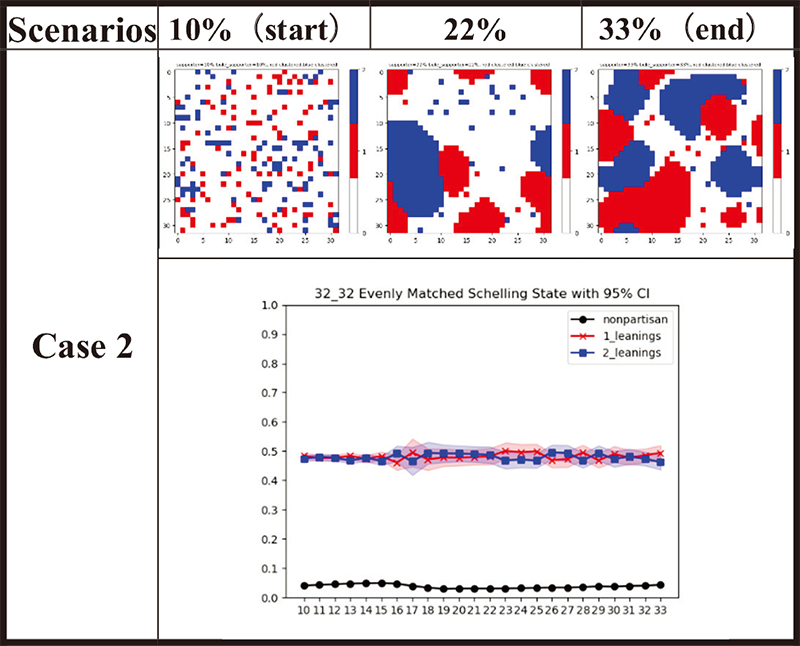
Purposeful movement reduces support rate
- [1] E. Bakshy, J. M. Hofman, W. A. Mason, and D. J. Watts, “Everyone’s an influencer: quantifying influence on twitter,” Proc. Fourth ACM Int. Conf. Web Search Data Min. (WSDM’11), pp. 65-74, 2011. https://doi.org/10.1145/1935826.1935845
- [2] R. Schmitt-Beck, “Bandwagon effect,” G. Mazzoleni (Ed.), “The International Encyclopedia of Political Communication,” John Wiley & Sons, pp. 1-5, 2015. https://doi.org/10.1002/9781118541555.wbiepc015
- [3] S.-M. Choi, H. Lee, Y.-S. Han, K. L. Man, and W. K. Chong, “A recommendation model using the bandwagon effect for e-marketing purposes in IoT,” Int. J. Distrib. Sens. Netw., Vol.11, Issue 7, Article No.475163, 2015. https://doi.org/10.1155/2015/47516
- [4] X. Shen, “The role of psychological needs in understanding propaganda’s heterogeneous effects,” Social Science Research Network, 2022. https://doi.org/10.2139/ssrn.4177261
- [5] R. M. Chang, W. Oh, A. Pinsonneault, and D. Kwon, “A network perspective of digital competition in online advertising industries: A simulation-based approach,” Inf. Syst. Res., Vol.21, Issue 3, pp. 571-593, 2010. https://doi.org/10.1287/isre.1100.0302
- [6] Gallup, “Party affiliation.” https://news.gallup.com/poll/15370/party-affiliation.aspx [Accessed May 28, 2024]
- [7] D. E. Broockman and J. L. Kalla, “When and why are campaigns’ persuasive effects small? Evidence from the 2020 U.S. presidential election,” Am. J. Political Sci., Vol.67, Issue 4, pp. 833-849, 2023. https://doi.org/10.1111/ajps.12724
- [8] D. Gambetta, G. Mauro, and L. Pappalardo, “Mobility constraints in segregation models,” Scient. Rep., Vol.13, Article No.12087, 2023. https://doi.org/10.1038/s41598-023-38519-6
- [9] Y. Liao, J. Gil, S. Yeh, R. H. M. Pereira, and L. Alessandretti, “Socio-spatial segregation and human mobility: A review of empirical evidence,” arXiv:2403.06641, 2024. https://arxiv.org/abs/2403.06641
- [10] Y. Zhou and L. Liu, “Social influence based clustering of heterogeneous information networks,” Proc. 19th ACM SIGKDD Int. Conf. Knowl. Discovery Data Min., pp. 338-346, 2013. https://doi.org/10.1145/2487575.2487640
- [11] R. B. Cialdini and N. J. Goldstein, “Social influence: Compliance and conformity,” Annu. Rev. Psychol., Vol.55, No.2, pp. 591-621, 2004. https://doi.org/10.1146/annurev.psych.55.090902.142015
- [12] M. Van Zomeren, T. Postmes, and R. Spears, “Toward an integrative social identity model of collective action: A quantitative research synthesis of three socio-psychological perspectives,” Psychol. Bull., Vol.134, Issue 4, pp. 504-535, 2008. https://doi.org/10.1037/0033-2909.134.4.504
- [13] C. Castellano, S. Fortunato, and V. Loreto, “Statistical physics of social dynamics,” Rev. Mod. Phys., Vol.81, No.2, pp. 591-646, 2009. https://doi.org/10.1103/RevModPhys.81.591
- [14] M. Jalili and M. Perc, “Information cascades in complex networks,” J. Complex Netw., Vol.5, Issue 5, pp. 665-693, 2017. https://doi.org/10.1093/comnet/cnx019
- [15] S. Bikhchandani, D. Hirshleifer, and I. Welch, “A theory of fads, fashion, custom, and cultural change as informational cascades,” J. Polit. Econ., Vol.100, No.5, pp. 992-1026, 1992. https://doi.org/10.1086/261849
- [16] C. Baraniuk, “Covid-19: People are gathering again, but can crowds be made safe?,” BMJ, Vol.371, Article No.m3511, 2020. https://doi.org/10.1136/bmj.m3511
- [17] A. Tavan, A. D. Tafti, M. Nekoie-Moghadam, M. Ehrampoush, M. R. V. Nasab, H. Tavangar, and H. Fallahzadeh, “Risks threatening the health of people participating in mass gatherings: A systematic review,” J. Educ. Health Promot., Vol.8, Article No.209, 2019. https://doi.org/10.4103/jehp.jehp_214_19
- [18] P. Zhu, X. Tan, M. Wang, F. Guo, S. Shi, and Z. Li, “The impact of mass gatherings on the local transmission of COVID-19 and the implications for social distancing policies: Evidence from Hong Kong,” PloS One, Vol.18, Issue 2, Article No.e0279539, 2023. https://doi.org/10.1371/journal.pone.0279539
- [19] T. C. Schelling, “Dynamic models of segregation,” J. Math. Sociol., Vol.1, Issue 2, pp. 143-186, 1971. https://doi.org/10.1080/0022250X.1971.9989794
- [20] D. Vinković and A. Kirman, “A physical analogue of the Schelling model,” Proc. Natl. Acad. Sci., Vol.103, Issue 51, pp. 19261-19265, 2006. https://doi.org/10.1073/pnas.0609371103
- [21] N. G. Domic, E. Goles, and S. Rica, “Dynamics and complexity of the Schelling segregation model,” Phys. Rev. E, Vol.83, Article No.056111, 2011. https://doi.org/10.1103/PhysRevE.83.056111
- [22] W. Michener, “The individual psychology of group hate,” J. Hate Stud., Vol.10, Issue 1, 2011. https://doi.org/10.33972/jhs.112
- [23] A. Singh, D. Vainchtein, and H. Weiss, “Schelling’s segregation model: parameters, scaling, and aggregation,” Demogr. Res., Vol.21, pp. 341-366, 2009. https://doi.org/10.4054/DemRes.2009.21.12
- [24] W. C. Kim, “Blue ocean strategy: From theory to practice,” Calif. Manag. Rev., Vol.47, Issue 3, pp. 105-121, 2005. https://doi.org/10.1177/000812560504700301
This article is published under a Creative Commons Attribution-NoDerivatives 4.0 Internationa License.