
Research Paper:
Prediction of Circulating Load Ratio for Semi-Autogenous Grinding Process Using Fuzzy C-Means and Bayesian-Optimized Random Forest
Zhenhong Liao*1,*2,*3,*4
 , Jinhua She*1,*5,†
, Yanglong Zhang*4, and Wen Chen*4
, Jinhua She*1,*5,†
, Yanglong Zhang*4, and Wen Chen*4
*1School of Automation, China University of Geosciences
No.388 Lumo Road, Hongshan District, Wuhan, Hubei 430074, China
*2Hubei Key Laboratory of Advanced Control and Intelligent Automation for Complex Systems
No.388 Lumo Road, Hongshan District, Wuhan, Hubei 430074, China
*3Engineering Research Center of Intelligent Technology for Geo-Exploration, Ministry of Education
No.300 Lumo Road, Hongshan District, Wuhan, Hubei 430074, China
*4Department of Mineral Resources Development and Utilization, Changsha Research Institute of Mining and Metallurgy Co., Ltd.
No.966 South Lushan Road, Yuelu District, Changsha, Hunan 410012, China
*5School of Engineering, Tokyo University of Technology
1404-1 Katakuramachi, Hachioji, Tokyo 192-0982, Japan
†Corresponding author

Grinding in mineral processing critically depends on real-time control of the circulating load ratio (CLR) to optimize efficiency and reduce energy consumption. While investigating the impact of the CLR on the grinding process from a mechanistic perspective can optimize production, it fails to achieve real-time perception of its dynamic variations during operation. This limitation hinders timely adjustments to operational parameters. Focusing on an actual semi-autogenous grinding (SAG) process, this paper presents a hybrid fuzzy C-means (FCM) and Bayesian-optimized random forest (BO-RF) framework that explicitly addresses nonlinearity and operational variability in the SAG process. Key parameters influencing CLR are first identified through mechanistic analysis. Operating conditions are clustered via FCM, followed by BO-RF submodel construction for each cluster. A nearest-neighbor criterion dynamically activates submodels for real-time prediction. Validated with industrial data from an iron concentrate plant, the method achieves more than 90% prediction accuracy. This approach establishes a generalizable framework for complex industrial processes with multivariate dynamics.
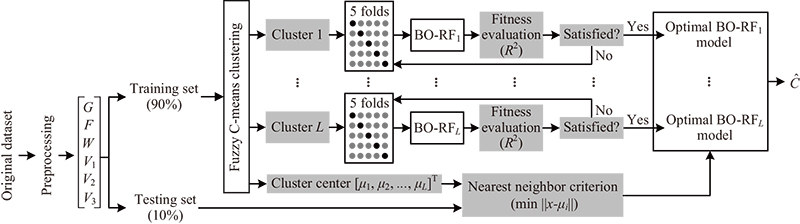
CLR modeling framework
- [1] K. B. Owusu, W. Skinner, and R. Asamoah, “Feed hardness and acoustic emissions of autogenous/semi-autogenous (AG/SAG) mills,” Miner. Eng., Vol.187, Article No.107781, 2022. https://doi.org/10.1016/j.mineng.2022.107781
- [2] Z.-X. Zhang, J. A. Sanchidrián, F. Ouchterlony, and S. Luukkanen, “Reduction of Fragment Size from Mining to Mineral Processing: A Review,” Rock Mechanics and Rock Engineering, Vol.56, No.1 pp. 747-778, 2023. https://doi.org/10.1007/s00603-022-03068-3
- [3] K. B. Owusu, M. Zanin, W. Skinner, and R. Asamoah, “AG/SAG mill acoustic emissions characterisation under different operating conditions,” Miner. Eng., Vol.171, Article No.107098, 2021. https://doi.org/10.1016/j.mineng.2021.107098
- [4] M. Fang, D. Zheng, X. Qiu, and Y. Du, “A Control System for the Ball Mill Grinding Process Based on Model Predictive Control and Equivalent-Input-Disturbance Approach,” J. Adv. Comput. Intell. Intell. Inform., Vol.20, No.7, pp. 1152-1158, 2016. https://doi.org/10.20965/jaciii.2016.p1152
- [5] A. Kumar, R. Sahu, and S. K. Tripathy, “Energy-Efficient Advanced Ultrafine Grinding of Particles Using Stirred Mills—A Review,” Energies, Vol.16, Issue 14, Article No.5277, 2023. https://doi.org/10.3390/en16145277
- [6] M. Hadizadeh, A. Farzanegan, and M. Noaparast, “A plant-scale validated MATLAB-based fuzzy expert system to control SAG mill circuits,” J. of Process Control, Vol.70, pp. 1-11, 2018. https://doi.org/10.1016/j.jprocont.2018.08.003
- [7] L. E. Olivier, M. G. Maritz, and I. K. Craig, “Estimating Ore Particle Size Distribution Using a Deep Convolutional Neural Network,” IFAC-PapersOnLine, Vol.53, Issue 2, pp. 12038-12043, 2020. https://doi.org/10.1016/j.ifacol.2020.12.740
- [8] J. Tang, J. Qiao, Z. Liu, X. Zhou, G. Yu, and J. Zhao, “Mechanism characteristic analysis and soft measuring method review for ball mill load based on mechanical vibration and acoustic signals in the grinding process,” Miner. Eng., Vol.128, pp. 294-311, 2018. https://doi.org/10.1016/j.mineng.2018.09.006
- [9] X. Fang, C. Wu, N. Liao, C. Yuan, B. Xie, and J. Tong, “The first attempt of applying ceramic balls in industrial tumbling mill: A case study,” Miner. Eng., Vol.180, Article No.107504, 2022. https://doi.org/10.1016/j.mineng.2022.107504
- [10] H. Wei, Y. He, S. Wang, W. Xie, W. Zuo, and F. Shi, “Effects of circulating load and grinding feed on the grinding kinetics of cement clinker in an industrial CKP mill,” Powder Technology, Vol.253, pp. 193-197, 2014. https://doi.org/10.1016/j.powtec.2013.11.016
- [11] H. Dündar, “Investigating the benefits of replacing hydrocyclones with high-frequency fine screens in closed grinding circuit by simulation,” Miner. Eng., Vol.148, Article No.106212, 2020. https://doi.org/10.1016/j.mineng.2020.106212
- [12] N. Li, L. Li, J. Wang, Z. Liu, Q. Feng, Q. Zhang, H. Liu, B. Klein, and B. Li, “Prediction of Circulation Load of Side-Flanged High-Pressure Grinding Rolls Closed-Circuit Crushing,” Minerals, Vol.15, Issue 6, Article No.603, 2025. https://doi.org/10.3390/min15060603
- [13] T. Chai, L. Zhai, and H. Yue, “Multiple models and neural networks based decoupling control of ball mill coal-pulverizing systems,” J. of Process Control, Vol.21, Issue 3, pp. 351-366, 2011. https://doi.org/10.1016/j.jprocont.2010.11.007
- [14] J. D. le Roux, A. Steinboeck, A. Kugi, and I. K. Craig, “Steady-state and dynamic simulation of a grinding mill using grind curves,” Miner. Eng., Vol.152, Article No.106208, 2020. https://doi.org/10.1016/j.mineng.2020.106208
- [15] J. T. McCoy and L. Auret, “Machine learning applications in minerals processing: A review,” Miner. Eng., Vol.132, pp. 95-109, 2019. https://doi.org/10.1016/j.mineng.2018.12.004
- [16] Z. Liao, C. Xu, W. Chen, F. Wang, and J. She, “Multi-model integration for predicting circulating load ratio based on clustering SAG milling operating conditions,” Control Eng. Pract., Vol.153, Article No.106129, 2024. https://doi.org/10.1016/j.conengprac.2024.106129
- [17] J. Hu, M. Wu, L. Chen, K. Zhou, P. Zhang, and W. Pedrycz, “Weighted Kernel Fuzzy C-Means-Based Broad Learning Model for Time-Series Prediction of Carbon Efficiency in Iron Ore Sintering Process,” IEEE Trans. on Cybernetics, Vol.52, Issue 6, pp. 4751-4763, 2022. https://doi.org/10.1109/TCYB.2020.3035800
- [18] L. Lin, S. Li, K. Wang, B. Guo, H. Yang, W. Zhong, P. Liao, and P. Wang, “A new FCM-XGBoost system for predicting Pavement Condition Index,” Expert Syst. Appl., Vol.249, Part B, Article No.123696, 2024. https://doi.org/10.1016/j.eswa.2024.123696
- [19] F. Hassanpour, S. Sharifazari, K. Ahmadaali, S. Mohammadi, and Z. Sheikhalipour, “Development of the FCM-SVR Hybrid Model for Estimating the Suspended Sediment Load,” KSCE J. Civ. Eng., Vol.23, Issue 6, pp. 2514-2523, 2019. https://doi.org/10.1007/s12205-019-1693-7
- [20] D. Graves and W. Pedrycz, “Kernel-based fuzzy clustering and fuzzy clustering: A comparative experimental study,” Fuzzy Sets Syst., Vol.161, Issue 4, pp. 522-543, 2010. https://doi.org/10.1016/j.fss.2009.10.021
- [21] J. Fan and J. Wang, “A Two-Phase Fuzzy Clustering Algorithm Based on Neurodynamic Optimization with Its Application for PolSAR Image Segmentation,” IEEE Trans. Fuzzy Syst., Vol.26, Issue 1, pp. 72-83, 2018. https://doi.org/10.1109/TFUZZ.2016.2637373
- [22] B. Chen, J. Hu, L. Duan, and Y. Gu, “Network Administrator Assistance System Based on Fuzzy C-means Analysis,” J. Adv. Comput. Intell. Intell. Inform., Vol.13, No.2, pp. 91-96, 2009. https://doi.org/10.20965/jaciii.2009.p0091
- [23] L. Breiman, “Random Forests,” Mach. Learn., Vol.45, pp. 5-32, 2001. https://doi.org/10.1023/A:1010933404324
- [24] M. S. H. Lipu, M. A. Hannan, A. Hussain, S. Ansari, S. A. Rahman, and M. H. M. Saad, “Real-Time State of Charge Estimation of Lithium-Ion Batteries Using Optimized Random Forest Regression Algorithm,” IEEE Trans. Intell. Veh., Vol.8, Issue 1, pp. 639-648, 2022. https://doi.org/10.1109/TIV.2022.3161301
- [25] M. G. Alfarizi, B. Tajiani, J. Vatn, and S. Yin, “Optimized Random Forest Model for Remaining Useful Life Prediction of Experimental Bearings,” IEEE Trans. Ind. Inf., Vol.19, No.6, pp. 7771-7779, 2023. https://doi.org/10.1109/TII.2022.3206339
- [26] J. Olivier and C. Aldrich, “Use of Decision Trees for the Development of Decision Support Systems for the Control of Grinding Circuits,” Minerals, Vol.11, Issue 6, Article No.595, 2021. https://doi.org/10.3390/min11060595
- [27] C. Loudari, M. Cherkaoui, R. Bennani, I. El Harraki, O. Fares, and M. El Adnani, “Predicting Grinding Mill Power Consumption in Mining: A Comparative Study,” 2023 7th IEEE Congress on Information Science and Technology (CiSt), pp. 395-399, 2023. https://doi.org/10.1109/CiSt56084.2023.10410011
- [28] L. F. Napier and C. Aldrich, “An IsaMill™ Soft Sensor based on Random Forests and Principal Component Analysis,” IFAC-PapersOnLine, Vol.50, Issue 1, pp. 1175-1180, 2017. https://doi.org/10.1016/j.ifacol.2017.08.270
- [29] R. K. Inapakurthi, S. S. Miriyala, and K. Mitra, “Recurrent neural networks based modelling of industrial grinding operation,” Chem. Eng. Sci., Vol.219, Article No.115585, 2020. https://doi.org/10.1016/j.ces.2020.115585
- [30] Z. Ghasemi, F. Neumann, M. Zanin, J. Karageorgos, and L. Chen, “A comparative study of prediction methods for semi-autogenous grinding mill throughput,” Miner. Eng., Vol.205, Article No.108458, 2024. https://doi.org/10.1016/j.mineng.2023.108458
- [31] A. M. Elshewey, M. Y. Shams, N. El-Rashidy, A. M. Elhady, S. M. Shohie, and Z. Tarek, “Bayesian Optimization with Support Vector Machine Model for Parkinson Disease Classification,” Sensors, Vol.23, Issue 4, Article No.2085, 2023. https://doi.org/10.3390/s23042085
- [32] D. Maclaurin, D. Duvenaud, and R. P. Adams, “Gradient-based hyperparameter optimization through reversible learning,” Proc. of the 32nd Int. Conf. on Machine Learning, Vol.37, pp. 2113-2122, 2015.
- [33] M. Aghaabbasi, M. Ali, M. Jasiński, Z. Leonowicz, and T. Novák, “On Hyperparameter Optimization of Machine Learning Methods Using a Bayesian Optimization Algorithm to Predict Work Travel Mode Choice,” IEEE Access, Vol.11, pp. 19762-19774, 2023. https://doi.org/10.1109/ACCESS.2023.3247448
- [34] T. Shaqarin and B. R. Noack, “A Fast-Converging Particle Swarm Optimization through Targeted, Position-Mutated, Elitism (PSO-TPME),” Int. J. Comput. Intell. Syst., Vol.16, No.1, Article No.6, 2023. https://doi.org/10.1007/s44196-023-00183-z
- [35] E. C. Garrido-Merchán and D. Hernández-Lobato, “Dealing with categorical and integer-valued variables in Bayesian optimization with Gaussian processes,” Neurocomputing, Vol.380, pp. 20-35, 2020. https://doi.org/10.1016/j.neucom.2019.11.004
- [36] H. Cho, Y. Kim, E. Lee, D. Choi, Y. Lee, and W. Rhee, “Basic Enhancement Strategies When Using Bayesian Optimization for Hyperparameter Tuning of Deep Neural Networks,” IEEE Access, Vol.8, pp. 52588-52608, 2020. https://doi.org/10.1109/ACCESS.2020.2981072
- [37] J. Zhan, X. Huang, Y. Qian, and W. Ding, “A Fuzzy C-Means Clustering-Based Hybrid Multivariate Time Series Prediction Framework with Feature Selection,” IEEE Trans. Fuzzy Syst., Vol.32, Issue 8, pp. 4270-4284, 2024. https://doi.org/10.1109/TFUZZ.2024.3393622
- [38] J. C. Bezdek, R. Ehrlich, and W. Full, “FCM: The fuzzy c-means clustering algorithm,” Comput. Geosci., Vol.10, Issues 2-3, pp. 191-203, 1984. https://doi.org/10.1016/0098-3004(84)90020-7
- [39] G. Yan, Q. Sun, J. Huang, and Y. Chen, “Helmet Detection Based on Deep Learning and Random Forest on UAV for Power Construction Safety,” J. Adv. Comput. Intell. Intell. Inform., Vol.25, No.1, pp. 40-49, 2021. https://doi.org/10.20965/jaciii.2021.p0040
This article is published under a Creative Commons Attribution-NoDerivatives 4.0 Internationa License.