
Research Paper:
Toolpath Generation Based on Mathematical Algorithms with Shape Simulation for Mold Machining
Daigo Inui, Hidenori Nakatsuji, and Isamu Nishida†
Graduate School of Engineering, Kobe University
1-1 Rokkodai-cho, Nada-ku, Kobe, Hyogo 657-8501, Japan
†Corresponding author

Owing to the shortening of product life cycles and the diversification of consumer needs, the mold industry is also facing increasing demands for shorter lead times, higher quality, and lower costs in mold manufacturing. To meet these demands, automation, high-precision, and high-efficiency technologies in both the pre-processing and post-processing of mold machining are essential. This study proposes and develops a system that includes solution methods of the mathematical Traveling Salesman Problem (TSP) to generate toolpaths with suppressed redundant motions from standard triangulated language (STL)-format computer-aided design (CAD) models, which represent the surface of a three-dimensional shape as a set of triangular meshes and are independent of the type of CAD software, as input data. In the proposed system, a dexel-based workpiece simulation is conducted in parallel with toolpath analysis to identify unmachined regions remaining after pre-machining processes. By detecting these remaining removal regions and calculating efficient paths based on the TSP, the system can output toolpaths from which idle tool motions without cutting have been reduced. To verify the effectiveness of the system, two case studies are conducted using two mold CAD models. The results of the case studies show that toolpaths for both mold models are automatically generated from their STL-format CAD models. The generated toolpaths are then used for actual machining, and the results confirm that the molds have been successfully machined without any critical issues.
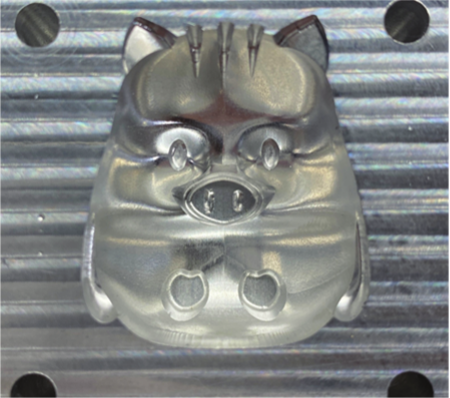
Machined results of case study
- [1] I. Nishida, E. Yamada, and H. Nakatsuji, “Automated process planning system for machining injection molding dies using CAD models of product shapes in STL format,” Int. J. Automation Technol., Vol.17, No.6, pp. 619-626, 2023. https://doi.org/10.20965/ijat.2023.p0619
- [2] K. Matsukawa, H. Nakatsuji, and I. Nishida, “Automated tool-path generation for complex shapes applicable to 5-axis indexing machining using STL-format CAD models,” Int. J. Automation Technol., Vol.19, No.5, pp. 698-711, 2025. https://doi.org/10.20965/ijat.2025.p0698
- [3] E. Morinaga, M. Yamada, H. Wakamatsu, and E. Arai, “Flexible process planning method for milling,” Int. J. Automation Technol., Vol.5, No.5, pp. 700-707, 2011. https://doi.org/10.20965/ijat.2011.p0700
- [4] K. Dwijayanti and H. Aoyama, “Basic study on process planning for turning-milling center based on machining feature recognition,” J. Adv. Mech. Des. Syst. Manuf., Vol.8, No.4, Article No.14-00096, 2014. https://doi.org/10.1299/jamdsm.2014jamdsm0058
- [5] H. Sakurai, “Volume decomposition and feature recognition: Part 1—polyhedral objects,” Comput.-Aided Des., Vol.27, No.11, pp. 833-843, 1995. https://doi.org/10.1016/0010-4485(95)00007-0
- [6] H. Sakurai and P. Dave, “Volume decomposition and feature recognition: Part II—curved objects,” Comput.-Aided Des., Vol.28, Nos.6-7, pp. 519-537, 1996. https://doi.org/10.1016/0010-4485(95)00067-4
- [7] B. K. Choi and K. Ko, “C-space based CAPP algorithm for freeform die-cavity machining,” Comput.-Aided Des., Vol.35, No.2, pp. 179-189, 2003. https://doi.org/10.1016/S0010-4485(02)00051-9
- [8] W.-R. Jong, P.-J. Lai, Y.-W. Chen, and Y.-H. Ting, “Automatic process planning of mold components with integration of feature recognition and group technology,” Int. J. Adv. Manuf. Technol., Vol.78, Nos.5-8, pp. 807-824, 2015. https://doi.org/10.1007/s00170-014-6627-4
- [9] C.-S. Jun, D.-S. Kim, and S. Park, “A new curve-based approach to polyhedral machining,” Comput.-Aided Des., Vol.34, No.5, pp. 379-389, 2002. https://doi.org/10.1016/S0010-4485(01)00110-5
- [10] K. Nakamoto, K. Shirase, H. Wakamatsu, A. Tsumaya, and E. Arai, “Automatic production planning system to achieve flexible direct machining,” JSME Int. J. C Mech. Syst. Mach. Elem. Manuf., Vol.47, No.1, pp. 136-143, 2004. https://doi.org/10.1299/jsmec.47.136
- [11] A. Ueno and K. Nakamoto, “Proposal of machining features for CAPP system for multi-tasking machine tools,” Trans. JSME, Vol.81, No.825, Article No.15-00108, 2015 (in Japanese). https://doi.org/10.1299/transjsme.15-00108
- [12] E. Morinaga, T. Hara, H. Joko, H. Wakamatsu, and E. Arai, “Improvement of computational efficiency in flexible computer-aided process planning,” Int. J. Automation Technol., Vol.8, No.3, pp. 396-405, 2014. https://doi.org/10.20965/ijat.2014.p0396
- [13] I. Nishida, H. Nakatsuji, and K. Shirase, “Automated tool path generation for roughing using flat drill,” Int. J. Automation Technol., Vol.14, No.6, pp. 1036-1044, 2020. https://doi.org/10.20965/ijat.2020.p1036
- [14] I. Nishida and K. Shirase, “Automated process planning system for end-milling operation by CAD model in STL format,” Int. J. Automation Technol., Vol.15, No.2, pp. 149-157, 2021. https://doi.org/10.20965/ijat.2021.p0149
- [15] H. Rushmeier, G. Greiner, and K. Hormann, “Efficient clipping of arbitrary polygons,” ACM Trans. Graph., Vol.17, No.2, pp. 71-83, 1998. https://doi.org/10.1145/274363.274364
- [16] E. L. Foster, K. Hormann, and R. T. Popa, “Clipping simple polygons with degenerate intersections,” Comput. Graph.: X, Vol.2, Article No.100007, 2019. https://doi.org/10.1016/j.cagx.2019.100007
- [17] M. Inui, T. Sakurai, and N. Umezu, “Data conversion technology between triple dexel model and polygonal model,” J. Jpn. Soc. Precis. Eng., Vol.76, No.2, pp. 226-231, 2010 (in Japanese). https://doi.org/10.2493/jjspe.76.226
- [18] M. Inui and N. Umezu, “Contour-type cutter path computation using ultra-high-resolution dexel model,” Comput.-Aided Des. Appl., Vol.17, No.3, pp. 621-638, 2020. https://doi.org/10.14733/cadaps.2020.621-638
- [19] D. J. Rosenkrantz, R. E. Stearns, and P. M. Lewis, “Approximate algorithms for the traveling salesperson problem,” 15th Annu. Symp. Switch. Autom. Theory, pp. 33-42, 1974. https://doi.org/10.1109/SWAT.1974.4
- [20] G. A. Croes, “A method for solving traveling-salesman problems,” Oper. Res., Vol.6, No.6, pp. 791-812, 1958. https://doi.org/10.1287/opre.6.6.791
- [21] S. Lin and B. W. Kernighan, “An effective heuristic algorithm for the traveling-salesman problem,” Oper. Res., Vol.21, No.2, pp. 498-516, 1973. https://doi.org/10.1287/opre.21.2.498
This article is published under a Creative Commons Attribution-NoDerivatives 4.0 Internationa License.