
Research Paper:
Automated Process Planning for Machining Organic Shapes Using Eccentric-Axis Turning
Kentaro Matsukawa, Hidenori Nakatsuji, and Isamu Nishida†

Graduate School of Engineering, Kobe University
1-1 Rokkodai-cho, Nada-ku, Kobe, Hyogo 657-8501, Japan
†Corresponding author

With the shift toward high-mix, low-volume production, the proportion of process planning within the overall manufacturing lead time has increased. This issue is particularly critical in the medical field, where custom-made production of organically shaped components with complex curved surfaces is required, while the number of experienced workers responsible for process planning is decreasing. Typically, machining of models with complex curved surfaces is performed by milling processes, including 5-axis indexing machining and 5-axis simultaneous machining. However, cycle time can be reduced by incorporating additional machining processes, such as turning, alongside milling. Recently, the development of multitasking machine tools equipped with eccentric-axis turning functions has enabled greater machining flexibility and the potential for reduced machining time. Nevertheless, methods for tool path generation and numerical control (NC) program generation that effectively utilize eccentric-axis turning have not yet been sufficiently established. Therefore, in this study, an automated process planning and tool path generation method was proposed that applies eccentric-axis turning to the roughing stage for organically shaped components. In the proposed method, workpiece dimensions and product placement are determined based on shape analysis of a three-dimensional computer-aided design model in Standard Triangulated Language format, and an intermediate shape suitable for eccentric-axis turning is automatically extracted. Furthermore, for regions where material removal by turning is difficult, scanning machining that considers air cuts is applied, and tool paths for each process are generated. To verify the effectiveness of the proposed method, analytical evaluation and actual machining experiments were conducted using organically shaped components. The results confirm that the proposed method appropriately performs shape analysis and NC program generation, and that roughing using eccentric-axis turning is effective in reducing machining time for organically shaped components.
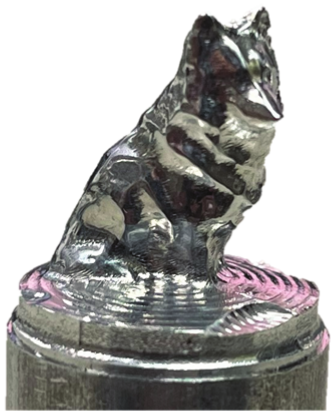
Result of machined product shape in Case study 2
- [1] H. Ueno, “Intelligent technology for machine tools, flexible automation,” Systems, Control and Information, Vol.61, No.3, pp. 107-112, 2017 (in Japanese). https://doi.org/10.11509/isciesci.61.3_107
- [2] Z. L. Gan, S. N. Musa, and H. J. Yap, “A review of the high-mix, low-volume manufacturing industry,” Applied Sciences, Vol.13, No.3, Article No.1687, 2023. https://doi.org/10.3390/app13031687
- [3] T. Tahmina, M. Garcia, Z. Geng, and B. Bidanda, “A survey of smart manufacturing for high-mix low-volume production in defense and aerospace industries,” Proc. of the Int. Conf. on Flexible Automation and Intelligent Manufacturing, pp. 237-245, 2022. https://doi.org/10.1007/978-3-031-18326-3_24
- [4] A. Lasemi, D. Xue, and P. Gu, “Recent development in CNC machining of freeform surfaces: A state-of-the-art review,” Computer-Aided Design, Vol.42, No.7, pp. 641-654, 2010. https://doi.org/10.1016/j.cad.2010.04.002
- [5] K. Nakamoto, K. Shirase, H. Wakamatsu, A. Tsumaya, and E. Arai, “Automatic production planning system to achieve flexible direct machining,” JSME Int. J., Series C, Vol.47, No.1, pp. 136-143, 2004. https://doi.org/10.1299/jsmec.47.136
- [6] Y. Woo, E. Wang, Y. S. Kim, and H. M. Rho, “A hybrid feature recognizer for machining process planning systems,” CIRP Annals – Manufacturing Technology, Vol.54, Issue 1, pp. 397-400, 2005. https://doi.org/10.1016/S0007-8506(07)60131-0
- [7] L. Wang, M. Holm, and G. Adamson, “Embedding a process plan in function blocks for adaptive machining,” CIRP Annals – Manufacturing Technology, Vol.59, Issue 1, pp. 433-436, 2010. https://doi.org/10.1016/j.cirp.2010.03.144
- [8] A. Ueno and K. Nakamoto, “Proposal of machining features for CAPP system for multi-tasking machine tools,” Trans. of the JSME, Vol.81, No.825, Article No.15-00108, 2015 (in Japanese). https://doi.org/10.1299/transjsme.15-00108
- [9] H. Sakurai, “Volume decomposition and feature recognition: Part 1—polyhedral objects,” Computer-Aided Design, Vol.27, Issue 11, pp. 833-843, 1995. https://doi.org/10.1016/0010-4485(95)00007-0
- [10] H. Sakurai and P. Dave, “Volume decomposition and feature recognition: Part 2—curved objects,” Computer-Aided Design, Vol.28, Issues 6-7, pp. 519-537, 1996. https://doi.org/10.1016/0010-4485(95)00067-4
- [11] E. Morinaga, M. Yamada, H. Wakamatsu, and E. Arai, “Flexible process planning method for milling,” Int. J. Automation Technol., Vol.5, No.5, pp. 700-707, 2011. https://doi.org/10.20965/ijat.2011.p0700
- [12] E. Morinaga, T. Hara, H. Joko, H. Wakamatsu, and E. Arai, “Improvement of computational efficiency in flexible computer-aided process planning,” Int. J. Automation Technol., Vol.8, No.3, pp. 396-405, 2014. https://doi.org/10.20965/ijat.2014.p0396
- [13] K. Dwijayanti and H. Aoyama, “Basic study on process planning for turning-milling center based on machining feature recognition,” J. of Advanced Mechanical Design, Systems and Manufacturing, Vol.8, No.4, Article No.JAMDSM0058, 2014. https://doi.org/10.1299/jamdsm.2014jamdsm0058
- [14] I. Nishida and K. Shirase, “Automatic determination of cutting conditions for NC program generation by reusing machining case data based on geometric properties of removal volume,” J. of Advanced Mechanical Design, Systems and Manufacturing, Vol.12, No.4, Article No.JAMDSM0093, 2018. https://doi.org/10.1299/jamdsm.2018jamdsm0093
- [15] P. Kosec, I. Huic, T. Martinec, and S. Škec, “Exploring generative design in context of mass personalization,” Proc. of the Design Society, Vol.5, pp. 1665-1674, 2025. https://doi.org/10.1017/pds.2025.10180
- [16] M. J. Dewey, R. S. H. Chang, A. V. Nosatov, K. Janssen, S. J. Crotts, S. J. Hollister, and B. A. C. Harley, “Generative design approach to combine architected Voronoi foams with porous collagen scaffolds to create a tunable composite biomaterial,” Acta Biomaterialia, Vol.172, pp. 249-259, 2023. https://doi.org/10.1016/j.actbio.2023.10.005
- [17] J. Zhu, M. Kato, T. Tanaka, H. Yoshioka, and Y. Saito, “Graph based automatic process planning system for multi-tasking machine,” J. of Advanced Mechanical Design, Systems and Manufacturing, Vol.9, No.3, Article No.JAMDSM0034, 2015. https://doi.org/10.1299/jamdsm.2015jamdsm0034
- [18] Y. Inoue and K. Nakamoto, “Development of a CAPP system for multi-tasking machine tools to deal with complicated machining operations,” J. of Advanced Mechanical Design, Systems and Manufacturing, Vol.14, No.1, Article No.JAMDSM0006, 2020. https://doi.org/10.1299/jamdsm.2020jamdsm0006
- [19] N. Date, P. Krishnawami, and V. V. S. K. Motipalli, “Automated process planning method to machine a B-spline free-form feature on a mill–turn center,” Computers & Industrial Engineering, Vol.56, Issue 1, pp. 198-207, 2009. https://doi.org/10.1016/j.cie.2008.05.004
- [20] T. Muraki and H. Yamamoto, “Current state and outlook of the multi-tasking machine,” J. of the Japan Society for Precision Engineering, Vol.78, No.9, pp. 740-743, 2012 (in Japanese). https://doi.org/10.2493/jjspe.78.740
- [21] R. Takamori, H. Nakatsuji, and I. Nishida, “Automated process planning system to machine organic shapes by combining turning and milling,” J. of Advanced Mechanical Design, Systems, and Manufacturing, Vol.18, Issue 4, Article No.JAMDSM0038, 2024. https://doi.org/10.1299/jamdsm.2024jamdsm0038
- [22] H. Zhou, B. Henson, and X. Wang, “Extracted control approach for CNC non-circular turning,” Asian J. of Control, Vol.7, No.1, pp. 50-55, 2005. https://doi.org/10.1111/j.1934-6093.2005.tb00227.x
- [23] Z. Sun and T.-C. Tsao, “Process feedback control of the noncircular turning process for camshaft machining,” J. of Dynamic Systems, Measurement, and Control, Vol.130, No.3, Article No.031006, 2008. https://doi.org/10.1115/1.2907403
- [24] Y. Zhang, H. Lu, X. Zhang, W. Fan, X. Su, H. Ling, and S. Wang, “Spiral tool path generation based on symbolic computation for machining of non-axisymmetric curved surface,” The Int. J. of Advanced Manufacturing Technology, Vol.91, pp. 3911-3924, 2017. https://doi.org/10.1007/s00170-017-0059-x
- [25] I. Nishida, E. Yamada, and H. Nakatsuji, “Automated process planning system for machining injection molding dies using CAD models of product shapes in STL format,” Int. J. Automation Technol., Vol.17, No.6, pp. 619-626, 2023. https://doi.org/10.20965/ijat.2023.p0619
- [26] M. Inui, T. Sakurai, and N. Umezu, “Data conversion technology between triple dexel model and polygonal model,” J. of the Japan Society for Precision Engineering, Vol.76, No.2, pp. 226-231, 2010 (in Japanese). https://doi.org/10.2493/jjspe.76.226
- [27] M. Inui and N. Umezu, “Contour-type cutter path computation using ultra-high-resolution dexel model,” Computer-Aided Design and Applications, Vol.17, No.3, pp. 621-638, 2020. https://doi.org/10.14733/cadaps.2020.621-638
- [28] M. Inui, “Visualization of machined shape in 3+2-axis machining by triple-dexel integration of multiple z-map models,” Proc. of the 18th Int. Conf. on Manufacturing Research, pp. 413-418, 2021.
This article is published under a Creative Commons Attribution-NoDerivatives 4.0 Internationa License.