
Research Paper:
Development of a Tactile Globe Maker for the Visually Impaired —Taglomal, the Spherical Surface Processing Machine—
Naoki Asakawa*,†
 , Tomoki Hidai*, Yuko Shimomura*, Hiroki Wada**, and Keigo Takasugi*
*Kanazawa University
Kakuma-machi, Kanazawa, Ishikawa 920-1192, Japan
†Corresponding author
**Kinjo College
Hakusan, Japan

This study aims to automate the production of globes for the visually impaired (VI) and provide low-cost alternatives. This process is achieved using a spherical surface processing machine dedicated to globe fabrication, equipped with a two-axis rotary positioning mechanism and a semiconductor laser. The machine operates based on machining paths generated by a custom-developed computer-aided manufacturing system specifically designed for globe production. As the system generates tool paths from geopolitical information, it supports a variety of applications beyond conventional drilling. These include the creation of raised solid borders, the addition of textures using small point clouds applied exclusively to land areas, and the merging of small-area countries with larger neighboring countries. This allows users to obtain globes tailored to their specific purposes and preferences. As a result, the developed processing system is capable of automatically producing customized globes for VI individuals within one day. In an experiment conducted to investigate which globe characteristics were preferred by several VI participants, no single design was found to be universally preferred. This finding indicates the effectiveness of the proposed system, as it enables customization according to individual user preferences.
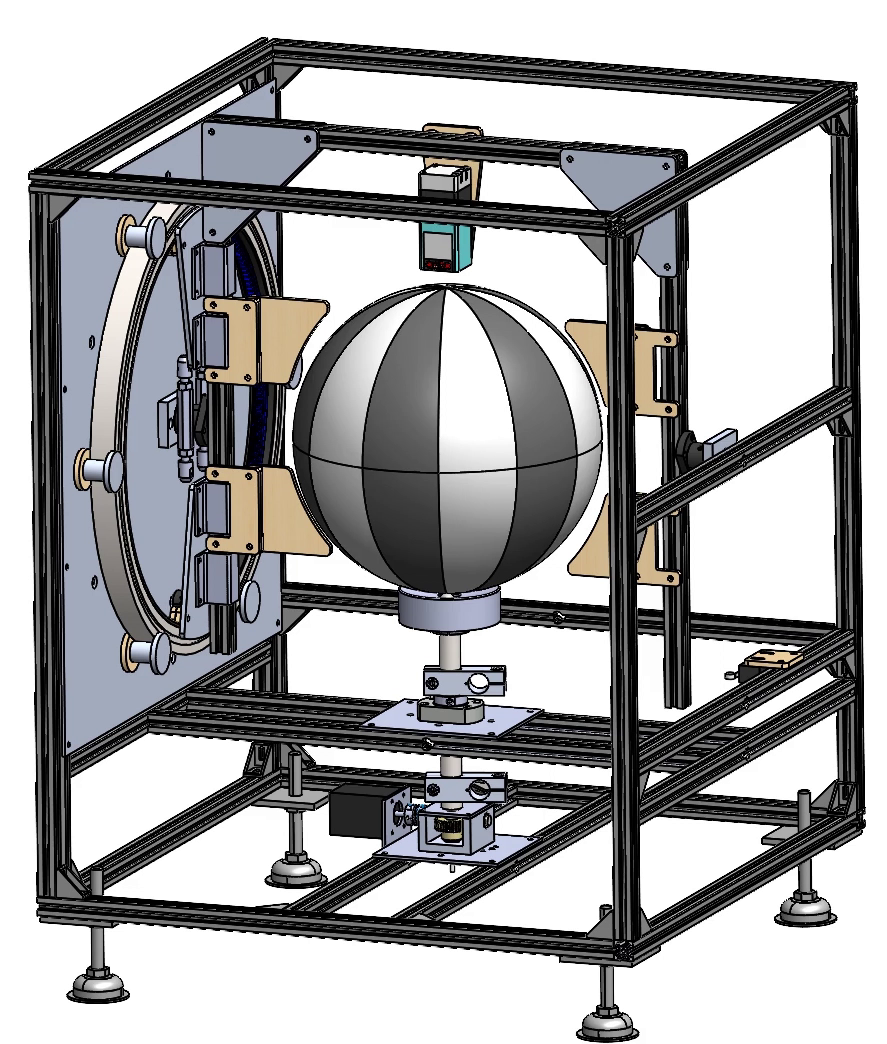
Structure of Taglomal – the spherical surface processing machine
- [1] B. Taylor, A. Dey, D. Siewiorek, and A. Smailagic, “Customizable 3D printed tactile maps as interactive overlays,” Proc. 18th Int. ACM SIGACCESS Conf. Comput. Accessibility (ASSETS’16), pp. 71-79, 2016. https://doi.org/10.1145/2982142.2982167
- [2] Ministry of Education, Culture, Sports, Science and Technology, “Revised Courses of Study for 2017, 2018, and 2019 (text and commentary).” https://www.mext.go.jp/a_menu/shotou/new-cs/1384661.htm [Accessed September 24, 2024]
- [3] E. Baldy, “Children’s representation of the Earth at the end of elementary school: The role of spherical and geographical information carried by the globe,” Rev. Sci. Math. ICT Educ., Vol.17, No.2, pp. 5-25, 2023. https://doi.org/10.26220/rev.4479
- [4] Räthgloben, “3D-Leuchtglobus FRI 30 15.” https://www.raethgloben.de/kollektionen/raethgloben-leipzig/relief-leuchtglobus-fri-30-15 [Accessed September 24, 2024].
- [5] Sun Kogei Co. Ltd., “Barrier-free globe.” http://www.sunkogei.co.jp/history/ [Accessed September 24, 2024]
- [6] Perkins School for the Blind, “Touching history.” https://www.perkins.org/touching-history/ [Accessed September 24, 2024]
- [7] Braille Works, “Braille literacy statistics and how they relate to equality.” https://brailleworks.com/braille-literacy-statistics/.
- [8] Doshisha Co. Ltd., “Perfect globe.” http://perfectglobe.net/ [Accessed September 24, 2024]
- [9] Ceciaa, “Globe terrestre tactile avec stylo parlant.” https://www.ceciaa.com/globe-terrestre-tactile-avec-stylo-parlant.html [Accessed September 24, 2024]
- [10] American Printing House, “Tactile world globe.” https://www.aph.org/product/tactile-world-globe/ [Accessed September 24, 2024]
- [11] U. Ghodke, L. Yusim, S. Somanath, and P. Coppin, “The cross-sensory globe: Participatory design of a 3D audio-tactile globe prototype for blind and low-vision users to learn geography,” Proc. 2019 Designing Interactive Systems Conf. (DIS’19), pp. 399-412, 2019. https://doi.org/10.1145/3322276.3323686
- [12] Reha Vision Co. Ltd., “Talking globe.” http://www.y-adagio.com/public/committees/vhis/confs/vhis5/vhis5-4.pdf [Accessed September 24, 2024]
- [13] N. Asakawa, R. Kito, and K. Takasugi, “Development of tactile globe for the visually impaired (automation of marking using an industrial robot),” Int. J. Automation Technol., Vol.11, No.2, pp. 270-277, 2017. https://doi.org/10.20965/ijat.2017.p0270
- [14] K. Takasugi, N. Asakawa, and Y. Morimoto, “A surface parameter based method for accurate and efficient tool path generation,” Int. J. Automation Technol., Vol.8, No.3, pp. 428-436, 2014. https://doi.org/10.20965/ijat.2014.p0428
- [15] Natural Earth, “Downloads.” https://www.naturalearthdata.com/downloads/ [Accessed September 24, 2024]
- [16] S. Kato, K. Onishi, and Y. Ishida, “Interpolated point thinning method for digital maps according to scale,” Proc. IPSJ 46th National Convention, 8Q-8, 1993 (in Japanese).
- [17] GeoPy, “Welcome to GeoPy’s documentation!” https://geopy.readthedocs.io/en/stable/ [Accessed September 24, 2024]
- [18] Japan Braille Commission, “Braille in Japan No.23.” http://www.braille.jp/_files/00005388/nihontenji23.pdf [Accessed September 24, 2024]
This article is published under a Creative Commons Attribution-NoDerivatives 4.0 Internationa License.