
Research Paper:
Muscle Synergy Comparison Between Gait and Supine Passive Pedaling Under Different Pedaling Conditions
Yuta Takahashi* and Akinori Sekiguchi**,†

*Sustainable Engineering Program, Graduate School of Engineering, Tokyo University of Technology
1404-1 Katakuramachi, Hachioji, Tokyo 192-0982, Japan
**Department of Mechanical Engineering, Tokyo University of Technology
1404-1 Katakuramachi, Hachioji, Tokyo 192-0982, Japan
†Corresponding author

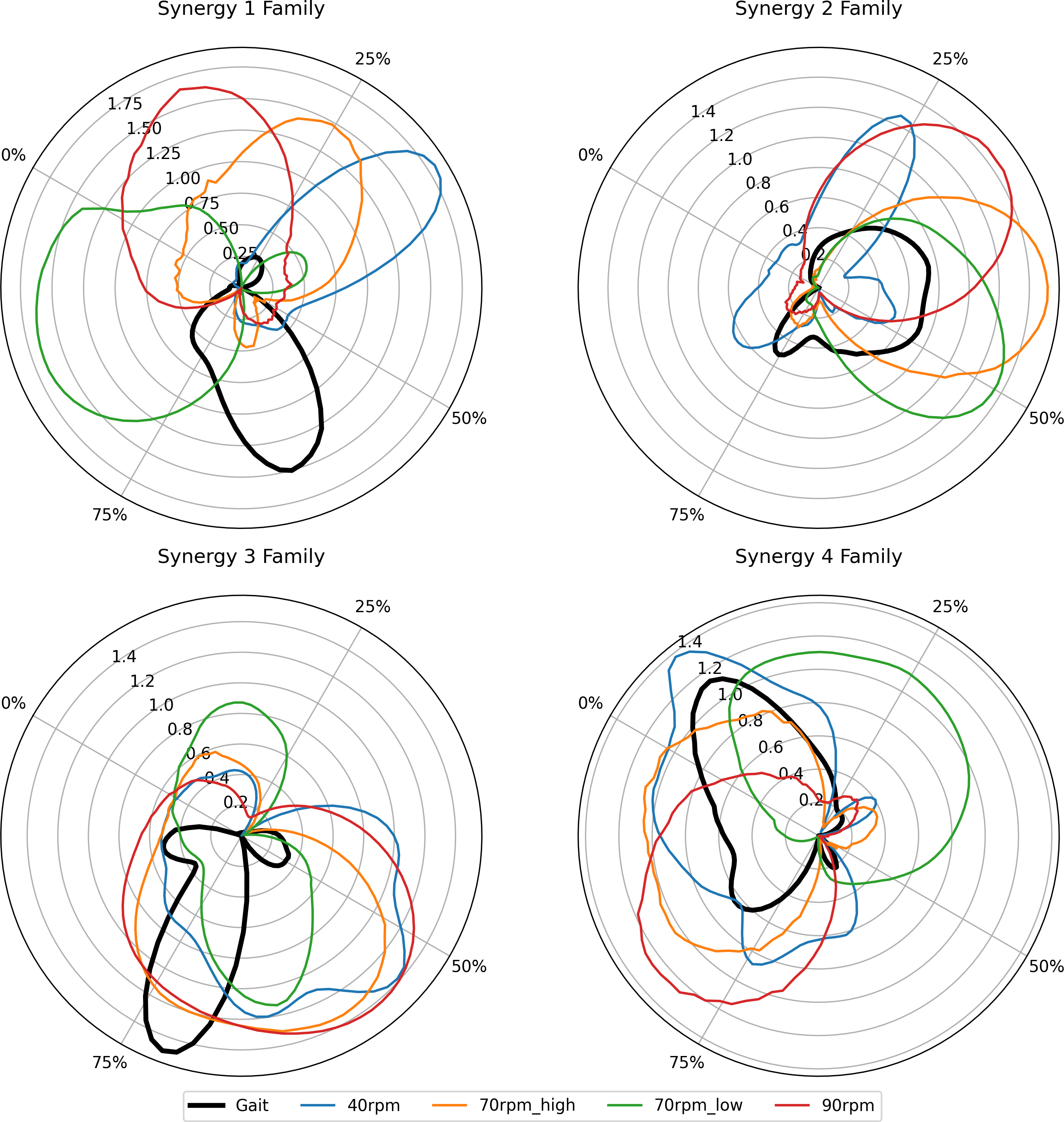
This study used muscle synergy analysis to quantitatively compare the muscle coordination patterns elicited during passive pedaling with those observed during walking. Surface electromyography signals were recorded from the lower limb muscles of a healthy adult during gait and under four different passive pedaling conditions. To evaluate the muscle coordination patterns, muscle synergies were extracted, and their structures were compared. The integrated electromyography was used to quantify the magnitude of muscle activity. Experimental results demonstrated that the fundamental coordination patterns of the thigh muscles observed during gait were largely reproduced during passive pedaling. In contrast, the coordination patterns of the lower leg muscles, which play critical roles in propulsion and weight-bearing, were not adequately reproduced. In addition, the overall muscle activity increased with pedaling speed. These findings suggest that while passive pedaling can reactivate the fundamental rhythmic patterns of locomotion, it cannot replace task-specific, weight-bearing exercises and should instead be used as a preparatory intervention for gait training.
Muscle synergy analysis of passive pedaling
- [1] N. Haida, “Basic science of disuse muscle atrophy,” Rigakuryoho Kagaku (The Science of Physical Therapy), Vol.21, No.2, pp. 94-97, 1994. (in Japanese).
- [2] E. A. Nunes, T. Stokes, J. McKendry, B. S. Currier, and S. M. Phillips, “Disuse-induced skeletal muscle atrophy in disease and nondisease states in humans: Mechanisms, prevention, and recovery strategies,” Am. J. Physiol. Cell Physiol., Vol.322, No.6, pp. C1068-C1084, 2022. https://doi.org/10.1152/ajpcell.00425.2021
- [3] E. J. Hardy, T. B. Inns, J. Hatt, B. Doleman, J. J. Bass, P. J. Atherton, J. N. Lund, and B. E. Phillips, “The time course of disuse muscle atrophy of the lower limb in health and disease,” J. of Cachexia, Sarcopenia and Muscle, Vol.13, No.6, pp. 2616-2629, 2022. https://doi.org/10.1002/jcsm.13067
- [4] J. McKendry, G. Coletta, E. A. Nunes, C. Lim, and S. M. Phillips, “Mitigating disuse-induced skeletal muscle atrophy in ageing: Resistance exercise as a critical countermeasure,” Experimental Physiology, Vol.109, No.10, pp. 1650-1662, 2024. https://doi.org/10.1113/EP091937
- [5] S. A. Horsley, R. D. Herbart, and L. Ada, “Four weeks of daily stretch has little or no effect on wrist contracture after stroke: A randomised controlled trial,” Australian J. of Physiotherapy, Vol.54, No.1, pp. 33-38, 2008. https://doi.org/10.1016/S0004-9514(07)70004-1
- [6] E. Ambrosini, C. De Marchis, A. Pedrocchi, G. Ferrigno, M. Monticone, M. Schmid, T. D’Alessio, S. Conforto, and S. Ferrante, “Neuro-mechanics of recumbent leg cycling in post-acute stroke patients,” Annals of Biomedical Engineering, Vol.44, No.11, pp. 3238-3251, 2016. https://doi.org/10.1007/s10439-016-1660-0
- [7] R. Nardone, A. Orioli, S. Golaszewski, F. Brigo, L. Sebastianelli, Y. Höller, V. Frey, and E. Trinka, “Passive cycling in neurorehabilitation after spinal cord injury: A review,” The J. of Spinal Cord Medicine, Vol.40, No.1, pp. 8-16, 2017. https://doi.org/10.1080/10790268.2016.1248524
- [8] S. D. Holzapfel, P. R. Bosch, C. D. Lee, P. S. Pohl, M. Szeto, B. Heyer, and S. D. Ringenbach, “Acute effects of assisted cycling therapy on post-stroke motor function: A pilot study,” Rehabilitation Research and Practice, Article No.9028714, 2019. https://doi.org/10.1155/2019/9028714
- [9] W. R. Galvão, L. K. C. Silva, M. F. Formiga, G. A. P. Thé, C. D. C. d. M. Faria, R. T. Viana, and L. A. O. Lima, “Cycling using functional electrical stimulation therapy to improve mobility after stroke: A systematic review and meta-analysis,” BioMedical Engineering OnLine, Vol.23, No.1, 2024. https://doi.org/10.1186/s12938-023-01195-8
- [10] O. Kiehn, “Decoding the organization of spinal circuits that control locomotion,” Nature Reviews Neuroscience, Vol.17, No.4, pp. 224-238, 2016. https://doi.org/10.1038/nrn.2016.9
- [11] A. J. Northcutt and D. J. Schulz, “Molecular mechanisms of homeostatic plasticity in central pattern generator networks,” Dev. Neurobiol., Vol.80, Nos.1-2, pp. 58-69, 2020. https://doi.org/10.1002/dneu.22727
- [12] A. G. Feldman, M. F. Levin, A. Garofolini, D. Piscitelli, and L. Zhang, “Central pattern generator and human locomotion in the context of referent control of motor actions,” Clinical Neurophysiology, Vol.132, No.11, pp. 2870-2889, 2021. https://doi.org/10.1016/j.clinph.2021.08.016
- [13] Y. P. Ivanenko, R. E. Poppele, and F. Lacquaniti, “Motor control programs and walking,” The Neuroscientist, Vol.12, No.4, pp. 339-348, 2006. https://doi.org/10.1177/1073858406287987
- [14] F. Michaud, M. S. Shourijeh, B. J. Fregly, and J. Cuadrado, “Do muscle synergies improve optimization prediction of muscle activations during gait?,” Frontiers in Computational Neuroscience, Vol.14, No.54, 2020. https://doi.org/10.3389/fncom.2020.00054
- [15] F. Hug, N. A. Turpin, A. Couturier, and S. Dorel, “Consistency of muscle synergies during pedaling across different mechanical constraints,” J. of Neurophysiology, Vol.106, No.1, pp. 91-103, 2011. https://doi.org/10.1152/jn.01096.2010
- [16] S. A. Safavynia, G. Torres-Oviedo, and L. H. Ting, “Muscle synergies: Implications for clinical evaluation and rehabilitation of movement,” Topics in Spinal Cord Injury Rehabilitation, Vol.17, No.1, pp. 16-24, 2011. https://doi.org/10.1310/sci1701-16
- [17] H. J. Hermens, B. Freriks, C. Disselhorst-Klug, and G. Rau, “Development of recommendations for SEMG sensors and sensor placement procedures,” J. of Electromyography and Kinesiology, Vol.10, No.5, pp. 361-374, 2000. https://doi.org/10.1016/s1050-6411(00)00027-4
- [18] H. Nakamura, “Essential knowledge of biometry 1 (electromyogram),” Japanese J. of Medical Electronics and Biological Engineering, Vol.57, Nos.4-5, pp. 149-157, 2019. (in Japanese).
- [19] D. D. Lee and H. S. Seung, “Learning the parts of objects with nonnegative matrix factorization,” Nature, Vol.401, pp. 788-791, 1999. https://doi.org/10.1038/44565
- [20] H. Kaneoka, “Non-negative matrix factorization,” J. of the Society of Instrument and Control Engineers, Vol.51, No.9, pp. 835-844, 2012. (in Japanese).
- [21] S. Kuroda, J. She, S. Nakamuro, R. Wang, D. Chugo, K. Ishiguro, H. Sakai, and H. Hashimoto, “Selecting pedal load for lower-limb rehabilitation based on the combination of muscle synergy and fourier series,” J. Adv. Comput. Intell. Intell. Inform., Vol.28, No.3, pp. 595-605, 2024. https://doi.org/10.20965/jaciii.2024.p0595
- [22] Y. Hara, M. Yoshida, M. Matsumura, and N. Ichihashi, “Evaluation of muscle activities with integrated EMG,” The Trans. of the Institute of Electrical Engineers of Japan C, Vol.124, No.2, pp. 431-435, 2004. (in Japanese).
- [23] R. R. Neptune, D. J. Clark, and S. A. Kautz, “Modular control of human walking: a simulation study,” J. of Biomechanics, Vol.42, No.9, pp. 1282-1287, 2009. https://doi.org/10.1016/j.jbiomech.2009.03.009
- [24] D.-S. Komaris, D. Tsaopoulos, K. Risvas, S. Nikolopoulos, V. Baltzopoulos, C. Maganaris, and I. Kompatsiaris, “Comparative analysis of muscle synergies in gait of stroke patients and healthy controls,” Front. Hum. Neurosci., Vol.19, Article No.1601147, 2025. https://doi.org/10.3389/fnhum.2025.1601147
This article is published under a Creative Commons Attribution-NoDerivatives 4.0 Internationa License.