
Research Paper:
Research on the Daily Frequency Time Structure Components of China’s Real-Time Carbon Emissions —Based on the Prophet Framework Model
Wuliu Zhang* and Zhiming Tu**
*Center for Big Data of Digital Fujian “the Belt and Road” Service Industry
No.668 Jimei Avenue, Jimei District, Xiamen, Fujian 361021, China
**Institute of Quantitative Economics and Statistics, Huaqiao University
No.668 Jimei Avenue, Jimei District, Xiamen, Fujian 361021, China

To accurately characterize the time structure of China’s daily CO2 emissions, this study uses daily data from the Carbon Monitor database spanning 2019–2025, covering total emissions and six sectoral categories: domestic aviation, ground transport, industry, international aviation, power, and residential. The Prophet framework is adopted to decompose the emission time series into four components: long-term trend, nonlinear seasonal component, holiday effect term, and COVID-19 impact term. Results show that the model achieves excellent fitting accuracy, with outstanding performance in international aviation and residential sectors, and low error levels across all sectors. In terms of long-term trends, total emissions exhibit a steady decline after 2022, the industry and power sectors are significantly influenced by the “dual carbon” policy and energy structure adjustment, whereas the transport sectors display phased recovery corresponding to changes in travel demand. For seasonal components, periodic peaks are observed in the residential and power sectors, fluctuations in ground transport align with travel demand patterns, and aviation sectors present weak seasonal characteristics with more moderate fluctuations during the pandemic. Regarding event impacts, the negative impact of the COVID-19 peak period on emissions is significantly stronger than that of holidays such as the Spring Festival, with distinct sectoral heterogeneity. The industry and power sectors are the most sensitive, whereas domestic aviation, international aviation, and residential sectors show lower sensitivity. This study provides scientific support for the dynamic management of carbon emissions and the formulation of “dual carbon” policies.
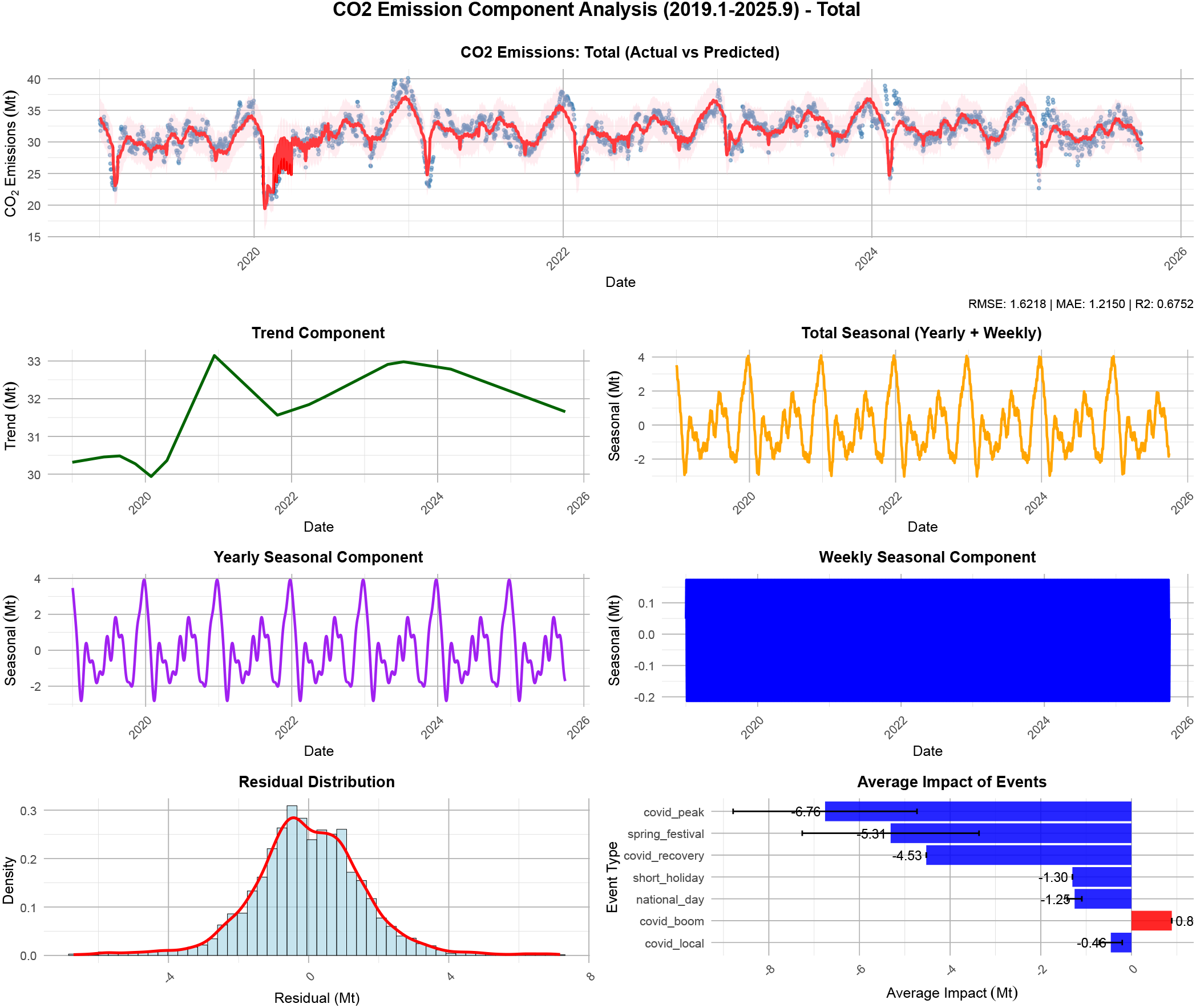
Decomposing China's daily CO2 emissions
- [1] S. Qu and C. Guo, “Forecast of China’s carbon emissions based on STIRPAT modely,” China Popul. Resour. Environ., Vol.20, No.12, pp. 10-15, 2010 (in Chinese).
- [2] C. Yan et al., “Impacts of COVlD-19 traffic control policy on population flows in Changsha,” J. Transp. Syst. Eng. Inf. Technol., Vol.21, No.5, pp. 190-197, 2021 (in Chinese). https://doi.org/10.16097/j.cnki.1009-6744.2021.05.019
- [3] F. Dong et al., “Drivers of carbon emission intensity change in China,” Resour. Conserv. Recycl., Vol.129, pp. 187-201, 2018. https://doi.org/10.1016/j.resconrec.2017.10.035
- [4] L.-C. Liu, Y. Fan, G. Wu, and Y.-M. Wei, “Using LMDI method to analyze the change of China’s industrial CO2 emissions from final fuel use: An empirical analysis,” Energy Policy, Vol.35, No.11, pp. 5892-5900, 2007. https://doi.org/10.1016/j.enpol.2007.07.010
- [5] J. Jiang, C. Han, W. X. Zhao, and J. Wang, “PDFormer: Propagation delay-aware dynamic long-range transformer for traffic flow prediction,” Proc. AAAI Conf. Artif. Intell., Vol.37, No.4, pp. 4365-4373, 2023. https://doi.org/10.1609/aaai.v37i4.25556
- [6] H. Qin and M. Han, “Real-time forecasting and short-term prediction of Chinese carbon dioxide emissions based on MIDAS model,” Acta Sci. Circumstantiae, Vol.38, No.5, pp. 2099-2107, 2018 (in Chinese). https://doi.org/10.13671/j.hjkxxb.2017.0496
- [7] Y. Jiang et al., “Dynamic carbon emission responsibility factor of electricity,” Proc. CSEE, Vol.44, No.17, pp. 7024-7039, 2024 (in Chinese). https://doi.org/10.13334/j.0258-8013.pcsee.240573
- [8] H. Yang and J. F. O’Connell, “Short-term carbon emissions forecast for aviation industry in Shanghai,” J. Clean. Prod., Vol.275, Article No.122734, 2020. https://doi.org/10.1016/j.jclepro.2020.122734
- [9] S. Huang, X. Xiao, and H. Guo, “A novel method for carbon emission forecasting based on EKC hypothesis and nonlinear multivariate grey model: Evidence from transportation sector,” Environ. Sci. Pollut. Res., Vol.29, No.40, pp. 60687-60711, 2022. https://doi.org/10.1007/s11356-022-20120-5
- [10] W. Zhong et al., “Accurate and efficient daily carbon emission forecasting based on improved ARIMA,” Appl. Energy, Vol.376, Part A, Article No.124232, 2024. https://doi.org/10.1016/j.apenergy.2024.124232
- [11] H. Luo et al., “Carbon emission prediction model of prefecture-level administrative region: A land-use-based case study of Xi’an city, China,” Appl. Energy, Vol.348, Article No.121488, 2023. https://doi.org/10.1016/j.apenergy.2023.121488
- [12] X. Zeng and Y. Zhao, “Study on the application of LSTM network in subway tunnel subsidence prediction,” J. Gansu Sci., Vol.31, No.6, pp. 117-122, 2019 (in Chinese). https://doi.org/10.16468/j.cnki.issn1004-0366.2019.06.021
- [13] Y. Long et al., “Japanese urban household carbon footprints during early-stage COVID-19 pandemic were consistent with those over the past decade,” npj Urban Sustain., Vol.3, Article No.19, 2023. https://doi.org/10.1038/s42949-023-00095-z
- [14] Q. Wang and M. Su, “A preliminary assessment of the impact of COVID-19 on environment – A case study of China,” Sci. Total Environ., Vol.728, Article No.138915, 2020. https://doi.org/10.1016/j.scitotenv.2020.138915
- [15] V. Yadav et al., “The impact of COVID-19 on CO2 emissions in the Los Angeles and Washington DC/Baltimore metropolitan areas,” Geophys. Res. Lett., Vol.48, No.11, Article No.e2021GL092744, 2021. https://doi.org/10.1029/2021GL092744
- [16] J.-P. Zhang, Y.-C. Qin, Y. Zhang, and L.-J. Zhang, “Measurement of urban CO2 emission structure and low-carbon standard – A case study for Bejing, Tianjin, Shanghai and Chongging City,” Sci. Geogr. Sin., Vol.30, No.6, pp. 874-879, 2010 (in Chinese). https://doi.org/10.13249/j.cnki.sgs.2010.06.874
- [17] R. Li and S. Li, “Carbon emission post-coronavirus: Continual decline or rebound?” Struct. Change Econ. Dyn., Vol.57, pp. 57-67, 2021. https://doi.org/10.1016/j.strueco.2021.01.008
- [18] X. Dou et al., “Near-real-time global gridded daily CO2 emissions 2021,” Sci. Data, Vol.10, Article No.69, 2023. https://doi.org/10.1038/s41597-023-01963-0
- [19] D. M. Miller and D. Williams, “Shrinkage estimators of time series seasonal factors and their effect on forecasting accuracy,” Int. J. Forecast., Vol.19, No.4, pp. 669-684, 2003. https://doi.org/10.1016/S0169-2070(02)00077-8
- [20] R. B. Cleveland, W. S. Cleveland, J. E. McRae, and I. Terpenning, “STL: A seasonal-trend decomposition procedure based on loess,” J. Off. Stat., Vol.6, No.1, pp. 3-73, 1990.
- [21] D. F. Findley, B. C. Monsell, W. R. Bell, M. C. Otto, and B.-C. Chen, “New capabilities and methods of the X-12-ARIMA seasonal adjustment program,” J. Bus. Econ. Stat., Vol.16, No.2, pp. 127-152, 1998. https://doi.org/10.1080/07350015.1998.10524743
This article is published under a Creative Commons Attribution-NoDerivatives 4.0 Internationa License.