
Research Paper:
A Retrospective Study of Shenshu Granules for the Treatment of Pyelonephritis in Xiamen
Yaling Kong*1,*2
 , Xulian Cai*1,*2, Ming Li*1,*2
, Jiayuan Zhang*1,*2
, Suping Wang*1,*2, Litao Yi*3,*4
, Guanghui Xu*1,*2
, and Moliang Chen*1,*2,†
*1Xiamen Health and Medical Big Data Center
No.2009 Huizhan Road, Siming, Xiamen, Fujian 361008, China
*2Xiamen Key Laboratory of Natural Medicine Research and Development
No.2009 Huizhan Road, Siming, Xiamen, Fujian 361008, China
*3Department of Chemical and Pharmaceutical Engineering, College of Chemical Engineering, Huaqiao University
No.668 Jimei Avenue, Jimei, Xiamen, Fujian 361021, China
*4Institute of Pharmaceutical Engineering, Huaqiao University
No.668 Jimei Avenue, Jimei, Xiamen, Fujian 361021, China
†Corresponding author

To characterize the clinical profile of Shenshu granules (SG) in patients with pyelonephritis and evaluate their effectiveness in reducing the recurrence of pyelonephritis. This retrospective cohort study included patients diagnosed with pyelonephritis in Xiamen between January 1, 2013, and December 31, 2023. To minimize potential selection bias, propensity score matching (PSM) was performed at a 1:2 ratio between the observation group and the control group. A total of 5,628 patients were initially enrolled in this study. After PSM, 1,110 patients were included in the final analysis: 740 in the antibiotic-only (AO) group and 370 in the antibiotics combined with SG group. Within six months of follow-up, recurrence occurred in 85 patients (23.0%) in the SG group and 247 patients (33.4%) in the AO group, representing a significantly lower recurrence rate in the SG group (p<0.001). Among patients who experienced recurrence within six months, 49 of 85 patients (57.6%) in the SG group and 109 of 247 patients (44.1%) in the AO group achieved therapeutic efficacy. Overall treatment effectiveness was significantly higher in the SG group than in the AO group (90.2% vs. 81.4%, p<0.001). SG demonstrated favorable therapeutic efficacy and may help alleviate symptoms, promote faster recovery, and reduce the risk of pyelonephritis recurrence when used as an adjunct to antibiotic therapy. These findings support the clinical potential of SG and warrant further investigation in larger prospective studies.
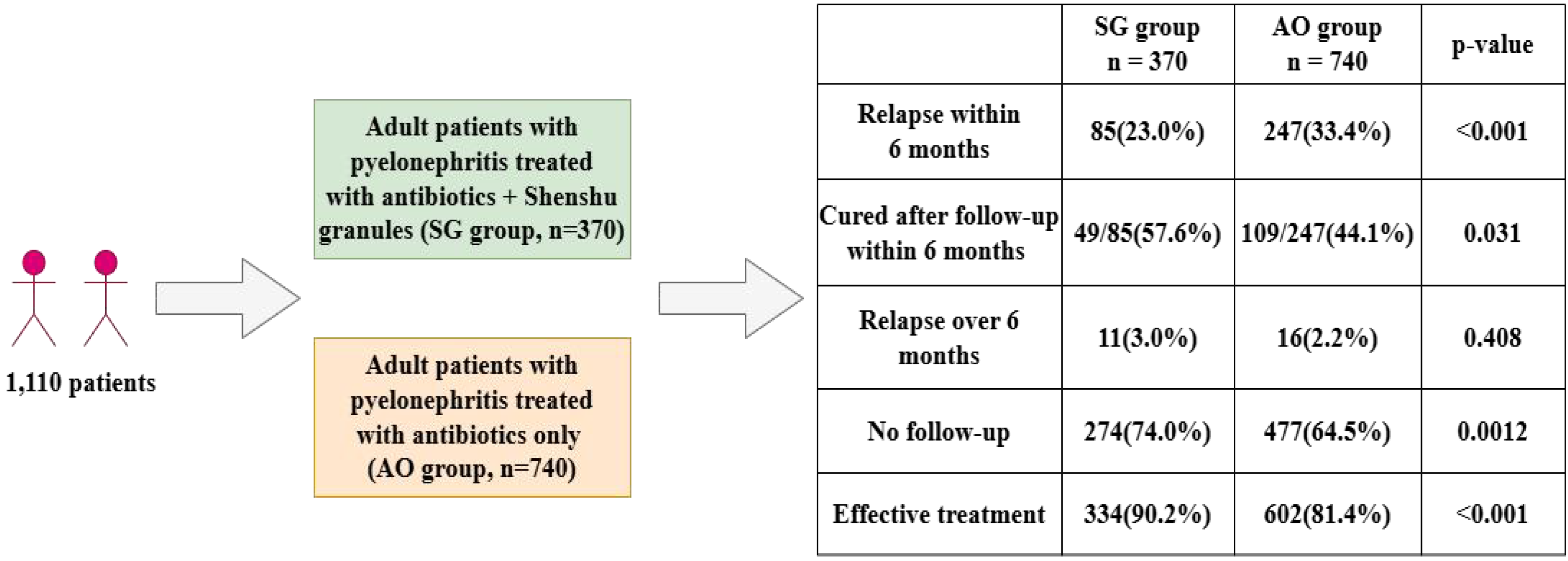
Flowchart of the study
- [1] T. J. Hatlen, R. Flor, M. H. Nguyen, G. H. Lee, and L. G. Miller, “Oral fosfomycin use for pyelonephritis and complicated urinary tract infections: A 1 year review of outcomes and prescribing habits in a large municipal healthcare system,” J. Antimicrob. Chemother., Vol.75, pp. 1993-1997, 2020. https://doi.org/10.1093/jac/dkaa126
- [2] S. Anumudu and G. Eknoyan, “Pyelonephritis: A historical reappraisal,” J. Am. Soc. Nephrol., Vol.30, pp. 914-917, 2019. https://doi.org/10.1681/ASN.2019010017
- [3] J. R. Johnson and T. A. Russo, “Acute pyelonephritis in adults,” New England J. of Medicine, Vol.378, pp. 48-59, 2018. https://doi.org/10.1056/NEJMcp1702758
- [4] R. Umeda, S. Ogata, S. Hara, K. Takahashi, D. Inaguma, M. Hasegawa, H. Yasuoka, Y. Yuzawa, H. Hayashi, and N. Tsuboi, “Comparison of the 2018 and 2003 International Society of Nephrology/renal Pathology Society classification in terms of renal prognosis in patients of lupus nephritis: A retrospective cohort study,” Arthritis Res. Ther., Vol.22, Article No.260, 2020. https://doi.org/10.1186/s13075-020-02358-x
- [5] K. B. Kolman, “Cystitis and pyelonephritis,” Prim. Care Clin. Off. Pract., Vol.46, pp. 191-202, 2019. https://doi.org/10.1016/j.pop.2019.01.001
- [6] K. S. Kaye, A. Belley, P. Barth, O. Lahlou, P. Knechtle, P. Motta, and P. Velicitat, “Effect of cefepime/enmetazobactam vs piperacillin/tazobactam on clinical cure and microbiological eradication in patients with complicated urinary tract infection or acute pyelonephritis: A randomized clinical trial,” JAMA 328, 1304, 2022 https://doi.org/10.1001/jama.2022.17034
- [7] W. Li and W. Xie, “Study on the Clinical Efficacy of Shenshu Granules in the Treatment of Chronic Urinary Tract Infection,” Research of Integrated Traditional Chinese and Western Medicine, pp. 246-249, 2015.
- [8] C. Cheng, “Clinical Observation of Shenshu Granule in the Treatment of Chronic Pyelonephritis,” Modern Diagnosis and Treatment, pp. 1522-1523, 2014.
- [9] National Medical Products Administration, “Announcement of the National Medical Products Administration and National Health Commission on Issuing the 2025 Edition of the Pharmacopoeia of the People’s Republic of China,” No.29, 2025.
- [10] M. Li, Z. Liu, C. Zhu, T. Ling, C. Li, L. Wang, and Y. Xu, “Antibacterial activity of ethyl acetate fraction from Polygonum aviculare,” Research and Development of Natural Products, Vol.28, pp. 547-550, 2016.
- [11] P. Zhao, J. Gong, A. Gao, H. Zheng, Y. Chen, X. Zhang, F. Lu, N. Li, and S. Ni, “Identification and Research Advance on pharmaceutical Science of Lyodium Sw. Plants,” J. of Anhui Agricultural Sciences, Vol.39, pp. 8380-8381, 2011.
- [12] R. Zhu, K. Xu, Y. Wei, F. Zeng, and Z. Zheng, “Study on the clinical application and dosage of Lophatherum gracile,” Jilin Chinese Medicine, Vol.41, pp. 668-671, 2021.
- [13] F. Yuan, M. Wu, and B. Tan, “Simultaneous determination of 9 components in Shenshu granules by quantitative analysis of multi-components by single marker (QAMS),” Chinese Patent Medicine, Vol.41, pp. 2848-2853, 2019.
- [14] X. Wang, Y. Wang, Z. Zhou, and S. Luo, “Study on the Antibacterial Activity of and Isatis Indigotica and Phellodendron Chinense Schneid Extracts in Vitro,” Heilongjiang Science, Vol.14, pp. 94-97, 2023.
- [15] T. Diao, “Preliminary study on pharmacological effects of Poria cocos,” Clinical Study of Traditional Chinese Medicine, Vol.7, pp. 23-24, 2015.
- [16] P. Li, Y. Meng, H. Li, B. Gong, X. Shi, and C. Hao, “Study on the effective components of polysaccharides from Nanhe Rehmannia glutinosa,” China Food Safety Magazine, pp. 81, 2017.
- [17] Q. Yang, Z. Meng, X. Wang, M. Fang, and G. Wu, “Extraction and Purification of Glycyrrhizin and Its Pharmacological Effects: A Review,” Chinese Wild Plant Resources, Vol.42, pp. 12-17, 2023.
- [18] X. Xiao, C. Li, X. Liu, and J. Xue, “Research progress of main chemical constituents and pharmacological effects of Glycyrrhizae Radix et Rhizoma,” J. of Xinxiang Medical University, Vol.40, pp. 280-285, 2023.
- [19] National Medical Products Administration, “National Drug Standard BFZ20010063: Shenshu Granules (Sugar-Free Type),” National Medical Products Administration, 2001.
- [20] Chinese Society of Nephrology, “Clinical Practice Guidelines: Nephrology Volume,” People’s Medical Publishing House, 2011.
- [21] S. Deoraj, F. Zakharious, A. Nasim, and C. Missouris, “Emphysematous pyelonephritis: Outcomes of conservative management and literature review,” BMJ Case Rep., Vol.2018, Article No.bcr-2018-225931, 2018. https://doi.org/10.1136/bcr-2018-225931
- [22] F. M. Wagenlehner, O. Umeh, J. Steenbergen, G. Yuan, and R. O. Darouiche, “Ceftolozane-tazobactam compared with levofloxacin in the treatment of complicated urinary-tract infections, including pyelonephritis: A randomised, double-blind, phase 3 trial (ASPECT-cUTI),” The Lancet, Vol.385, pp. 1949-1956, 2015. https://doi.org/10.1016/S0140-6736(14)62220-0
- [23] S. Messous, I. Trabelsi, K. Bel Haj Ali et al., “Two-day versus seven-day course of levofloxacin in acute COPD exacerbation: A randomized controlled trial,” Ther. Adv. Respir. Dis., Vol.16, Article No.175346662210997, 2022. https://doi.org/10.1177/17534666221099729
- [24] C. Rafat, I. Debrix, and A. Hertig, “Levofloxacin for the treatment of pyelonephritis,” Expert Opin, Pharmacother, Vol.14, pp. 1241-1253, 2013. https://doi.org/10.1517/14656566.2013.792805
- [25] K. Lin, Y. Zahlanie, J. K. Ortwine, W. Wei, N. S. Mang, and B. C. Prokesch, “A retrospective review of oral cephalosporins versus fluoroquinolones for the treatment of pyelonephritis,” PLoS ONE, Vol.17, No.9, Article No.e0274194, 2022. https://doi.org/10.1371/journal.pone.0274194
- [26] S. Tehrani, F. Elyasi, and S. Abolghasemi, “Levofloxacin versus ceftriaxone for the treatment of acute pyelonephritis in Iranian adults,” Infect. Disord. – Drug Targets, Vol.21, pp. 603-607, 2021. https://doi.org/10.2174/1871526520999200727154214
This article is published under a Creative Commons Attribution-NoDerivatives 4.0 Internationa License.