
Paper:
Modeling of Higher-Order Rotor Flap Angle Dynamics for Flybarless Uncrewed Helicopters in High-Speed Flight
Hiroaki Nakanishi
 and Yoshiki Nishimoto
Kyoto University
Kyotodaigaku-Katsura, Nishikyo-ku, Kyoto 615-8540, Japan

Stable autonomous flight at high speeds is essential to expand the operational capabilities of flybarless uncrewed helicopters. This study develops a high-fidelity flapping dynamics model to accurately describe rotor behavior at high speeds. We derive a dynamics model that incorporates higher-order terms of the advance ratio. By expanding the flapping angle into a Fourier series, we obtain an n-th-order constant-coefficient differential equation model that accounts for inter-harmonic coupling. Numerical simulations were conducted at low (μx=0.04) and high (μx=0.25) speeds. Power spectral density analysis revealed that higher-order harmonics (2 /rev and 3 /rev) become significant at high speeds, rendering the conventional first-order approximation inadequate. Furthermore, the impact on the aerodynamic forces and moments of the rotor was quantified. In high-speed flight, the first-order model produces substantial errors in lateral force, drag, and moments owing to lift asymmetry between blades. Second-order or higher models significantly improve accuracy. Considering the balance between computational load and precision, a second-order model is the most practical choice for high-speed aerodynamic evaluation. These findings provide fundamental insights for the advanced control system design of high-speed flybarless uncrewed helicopters.
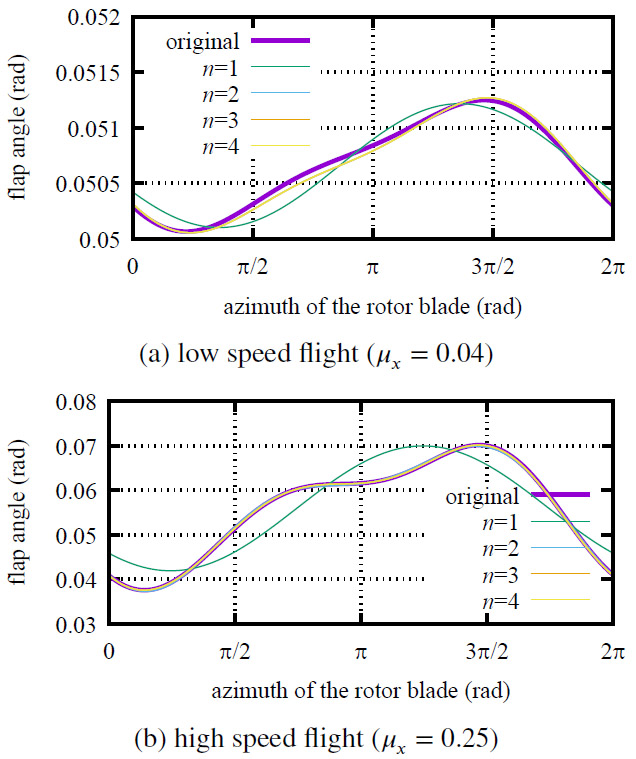
Flap angle models at low and high speed. n is the harmonic expansion order
- [1] A. Sato and H. Nakanishi, “Observation and Measurement in Disaster Areas Using Industrial Use Unmanned Helicopters,” 2014 IEEE Int. Symp. on Safety, Security, and Rescue Robotics, 2014. https://doi.org/10.1109/SSRR.2014.7017671
- [2] K. Hui and R. Srinivasan, “The Inclusion of Higher-Order Rotor Dynamics to Improve the Dynamic Model of a Single-Rotor Helicopter in Hover,” NATO Symp. on System Identification for Integrated Aircraft Development and Flight Testing, 2009.
- [3] S. Bhandari and R. Colgren, “High-Order Dynamics Models of a Small UAV Helicopter Using Analytical and Parameter Identification Techniques,” J. of the American Helicopter Society, Vol.60, No.2, pp. 1-10, 2015. https://doi.org/10.4050/JAHS.60.022012
- [4] A. Sato, H. Nakanishi, and H. Okawa, “Stabilizer-bar’s Effect on Flight Dynamics of Unmanned Helicopter,” J. of the Japan Society for Aeronautical and Space Sciences, Vol.63, Issue 2, pp. 68-76, 2015. https://doi.org/10.2322/jjsass.63.68
- [5] B. Zhu and Z. Zuo, “Approximate analysis for main rotor flapping dynamics of a model-scaled helicopter with Bell-Hiller stabilizing bar in hovering and vertical flights,” Nonlinear Dynamics, Vol.85, No.3, pp. 1705-1717, 2016. https://doi.org/10.1007/s11071-016-2788-z
- [6] M. Alexander, “Identification of Higher-Order Rotor Flapping Dynamics Model Structures Using Explicit Soft Inplane Hingeless Rotor Hub State Measurements of the NRC Bell 412 Advanced System Research Aircraft,” Proc. of the Vertical Flight Society 80th Annual Forum and Technology Display, 2024. https://doi.org/10.4050/F-0080-2024-1396
- [7] J. R. Majhi and R. Ganguli, “Helicopter blade flapping with and without small angle assumption in the presence of dynamic stall,” Applied Mathematical Modeling, Vol.34, Issue 12, pp. 3726-3740, 2010. https://doi.org/10.1016/j.apm.2010.02.010
- [8] W. Johnson, “Helicopter Theory,” Courier Corporation, 2012.
- [9] W. Johnson, “Rotorcraft Aeromechanics,” Cambridge University Press, 2013. https://doi.org/10.1017/CBO9781139235655
- [10] D. A. Peters, D. D. Boyd, and C. J. He, “Finite-State Induced-Flow Model for Rotors in Hover and Forward Flight,” J. of the American Helicopter Society, Vol.34, No.4, pp. 5-17, 1989. https://doi.org/10.4050/JAHS.34.5
- [11] D. A. Peters and C. J. He, “Finite state induced flow models. II – Three-dimensional rotor disk,” J. of Aircraft, Vol.32, No.2, pp. 323-333, 1995. https://doi.org/10.2514/3.46719
This article is published under a Creative Commons Attribution-NoDerivatives 4.0 Internationa License.