
Paper:
Electropermanent Magnet Modular Boa (EMB): Reconfigurable Snake Robot with Magnetic Wall Interaction
Yuya Shimizu
 , Yosuke Kita, So Shimooka
, and Tetsushi Kamegawa
Graduate School of Environmental, Life, Natural Science and Technology, Okayama University
3-1-1 Tsushima-naka, Kita-ku, Okayama, Okayama 700-8530, Japan

Snake robots possess high mobility by leveraging their redundant degrees of freedom. However, it is challenging to optimize the degrees of freedom of conventional snake robots with fixed configurations for unknown environments and it is particularly difficult to maintain their operation by detaching failed joints. To enhance the environmental adaptability and fault tolerance of snake robots, in this study, we developed a modular snake robot capable of reconfiguring its degrees of freedom according to the situation. In our previous systems, even though the mechanical coupling mechanisms achieved robust connections, the systems were structurally complex at their interfaces. In contrast, even though magnetic coupling mechanisms resulted in simpler designs, the systems were susceptible to strong vibrations and shear loads during locomotion, which made it challenging to maintain stable electrical connections. To address these challenges, we developed the electropermanent magnet modular boa (EMB) in this study, which was a modular snake robot featuring hybrid connectors that balanced strong attraction forces via electropermanent magnet with mechanical support for shear loads through passive reinforcement pins. By ensuring the precise alignment of the reinforcement pins as positioning guides, we achieved simultaneous robust inter module coupling and electrical connectivity within a lightweight and simple structure. Furthermore, a unique feature of our hybrid connector is its dual functionality, where it can also be adapted for attachment to ferromagnetic surfaces, enabling both locomotion on ferromagnetic surfaces and module coupling with a single mechanism. We demonstrated the effectiveness of the physical EMB prototype based on characteristic evaluation of the standalone connector and locomotion experiments.
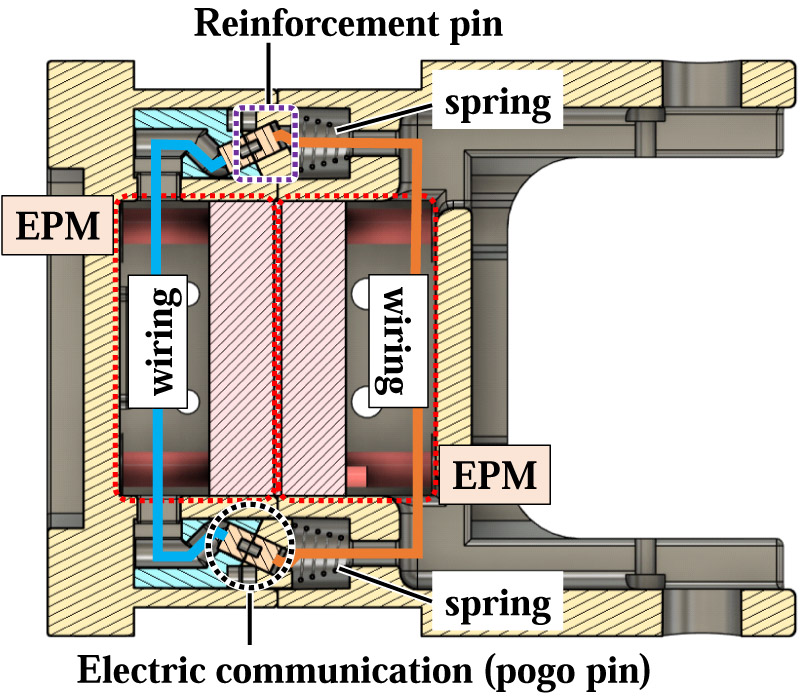
Details of the passive rod-lock mechanism and electrical contacts
- [1] J. K. Hopkins, B. W. Spranklin, and S. K. Gupta, “A survey of snake-inspired robot designs,” Bioinspir. Biomim., Vol.4, No.2, Article No.021001, 2009. https://doi.org/10.1088/1748-3182/4/2/021001
- [2] C. Wright, A. Buchan, B. Brown, J. Geist, M. Schwerin, D. Rollinson, M. Tesch, and H. Choset, “Design and architecture of the unified modular snake robot,” Proc. IEEE Int. Conf. on Robotics and Automation (ICRA), pp. 4347-4354, 2012. https://doi.org/10.1109/ICRA.2012.6225255
- [3] S. Hirose, “Biologically Inspired Robots: Snake-like Locomotors and Manipulators,” Oxford University Press, 1993.
- [4] M. Tanaka, M. Nakajima, Y. Suzuki, and K. Tanaka, “Development and Control of Articulated Mobile Robot for Climbing Steep Stairs,” IEEE/ASME Trans. on Mechatronics, Vol.23, Issue 2, pp. 531-541, 2018. https://doi.org/10.1109/TMECH.2018.2792013
- [5] Q. Fu and C. Li, “Robotic modelling of snake traversing large, smooth obstacles reveals stability benefits of body compliance,” R. Soc. Open Sci., Vol.7, Issue 2, Article No.191192, 2020. https://doi.org/10.1098/rsos.191192
- [6] T. Takemori, M. Tanaka, and F. Matsuno, “Ladder Climbing with a Snake Robot,” 2018 IEEE/RSJ Int. Conf. on Intelligent Robots and Systems (IROS), 2018. https://doi.org/10.1109/IROS.2018.8594411
- [7] T. Kamegawa, T. Harada, and A. Gofuku, “Realization of cylinder climbing locomotion with helical form by a snake robot with passive wheels,” 2009 IEEE Int. Conf. on Robotics and Automation (ICRA), pp. 3067-3072, 2009. https://doi.org/10.1109/ROBOT.2009.5152862
- [8] T. Kamegawa, T. Baba, and A. Gofuku, “V-shift control for snake robot moving the inside of a pipe with helical rolling motion,” 2011 IEEE Int. Symp. on Safety, Security and Rescue Robotics, 2011. https://doi.org/10.1109/SSRR.2011.6106789
- [9] W. Qi, T. Kamegawa, and A. Gofuku, “Helical wave propagation motion for a snake robot on a vertical pipe containing a branch,” Artificial Life Robotics, Vol.23, pp. 515-522, 2018. https://doi.org/10.1007/s10015-018-0479-1
- [10] J. Liu, X. Zhang, and G. Hao, “Survey on research and development of reconfigurable modular robots,” Advances in Mechanical Engineering, Vol.8, No.8, 2016. https://doi.org/10.1177/1687814016659597
- [11] P. Moubarak and P. Ben-Tzvi, “Modular and reconfigurable mobile robotics,” Robotics and Autonomous Systems, Vol.60, Issue 12, pp. 1648-1663, 2012. https://doi.org/10.1016/j.robot.2012.09.002
- [12] B. A. Elsayed, T. Takemori, and F. Matsuno, “Gait Recovery for a Snake Robot With Multiple Failed Joints,” IEEE/ASME Trans. on Mechatronics, Vol.29, Issue 4, pp. 2625-2636, 2024. https://doi.org/10.1109/TMECH.2023.3334481
- [13] Y. Shimizu, Y. Kita, S. Shimooka, and T. Kamegawa, “Design of a Module for a Modular Snake Robot with 3D Locomotion,” 2025 IEEE/RSJ Int. Conf. on Intelligent Robots and Systems (IROS), pp. 5553-5558, 2025. https://doi.org/10.1109/IROS60139.2025.11246453
- [14] Y. Kita, Y. Shimizu, S. Shimooka, and T. Kamegawa, “Prototype of a reconfigurable modular snake robot compatible with ROS,” Proc. the Robotics and Mechatronics Conf. 2025 (ROBOMECH 2025), Article No.1A1-J02, 2025 (in Japanese).
- [15] S. Murata, E. Yoshida, A. Kamimura, H. Kurokawa, K. Tomita, and S. Kokaji, “M-TRAN: Self-reconfigurable modular robotic system,” IEEE/ASME Trans. on Mechatronics, Vol.7, Issue 4, pp. 431-441, 2002. https://doi.org/10.1109/TMECH.2002.806220
- [16] R. Michikawa, K. Hosotani, Y. Shimizu, C. W. Chin, X. Wang, T. Hayakawa, R. Fujisawa, T. Kamegawa, M. Tanaka, and F. Matsuno, “Development and verification of connectors for modular robots to complete practical tasks on the moon,” Artificial Life Robotics, Vol.30, pp. 198-207, 2025. https://doi.org/10.1007/s10015-024-00987-y
- [17] Y. Tu, G. Liang, and T. L. Lam, “FreeSN: A Freeform Strut-node Structured Modular Self-reconfigurable Robot – Design and Implementation,” 2022 Int. Conf. on Robotics and Automation (ICRA), pp. 4239-4245, 2022. https://doi.org/10.1109/ICRA46639.2022.9811583
- [18] G. Liang, H. Luo, M. Li, H. Qian, and T. L. Lam, “FreeBOT: A Freeform Modular Self-reconfigurable Robot with Arbitrary Connection Point – Design and Implementation,” 2020 IEEE/RSJ Int. Conf. on Intelligent Robots and Systems (IROS), pp. 6506-6513, 2020. https://doi.org/10.1109/IROS45743.2020.9341129
- [19] E. Bray and R. Groß, “Recent Developments in Self-Assembling Multi-Robot Systems,” Curr. Robot. Rep., Vol.4, pp. 101-116, 2023. https://doi.org/10.1007/s43154-023-00106-y
- [20] S. Ueno, M. Nakajima, and M. Tanaka, “Development of an articulated mobile robot moving on magnetic curved walls and passing over obstacles,” Advanced Robotics, Vol.36, Issue 21, pp. 1156-1171, 2022. https://doi.org/10.1080/01691864.2022.2138720
- [21] A. Shinagawa, C. W. Chin, and M. Tanaka, “Development of multi-linked mobile robot MagSnake-3 capable of moving on magnetic curved walls,” Proc. the Robotics and Mechatronics Conf. 2025 (ROBOMECH 2025), Article No.1A1-A03, 2025 (in Japanese).
This article is published under a Creative Commons Attribution-NoDerivatives 4.0 Internationa License.