
Research Paper:
ARLC-Net: An Adaptive Representation Learning Framework for Electroencephalography-Based Brain Age Clustering
Jian Wang*,**,†
 , Zhengyang Song*,**
, and Yiding Zhang*,**
, Zhengyang Song*,**
, and Yiding Zhang*,**
*Faculty of Information Engineering and Automation, Kunming University of Science and Technology
No.727 Jingming South Road, Chenggong District, Kunming, Yunnan 650500, China
**Yunnan Key Lab of Artificial Intelligence
No.727 Jingming South Road, Chenggong District, Kunming, Yunnan 650500, China
†Corresponding author

The structure and cognitive functions of the brain undergo significant changes throughout the lifespan, making electroencephalography (EEG)-based brain age clustering a powerful method for studying brain functional connectivity. Unfortunately, the application of clustering methods for EEG-based brain age clustering analysis has been extremely rare in recent years. Additionally, existing clustering methods face several challenges, including a strong dependence on predefined cluster numbers. To address these challenges, we propose an adaptive representation learning framework for electroencephalography-based brain age clustering, called ARLC-Net. Specifically, ARLC-Net integrates cluster number determination with unsupervised representation learning into a reinforcement learning framework, dynamically determining the optimal number of clusters using a Markov decision process. It also introduces a clustering-driven reward function to improve the separation between clusters. Experimental validation on both TUAB and CHBMP datasets demonstrates the efficacy of our approach. Spatial analysis further quantifies EEG spectral features and spatial dispersion of functional networks across age groups, elucidating temporal dynamics in neural oscillatory power and functional network topology during brain development and aging. As the first clustering method in this field requiring no predefined cluster numbers, this study provides novel perspectives and tools for exploring relationships between functional brain connectivity and age.
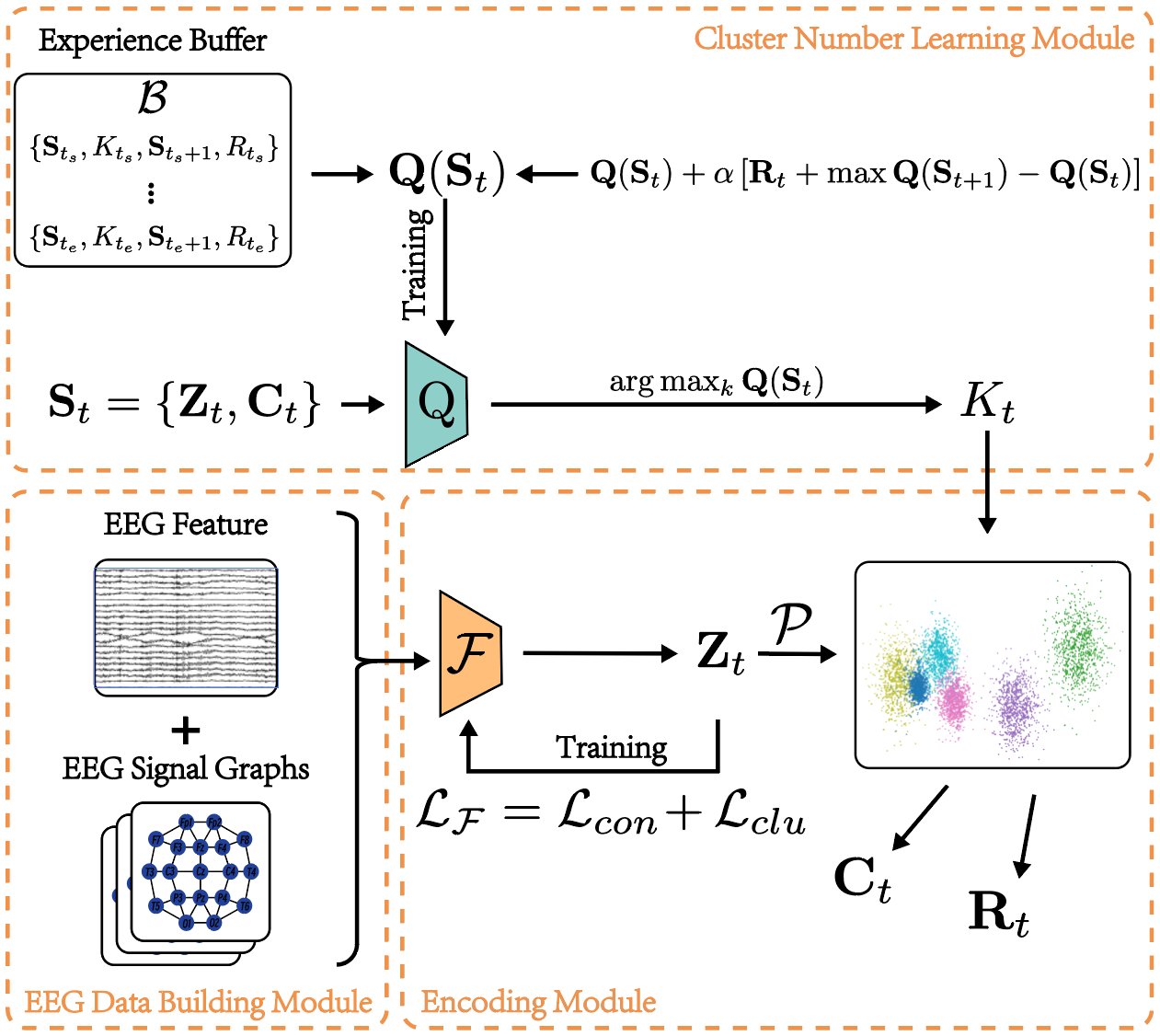
Overview of the ARLC-Net framework
- [1] X. Di and B. B. Biswal, “Toward Task Connectomics: Examining Whole-Brain Task Modulated Connectivity in Different Task Domains,” Cerebral Cortex, Vol.29, Issue 4, pp. 1572-1583, 2019. https://doi.org/10.1093/cercor/bhy055
- [2] F. Zamani Esfahlani, J. Faskowitz, J. Slack, B. Mišić, and R. F. Betzel, “Local structure-function relationships in human brain networks across the lifespan,” Nature Communications, Vol.13, No.1, Article No.2053, 2022. https://doi.org/10.1038/s41467-022-29770-y
- [3] F. Di Gregorio and S. Battaglia, “Advances in EEG-based functional connectivity approaches to the study of the central nervous system in health and disease,” Advances in Clinical and Experimental Medicine, Vol.32, No.6, pp. 607-612, 2023. https://doi.org/https://dx.doi.org/10.17219/acem/166476
- [4] M. Wang, J. Hu, and H. A. Abbass, “BrainPrint: EEG biometric identification based on analyzing brain connectivity graphs,” Pattern Recognition, Vol.105, Article No.107381, 2020. https://doi.org/10.1016/j.patcog.2020.107381
- [5] S. Morales and M. E. Bowers, “Time-frequency analysis methods and their application in developmental EEG data,” Developmental Cognitive Neuroscience, Vol.54, Article No.101067, 2022. https://doi.org/10.1016/j.dcn.2022.101067
- [6] S. Coelli, M. Corda, and A. M. Bianchi, “The time-varying brain: A comprehensive review of dynamic functional connectivity analysis in EEG and MEG,” J. of Neural Engineering, Vol.22, No.5, 2025. https://doi.org/10.1088/1741-2552/ae1258
- [7] E. R. Paitel, C. B. D. Otteman, M. C. Polking, H. J. Licht, and K. A. Nielson, “Functional and effective EEG connectivity patterns in Alzheimer’s disease and mild cognitive impairment: A systematic review,” Frontiers in Aging Neuroscience, Vol.17, Article No.1496235, 2025. https://doi.org/10.3389/fnagi.2025.1496235
- [8] S. Marek, B. Tervo-Clemmens, N. Klein, W. Foran, A. S. Ghuman, and B. Luna, “Adolescent development of cortical oscillations: Power, phase, and support of cognitive maturation,” PLoS Biology, Vol.16, No.11, Article No.e2004188, 2018. https://doi.org/10.1371/journal.pbio.2004188
- [9] S.-B. Wong, Y. Tsao, W.-H. Tsai, T.-S. Wang, H.-C. Wu, and S.-S. Wang, “Author Correction: Application of bi-directional long-short-term memory network in cognitive age prediction based on EEG signals,” Scientific Reports, Vol.14, Article No.5433, 2024. https://doi.org/10.1038/s41598-024-53922-3
- [10] Y. Li, X. Zhang, J. Nie, G. Zhang, R. Fang, X. Xu, Z. Wu, D. Hu, L. Wang, H. Zhang, W. Lin, and G. Li, “Brain Connectivity Based Graph Convolutional Networks and Its Application to Infant Age Prediction,” IEEE Trans. on Medical Imaging, Vol.41, Issue 10, pp. 2764-2776, 2022. https://doi.org/10.1109/TMI.2022.3171778
- [11] J. Wang, J. Zhao, and T. Cheng, “SGAAE-AC: A Semi-Supervised Graph Attention Autoencoder for Electroencephalography (EEG) Age Clustering,” Applied Sciences, Vol.14, No.13, Article No.5392, 2024. https://doi.org/10.3390/app14135392
- [12] W. Song, M. Li, P. Zhang, Y. Wu, L. Jia, and L. An, “Unsupervised PolSAR Image Classification and Segmentation Using Dirichlet Process Mixture Model and Markov Random Fields with Similarity Measure,” IEEE J. of Selected Topics in Applied Earth Observations and Remote Sensing, Vol.10, Issue 8, pp. 3556-3568, 2017. https://doi.org/10.1109/JSTARS.2017.2684301
- [13] M. Kobayashi and K. Watanabe, “Generalized Dirichlet-Process-Means for Robust and Maximum Distortion Criteria,” 2018 Int. Symp. on Information Theory and Its Applications (ISITA), pp. 45-49, 2018. https://doi.org/10.23919/ISITA.2018.8664260
- [14] M. A. Asghar, M. J. Khan, M. Rizwan, R. M. Mehmood, and S.-H. Kim, “An Innovative Multi-Model Neural Network Approach for Feature Selection in Emotion Recognition Using Deep Feature Clustering,” Sensors, Vol.20, Issue 13, Article No.3765, 2020. https://doi.org/10.3390/s20133765
- [15] C. Niu, M. Wu, and L. Zhou, “Dual-Adaptive Fusion Multi-View Clustering Based on Graph Autoencoder,” 2024 Int. Joint Conf. on Neural Networks (IJCNN), 2024. https://doi.org/10.1109/IJCNN60899.2024.10650084
- [16] Q. Wang, F. Wang, F. Ren, Z. Li, and F. Nie, “An Effective Clustering Optimization Method for Unsupervised Linear Discriminant Analysis,” IEEE Trans. on Knowledge and Data Engineering, Vol.35, Issue 4, pp. 3444-3457, 2023. https://doi.org/10.1109/TKDE.2021.3124023
- [17] J. Tabbal, A. Ebadi, A. Mheich, A. Kabbara, B. Güntekin, G. Yener, V. Paban, U. Gschwandtner, P. Fuhr, M. Verin et al., “Characterizing the heterogeneity of neurodegenerative diseases through EEG normative modeling,” npj Parkinson’s Disease, Vol.11, Article No.117, 2025. https://doi.org/10.1038/s41531-025-00957-6
- [18] D. K. Hu, M. A. Pinto-Orellana, M. Rana, L. Do, D. J. Adams, S. A. Hussain, D. W. Shrey, and B. A. Lopour, “Discovering EEG biomarkers of Lennox-Gastaut syndrome through unsupervised time-frequency analysis,” Epilepsia, Vol.66, Issue 2, pp. 541-553, 2025. https://doi.org/10.1111/epi.18211
- [19] T. M. Rutkowski, T. Komendziński, and M. Otake-Matsuura, “Mild cognitive impairment prediction and cognitive score regression in the elderly using EEG topological data analysis and machine learning with awareness assessed in affective reminiscent paradigm,” Frontiers in Aging Neuroscience, Vol.15, Article No.1294139, 2024. https://doi.org/10.3389/fnagi.2023.1294139
- [20] L. E. Ismail and W. Karwowski, “A Graph Theory-Based Modeling of Functional Brain Connectivity Based on EEG: A Systematic Review in the Context of Neuroergonomics,” IEEE Access, Vol.8, pp. 155103-155135, 2020. https://doi.org/10.1109/ACCESS.2020.3018995
- [21] T. Balasuntharam, H. Davoudi, and M. Ebrahimi, “Preferential Proximal Policy Optimization,” 2023 Int. Conf. on Machine Learning and Applications (ICMLA), pp. 293-300, 2023. https://doi.org/10.1109/ICMLA58977.2023.00048
- [22] J. Yang, J. Cai, L. Zhong, Y. Pi, and S. Wang, “Deep Masked Graph Node Clustering,” IEEE Trans. on Computational Social Systems, Vol.11, Issue 6, pp. 7257-7270, 2024. https://doi.org/10.1109/TCSS.2024.3401218
- [23] N. Mrabah, M. Bouguessa, and R. Ksantini, “A contrastive variational graph auto-encoder for node clustering,” Pattern Recognition, Vol.149, Article No.110209, 2024. https://doi.org/10.1016/j.patcog.2023.110209
- [24] J. Bian, C. Dai, and G. Li, “Adaptive channel-weight dual-constrained semi-supervised EEG clustering,” Biomedical Signal Processing and Control, Vol.98, Article No.106720, 2024. https://doi.org/10.1016/j.bspc.2024.106720
- [25] Z. Peng, H. Liu, Y. Jia, and J. Hou, “EGRC-Net: Embedding-Induced Graph Refinement Clustering Network,” IEEE Trans. on Image Processing, Vol.32, pp. 6457-6468, 2023. https://doi.org/10.1109/TIP.2023.3333557
- [26] A. Tsitsulin, J. Palowitch, B. Perozzi, and E. Müller, “Graph Clustering with Graph Neural Networks,” J. of Machine Learning Research, Vol.24, No.127, pp. 1-21, 2023.
- [27] Y. Liu, X. Yang, S. Zhou, X. Liu, S. Wang, K. Liang, W. Tu, and L. Li, “Simple Contrastive Graph Clustering,” IEEE Trans. on Neural Networks and Learning Systems, Vol.35, Issue 10, pp. 13789-13800, 2024. https://doi.org/10.1109/TNNLS.2023.3271871
- [28] G. Li, D. Li, and C. Dai, “ssvEEGc: An efficient EEG clustering method using balance-constrained voting mechanism,” Biomedical Signal Processing and Control, Vol.81, Article No.104539, 2023. https://doi.org/10.1016/j.bspc.2022.104539
- [29] N. Mrabah, M. Bouguessa, M. F. Touati, and R. Ksantini, “Rethinking Graph Auto-Encoder Models for Attributed Graph Clustering,” IEEE Trans. on Knowledge and Data Engineering, Vol.35, Issue 9, pp. 9037-9053, 2023. https://doi.org/10.1109/TKDE.2022.3220948
- [30] Y. Liu, W. Tu, S. Zhou, X. Liu, L. Song, X. Yang, and E. Zhu, “Deep Graph Clustering via Dual Correlation Reduction,” Proc. of the AAAI Conf. on Artificial Intelligence, Vol.36, No.7, pp. 7603-7611, 2022. https://doi.org/10.1609/aaai.v36i7.20726
- [31] C. Dai, J. Wu, J. J. M. Monaghan, G. Li, H. Peng, S. I. Becker, and D. McAlpine, “Semi-Supervised EEG Clustering with Multiple Constraints,” IEEE Trans. on Knowledge and Data Engineering, Vol.35, Issue 8, pp. 8529-8544, 2023. https://doi.org/10.1109/TKDE.2022.3206330
- [32] Z. Peng, H. Liu, Y. Jia, and J. Hou, “Attention-driven Graph Clustering Network,” Proc. of the 29th ACM Int. Conf. on Multimedia (MM’21), pp. 935-943, 2021. https://doi.org/10.1145/3474085.3475276
- [33] C. Dai, J. Wu, D. Pi, L. Cui, B. Johnson, and S. I. Becker, “Electroencephalogram Signal Clustering with Convex Cooperative Games,” IEEE Trans. on Knowledge and Data Engineering, Vol.34, Issue 12, pp. 5755-5769, 2022. https://doi.org/10.1109/TKDE.2021.3060742
- [34] S. Pan, R. Hu, G. Long, J. Jiang, L. Yao, and C. Zhang, “Adversarially Regularized Graph Autoencoder for Graph Embedding,” arXiv preprint, arXiv:1802.04407, 2019. https://doi.org/10.48550/arXiv.1802.04407
- [35] I. Obeid and J. Picone, “The Temple University Hospital EEG Data Corpus,” Frontiers in Neuroscience, Vol.10, Article No.196, 2016. https://doi.org/10.3389/fnins.2016.00196
- [36] P. A. Valdes-Sosa, L. Galan-Garcia, J. Bosch-Bayard, M. L. Bringas-Vega, E. Aubert-Vazquez, I. Rodriguez-Gil, S. Das, C. Madjar, T. Virues-Alba, Z. Mohades et al., “The Cuban Human Brain Mapping Project, a young and middle age population-based EEG, MRI, and cognition dataset,” Scientific Data, Vol.8, Article No.45, 2021. https://doi.org/10.1038/s41597-021-00829-7
- [37] P. J. Rousseeuw, “Silhouettes: A graphical aid to the interpretation and validation of cluster analysis,” J. of Computational and Applied Mathematics, Vol.20, pp. 53-65, 1987. https://doi.org/10.1016/0377-0427(87)90125-7
- [38] T. Caliński and J. Harabasz, “A dendrite method for cluster analysis,” Communications in Statistics, Vol.3, Issue 1, pp. 1-27, 1974. https://doi.org/10.1080/03610927408827101
- [39] D. L. Davies and D. W. Bouldin, “A Cluster Separation Measure,” IEEE Trans. on Pattern Analysis and Machine Intelligence, Vol.PAMI-1, Issue 2, pp. 224-227, 1979. https://doi.org/10.1109/TPAMI.1979.4766909
- [40] A. Likas, N. Vlassis, and J. J. Verbeek, “The global -means clustering algorithm,” Pattern Recognition, Vol.36, Issue 2, pp. 451-461, 2003. https://doi.org/10.1016/S0031-3203(02)00060-2
- [41] S. V. Ülker, M. Çınaroğlu, E. Yılmazer, and S. Tarlacı, “Theta Cordance Decline in Frontal and Temporal Cortices: Longitudinal Evidence of Regional Cortical Aging,” J. of Clinical Medicine, Vol.14, Issue 23, Article No.8341, 2025. https://doi.org/10.3390/jcm14238341
- [42] Z. Kardos, B. Tóth, R. Boha, B. File, and M. Molnár, “Age-related changes of frontal-midline theta is predictive of efficient memory maintenance,” Neuroscience, Vol.273, pp. 152-162, 2014. https://doi.org/10.1016/j.neuroscience.2014.04.071
- [43] E. Huizeling, H. Wang, C. Holland, and K. Kessler, “Changes in theta and alpha oscillatory signatures of attentional control in older and middle age,” European J. of Neuroscience, Vol.54, Issue 1, pp. 4314-4337, 2021. https://doi.org/10.1111/ejn.15259
- [44] E.-M. Kurz, L. Bastian, M. Mölle, J. Born, and M. Friedrich, “Development of slow oscillation–spindle coupling from infancy to toddlerhood,” Sleep Advances, Vol.5, Issue 1, Article No.zpae084, 2024. https://doi.org/10.1093/sleepadvances/zpae084
- [45] A.-L. Satomaa, T. Mäkelä, O. Saarenpää-Heikkilä, A. Kylliäinen, E. Huupponen, and S.-L. Himanen, “Slow-wave activity and sigma activities are associated with psychomotor development at 8 months of age,” Sleep, Vol.43, Issue 9, Article No.zsaa061, 2020. https://doi.org/10.1093/sleep/zsaa061
This article is published under a Creative Commons Attribution-NoDerivatives 4.0 Internationa License.