
Research Paper:
An Interactive Remaining Useful Life Estimation Method for Lithium-Ion Batteries Based on Composite Performance Index and Nonlinear Wiener Process
Shisheng Fu*1, Ruifeng Chen*2, Xiao He*3, Hangfeng Guo*4, Baokang Zhang*1
 , Qi Wu*1,†
, and Wen-An Zhang*1
, Qi Wu*1,†
, and Wen-An Zhang*1
*1Zhejiang University of Technology
No.288 Liuhe Road, Hangzhou, Zhejiang 310023, China
†Corresponding author
*2Zhejiang Zhongchai Machine Co., Ltd.
No.1 Meixi Road, Shaoxing, Zhejiang 312532, China
*3University of Pennsylvania
3451 Walnut Street Philadelphia, PA 19104, USA
*4Zhejiang Hengjiu Transmission Technology Inc., Ltd.
No.27 Qianxi Road, Taozhu Street, Zhuji, Zhejiang 311800, China

A framework integrating deep learning and nonlinear Wiener process (NWP) is proposed for the remaining useful life prediction of lithium-ion batteries. First, degradation features from multi-source sensor data are automatically extracted using an autoencoder incorporating embedded L1 regularization. Second, a one-dimensional composite performance indicator is constructed via neural networks to accurately describe the performance degradation trajectory of the battery. Subsequently, a stochastic degradation model based on the NWP is established, wherein complex degradation dynamics are effectively captured by a time-varying drift function. On this basis, a Bayesian posterior update mechanism is integrated to adaptively adjust model parameters online, whereby individual differences are quantified. Finally, experimental verification on public datasets demonstrates that the proposed method reduces root mean square error and mean absolute error by more than 20%, and significant improvements in prediction accuracy are achieved via the data-model interaction architecture that combines feature compression, degradation quantification, and parameter adaptation.
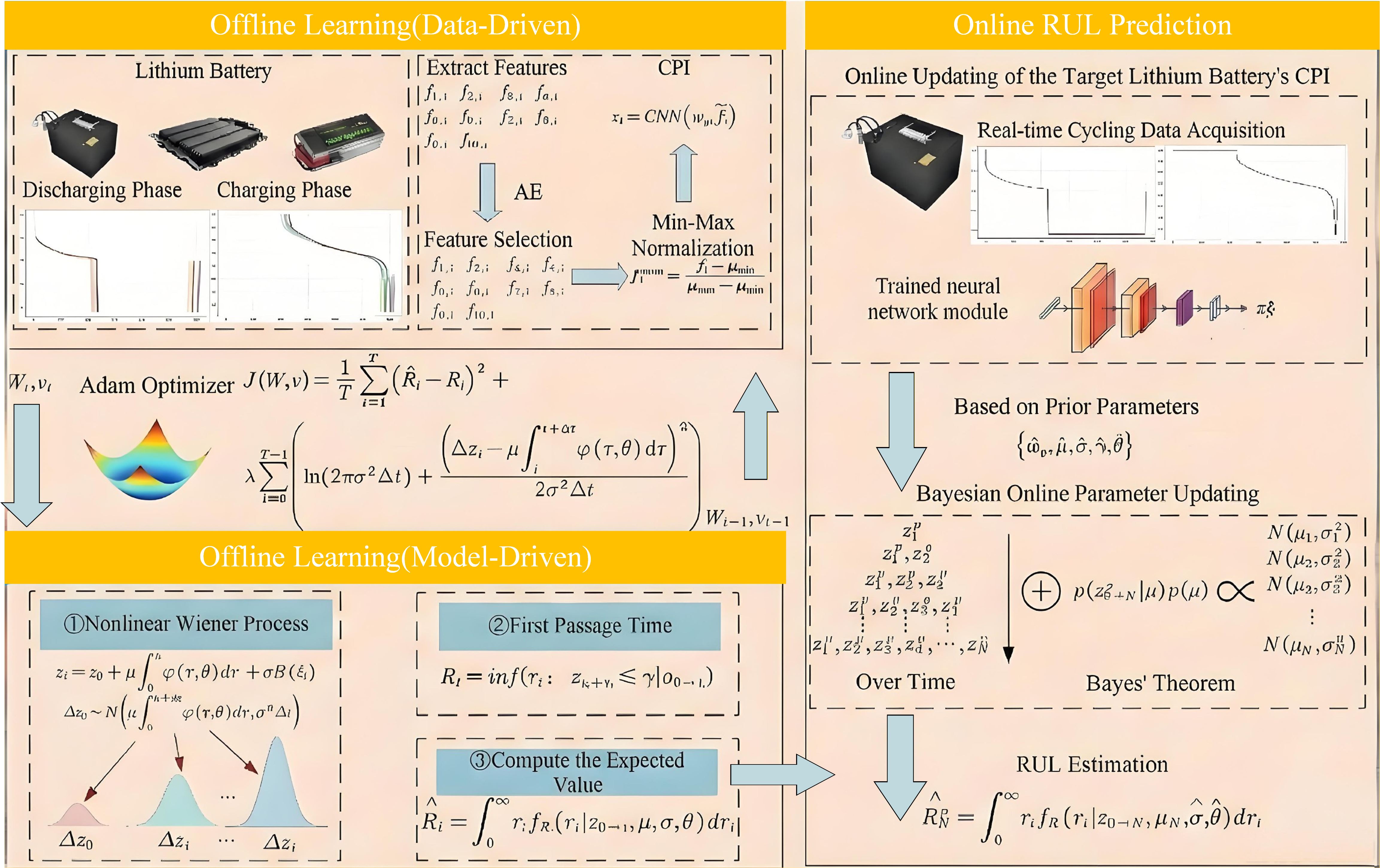
Framework of the proposed RUL method
- [1] T. Lu and W. Yang, “Review of evaluation parameters and methods of lithium batteries throughout its life cycle,” Energy Storage Science and Technology, Vol.9, Issue 3, pp. 657-669, 2020. https://doi.org/10.19799/j.cnki.2095-4239.2019.0263
- [2] C. Gu, Q. Wu, B. Zhang et al., “Data-model interactive Rul prediction of stochastic degradation devices with multiple uncertainty quantification and multi-sensor information fusion,” ISA Trans., Vol.157, pp. 293-305, 2025. https://doi.org/10.1016/j.isatra.2024.12.024
- [3] H. Weiss, T. Winkler, and H. Ziegerhofer, “Large lithium-ion battery-powered electric vehicles – From idea to reality,” 2018 ELEKTRO, 2018. https://doi.org/10.1109/ELEKTRO.2018.8398241
- [4] C. Gu, X. Wu, W.-A. Zhang et al., “Active Disturbance Rejection Formation Control for Multiagent Systems with Input Constraints,” IEEE Trans. on Control of Network Systems, Vol.12, Issue 1, pp. 38-50, 2025. https://doi.org/10.1109/TCNS.2024.3432823
- [5] Q. Wu, C. Dong, F. Guo et al., “Privacy-Preserving Federated Learning for Power Transformer Fault Diagnosis with Unbalanced Data,” IEEE Trans. on Industrial Informatics, Vol.20, Issue 4, pp. 5383-5394, 2024. https://doi.org/10.1109/TII.2023.3333914
- [6] D. Chen, L. Xiao, W. Yan, and Y. Guo, “A novel hybrid equivalent circuit model for lithium-ion battery considering nonlinear capacity effects,” Energy Reports, Vol.7, Supplement 3, pp. 320-329, 2021. https://doi.org/10.1016/j.egyr.2021.06.051
- [7] J. Sun and H. Wang, “Enhanced state of health estimation of lithium-ion batteries through advanced feature selection and self-developed datasets,” J. of Energy Storage, Vol.114, Part A, Article No.115713, 2025. https://doi.org/10.1016/j.est.2025.115713
- [8] M. Li, M. Sadoughi, S. Shen, and C. Hu, “Remaining Useful Life Prediction of Lithium-Ion Batteries Using Multi-model Gaussian Process,” IEEE Int. Conf. on Prognostics and Health Management (ICPHM), 2019. https://doi.org/10.1109/ICPHM.2019.8819384
- [9] K. Park, Y. Choi, W. J. Choi et al., “LSTM-Based Battery Remaining Useful Life Prediction with Multi-Channel Charging Profiles,” IEEE Access, pp. 20786-20798, 2020. https://doi.org/10.1109/ACCESS.2020.2968939
- [10] Q. Liu and Y. Xing, “Remaining life prediction of lithium-ion battery based on VMD-PSO-GRU model,” Energy Storage Science and Technology, Vol.12, Issue 1, pp. 236-246, 2023. https://doi.org/10.19799/j.cnki.2095-4239.2022.0491
- [11] Lixin E., J. Wang, R. Yang et al., “A physics-informed neural network-based method for predicting degradation trajectories and remaining useful life of supercapacitors,” Green Energy and Intelligent Transportation, Vol.4, Issue 3, Article No.100291, 2025. https://doi.org/10.1016/j.geits.2025.100291
- [12] X. Liao, S. Chen, P. Wen, and S. Zhao, “Remaining useful life with self-attention assisted physics-informed neural network,” Advanced Engineering Informatics, Vol.58, Article No.102195, 2023. https://doi.org/10.1016/j.aei.2023.102195
- [13] R. Wang, L. Chen, J. Xu et al., “Multimodal deep learning with time-frequency health features for battery SOH and RUL prediction,” J. of Energy Chemistry, Vol.113, pp. 303-314, 2026. https://doi.org/10.1016/j.jechem.2025.09.018
- [14] X. Wu, P. Li, Z. Deng et al., “LDNet-RUL: Lightweight Deformable Neural Network for Remaining Useful Life Prognostics of Lithium-Ion Batteries,” IEEE Trans. on Power Electronics, Vol.40, Issue 9, pp. 13514-13528, 2025. https://doi.org/10.1109/TPEL.2025.3562188
- [15] L. Dai, J. Guo, J.-L. Wan, J. Wang, and X. Zan, “A reliability evaluation model of rolling bearings based on WKN-BiGRU and Wiener process,” Reliability Engineering & System Safety, Vol.225, Article No.108646, 2022. https://doi.org/10.1016/j.ress.2022.108646
- [16] K.-X. Peng, Y.-T. Pi, R.-H. Jiao, and P. Tang, “Health indicator construction and remaining useful life prediction for aircraft engine,” Control Theory and Applications, Vol.37, No.4, pp. 713-720, 2020. https://doi.org/10.7641/CTA.2019.90039
- [17] Q. Wu, B. Zhang, T. Li et al., “Remaining Useful Life Estimation for Key Components of Manufacturing Equipment with Individual Differences,” IEEE Sensors J., Vol.25, Issue 13, pp. 26228-26240, 2025. https://doi.org/10.1109/JSEN.2025.3574756
- [18] D. P. Kingma and M. Welling, “An Introduction to Variational Autoencoders,” Foundations and Trends in Machine Learning, Vol.12, Issue 4, pp. 307-392, 2019. https://doi.org/10.1561/2200000056
- [19] F. Li, S. Zhou, and R. Liu, “Parameter estimation for the Hammerstein–Wiener nonlinear system and application in lithium-ion batteries,” J. of Energy Storage, Vol.102, Part B, Article No.114265, 2024. https://doi.org/10.1016/j.est.2024.114265
- [20] J. Li, G. Bai, J. Yan, and J. Gu, “On-line parameter identification and SOC estimation of nonlinear model of lithium-ion battery based on Wiener structure,” J. of Energy Storage, Vol.92, Article No.112094, 2024. https://doi.org/10.1016/j.est.2024.112094
- [21] Y. Zhang, F. Feng, S. Wang et al., “Joint nonlinear-drift-driven Wiener process–Markov chain degradation switching model for adaptive online predicting lithium-ion battery remaining useful life,” Applied Energy, Vol.341, Article No.121043, 2023. https://doi.org/10.1016/j.apenergy.2023.121043
- [22] Y. Zhu, S. Liu, K. Wei et al., “A novel based-performance degradation Wiener process model for real-time reliability evaluation of lithium-ion battery,” J. of Energy Storage, Vol.50, Article No.104313, 2022. https://doi.org/10.1016/j.est.2022.104313
- [23] G. Jin, D. E. Matthews, and Z. Zhou, “A Bayesian framework for on-line degradation assessment and residual life prediction of secondary batteries inspacecraft,” Reliability Engineering & System Safety, Vol.113, pp. 7-20, 2013. https://doi.org/10.1016/j.ress.2012.12.011
- [24] J. Liang, H. Liu, and N.-C. Xiao, “A hybrid approach based on deep neural network and double exponential model for remaining useful life prediction,” Expert Systems with Applications, Vol.249, Part A, Article No.123563, 2024. https://doi.org/10.1016/j.eswa.2024.123563
- [25] R. Zheng, B. Yang, Y. Qian et al., “Joint SOH and RUL estimation for lithium-ion batteries via optimal deep belief network with Bayesian algorithm,” J. of Energy Storage, Vol.114, Part B, Article No.115891, 2025. https://doi.org/10.1016/j.est.2025.115891
- [26] Q. Ma, Y. Zheng, W. Yang et al., “Remaining useful life prediction of lithium battery based on capacity regeneration point detection,” Energy, Vol.234, Article No.121233, 2021. https://doi.org/10.1016/j.energy.2021.121233
- [27] W. Qin, H. Lv, C. Liu et al., “Remaining useful life prediction for lithium-ion batteries using particle filter and artificial neural network,” Industrial Management & Data Systems, Vol.120, Issue 2, pp. 312-328, 2020. https://doi.org/10.1108/IMDS-03-2019-0195
- [28] Z. Xue, Y. Zhang, C. Cheng, and G. Ma, “Remaining useful life prediction of lithium-ion batteries with adaptive unscented kalman filter and optimized support vector regression,” Neurocomputing, Vol.376, pp. 95-102, 2020. https://doi.org/10.1016/j.neucom.2019.09.074
- [29] J. Sun and H. Wang, “Enhanced state of health estimation of lithium-ion batteries through advanced feature selection and self-developed datasets,” J. of Energy Storage, Vol.114, Part A, Article No.115713, 2025. https://doi.org/10.1016/j.est.2025.115713
This article is published under a Creative Commons Attribution-NoDerivatives 4.0 Internationa License.