
Research Paper:
Digitalization, Environmental Regulation, and Carbon Productivity: Evidence from China
Leifeng Zhang*, Yanfang Lyu**,†, and Dong Wang***
*School of Economics and Management, Henan University of Urban Construction
No.8 Longxiang Street, New City District, Pingdingshan, Henan 467036, China
**School of Economics, Guangdong University of Technology
No.161 Yinglong Road, Tianhe District, Guangzhou, Guangdong 510520, China
†Corresponding author
***School of Business, Minnan Normal University
No.36 Xianqianzhi Street, Xiangcheng District, Zhangzhou, Fujian 363000, China

This study incorporates digital factors into the corporate production function and extends the firm-level pollution emission decision-making model. From both technological and structural perspectives, it examines the mechanisms through which digitalization influences carbon productivity. An orthogonal projection-based dynamic evaluation framework is employed to quantify the level of digitalization across Chinese provinces for the period 2011–2022. On this basis, fixed effects, mediation, and partially linear functional-coefficient models are applied to analyze how digitalization affects carbon productivity and its boundary conditions. The results indicate that digitalization significantly enhances carbon productivity, primarily through technological diffusion, industrial restructuring, and energy decarbonization. The results are confirmed by multiple robustness tests. Moreover, environmental regulation plays a nonlinear moderating role, resulting in an inverted U-shaped relationship between digitalization and carbon productivity. When environmental regulation is weak, digitalization crowds out carbon reduction investment, thereby suppressing carbon productivity. As environmental regulation intensifies, the positive impact of digitalization on carbon productivity strengthens. However, once regulation exceeds a certain threshold, digitalization begins to hinder carbon productivity. This study verifies the applicability of the “Porter Hypothesis” in China from the viewpoint of digitalization and offers policy implications for better alignment between digital development and environmental regulation.
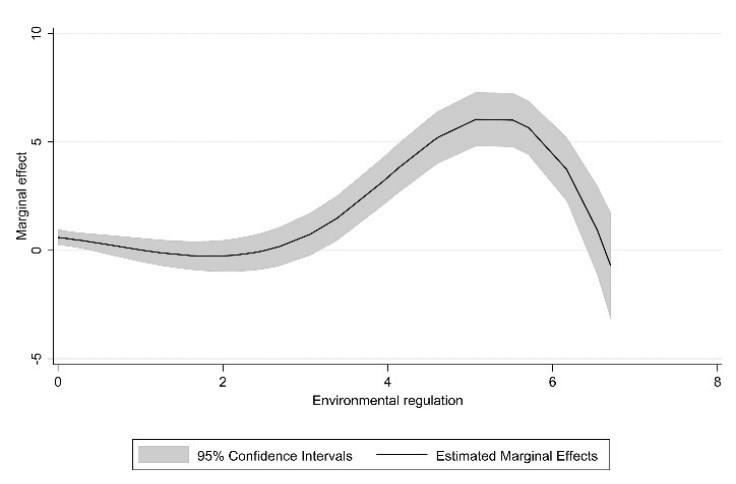
Functional coefficient estimation results
- [1] K. Yin et al., “Can the combination of urban development models promote carbon productivity? Evidence from an empirical analysis in China,” Sust. Cities Soc., Vol.114, Article No.105802, 2024. https://doi.org/10.1016/j.scs.2024.105802
- [2] Q. Zhang et al., “Digital transformation and economic growth efficiency improvement in the digital media era: Digitalization of industry or Digital industrialization?,” Int. Rev. Econ. Financ., Vol.92, pp. 667-677, 2024. https://doi.org/10.1016/j.iref.2024.02.010
- [3] T. Kopp, M. Nabernegg, and S. Lange, “The net climate effect of digitalization, differentiating between firms and households,” Energy Econ., Vol.126, Article No.106941, 2023. https://doi.org/10.1016/j.eneco.2023.106941
- [4] D. Zhou and J. Chu, “The carbon emission reduction effect of the digital economy from the perspective of biased technological progress,” J. Environ. Manage., Vol.373, Article No.123857, 2025. https://doi.org/10.1016/j.jenvman.2024.123857
- [5] L. Li et al., “Digital technology-enabled carbon-neutral management: A mechanism of supply chain digitalization in carbon performance,” Technol. Forecast. Soc. Chang., Vol.210, Article No.123834, 2025. https://doi.org/10.1016/j.techfore.2024.123834
- [6] Y. Shang et al., “Does enterprise digital transformation contribute to the carbon emission reduction? Micro-level evidence from China,” Int. Rev. Econ. Financ., Vol.86, No.7 pp. 1-13, 2023. https://doi.org/10.1016/j.iref.2023.02.019
- [7] Y. Lyu, L. Zhang, and D. Wang, “Does digital economy development reduce carbon emission intensity?,” Front. Ecol. Evol., Vol.11, Article No.1176388, 2023. https://doi.org/10.3389/fevo.2023.1176388
- [8] M. Salahuddin and K. Alam, “Internet usage, electricity consumption and economic growth in Australia: A time series evidence,” Telemat. Inform., Vol.32, No.4, pp. 862-878, 2015. https://doi.org/10.1016/j.tele.2015.04.011
- [9] I. Benedetti, G. Guarini, and T. Laureti, “Digitalization in Europe: A potential driver of energy efficiency for the twin transition policy strategy,” Socio-Econ. Plan. Sci., Vol.89, Article No.101701, 2023. https://doi.org/10.1016/j.seps.2023.101701
- [10] T. Baležentis et al., “Exploring the limits for increasing energy efficiency in the residential sector of the European Union: Insights from the rebound effect,” Energy Policy, Vol.149, Article No.112063, 2021. https://doi.org/10.1016/j.enpol.2020.112063
- [11] C. Mula, N. Zybura, and T. Hipp, “From digitalized start-up to scale-up: Opening the black box of scaling in digitalized firms towards a scaling process framework,” Technol. Forecast. Soc. Chang., Vol.202, Article No.123275, 2024. https://doi.org/10.1016/j.techfore.2024.123275
- [12] Q. Wang et al., “Digital economy and carbon dioxide emissions: Examining the role of threshold variables,” Geosci. Front., Vol.15, Article No.101644, 2024. https://doi.org/10.1016/j.gsf.2023.101644
- [13] G. M. Grossman and A. B. Krueger, “Environmental impacts of a North American Free Trade Agreement,” National Bureau of Economic Research Working Paper, Article No.3914, 1991. https://doi.org/10.3386/w3914
- [14] D. Acemoglu and P. Restrepo, “Demographics and automation,” The Review of Economic Studies, Vol.89, No.1, pp. 1-44, 2022. https://doi.org/10.1093/restud/rdab031
- [15] R. Forslid, T. Okubo, and K. H. Ulltveit-Moe, “Why are firms that export cleaner? International trade, abatement and environmental emissions,” J. Environ. Econ. Manage., Vol.91, No.9, pp. 166-183, 2018. https://doi.org/10.1016/j.jeem.2018.07.006
- [16] N. Kuosmanen, T. Kuosmanen, and T. Maczulskij, “Micro-level structural change decomposition of carbon productivity: Application to electricity generation in Finland,” Environ. Impact Assess. Rev., Vol.113, Article No.107877, 2025. https://doi.org/10.1016/j.eiar.2025.107877
- [17] Y. Yang, P. Mukhopadhaya, and Z. Yu, “How does enterprise digitalization affect corporate carbon emission in China: A firm-level study,” China Econ. Rev., Vol.88, Article No.102285, 2024. https://doi.org/10.1016/j.chieco.2024.102285
- [18] X. Shi and S. Geng, “Double-edged sword? Heterogeneous effects of digital technology on environmental regulation-driven green transformation,” J. Environ. Manage., Vol.389, Article No.125960, 2025. https://doi.org/10.1016/j.jenvman.2025.125960
- [19] Y. Hao, Y. Jiang, and S. Lv, “Can the digital economy effectively contribute to the clean energy transition? A provincial panel data analysis from China,” Environ. Innov. Soc. Trans., Vol.56, Article No.101003, 2025. https://doi.org/10.1016/j.eist.2025.101003
- [20] Y. Shen and X. Zhang, “The impact of artificial intelligence on employment: The role of virtual agglomeration,” Humanities and Social Sciences Communications, Vol.11, Article No.122, 2024. https://doi.org/10.1057/s41599-024-02647-9
- [21] Y. Li et al., “Digital economy, environmental regulations, and green economic development,” Financ. Res. Lett., Vol.75, Article No.106858, 2025. https://doi.org/10.1016/j.frl.2025.106858
- [22] Y. F. Xiao, B. L. Zhang, and H. L. Wang, “Research on the impact of environmental regulations on green technological innovation in China from the perspective of digital transformation: A threshold model approach,” Environ. Res. Commun., Vol.6, No.3, Article No.035001, 2024. https://doi.org/10.1088/2515-7620/ad2bb6
- [23] K. Du, Y. Yu, and J. Li, “Does international trade promote CO emission performance? An empirical analysis based on a partially linear functional-coefficient panel data model,” Energy Econ., Vol.92, Article No.104983, 2020. https://doi.org/10.1016/j.eneco.2020.104983
- [24] J. Li, H. Liu, and K. Du, “Does market-oriented reform increase energy rebound effect? Evidence from China’s regional development,” China Econ. Rev., Vol.56, Article No.101304, 2019. https://doi.org/10.1016/j.chieco.2019.101304
- [25] Y. An, H. Cheng, and L. Dong, “Semiparametric estimation of partially linear varying coefficient panel data models,” G. Gonzalez-rivera, R. C. Hill, and T. Lee (Eds.), “Essays in Honor of Aman Ullah,” Advances in Econometrics, Vol.36, pp. 47-65, Emerald Group Publishing Limited, 2016.
- [26] Y. Han and T. Wei, “Supply chain digitization and corporate carbon emissions: A chain mediation examination based on digital transformation and green innovation,” J. Environ. Manage., Vol.379, Article No.124825, 2025. https://doi.org/10.1016/j.jenvman.2025.124825
- [27] Y. Liu, N. Liu, and Y. Huo, “Impact of digital technology innovation on carbon emission reduction and energy rebound: Evidence from the Chinese firm level,” Energy, Vol.320, Article No.135187, 2025. https://doi.org/10.1016/j.energy.2025.135187
- [28] L. Feng et al., “Exploring the nexus between rural economic digitalization and agricultural carbon emissions: A multi-scale analysis across 1607 counties in China,” J. Environ. Manage., Vol.373, Article No.123497, 2025. https://doi.org/10.1016/j.jenvman.2024.123497
- [29] T. J. Bartik, “How do the effects of local growth on employment rates vary with initial labor market conditions?,” Upjohn Institute Working Paper, Article No.09-148, 2006. https://doi.org/10.2139/ssrn.1372814
- [30] R. Calel and A. Dechezleprêtre, “Environmental policy and directed technological change: Evidence from the European carbon market,” The Review of Economics and Statistics, Vol.98, No.1, pp. 173-191, 2016. https://doi.org/10.1162/REST_a_00470
- [31] S. Jacobsson and V. Lauber, “The politics and policy of energy system transformation-explaining the German diffusion of renewable energy technology,” Energy Policy, Vol.34, No.3, pp. 256-276, 2006. https://doi.org/10.1016/j.enpol.2004.08.029
- [32] M. Peneder, “Industrial structure and aggregate growth,” Struct. Change and Econ. Dyn., Vol.14, No.4, pp. 427-448, 2003. https://doi.org/10.1016/S0954-349X(02)00052-8
- [33] Y. Zhang et al., “The impact of economic growth, industrial structure and urbanization on carbon emission intensity in China,” Nat. Hazards, Vol.73, No.2, pp. 579-595, 2014. https://doi.org/ 10.1007/s11069-014-1091-x
- [34] F. Dong et al., “Drivers of carbon emission intensity change in China,” Resources, Conservation and Recycling, Vol.129, No.2, pp. 187-201, 2018. https://doi.org/10.1016/j.resconrec.2017.10.035
- [35] X. Xie and J. Wang, “Study on the impact of industrial digitization on carbon emissions: Evidence from China’s Logistics Industry,” Environ. Res. Commun., Vol.5, No.10, Article No.105008, 2023. https://doi.org/10.1088/2515-7620/acf918
- [36] Y. Shen and X. Zhang, “Towards a low-carbon and beautiful world: Assessing the impact of digital technology on the common benefits of pollution reduction and carbon reduction,” Environ. Monit. Assess., Vol.196, Article No.695, 2024. https://doi.org/10.1007/s10661-024-12860-3
- [37] Y. Lyu, L. Zhang, and D. Wang, “The impact of digital transformation on low-carbon development of manufacturing,” Front. Environ. Sci., Vol.11, Article No.1134882, 2023. https://doi.org/10.3389/fenvs.2023.1134882
- [38] L. Zhang, H. Wu, and Y. Shen, “Unlocking the digital dividend: How does digitalization promote corporate carbon emission reduction?,” Sustainability, Vol.17, No.16, Article No.7222, 2025. https://doi.org/10.3390/su17167222
- [39] S. Lu et al., “Absorptive capacity and the low-carbon impact of external digital and green technologies,” Technol. Soc., Vol.84, Article No.103123, 2026. https://doi.org/10.1016/j.techsoc.2025.103123
- [40] C. Huang and B. Lin, “Digital economy solutions towards carbon neutrality: The critical role of energy efficiency and energy structure transformation,” Energy, Vol.306, Article No.132524, 2024. https://doi.org/10.1016/j.energy.2024.132524
This article is published under a Creative Commons Attribution-NoDerivatives 4.0 Internationa License.