
Research Paper:
Impact of Digital Economy Development on Employment Mechanisms: Perspectives from Industrial Structure and Human Capital
Dan Tang*,†, Liucen Lai**, and Jingjing Li**
*Research Center for Quantitative Economics, Huaqiao University
No.668 Jimei Avenue, Jimei District, Xiamen, Fujian 361021, China
†Corresponding author
**Institute of Quantitative Economics and Statistics, Huaqiao University
No.668 Jimei Avenue, Jimei District, Xiamen, Fujian 361021, China

The rapid development of the digital economy (DE) has exerted a profound influence on employment dynamics. Building upon a framework that captures the level of digital economic development, this study examines the effects of the DE on both the quantity and structure of employment. The analysis further explores the mechanisms underlying the influence of DE on employment outcomes from the perspectives of industrial structure and human capital. Results indicate that the DE exhibits both a “creation effect” and a “substitution effect” on total employment, with the creation effect playing the dominant role. As industrial structures advance and rationalize, and human capital structures improve, the promotional effect of DE on total employment will gradually increase. These developments expand job opportunities for highly skilled workers, promote a transition in employment structure from medium-low to high-skill occupations, and exert an “employment polarization” effect across the skill-level structure within the workforce of China. Therefore, this study proposes policy recommendations to accelerate the development of the DE, expand emerging employment opportunities, enhance the digital competencies of the labor force, and emphasize improving their digital literacy.
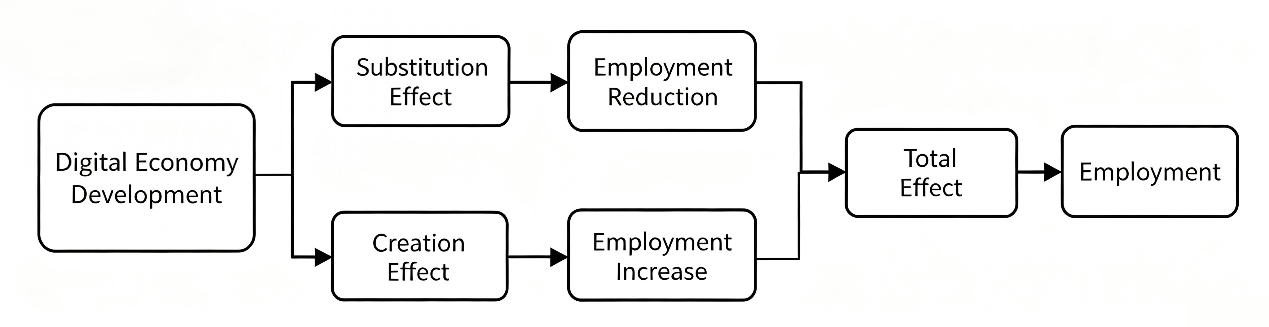
Theoretical mechanism of digital economy development on employment
- [1] B. Kim, A. Barua, and A. B. Whinston, “Virtual field experiments for a DE: A new research methodology for exploring an information economy,” Decision Support Systems, Vol.32, No.3, pp. 215-231, 2002. https://doi.org/10.1016/S0167-9236(01)00094-X
- [2] W. J. Jing and B. W. Sun, “DE promotes high-quality economic development: A theoretical analysis framework,” Economist, Vol.2, pp. 66-73, 2019.
- [3] T. X. Kang, “Research on the measurement of the scale of China’s DE,” Contemporary Finance & Economics, Vol.3, pp. 118-121, 2008.
- [4] X. Xu and M. Zhang, “Research on the scale measurement of China’s DE—Based on the perspective of international comparison,” China Ind. Econ., Vol.5, pp. 23-41, 2020.
- [5] X. L. Zhang and Y. X. Jiao, “Research on the development index of China’s DE and its preliminary application,” Zhejiang Social Sciences, Vol.4, pp. 32-40+157, 2017.
- [6] C. J. Yang and Z. X. Li, “Development level, regional differences and distribution dynamic evolution of China’s digital economy,” Statistics and Decision, Vol.39, No.5, pp. 5-10, 2023.
- [7] D. Autor, “The polarization of job opportunities in the US labor market: Implications for employment and earnings,” Center for American Progress and The Hamilton Project, Vol.6, pp. 11-19, 2010.
- [8] Z. Y. He and X. G. Song, “The mechanism and enlightenment of DE promoting employment: Thinking after the coronavirus epidemic,” Economist, Vol.5, No.5, pp. 58-68, 2020.
- [9] Z. M. Li, “Challenges and reflections on the impact of technological progress on employment in the era of the new industrial revolution,” Jiangxi Social Sciences, Vol.38, No.11, pp. 78-85, 2018.
- [10] H. C. Tian and M. X. Shi, “Research on the impact of manufacturing industrial upgrading on the employment quantity in China,” Economic Review, Vol.5, pp. 68-78, 2013.
- [11] W. G. Yang and B. Z. Wu, “The impact of platform economy on employment structure,” Chinese J. of Population Science, Vol.4, pp. 2-16+126, 2022.
- [12] W. Wang, “Does industrial intelligence promote high-quality employment in the DE era,” Economist, Vol.4, pp. 89-98, 2020.
- [13] M. N. Li and Y. B. Zhou, “Research on human capital structure effect of DE development,” Res. Econ. Manag., Vol.43, pp. 23-38, 2022.
- [14] H. S. Zhang, S. Y. Zhang, and C. Z. Wang, “The impact of human capital on high-quality economic development – A dual perspective of education and health capital,” Statistical J., Vol.3, No.2, pp. 16-30, 2022.
- [15] Y. Cong and B. Y. Yu, “The influence of DE on the efficiency of Chinese labor force resource allocation,” The Theory and Practice of Finance and Economics, Vol.41, No.2, pp. 108-114, 2020.
- [16] G. Fan, X. L. Wang, and G. R. Ma, “The contribution of China’s marketization process to economic growth,” Economic Research J., Vol.46, No.9, pp. 4-16, 2011.
- [17] E. Berman, J. Bound, and Z. Griliches, “Changes in the demand for skilled labor within U.S. manufacturing: Evidence from the annual survey of manufacturers,” The Quarterly J. of Economics, Vol.109, No.2, pp. 367-397, 1994. https://doi.org/10.2307/2118467
- [18] T. Zhao, Z. Zhang, and S. K. Liang, “Digital economy, entrepreneurial activity and high‑quality development: Empirical evidence from Chinese cities,” Management World, Vol.36, No.10, pp. 65‑76, 2020.
- [19] H. Y. Cai and Y. Z. Xu, “Does trade openness affect the upgrading of China’s industrial structure,” J. Quant. Tech. Econ., Vol.34, pp. 3-22, 2017.
- [20] L. H. Fu, “An empirical study on the relationship between industrial structure advancement and economic growth in China,” Statistical Research, Vol.27, No.8, pp. 79-81, 2010.
- [21] C. H. Gan and R. G. Zheng, “Research on the evolution of regional economic disparities and its industrial decomposition in China,” China Industrial Economics, Vol.6, pp. 25-34, 2010.
- [22] T. Jiang, “Mediating and moderating effects in empirical causal inference studies,” China Industrial Economics, Vol.5, pp. 100‑120, 2022.
- [23] B. Y. Yu and Y. Cong, “DE, human capital dividend and advanced industrial structure,” The Theory and Practice of Finance and Economics, Vol.42, No.3, pp. 124-131, 2021.
This article is published under a Creative Commons Attribution-NoDerivatives 4.0 Internationa License.