
Research Paper:
Risk Transmission and Cascade Failures in Digital Economy Industrial Networks Under Emergency Impacts
Ming Cai*
 , Yanwu Chen*,†
, Huan Luo*, Ying Lu*, Guiyuan Fu**, and Jun Pan***
, Yanwu Chen*,†
, Huan Luo*, Ying Lu*, Guiyuan Fu**, and Jun Pan***
*Institute of Quantitative Economy and Statistics, Huaqiao University
No.668 Jimei Avenue, Jimei District, Xiamen, Fujian 361021, China
†Corresponding author
**Institute of Financial Technology, Shanghai University of Finance and Economics
No.777 Guoding Road, Yangpu District, Shanghai 200433, China
***School of Business and Economics, University Purtra Malaysia
Serdang, Selangor Darul Ehsan 43400, Malaysia

With the background of emergencies and the digital economy industry as the core, this study collected data from China’s 2020 input-output table, used network analysis technology to establish digital economy industrial networks, analyzed the structural characteristics of industrial networks and their risk transmission characteristics under the impact of various emergencies by establishing cascade failure simulation models. The results indicate that (1) the digital trading industry is an intermediary industry of the overall economy, which can control the flow of more resources than other digital economic industries; (2) different emergencies, shutdown thresholds, and impact degrees have different impacts. In addition to the dual impact of supply and demand, sudden systemic financial risks cause the most significant damage at the highest risk transmission speed; (3) the transmission of industrial risks has a certain time lag, but the failure of a key industry in the industrial chain may cause all industries to cease production in a short time; and (4) the industry with a more important position in the industrial network is more destructive to the economy after being impacted. This study can provide some theoretical reference for establishing the mechanism of emergency risk prevention and resolution.
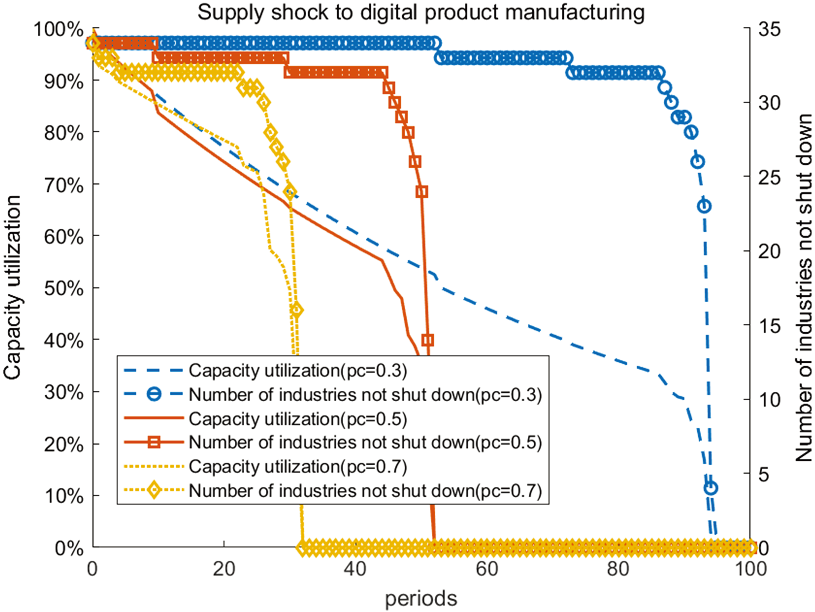
Changes of DPM after supply shocks
- [1] C. Yin, “Industry complex network: Modeling and application,” Shandong University, 2012 (in Chinese).
- [2] M. Xu and S. Liang, “Input–output networks offer new insights of economic structure,” Phys. A: Stat. Mech. Appl., Vol.527, Article No.121178, 2019. https://doi.org/10.1016/j.physa.2019.121178
- [3] K. Barauskaite and A. D. M. Nguyen, “Global intersectoral production network and aggregate fluctuations,” Econ. Model., Vol.102, Article No.105577, 2021. https://doi.org/10.1016/j.econmod.2021.105577
- [4] J. Maluck and R. V. Donner, “A network of networks perspective on global trade,” PLOS One, Vol.10, No.7, Article No.e0133310, 2015. https://doi.org/10.1371/journal.pone.0133310
- [5] X. Wang et al., “Global embodied rare earths flows and the outflow paths of China’s embodied rare earths: Combining multi-regional input-output analysis with the complex network approach,” J. Clean. Prod., Vol.216, pp. 435-445, 2019. https://doi.org/10.1016/j.jclepro.2018.12.312
- [6] X. Sun, H. An, X. Guo, X. Jia, and X. Liu, “Indirect energy flow between industrial sectors in China: A complex network approach,” Energy, Vol.94, pp. 195-205, 2016. https://doi.org/10.1016/j.energy.2015.10.102
- [7] Z. Yang, Y. Chen, and P. Zhang, “Macroeconomic shock, financial risk transmission and governance response to major public emergencies,” Manag. World, Vol.36, No.5, pp. 13-35+7, 2020 (in Chinese). https://doi.org/10.19744/j.cnki.11-1235/f.2020.0067
- [8] D. Li, J. Li, and J. Ma, “An empirical study on the influence of random events at home and abroad on food price volatility in China,” Issues Agric. Econ., Vol.35, No.3, pp. 68-74+111, 2014 (in Chinese). https://doi.org/10.13246/j.cnki.iae.2014.03.012
- [9] X. Chen, X. Zhang, and C. Hu, “Timing-varying shock measurement of demand-side growth: Based on TVP-SV-VAR model,” J. Nanjing Univ. Finance Econ., Vol.2021, No.2, pp. 1-12, 2021 (in Chinese).
- [10] X. Zhang and L. Liu, “Financial risk and economic growth under the new paradigm of macro-analysis on the impact of the Covid-19 pandemic and growth at risk,” Econ. Res. J., Vol.55, No.6, pp. 4-21, 2020 (in Chinese).
- [11] J. Wu, Y. Tan, H. Deng, and Y. Chi, “Evaluating node importance considering cascading failure in complex load-networks,” J. Chin. Comput. Syst., Vol.2007, No.4, pp. 627-630, 2007 (in Chinese).
- [12] X. Huang, I. Vodenska, S. Havlin, and H. E. Stanley, “Cascading failures in bi-partite graphs: Model for systemic risk propagation,” Scientific Reports, Vol.3, Article No.1219, 2013. https://doi.org/10.1038/srep01219
- [13] X. Zhang, J. Yu, and I. Vodenska, “Modeling the impact of the COVID-19 outbreak on regional industry risk contagion,” J. Univ. Electron. Sci. Technol. China, Vol.49, No.3, pp. 415-424, 2020 (in Chinese).
- [14] X. Zhao, K. Wang, and P. He, “Major public emergencies, industrial networks, and macroeconomic risks,” Shanghai Finance, Vol.2021, No.10, pp. 12-23, 2021 (in Chinese). https://doi.org/10.13910/j.cnki.shjr.2021.10.0012
- [15] Q. Zhou, Z. Li, and Y. Zeng, “Industry risk contagion and bank credit allocation from the perspective of complex network,” J. Manag. Sci. China, Vol.25, No.2, pp. 24-46, 2022 (in Chinese). https://doi.org/10.19920/j.cnki.jmsc.2022.02.002
- [16] K. Fuji, A. Suppasri, P. Kwanchai, E. Lahcene, and F. Imamura, “Assessing future tsunami hazards from Japan trench coupling with sea level rise impact on economic risks using an input–output table,” Int. J. Disaster Risk Reduct., Vol.104, Article No.104286, 2024. https://doi.org/10.1016/j.ijdrr.2024.104286
- [17] G.-J. Wang, C. Xie, L. Zhao, and Z.-Q. Jiang, “Volatility connectedness in the Chinese banking system: Do state-owned commercial banks contribute more?,” J. Int. Financ. Mark. Inst. Money, Institutions and Money, Vol.57, pp. 205-230, 2018. https://doi.org/10.1016/j.intfin.2018.07.008
- [18] J. Khan, Y. Li, and Q. J. Mahsud, “Linkages and structural changes in the Chinese financial sector, 1996–2018: A network and input–output approach,” Struct. Change Econ. Dyn., Vol.70, pp. 33-44, 2024. https://doi.org/10.1016/j.strueco.2023.12.017
- [19] G. Wu et al., “The impact of the COVID-19 pandemic on input-output networks, risk transmission, and policy responses,” Shanghai Finance, Vol.2021, No.5, pp. 25-37, 2021 (in Chinese). https://doi.org/10.13910/j.cnki.shjr.2021.05.003
- [20] X. Xu and M. Zhang, “Research on the scale measurement of China’s digital economy—Based on the perspective of international comparison,” China Ind. Econ., Vol.2020, No.5, pp. 23-41, 2020 (in Chinese). https://doi.org/10.19581/j.cnki.ciejournal.2020.05.013
- [21] Y. Chen, H. Ding, and J. Ma, “Industrial chain map and linkage network characteristics of digital economy,” J. Adv. Comput. Intell. Intell. Inform., Vol.27, No.5, pp. 739-747, 2023. https://doi.org/10.20965/jaciii.2023.p0739
This article is published under a Creative Commons Attribution-NoDerivatives 4.0 Internationa License.