
Research Paper:
Artificial Intelligence-Driven Personalized Employment Guidance for College Students: Model Construction and Effectiveness Evaluation
Long Dai* and Feifei Fu**,†
*Zhejiang Gongshang University Hangzhou College of Commerce
No.66 South Huancheng Road, Tonglu County, Hangzhou, Zhejiang 311508, China
**Zhejiang Business College
No.470 Binwen Road, Binjiang District, Hangzhou, Zhejiang 310056, China
†Corresponding author

This paper proposes an AI-empowered personalized employment guidance system integrating multi-modal deep learning, graph neural network-based collaborative filtering, and knowledge graph enhancement within an adaptive multi-algorithm fusion framework, addressing the limitations of insufficient personalization and low matching accuracy in conventional approaches. The system introduces dynamic student profile modeling, temporal-aware student–position matching, and domain-adaptive feature weighting as core innovations. Experiments on 68,247 student samples and 172,456 job postings from 15 universities demonstrate that the system achieves 87.6% recommendation accuracy (+26.8% over traditional methods), outperforms the strongest baseline by 6.2% in AUC and 5.4% in NDCG@10 (p<0.001), reduces job search duration by 38.7%, and improves employment success efficiency by 32.4%. These findings confirm the practical value of systematic AI integration for intelligent transformation of university career services.
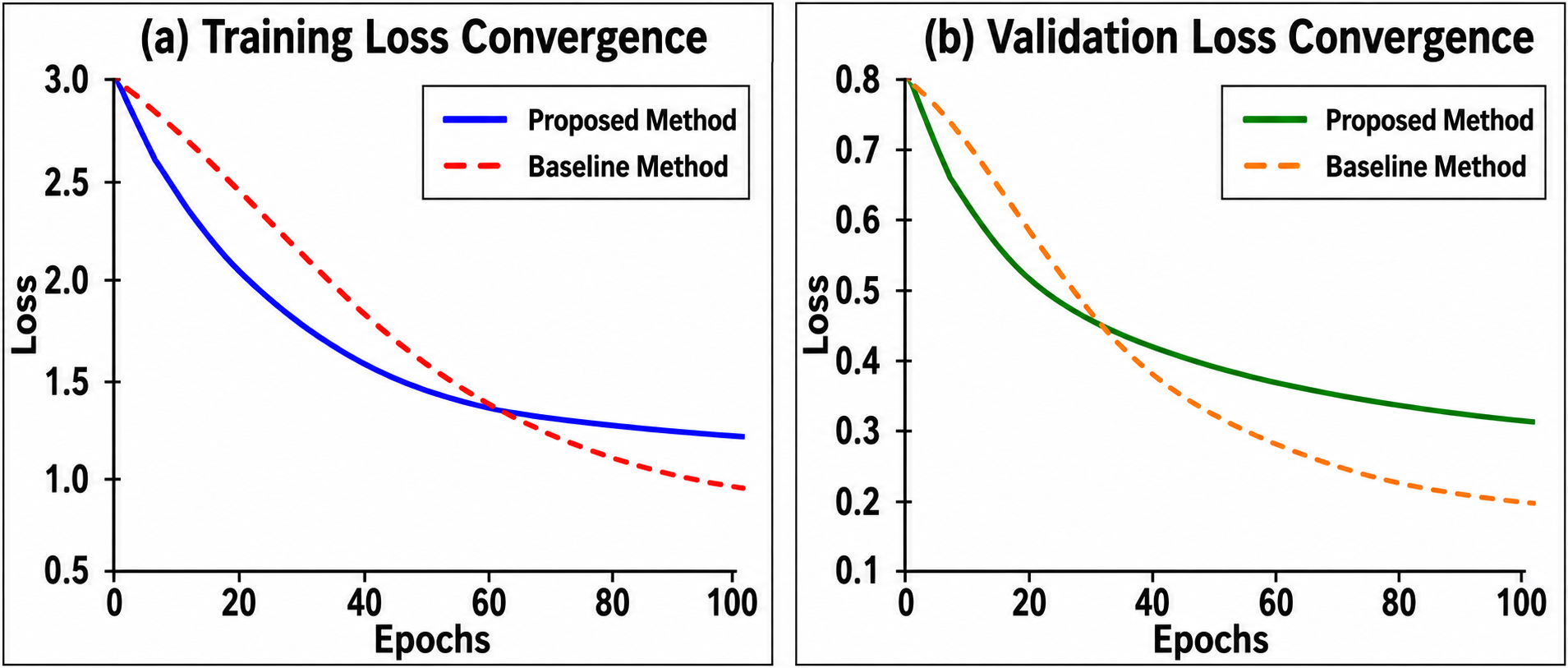
Model convergence analysis comparison chart
- [1] X. Huang, A. A. Samad, X. Yao, and B. He, “Using artificial intelligence technology to improve the English learning experience for college students,” J. Adv. Comput. Intell. Intell. Inform., Vol.29, No.5, pp. 1007-1018, 2025. https://doi.org/10.20965/jaciii.2025.p1007
- [2] J. Chen, “AI empowers college students’ career planning education: Model construction, practical dilemmas and optimization paths,” World J. Educ. Stud., Vol.3, No.5, pp. 79-82, 2025. https://doi.org/10.61784/wjes3080
- [3] C. Babu and F. Jafari, “Empowering career development: A comprehensive AI-driven system for personalised guidance and recommendations,” Clust. Comput., Vol.28, No.16, Article No.1028, 2025. https://doi.org/10.1007/s10586-025-05739-6
- [4] Y. Zhang and J. Luo, “Influence mechanism and coping strategies of generative artificial intelligence empowering vocational education,” Adult Educ., Vol.45, No.11, pp. 67-76, 2025 (in Chinese).
- [5] N. Drydakis, “The formation of AI Capital in higher education: Enhancing students’ academic performance and employment rates,” Comput. Educ. Artif. Intell., Vol.9, Article No.100476, 2025. https://doi.org/10.1016/j.caeai.2025.100476
- [6] Y. Zheng, “Research on the precise employment paths of applied undergraduate universities empowered by generative artificial intelligence,” Vocat. Tech. Educ., Vol.46, No.26, pp. 71-75, 2025 (in Chinese).
- [7] X. Shuang, “Research on the construction of a digitalized employment service platform for college students in the digital era,” Educ. Res. Innov., Vol.1, No.9, pp. 96-99, 2025.
- [8] X. Lin, “New ideas for university students’ career planning from the perspective of AI,” Educ. Insights, Vol.2, No.8, pp. 148-155, 2025. https://doi.org/10.70088/yfj03692
- [9] T. Wang, M. Yi, and S. Li, “Artificial intelligence literacy promotes high-quality employment of college students: Theoretical logic and practical path,” J. Beijing Univ. Technol. (Soc. Sci. Ed.), Vol.25, No.5, pp. 8-20, 2025 (in Chinese).
- [10] Z. Hu, Z. Yin, Y. Zhou, and K. Wu, “The path of artificial intelligence empowering career planning education for local college students in China,” J. Comput. Sci. Electr. Eng., Vol.7, No.5, pp. 46-50, 2025. https://doi.org/10.61784/jcsee3076
- [11] X. Chao and Q. Wang, “The influence of data element penetration on employment skill structure bias in manufacturing industry,” Finance Trade Res., Vol.36, No.6, pp. 1-18, 2025 (in Chinese). https://doi.org/10.19337/j.cnki.34-1093/f.2025.06.001
- [12] Y. Huang, “Individualized career planning intelligent teaching system for college students based on adaptive artificial intelligence,” J. Comput. Methods Sci. Eng., Vol.25, No.4, pp. 3121-3136, 2025. https://doi.org/10.1177/14727978251315731
- [13] Y. Tao, “Public data openness empowers high-quality full employment: Mechanism and pathways,” J. Tech. Econ. Manag., Vol.2025, No.5, pp. 66-72, 2025 (in Chinese).
- [14] A. Guo, and Q. Li, “Current status and future trends of artificial intelligence empowering vocational education development,” J. Vocat. Educ., Vol.41, No.2, pp. 36-45, 2025 (in Chinese).
- [15] M. Cai and Z. Sun, “Value implications, connotational characteristics and practical paths of artificial intelligence empowering vocational education,” Educ. Vocat., Vol.2025, No.3, pp. 98-105, 2025 (in Chinese). https://doi.org/10.13615/j.cnki.1004-3985.2025.03.009
- [16] J. Hu and C. Cheng, “The impact of new generation of artificial intelligence on employment and its countermeasures,” J. Humanit., Vol.2025, No.1, pp. 40-52, 2025 (in Chinese). https://doi.org/10.15895/j.cnki.rwzz.20250117.001
- [17] X. Kong and Z. Mo, “Research on the effect of generative artificial intelligence on employment in service industry,” J. Shaanxi Norm. Univ. (Philos. Soc. Sci. Ed.), Vol.54, No.1, pp. 102-114, 2025 (in Chinese). https://doi.org/10.15983/j.cnki.sxss.2025.0108
- [18] X. Li, “The Impact of international artificial intelligence competition on employment,” J. Beijing Univ. Technol. (Soc. Sci. Ed.), Vol.25, No.3, pp. 13-18, 2025 (in Chinese). https://doi.org/10.12120/bjutskxb202503013
- [19] Y. Liang, “Frontier developments in artificial intelligence and employment,” J. Beijing Univ. Technol. (Soc. Sci. Ed.), Vol.25, No.3, pp. 7-12, 2025 (in Chinese). https://doi.org/10.12120/bjutskxb202503007
- [20] W. He and X. Zang, “Can volunteer service participation cultivate college students’ entrepreneurship,” Zhejiang Acad. J., Vol.2025, No.1, pp. 159-167, 2025 (in Chinese). https://doi.org/10.16235/j.cnki.33-1005/c.2025.01.008
- [21] Z. Hu and T. Zhou, “Optimization of personalized service system for student work in smart campus colleges and universities with the aid of artificial intelligence,” Appl. Math. Nonlinear Sci., Vol.10, No.1, 2025. https://doi.org/10.2478/amns-2025-0292
- [22] J. Liu, H. Zeng, W. Jin, Z. Li, and B. Qi, “Artificial intelligence empowers higher education: Logic path, typical scenarios and practical approaches,” J. Xi’an Jiaotong Univ. (Soc. Sci.), Vol.44, No.3, pp. 11-20, 2024 (in Chinese). https://doi.org/10.15896/j.xjtuskxb.202403002
- [23] H. Zhao and Y. Zheng, “Research on employment skill improvement of vocational college students under artificial intelligence background,” Educ. Vocat., Vol.2024, No.4, pp. 92-96, 2024 (in Chinese). https://doi.org/10.13615/j.cnki.1004-3985.2024.04.002
- [24] K. Feng, “Research on college students’ career planning and employment guidance strategies assisted by artificial intelligence,” Appl. Math. Nonlinear Sci., Vol.9, No.1, 2025. https://doi.org/10.2478/amns-2024-3134
- [25] H. Ying, F. Cai, and X. Yang, “Exploration of paths for artificial intelligence empowering university students’ career planning education, ” China High. Educ., Vol.2023, No.Z3, pp. 35-38, 2023 (in Chinese).
- [26] Y. Li, F. Yang, F. Wang, and D. Feng, “Systematic thinking on the trinity of ‘artificial intelligence + higher education’,” China Educ. Technol., Vol.2021, No.9, pp. 88-96, 2021 (in Chinese).
- [27] H. Liu, X. Teng, and H. Bai, “Construction and application of intelligent employment platform in colleges and universities based on big data,” Mod. Educ. Technol., Vol.30, No.2, pp. 111-117, 2020 (in Chinese).
This article is published under a Creative Commons Attribution-NoDerivatives 4.0 Internationa License.