
Paper:
Unit-Assembly Module Design Enabling Easy Disassembly and Automatic Assembly for Recyclable Robots
Xingyan Cheng, Shuangyu Wang, Junichiro Shiomi
 , and Yuki Asano
Department of Mechanical Engineering, Graduate School of Engineering, The University of Tokyo
7-3-1 Hongo, Bunkyo-ku, Tokyo 113-8656, Japan

This study proposes a unit-assembly architecture for robot modules that enables tool-less disassembly and automated assembly as a design pathway for recyclable robots. The robot module is decomposed into nine separable functional units (drivetrain, cooling, and control groups) connected exclusively via three types of releasable interfaces: magnetic docking, magnetic dowels, and mortise-and-tenon joints. This architecture allows non-destructive disassembly of all functional units in eight pull or slide operations, enables the clean separation of material streams, and facilitates the recovery and reuse of high-value components (motors, sensors, thermoelectric coolers, and printed circuit boards). Experimental validation confirms that the design does not compromise performance: the drivetrain achieves stable positioning (settling time ∼0.9 s, steady-state error ∼1%) and the active cooling system reduces motor temperature to room temperature within 200 s. Furthermore, we demonstrate an automatic assembly system using a 4-DOF robot arm with YOLOv8-based vision (mAP50=0.828), thereby validating that a representative set of releasable interfaces supporting disassembly are also compatible with the robotic assembly. Full nine-unit automatic assembly remains a topic for future investigation.
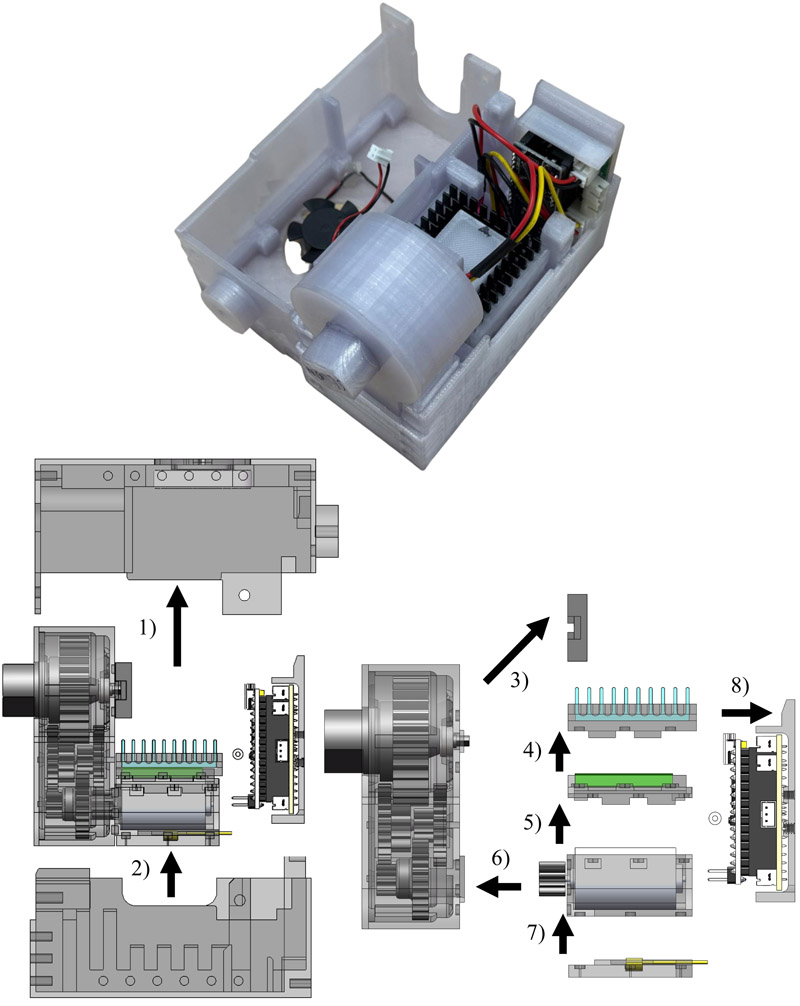
Unit-assembly design for robot recycling
- [1] A. Jurkat, R. Klump, and F. Schneider, “Tracking the rise of robots: The IFR database,” Jahrb. Nationalökon. Stat., Vol.242, Nos.5-6, pp. 669-689, 2022. https://doi.org/10.1515/jbnst-2021-0059
- [2] Y. Asano et al., “A sensor-driver integrated muscle module with high-tension measurability and flexibility for tendon-driven robots,” 2015 IEEE/RSJ Int. Conf. Intell. Robots Syst. (IROS), pp. 5960-5965, 2015. https://doi.org/10.1109/IROS.2015.7354225
- [3] C. Favi, M. Marconi, M. Germani, and M. Mandolini, “A design for disassembly tool oriented to mechatronic product de-manufacturing and recycling,” Adv. Eng. Inform., Vol.39, pp. 62-79, 2019. https://doi.org/10.1016/j.aei.2018.11.008
- [4] P. Vanegas et al., “Ease of disassembly of products to support circular economy strategies,” Resour. Conserv. Recycl., Vol.135, pp. 323-334, 2018. https://doi.org/10.1016/j.resconrec.2017.06.022
- [5] Z. Zhang et al., “Recyclable vitrimer-based printed circuit boards for sustainable electronics,” Nat. Sustain., Vol.7, No.5, pp. 616-627, 2024. https://doi.org/10.1038/s41893-024-01333-7
- [6] J. K. Gershenson, G. J. Prasad, and Y. Zhang, “Product modularity: Definitions and benefits,” J. Eng. des., Vol.14, No.3, pp. 295-313, 2003. https://doi.org/10.1080/0954482031000091068
- [7] Y. Zou et al., “Towards robot modularity—A review of international modularity standardization for service robots,” Robot. Auton. Syst., Vol.148, Article No.103943, 2022. https://doi.org/10.1016/j.robot.2021.103943
- [8] S. Murata et al., “M-TRAN: Self-reconfigurable modular robotic system,” IEEE/ASME Trans. Mechatron., Vol.7, No.4, pp. 431-441, 2002. https://doi.org/10.1109/TMECH.2002.806220
- [9] C. Liu, Q. Lin, H. Kim, and M. Yim, “SMORES-EP, a modular robot with parallel self-assembly,” Auton. Robots, Vol.47, No.2, pp. 211-228, 2023. https://doi.org/10.1007/s10514-022-10078-1
- [10] R. Moreno and A. Faiña, “EMERGE modular robot: A tool for fast deployment of evolved robots,” Front. Robot. AI, Vol.8, Article No.699814, 2021. https://doi.org/10.3389/frobt.2021.699814
- [11] J. W. Romanishin, K. Gilpin, and D. Rus, “M-blocks: Momentum-driven, magnetic modular robots,” 2013 IEEE/RSJ Int. Conf. Intell. Robots Syst., pp. 4288-4295, 2013. https://doi.org/10.1109/IROS.2013.6696971
- [12] N. M. P. Bocken, I. de Pauw, C. Bakker, and B. van der Grinten, “Product design and business model strategies for a circular economy,” J. Ind. Prod. Eng., Vol.33, No.5, pp. 308-320, 2016. https://doi.org/10.1080/21681015.2016.1172124
- [13] J. Saenz et al., “Automated disassembly of e-waste—Requirements on modeling of processes and product states,” Front. Robot. AI, Vol.11, Article No.1303279, 2024. https://doi.org/10.3389/frobt.2024.1303279
- [14] P. Wei et al., “Biodegradable origami enables closed-loop sustainable robotic systems,” Sci. Adv., Vol.11, No.6, Article No.eads0217, 2025. https://doi.org/10.1126/sciadv.ads0217
- [15] M. G. Mazzotta, C. M. Reddy, and C. P. Ward, “Rapid degradation of cellulose diacetate by marine microbes,” Environ. Sci. Technol. Lett., Vol.9, No.1, pp. 37-41, 2022. https://doi.org/10.1021/acs.estlett.1c00843
- [16] A. Gallet-Pandellé, R. G. Rinaldi, F. Dalmas, H. Kurita, and F. Narita, “On the use of cellulose acetate as a structural material for parts produced by fused filament fabrication,” Cellulose, Vol.31, No.15, pp. 9265-9279, 2024. https://doi.org/10.1007/s10570-024-06092-4
- [17] G. Gadaleta et al., “Degradation of thermoplastic cellulose acetate-based bioplastics by full-scale experimentation of industrial anaerobic digestion and composting,” Chem. Eng. J., Vol.462, Article No.142301, 2023. https://doi.org/10.1016/j.cej.2023.142301
- [18] K. Hayashi, Y. Asano, Y. Nishikawa, and J. Shiomi, “Design concept of robot actuator module with passive cooling by heat transfer among close contact components,” 2024 IEEE/SICE Int. Symp. Syst. Integr. (SII), pp. 1211-1216, 2024. https://doi.org/10.1109/SII58957.2024.10417207
- [19] K. Sun, B. Xiao, D. Liu, and J. Wang, “Deep high-resolution representation learning for human pose estimation,” 2019 IEEE/CVF Conf. Comput. Vis. Pattern Recognit. (CVPR), pp. 5686-5696, 2019. https://doi.org/10.1109/CVPR.2019.00584
- [20] M. Sohan, T. Sai Ram, and C. V. Rami Reddy, “A review on YOLOv8 and its advancements,” Int. Conf. Data Intell. Cogn. Inform., pp. 529-545, 2024. https://doi.org/10.1007/978-981-99-7962-2_39
- [21] M. Niero and P. P. Kalbar, “Coupling material circularity indicators and life cycle based indicators: A proposal to advance the assessment of circular economy strategies at the product level,” Resour. Conserv. Recycl., Vol.140, pp. 305-312, 2019. https://doi.org/10.1016/j.resconrec.2018.10.002
- [22] Nature 3D, “Cellulose Acetate Filament.” https://nature3d.thebase.in/items/66101734 [Accessed November 25, 2025]
- [23] NEQAS Corporation, “NEQAS OCEAN.” https://neqas.co.jp/neqas-ocean/ [Accessed November 25, 2025]
- [24] Ultralytics, “YOLOv8.” https://github.com/ultralytics/ultralytics [Accessed February 25, 2026]
This article is published under a Creative Commons Attribution-NoDerivatives 4.0 Internationa License.