
Paper:
Human-Like Decision Making for Automatic Lane Changes at Congested Highway On-Ramp
Hanwool Woo
 , Keiju Nishimura, and Takumi Iwasa
Department of Mechanical Systems Engineering, Kogakuin University
2665-1 Nakano-machi, Hachioji, Tokyo 192-0015, Japan

This study considers a merging scenario on a congested highway on-ramp and develops a system that autonomously performs lane changes from an on-ramp to the main lane. In particular, we focused on constructing a method for selecting a target space in a congested traffic flow into which the host vehicle enters itself. Driving-behavior data of human drivers were collected using a driving simulator, and the proposed method was constructed by mimicking human decision-making mechanisms through machine learning. This enables autonomous vehicles to make natural decisions that are similar to those of human drivers, thereby enhancing the social acceptance of autonomous driving technologies. Simulation experiments confirmed that the proposed method ensures sufficient safety while selecting a target space comparable to that chosen by human drivers.
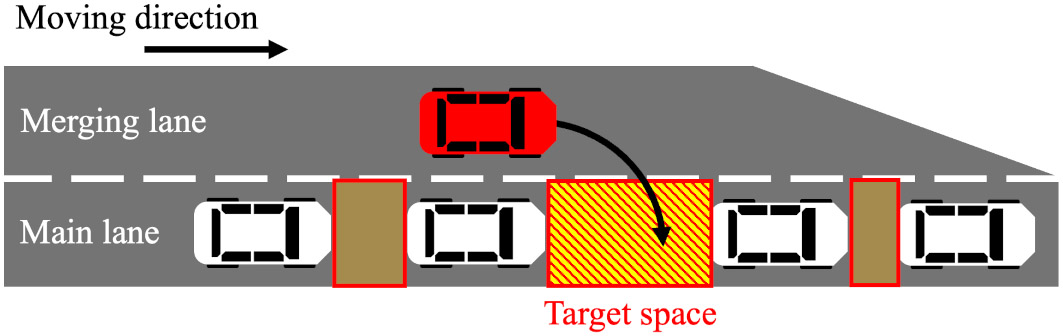
Merging scene at congested highway
- [1] K. Kim, K. Matsuhashi, and M. Ishikawa, “Analysis of primary-party traffic accident rates per driver in Japan from 1995 to 2015: Do older drivers cause more accidents?,” IATSS Res., Vol.47, No.4, pp. 447-454, 2023. https://doi.org/10.1016/j.iatssr.2023.09.001
- [2] D.-N. Nguyen, H.-T. Nguyen, A. Kojima, and H. Kubota, “Traffic safety of elderly road user: The global trend and the Japanese case,” J. Jpn. Soc. Civ. Eng. Ser. D3 (Infrastruct. Plan. Manag.), Vol.72, No.5, pp. I_1249-I_1264, 2016. https://doi.org/10.2208/jscejipm.72.I_1249
- [3] Y. Nishimura et al., “A study on behavior of autonomous vehicles cooperating with manually-driven vehicles,” 2019 IEEE Int. Conf. Pervasive Comput. Commun. (PerCom), pp. 212-219, 2019. https://doi.org/10.1109/PERCOM.2019.8767390
- [4] Q. H. Do et al., “Human drivers based active-passive model for automated lane change,” IEEE Intell. Transp. Syst. Mag., Vol.9, No.1, pp. 42-56, 2017. https://doi.org/10.1109/MITS.2016.2613913
- [5] Y. Yoon, H. Lee, and K. Yi, “Risk-aware lane change decision for autonomous vehicle considering feasibility,” Proc. 7th Int. Symp. Future Act. Saf. Technol. (FAST-zero), Session No.Fri-AM2-B-3, 2023.
- [6] H. Yajima and K. Takami, “Inter-vehicle communication protocol design for a yielding decision at an unsignalized intersection and evaluation of the protocol using radio control cars equipped with Raspberry Pi,” Computers, Vol.8, No.1, Article No.16, 2019. https://doi.org/10.3390/computers8010016
- [7] Y. Luo, Y. Xiang, K. Cao, and K. Li, “A dynamic automated lane change maneuver based on vehicle-to-vehicle communication,” Transp. Res. Part C Emerg. Technol., Vol.62, pp. 87-102, 2016. https://doi.org/10.1016/j.trc.2015.11.011
- [8] L. Li, J. Gan, K. Zhou, X. Qu, and B. Ran, “A novel lane-changing model of connected and automated vehicles: Using the safety potential field theory,” Phys. A Stat. Mech. Appl., Vol.559, Article No.125039, 2020. https://doi.org/10.1016/j.physa.2020.125039
- [9] Y. Ali, Z. Zheng, M. M. Haque, M. Yildirimoglu, and S. Washington, “Understanding the discretionary lane-changing behaviour in the connected environment,” Accid. Anal. Prev., Vol.137, Article No.105463, 2020. https://doi.org/10.1016/j.aap.2020.105463
- [10] H. Woo, H. Tetsuka, and J. Gwak, “Automatic lane-changing system on congested highway,” J. Robot. Mechatron., Vol.36, No.3, pp. 779-786, 2024. https://doi.org/10.20965/jrm.2024.p0779
- [11] H. Woo, H. Tetsuka, and J. Gwak, “Autonomous lane-changing system at congested merging area,” Proc. 7th Int. Symp. Future Act. Saf. Technol. (FAST-zero), Session No.Fri-AM2-B-2, 2023.
- [12] K. Nishimura and H. Woo, “Target space selection for automatic lane-changing system at congested highway on-ramp,” J. Robot. Mechatron., Vol.37, No.5, pp. 1061-1067, 2025. https://doi.org/10.20965/jrm.2025.p1061
- [13] M. Fujita, A. Aratani, and S. Yamada, “Analysis of traffic volume and travel-time relationship using continuous one-hour values on urban expressway,” J. Adv. Transp., Vol.2023, Article No.6866060, 2023. https://doi.org/10.1155/2023/6866060
- [14] G. Ke et al., “LightGBM: A highly efficient gradient boosting decision tree,” Proc. 31st Int. Conf. Neural Inf. Process. Syst. (NIPS), pp. 3149-3157, 2017.
- [15] Y. Shi, G. Ke, Z. Chen, S. Zheng, and T.-Y. Liu, “Quantized training of gradient boosting decision trees,” Proc. 36th Int. Conf. Neural Inf. Process. Syst. (NIPS), pp. 18822-18833, 2022.
- [16] T. Hiraoka, M. Tanaka, H. Kumamoto, T. Izumi, and K. Hatanaka, “Collision risk evaluation index based on deceleration for collision avoidance (first report),” Rev. Automot. Eng., Vol.30, No.4, pp. 429-437, 2009. https://doi.org/10.11351/jsaereview.30.429
- [17] L. Yang, C.-F. Xing, and H.-B. Zhao, “Study on driver’s reaction time (DRT) during car following,” Comput. Technol. Autom., Vol.34, No.3, pp. 33-37, 2015 (in Chinese). https://doi.org/10.16339/j.cnki.jsjsyzdh.2015.03.007
- [18] D. D. Boos and J. M. Hughes-Oliver, “How large does n have to be for Z and t intervals?,” Am. Stat., Vol.54, No.2, pp. 121-128, 2000. https://doi.org/10.1080/00031305.2000.10474524
- [19] L. Lwambagaza, T. Sando, E. Mtoi, E. E. Ozguven, and J. O. Sobanjo, “Age-based simulation of merging behavior at freeway merging ramps,” Transp. Res. Rec., Vol.2663, pp. 57-66, 2017. https://doi.org/10.3141/2663-08
- [20] D. de Waard, C. Dijksterhuis, and K. A. Brookhuis, “Merging into heavy motorway traffic by young and elderly drivers,” Accid. Anal. Prev., Vol.41, No.3, pp. 588-597, 2009. https://doi.org/10.1016/j.aap.2009.02.011
- [21] X. Wan, P. J. Jin, L. Zheng, Y. Cheng, and B. Ran, “Speed synchronization process of merging vehicles from the entrance ramp: Empirical analysis,” Transp. Res. Rec., Vol.2391, pp. 11-21, 2013. https://doi.org/10.3141/2391-02
- [22] V. Milanés and S. E. Shladover, “Modeling cooperative and autonomous adaptive cruise control dynamic responses using experimental data,” Transp. Res. Part C Emerg. Technol., Vol.48, pp. 285-300, 2014. https://doi.org/10.1016/j.trc.2014.09.001
- [23] Y. Wang et al., “Online parameter estimation methods for adaptive cruise control systems,” IEEE Trans. Intell. Veh., Vol.6, No.2, pp. 288-298, 2021. https://doi.org/10.1109/TIV.2020.3023674
- [24] J. Marzbanrad and I. T. Moghaddam, “Self-tuning control algorithm design for vehicle adaptive cruise control system through real-time estimation of vehicle parameters and road grade,” Veh. Syst. Dyn., Vol.54, No.9, pp. 1291-1316, 2016. https://doi.org/10.1080/00423114.2016.1199886
- [25] J. Boylan, W. S. Chen, and D. Meyer, “The influence of vehicle characteristics on the braking behaviour of young people as measured using telematics,” J. Road Saf., Vol.36, No.1, pp. 1-10, 2025. https://doi.org/10.33492/JRS-D-25-1-2468883
- [26] National Highway Traffic Safety Administration, “Critical reasons for crashed investigated in the National Motor Vehicle Crash Causation Survey,” Traffic Safety Facts, No.DOT HS 812 115, 2015. https://crashstats.nhtsa.dot.gov/Api/Public/ViewPublication/812115 [Accessed July 22, 2026]
This article is published under a Creative Commons Attribution-NoDerivatives 4.0 Internationa License.