
Paper:
Proposal of a Flexible Sensor with an Inflatable Structure in Learning Pressure Massage Techniques
Yasutaka Nishioka*
 , Hitoshi Yamauchi*, Keiko Seki**, Shinya Nakajima***, and Junpei Kato***
*Department of Mechanical System Engineering, The University of Shiga Prefecture
2500 Hassaka, Hikone, Shiga 522-8533, Japan
**Department of Human Nursing, The University of Shiga Prefecture
2500 Hassaka, Hikone, Shiga 522-8533, Japan
***Department of Kyoto Kagaku Corporation
15 Kitanegoya-cho, Fushimi-ku, Kyoto, Kyoto 612-8388, Japan

Massage has both physical and mental benefits. Pressure massage is suitable for exerting a strong force on the skin’s surface in the normal direction. This technique is taught visually or using force feedback. Quantitative evaluation and learning methodologies are required. In this study, we propose a learning support system for massage techniques. The applied force and angle are quantitatively evaluated. Large forces, such as those applied during a massage, are difficult to measure using conventional rigid sensors or sensors incapable of handling large displacements. Therefore, we propose a flexible three-axis force sensor with an inflatable structure using pneumatics. The sensor is made of a non-elastic material; therefore, it can measure large forces based on volume changes. We show the design and construction of the proposed sensor and evaluate it.
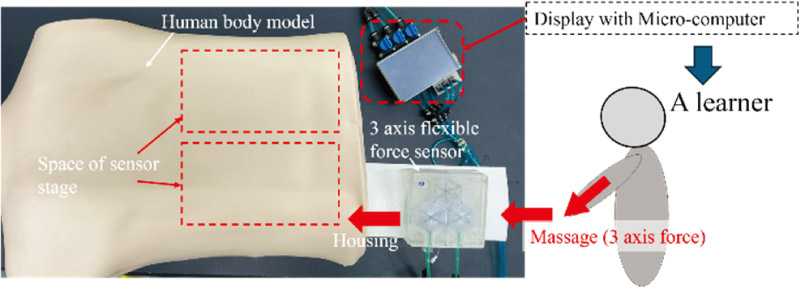
Schematic of pressure massage learning support system
- [1] E. Ernst, “The safety of massage therapy,” Rheumatology, Vol.42, No.9, pp. 1101-1106, 2003. https://doi.org/10.1093/rheumatology/keg306
- [2] T. Field, M. Diego, and M. Hernandez-Reif, “Massage therapy research,” Developmental Review, Vol.27, Issue 1, pp. 75-89, 2007. https://doi.org/10.1016/j.dr.2005.12.002
- [3] C. A. Moyer, J. Rounds, and J. W. Hannum, “A meta-analysis of massage therapy research,” Psychological Bulletin, Vol.130, No.1, pp. 3-18, 2004. https://doi.org/10.1037/0033-2909.130.1.3
- [4] N. Robinson, A. Lorenc, and X. Liao, “The evidence for shiatsu: A systematic review of shiatsu and acupressure,” BMC Complementary and Alternative Medicine, Vol.11, Article No.88, 2011. https://doi.org/10.1186/1472-6882-11-88
- [5] L. H. Brady, K. Henry, J. F. Luth, and K. K. Casper-Bruett, “The effects of shiatsu on lower back pain,” J. of Holistic Nursing, Vol.19, Issue 1, pp. 57-70, 2001. https://doi.org/10.1177/0898010101019001
- [6] M. Iida, A. Chiba, Y. Yoshida, K. Shimizu, and K. Kanda, “Effects of shiatsu massage on relief of anxiety and side effect symptoms of patients receiving cancer chemotherapy,” The Kitakanto Medical J., Vol.50, Issue 3, pp. 227-232, 2000. https://doi.org/10.2974/kmj.50.227
- [7] T. Koori and A. Ogata, “A survey on the evaluation of in-school clinical training at schools for training massage therapists,” J. of the Japanese Society of Oriental Medicine Physical Therapy, Vol.42, No.2, pp. 111-117, 2017 (in Japanese). https://doi.org/10.32255/jjsop.42.2_111
- [8] M. Tani, T. Kimura, and S. Aizawa, “Evaluation method for basic massage skills using pressure sensors,” Education of Acupuncture and Manual Therapy, Vol.4 pp. 55-58, 2008 (in Japanese).
- [9] T. Kato, H. Takase, K. Eto, K. Ito, and T. Iwata, “Development of a support system for learning foot massage movement skills using IoT technology,” Procedia Computer Science, Vol.207, pp. 3430-3438, 2022. https://doi.org/10.1016/j.procs.2022.09.402
- [10] R. Arai, H. Takase, K. Eto, T. Kato, K. Ito, and T. Iwata, “Development of a support system for acquiring movement skills for foot care massage using IoT technology,” Procedia Computer Science, Vol.246, pp. 1640-1648, 2024. https://doi.org/10.1016/j.procs.2024.09.641
- [11] M. Tojo, N. Hasegawa, R. Fujii, A. Ogata, and N. Donoyama, “Effect of learning thumb compression technique using a massage score reader system,” Tsukuba University of Technology Techno Report, Vol.19, No.1, pp. 7-12, 2011 (in Japanese).
- [12] Y. Wan, Y. Wang, and C. F. Guo, “Recent progresses on flexible tactile sensors,” Materials Today Physics, Vol.1, pp. 61-73, 2017. https://doi.org/10.1016/j.mtphys.2017.06.002
- [13] T.-D. Nguyen and J. S. Lee, “Recent development of flexible tactile sensors and their applications,” Sensors, Vol.22, Issue 1, Article No.50, 2022. https://doi.org/10.3390/s22010050
- [14] H. Niu, H. Zhang, W. Yue, S. Gao, H. Kan, C. Zhang et al., “Micro–nano processing of active layers in flexible tactile sensors via template methods: A review,” Small, Vol.17, Issue 41, Article No.2100804, 2021. https://doi.org/10.1002/smll.202100804
- [15] K. Kim, K. R. Lee, W. H. Kim, K.-B. Park, T.-H. Kim, J.-S. Kim, and J. J. Pak, “Polymer-based flexible tactile sensor up to 32 times 32 arrays integrated with interconnection terminals,” Sensors and Actuators A: Physical, Vol.156, No.2, pp. 284-291, 2009. https://doi.org/10.1016/j.sna.2009.08.015
- [16] H. Choi and K. Kong, “A soft three-axis force sensor based on radially symmetric pneumatic chambers,” IEEE Sensors J., Vol.19, No.13, pp. 5229-5238, 2019. https://doi.org/10.1109/JSEN.2019.2904606
- [17] K. Suzumori and H. Nabae, “Review of flexible/stretchable sensors for soft robot,” J. Robot. Mechatron., Vol.37, No.1, pp. 8-12, 2025. https://doi.org/10.20965/jrm.2025.p0008
- [18] Y. Wang, K. Xi, D. Mei, G. Liang, and Z. Chen, “A flexible tactile sensor array based on pressure conductive rubber for contact force measurement and slip detection,” J. Robot. Mechatron., Vol.28, No.3, pp. 378-385, 2016. https://doi.org/10.20965/jrm.2016.p0378
- [19] D. M. Vogt, Y.-L. Park, and R. J. Wood, “Design and characterization of a soft multi-axis force sensor using embedded microfluidic channels,” IEEE Sensors J., Vol.13, Issue 10, pp. 4056-4064, 2013. https://doi.org/10.1109/JSEN.2013.2272320
- [20] L. Viry, A. Levi, M. Totaro, A. Mondini, V. Mattoli, B. Mazzolai, and L. Beccai, “Flexible three–axial force sensor for soft and highly sensitive artificial touch,” Advanced Materials, Vol.26, Issue 17, pp. 2659-2664, 2014. https://doi.org/10.1002/adma.201305064
- [21] H. Wang, G. De Boer, J. Kow, A. Alazmani, M. Ghajari, R. Hewson, and P. Culmer, “Design methodology for magnetic field-based soft tri-axis tactile sensors,” Sensors, Vol.16, Issue 9, Article No.1356, 2016. https://doi.org/10.3390/s16091356
- [22] H.-K. Lee, S.-I. Chang, and E. Yoon, “A flexible polymer tactile sensor: Fabrication and modular expandability for large area deployment,” J. of Microelectromechanical Systems, Vol.15, Issue 6, pp. 1681-1686, 2006. https://doi.org/10.1109/JMEMS.2006.886021
- [23] K. Kim, J. Park, J.-h. Suh, M. Kim, Y. Jeong, and I. Park, “3D printing of multiaxial force sensors using carbon nanotube (CNT)/thermoplastic polyurethane (TPU) filaments,” Sensors and Actuators A: Physical, Vol.263, pp. 493-500, 2017. https://doi.org/10.1016/j.sna.2017.07.020
- [24] T. Zhang, Y. Zhao, Q. Long, X. Zhu, L. He, Z. Li et al., “Graphene/MXene/Cellulose cellulosic paper-based flexible bifunctional sensors utilizing molecular bridge strategy with tunable piezoresistive effect for temperature-pressure sensing,” Chemical Engineering J., Vol.497, Article No.154972, 2024. https://doi.org/10.1016/j.cej.2024.154972
- [25] X. Guo, X. Zhu, Q. Long, X. Wu, Z. Li, J. Li et al., “Multifunctional pressure and humidity sensor modulated by electrostatic interactions and hydrogen bonds for wearable health monitoring,” J. of Colloid and Interface Science, Vol.678, Part B, pp. 1061-1072, 2025. https://doi.org/10.1016/j.jcis.2024.09.075
- [26] T. Nakamura, Y. Akamatsu, and Y. Kusaka, “Development of soft manipulator with variable rheological joints and pneumatic sensor for collision with environment,” J. Robot. Mechatron., Vol.20, No.4, pp. 634-640, 2008. https://doi.org/10.20965/jrm.2008.p0634
- [27] Y. Suzuki, R. Yoshida, T. Tsuji, T. Nishimura, and T. Watanabe, “Local curvature estimation and grasp stability prediction based on proximity sensors on a multi-fingered robot hand,” J. Robot. Mechatron., Vol.35, No.5, pp. 1340-1353, 2023. https://doi.org/10.20965/jrm.2023.p1340
- [28] Y. Sugano, H. Kim, and S. Kawamura, “Performance improvement of multi-axial force sensor using inflatable structure,” The Proc. of JSME Annual Conf. on Robotics and Mechatronics (Robomec), Article No.1A1-I10, 2017 (in Japanese). https://doi.org/10.1299/jsmermd.2017.1A1-I10
This article is published under a Creative Commons Attribution-NoDerivatives 4.0 Internationa License.