
Paper:
Learning Support System for Nursing Massage Movements Based on LED-Embedded Air Pressure Rubber Sensor
Yasutaka Nishioka*
 , Suzuka Yamashita**, and Keiko Seki***
*Department of Mechanical System Engineering, University of Shiga Prefecture
2500 Hassaka, Hikone, Shiga 522-8533, Japan
**Department of Mechanical System Engineering, University of Shiga Prefecture
2500 Hassaka, Hikone, Shiga 522-8533, Japan
***Department of Human Nursing, University of Shiga Prefecture
2500 Hassaka, Hikone, Shiga 522-8533, Japan

In the field of nursing, hand massage has attracted attention because it can be easily performed anywhere and has numerous benefits, such as reducing anxiety and stress, promoting healing, improving health, and providing relaxation. However, mastering hand massage techniques requires instruction from a professional instructor. Challenges include the difficulty of self-study and of visually assessing the amount of force applied. To improve learning efficiency, this study develops a massage movement learning support system that visually displays force information in real time, allowing for objective evaluation. The learning system displays force information on an arm simulator model with a smooth surface, using a sheet-type rubber sensor and full-color LED lights. Basic experiments are conducted to evaluate the effectiveness of the developed learning system. In addition, a method is proposed for evaluating massage skill and learning level based on changes in force distribution detected by the rubber sensor. The effects of learning are verified using the proposed evaluation indices and physiological evaluations.
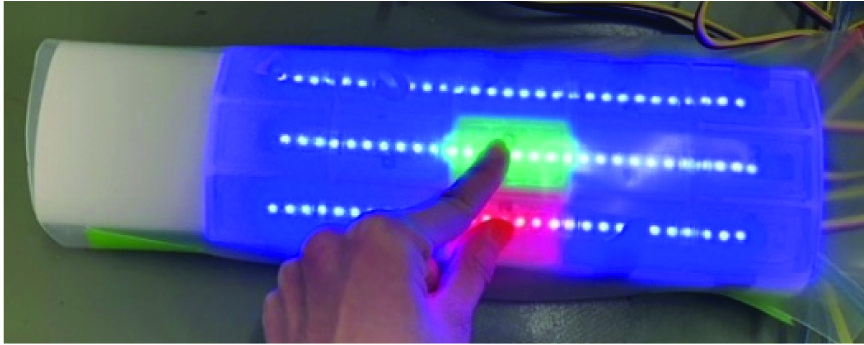
Example of force color indication using rubber sensors and LEDs
- [1] H. Kunikata, K. Watanabe, M. Miyoshi, and T. Tanioka, “The effects measurement of hand massage by the autonomic activity and psychological indicators,” The J. of Medical Investigation, Vol.59, Nos.1-2, pp. 206-212, 2012. https://doi.org/10.2152/jmi.59.206
- [2] A. Santos, M. Percy, and D. Rabinowitsch, “Evaluating the aromatherapy recommendation for pain in the holistic nurses’ pain relief tools for patients and self-care,” J. of Holistic Nursing, Vol.40, No.2, pp. 99-107, 2022. https://doi.org/10.1177/08980101211025373
- [3] K. Kolcaba, V. Schirm, and R. Steiner, “Effects of hand massage on comfort of nursing home residents,” Geriatric Nursing, Vol.27, No.2, pp. 85-91, 2006. https://doi.org/10.1016/j.gerinurse.2006.02.006
- [4] H. J. Oh and J. S. Park, “Effects of hand massage and hand holding on the anxiety in patients with local infiltration anesthesia,” J. of Korean Academy of Nursing, Vol.34, No.6, pp. 924-933, 2004 (in Korean). https://doi.org/10.4040/jkan.2004.34.6.924
- [5] H.-L. Wang and J. F. Keck, “Foot and hand massage as an intervention for postoperative pain,” Pain Management Nursing, Vol.5, No.2, pp. 59-65, 2004. https://doi.org/10.1016/j.pmn.2004.01.002
- [6] H. Kitagawa, T. Terai, P. Minyong, and K. Terashima, “Application of neural network to teaching of massage using multi-fingered robot hand,” J. Robot. Mechatron., Vol.14, No.2, pp. 162-169, 2002. https://doi.org/10.20965/jrm.2002.p0162
- [7] K. Terashima, T. Miyoshi, K. Mouri, H. Kitagawa, and P. Minyong, “Hybrid impedance control of massage considering dynamic interaction of human and robot collaboration systems,” J. Robot. Mechatron., Vol.21, No.1, pp. 146-155, 2009. https://doi.org/10.20965/jrm.2009.p0146
- [8] M. Khoramshahi, G. Henriks, A. Naef, S. S. M. Salehian, J. Kim, and A. Billard, “Arm-hand motion-force coordination for physical interactions with non-flat surfaces using dynamical systems: Toward compliant robotic massage,” 2020 IEEE Int. Conf. on Robotics and Automation (ICRA), pp. 4724-4730, 2020. https://doi.org/10.1109/ICRA40945.2020.9196593
- [9] N. Harada, M. Kitazaki, and R. Tasaki, “Physical therapy massage robot system with human motion tracking and finger-pressing force control,” Advanced Robotics, Vol.39, No.5, pp. 223-242, 2025. https://doi.org/10.1080/01691864.2025.2469695
- [10] C. Wang, Z. Sun, J. Long, J. Wei, X. Chen, Q. Liu, Y. Shen, W. Shang, Y. Wang, L. Duan, and Z. Wu, “Development of a novel massage platform for medical training,” Technology and Health Care, Vol.28, No.1_suppl, pp. 89-101, 2020. https://doi.org/10.3233/THC-209010
- [11] R. Arai, H. Takase, K. Eto, T. Kato, K. Ito, and T. Iwata, “Development of a support system for acquiring movement skills for foot care massage using IoT technology,” Procedia Computer Science, Vol.246, pp. 1640-1648, 2024. https://doi.org/10.1016/j.procs.2024.09.641
- [12] T. Kato, H. Takase, K. Eto, K. Ito, and T. Iwata, “Development of a support system for learning foot massage movement skills using IoT technology,” Procedia Computer Science, Vol.207, pp. 3430-3438, 2022. https://doi.org/10.1016/j.procs.2022.09.402
- [13] A. Katsumata, Y. Iida, M. Fujishita, M. Izumi, K. Kobayashi, Y. Ogura, Y. Usuda, and A. Takanishi, “Development of a force measurement system for massage of the face,” J. of Temporomandibular Joint, Vol.19, No.2, pp. 158-163, 2007 (in Japanese). https://doi.org/10.11246/gakukansetsu1989.19.158
- [14] K. Suzumori and H. Nabae, “Review of flexible/stretchable sensors for soft robot,” J. Robot. Mechatron., Vol.37, No.1, pp. 8-12, 2025. https://doi.org/10.20965/jrm.2025.p0008
- [15] Y. Kato, T. Hayakawa, and T. Mukai, “Soft areal tactile sensor using tomography algorithm,” J. Robot. Mechatron., Vol.20, No.4, pp. 628-633, 2008. https://doi.org/10.20965/jrm.2008.p0628
- [16] T. Yoshikai, T. Sagisaka, M. Hayashi, and M. Inaba, “Acquisition and realization of a rolling-over motion for a humanoid with soft sensor flesh,” J. Robot. Mechatron., Vol.20, No.2, pp. 241-249, 2008. https://doi.org/10.20965/jrm.2008.p0241
- [17] T. Nakamura, Y. Akamatsu, and Y. Kusaka, “Development of soft manipulator with variable rheological joints and pneumatic sensor for collision with environment,” J. Robot. Mechatron., Vol.20, No.4, pp. 634-640, 2008. https://doi.org/10.20965/jrm.2008.p0634
This article is published under a Creative Commons Attribution-NoDerivatives 4.0 Internationa License.