
Paper:
Development of Invisible QR Code Using Watermarking Technology
Souma Kawanishi and Kazuyoshi Wada

Graduate School of Systems Design, Tokyo Metropolitan University
6-6 Asahigaoka, Hino, Tokyo 191-0065, Japan

The decline in the working population due to falling birth rates and an aging population is a pressing issue. Convenience stores, in particular, have become part of the social infrastructure; however, their operations are diverse, and labor shortages are becoming increasingly acute. Therefore, automating display operations is necessary to reduce workloads. However, existing methods pose several challenges, such as loss of visual appeal and the high costs associated with developing deep learning models. This study focuses on information-hiding technology and proposes an invisible QR code that embeds information into product packaging in an imperceptible manner. Because it is invisible, it does not detract from the package’s appearance and can be detected by image processing, thereby eliminating computational learning costs. In this study, we evaluated the proposed method through experiments on image quality degradation, recognition accuracy, and the position and orientation estimation accuracy of the invisible QR codes.
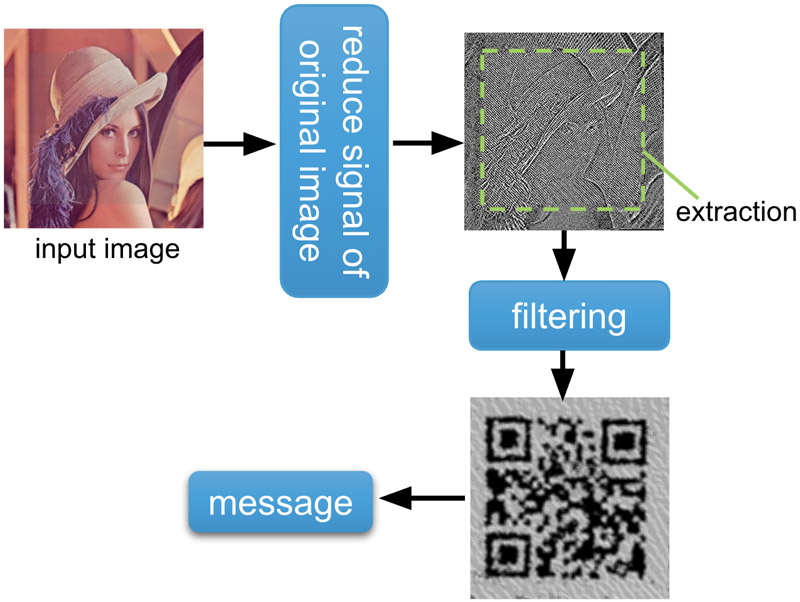
Decoding flow of invisible QR codes
- [1] N. Muramatsu and H. Akiyama, “Japan: Super-Aging Society Preparing for the Future,” The Gerontologist, Vol.51, Issue 4, pp. 425-432, 2011. https://doi.org/10.1093/geront/gnr067
- [2] K. Miwa, “Study of Operations and Staff Scheduling in Retail Store,” J. of Nagoya Gakuin University, Vol.51, No.4, pp. 143-158, 2015 (in Japanese).
- [3] M. Alghamdi, A. Al-Marakeby, and S. Abdel-Mageid, “Mobile Robot Navigation Based on Artificial Markers: A Systematic Mapping Study,” J. Robot. Mechatron., Vol.37, No.3, pp. 762-778, 2025. https://doi.org/10.20965/jrm.2025.p0762
- [4] G. A. Garcia Ricardez, S. Okada, N. Koganti, A. Yasuda, P. M. U. Eljuri, T. Sano, P.-C. Yang, L. El Hafi, M. Yamamoto, J. Takamatsu, and T. Ogasawara, “Restock and straightening system for retail automation using compliant and mobile manipulation,” Advanced Robotics, Vol.34, Issues 3-4, pp. 235-249, 2020. https://doi.org/10.1080/01691864.2019.1698460
- [5] M. Seki, K. Wada, Y. Kitajima, M. Hashimoto, and T. Tomizawa, “Development of XYZ stage-type display robot system for stock and disposal tasks in convenience stores,” Advanced Robotics, Vol.36, Issue 23, pp. 1252-1272, 2022. https://doi.org/10.1080/01691864.2022.2134736
- [6] T. Takubo, T. Nakamura, R. Sugiyama, and A. Ueno, “Multifunctional Shelf and Magnetic Marker for Stock and Disposal Tasks in Convenience Stores,” J. Robot. Mechatron., Vol.35, No.1, pp. 18-29, 2023. https://doi.org/10.20965/jrm.2023.p0018
- [7] A. Jain, M. Singhal, and M. Jhamb, “ArUco Marker-Based Pick and Place Approach Using a UR5 Robotic Arm and Vacuum Gripper,” H. Sharma et al. (Eds.), “Artificial Intelligence: Theory and Applications,” Lecture Notes in Networks and Systems, Vol.843, pp. 365-379, 2024. https://doi.org/10.1007/978-981-99-8476-3_30
- [8] Y. Wei, S. Tran, S. Xu, B. Kang, and M. Springer, “Deep Learning for Retail Product Recognition: Challenges and Techniques,” Computational Intelligence and Neuroscience, Article No.8875910, 2020. https://doi.org/10.1155/2020/8875910
- [9] S. Kawanishi, K. Wada, and Y. Kikutake, “Packaging Design for Product Recognition Using Deep Learning,” J. Robot. Mechatron., Vol.37, No.2, pp. 535-543, 2025. https://doi.org/10.20965/jrm.2025.p0535
- [10] A. Keskinarkaus, “Digital Watermarking Techniques for Printed Images,” University of Oulu, 2012.
- [11] A. Keskinarkaus, A. Pramila, and T. Seppänen, “Image watermarking with a directed periodic pattern to embed multibit messages resilient to print-scan and compound attacks,” J. of Systems and Software, Vol.83, Issue 10, pp. 1715-1725, 2010. https://doi.org/10.1016/j.jss.2010.04.073
- [12] A. Pramila, A. Keskinarkaus, and T. Seppänen, “Toward an interactive poster using digital watermarking and a mobile phone camera,” Signal, Image and Video Processing, Vol.6, No.2, pp. 211-222, 2012. https://doi.org/10.1007/s11760-011-0211-2
- [13] W.-G. Kim, S. H. Lee, and Y.-S. Seo, “Image Fingerprinting Scheme for Print-and-Capture Model,” Y. Zhuang et al. (Eds.), “Advances in Multimedia Information Processing – PCM 2006,” Lecture Notes in Computer Science, Vol.4261, pp. 106-113, 2006. https://doi.org/10.1007/11922162_13
- [14] A. Pramila, A. Keskinarkaus, and T. Seppänen, “Increasing the capturing angle in print-cam robust watermarking,” J. of Systems and Software, Vol.135, pp. 205-215, 2018. https://doi.org/10.1016/j.jss.2017.10.029
- [15] T. Nakamura, A. Katayama, M. Yamamuro, and N. Sonehara, “High-speed watermark detection method from analog images using camera-equipped cell phones,” IEICE Trans. (Japanese Edition), Vol.J87-D-II, No.12, pp. 2145-2155, 2004 (in Japanese).
- [16] T. Nakamura, A. Katayama, M. Yamamuro, and N. Sonehara, “Fast watermark detection scheme for camera-equipped cellular phone,” Proc. of the 3rd Int. Conf. on Mobile and Ubiquitous Multimedia (MUM’04), pp. 101-108, 2004. https://doi.org/10.1145/1052380.1052395
- [17] M. Iwata, K. Yamanaka, and K. Kise, “Digital Watermarking Method to Extract Watermarks from Printed Matters with Cell Phone by Using Finder Patterns and Alignment Pattern of QR Code,” 2013 2nd IAPR Asian Conf. on Pattern Recognition, pp. 391-395, 2013. https://doi.org/10.1109/ACPR.2013.79
- [18] H. Ogawa, M. Iwata, and K. Kise, “Watermarking method that can extract watermarks from printed materials without positional markers using image search,” 2016 Symp. on Cryptography and Information Security, 2016.
- [19] H. Imagawa, M. Iwata, and K. Kise, “Digital Watermarking Method for Printed Matters Using Deep Learning for Detecting Watermarked Areas,” IEICE Trans. on Information and Systems, Vol.E104.D, Issue 1, pp. 34-42, 2021. https://doi.org/10.1587/transinf.2020MUP0004
- [20] R. C. Gonzalez and R. E. Woods, “Digital Image Processing,” Pearson Education Limited, 2018.
- [21] R. Hartley and A. Zisserman, “Multiple View Geometry in Computer Vision,” Cambridge University Press, 2003. https://doi.org/10.1017/CBO9780511811685
- [22] C.-P. Lu, G. D. Hager, and E. Mjolsness, “Fast and globally convergent pose estimation from video images,” IEEE Trans. on Pattern Analysis and Machine Intelligence, Vol.22, Issue 6, pp. 610-622, 2000. https://doi.org/10.1109/34.862199
- [23] J. A. Hesch and S. I. Roumeliotis, “A direct least-squares (DLS) method for PnP,” 2011 Int. Conf. on Computer Vision, pp. 383-390, 2011. https://doi.org/10.1109/ICCV.2011.6126266
- [24] Y. Zheng, Y. Kuang, S. Sugimoto, K. Åström, and M. Okutomi, “Revisiting the PnP Problem: A Fast, General and Optimal Solution,” 2013 IEEE Int. Conf. on Computer Vision, pp. 2344-2351, 2013. https://doi.org/10.1109/ICCV.2013.291
- [25] Z. Wang, A. C. Bovik, H. R. Sheikh, and E. P. Simoncelli, “Image quality assessment: From error visibility to structural similarity,” IEEE Trans. on Image Processing, Vol.13, Issue 4, pp. 600-612, 2004. https://doi.org/10.1109/TIP.2003.819861
- [26] Z. Liu, “What is Wrong with SSIM Quality Metric,” The 77th National Convention of IPSJ, pp. 35-36, 2015.
- [27] U. Sara, “Comparative Study of Different Quality Assessment Techniques on Color Images,” Iconic Research and Engineering J., Vol.2, Issue 11, pp. 127-133, Article No.1701217, 2019.
- [28] Y. Reznik, “Another look at SSIM image quality metric,” Electronic Imaging, Vol.35, Article No.IQSP-305, 2023. https://doi.org/10.2352/EI.2023.35.8.IQSP-305
- [29] D. R. I. M. Setiadi, “PSNR vs SSIM: Imperceptibility quality assessment for image steganography,” Multimedia Tools and Applications, Vol.80, No.6, pp. 8423-8444, 2021. https://doi.org/10.1007/s11042-020-10035-z
- [30] M. Tancik, B. Mildenhall, and R. Ng, “StegaStamp: Invisible Hyperlinks in Physical Photographs,” 2020 IEEE/CVF Conf. on Computer Vision and Pattern Recognition (CVPR), pp. 2114-2123, 2020. https://doi.org/10.1109/CVPR42600.2020.00219
- [31] Seven-Eleven Japan Investor Relations Report (in Japanese). https://www.7andi.com/ir/file/library/co/pdf/2024_03.pdf [Accessed October 28, 2024]
- [32] S. Ando, I. Igarashi, T. Kinebuchi, T. Nakamura, D. Namikawa, R. Yamashita, Y. Yao, Y. Kusachi, and N. Takei, “Image recognition watermark embedding and detection technology for product information presentation service for convenience stores,” 2017 (in Japanese). https://journal.ntt.co.jp/backnumber2/1706/files/JN20170610.pdf [Accessed March 17, 2025]
- [33] Ultralytics Repository. https://github.com/ultralytics/ultralytics [Accessed December 16, 2024]
- [34] Kanagawa Institute of Technology Standard Image / Sample Data (in Japanese). http://www.ess.ic.kanagawa-it.ac.jp/app_images_j.html [Accessed September 8, 2025]
- [35] SONY ELP-USB4K02AF-V100. https://www.elpcctv.com/elp-128-sony-imx415-color-cmos-sensor-4k-autofocus-usb-camera-elpusb4k02afv100-p-162.html [Accessed March 9, 2025]
- [36] Seven Premium fruit juice 100% orange and mandarin oranges 200 mL (in Japanese). https://7premium.jp/product/search/detail?id=43l [Accessed May 3, 2025]
- [37] Meiji Probio Yogurt R-1 (in Japanese). https://www.meiji.co.jp/dairies/yogurt/meiji-r1/product/ [Accessed May 3, 2025]
This article is published under a Creative Commons Attribution-NoDerivatives 4.0 Internationa License.