
Paper:
Error Compensation Strategies for Lower-Limb Rehabilitation Robots: A Staged Approach with MLP and Transformer Models
Aihui Wang†
 , Rui Teng, Jinkang Dong, Xuebin Yue
, and Xiang Zhang
, Rui Teng, Jinkang Dong, Xuebin Yue
, and Xiang Zhang
School of Automation and Electrical Engineering, Zhongyuan University of Technology
No.41 Zhongyuan Road, Zhengzhou, Henan 450007, China
†Corresponding author

Lower-limb rehabilitation robots are valuable for gait training, but accurate joint motor angle tracking remains challenging due to various motion-related disturbances. This paper presents a staged joint-compensation strategy to improve control accuracy. The gait control process is partitioned into initiation, cyclic, and termination phases. A multilayer perceptron is employed during initiation and termination to predict and compensate for short-term aperiodic errors, while a Transformer-based sequence model combined with repetitive-control concepts is used in the cyclic phase to predict and correct periodic errors. Phase detection and safety-constraint mechanisms are integrated to ensure system stability and safety. Experiments are performed on a self-developed robotic platform with field-oriented control at the motor level, using a 165 cm, 60 kg dummy as the load. The proposed strategy substantially reduced joint-angle RMSE: left hip from 0.692° to 0.494° (28.6% reduction), right hip from 0.687° to 0.402° (41.5% reduction), left knee from 1.754° to 0.426° (75.7% reduction), and right knee from 1.667° to 0.461° (72.3% reduction). Ablation studies and repeated-trial statistical analyses further confirm the effectiveness of the approach. This study significantly reduces the gait trajectory tracking errors of joint actuators in a lower-limb rehabilitation robot, thereby providing a feasible and effective approach for the optimization of its control algorithm design.
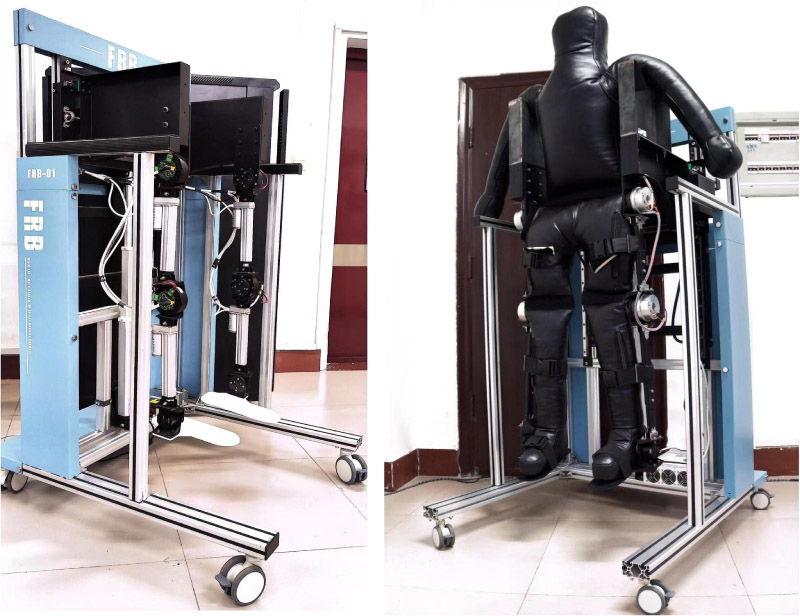
Lower-limb rehabilitation robot
- [1] N. Alam, S. Hasan, G. A. Mashud, and S. Bhujel, “Neural Network for Enhancing Robot-Assisted Rehabilitation: A Systematic Review,” Actuators, Vol.14, Issue 1, Article No.16, 2025. https://doi.org/10.3390/act14010016
- [2] V. Firouzi, A. Seyfarth, S. Song, O. von Stryk, and M. A. Sharbafi, “Biomechanical models in the lower-limb exoskeletons development: A review,” J. of NeuroEngineering and Rehabilitation, Vol.22, No.1, Article No.12, 2025.
- [3] K. Aqabakee, F. Abdollahi, A. Taghvaeipour, and M.-R. Akbarzadeh-T, “Recursive generalized type-2 fuzzy radial basis function neural networks for joint position estimation and adaptive EMG-based impedance control of lower limb exoskeletons,” Biomedical Signal Processing and Control, Vol.100, Part C, Article No.106791, 2025. https://doi.org/10.1016/j.bspc.2024.106791
- [4] H. Xia, Y. Zhang, N. Rajabi, F. Taleb, Q. Yang, D. Kragic, and Z. Li, “Shaping high-performance wearable robots for human motor and sensory reconstruction and enhancement,” Nature Communications, Vol.15, No.1, Article No.1760, 2024. https://doi.org/10.1038/s41467-024-46249-0
- [5] S. Ha, J. Lee, M. van de Panne, Z. Xie, W. Yu, and M. Khadiv, “Learning-based legged locomotion: State of the art and future perspectives,” The Int. J. of Robotics Research, Vol.44, Issue 8, pp. 1396-1427, 2025. https://doi.org/10.1177/02783649241312698
- [6] O. Flor-Unda, R. Arcos-Reina, C. Toapanta, F. Villao, A. Bustos-Estrella, C. Suntaxi, and H. Palacios-Cabrera, “Challenges in the Development of Exoskeletons for People with Disabilities,” Technologies, Vol.13, Issue 7, Article No.291, 2025. https://doi.org/10.3390/technologies13070291
- [7] G.-R. Duan, “Fully Actuated System Approach for Control: An Overview,” IEEE Trans. on Cybernetics, Vol.54, Issue 12, pp. 7285-7306, 2024. https://doi.org/10.1109/TCYB.2024.3457584
- [8] X. Lu, X. Chen, Y. Bai, and R. Liu, “Explicit model based fuzzy control method for lower limb exoskeleton robot,” Expert Systems with Applications, Vol.270, Article No.126601, 2025. https://doi.org/10.1016/j.eswa.2025.126601
- [9] A. D. Banyai and C. Brișan, “Robotics in Physical Rehabilitation: Systematic Review,” Healthcare, Vol.12, Issue 17, Article No.1720, 2024. https://doi.org/10.3390/healthcare12171720
- [10] M. S. Amiri and R. Ramli, “Fuzzy Adaptive Controller of a Wearable Assistive Upper Limb Exoskeleton Using a Disturbance Observer,” IEEE Trans. on Human-Machine Systems, Vol.55, Issue 2, pp. 197-206, 2025. https://doi.org/10.1109/THMS.2025.3529759
- [11] Y. Wang, Y. Tian, Y. Guo, and H. Wang, “Active torque-based gait adjustment multi-level control strategy for lower limb patient – Exoskeleton coupling system in rehabilitation training,” Mathematics and Computers in Simulation, Vol.215, pp. 357-381, 2024. https://doi.org/10.1016/j.matcom.2023.08.020
- [12] R. L. McGrath and F. Sergi, “Repetitive Control of Knee Interaction Torque via a Lower Extremity Exoskeleton for Improved Transparency During Walking,” IEEE Trans. on Medical Robotics and Bionics, Vol.6, Issue 4, pp. 1581-1590, 2024. https://doi.org/10.1109/TMRB.2024.3464119
- [13] B. Chen, L. Zhou, B. Zi, E. Li, and D. Zhang, “Adaptive Admittance Control Strategy for a Robotic Knee Exoskeleton with a Nonlinear Variable Stiffness Actuator,” IEEE/ASME Trans. on Mechatronics, Vol.30, Issue 3, pp. 1888-1899, 2024. https://doi.org/10.1109/TMECH.2024.3422478
- [14] J. Luo, C. Zhang, W. Si, Y. Jiang, C. Yang, and C. Zeng, “A Physical Human–Robot Interaction Framework for Trajectory Adaptation Based on Human Motion Prediction and Adaptive Impedance Control,” IEEE Trans. on Automation Science and Engineering, Vol.22, pp. 5072-5083, 2024. https://doi.org/10.1109/TASE.2024.3415650
- [15] L. Pezeshki, H. Sadeghian, A. Mohebbi, M. Keshmiri, and S. Haddadin, “Personalized Assistance in Robotic Rehabilitation: Real-Time Adaptation via Energy-Based Performance Monitoring,” IEEE Trans. on Automation Science and Engineering, Vol.22, pp. 13298-13309, 2025. https://doi.org/10.1109/TASE.2025.3552446
- [16] H. Liu, C. Zhu, Z. Zhou, Y. Dong, W. Meng, and Q. Liu, “Synergetic gait prediction and compliant control of SEA-driven knee exoskeleton for gait rehabilitation,” Frontiers in Bioengineering and Biotechnology, Vol.12, Article No.1358022, 2024. https://doi.org/10.3389/fbioe.2024.1358022
- [17] H. van der Kooij, E. H. F. van Asseldonk, M. Sartori, C. Basla, A. Esser, and R. Riener, “AI in therapeutic and assistive exoskeletons and exosuits: Influences on performance and autonomy,” Science Robotics, Vol.10, No.104, Article No.eadt7329, 2025. https://doi.org/10.1126/scirobotics.adt7329
- [18] D. Astolfi, S. Marx, and N. van de Wouw, “Repetitive control design based on forwarding for nonlinear minimum-phase systems,” Automatica, Vol.129, Article No.109671, 2021. https://doi.org/10.1016/j.automatica.2021.109671
- [19] K. Umeda, Y. Jiang, H. Yokoi, and S. Togo, “Repetitive Control of Robotic Joint with Variable Impedance Utilizing Agonist-Antagonist Muscle Pair Structure Based on Virtual Trajectories,” IEEE Access, Vol.13, pp. 16866-16878, 2025. https://doi.org/10.1109/ACCESS.2025.3532633
- [20] Z. Sun, F. Li, X. Duan, L. Jin, Y. Lian, S. Liu, and K. Liu, “A novel adaptive iterative learning control approach and human-in-the-loop control pattern for lower limb rehabilitation robot in disturbances environment,” Autonomous Robots, Vol.45, No.4, pp. 595-610, 2021. https://doi.org/10.1007/s10514-021-09988-3
- [21] J. Yang, T. Sun, L. Cheng, and Z.-G. Hou, “Spatial Repetitive Impedance Learning Control for Robot-Assisted Rehabilitation,” IEEE/ASME Trans. on Mechatronics, Vol.28, Issue 3, pp. 1280-1290, 2022. https://doi.org/10.1109/TMECH.2022.3221931
- [22] X. Wang, R. Zhang, Y. Miao, M. An, S. Wang, and Y. Zhang, “PI^{mathrm{2}}-Based Adaptive Impedance Control for Gait Adaption of Lower Limb Exoskeleton,” IEEE/ASME Trans. on Mechatronics, Vol.29, Issue 6, pp. 4251-4261, 2024. https://doi.org/10.1109/TMECH.2024.3370954
- [23] T. K. Best, C. G. Welker, E. J. Rouse, and R. D. Gregg, “Data-Driven Variable Impedance Control of a Powered Knee-Ankle Prosthesis for Adaptive Speed and Incline Walking,” IEEE Trans. on Robotics, Vol.39, Issue 3, pp. 2151-2169, 2023. https://doi.org/10.1109/TRO.2022.3226887
- [24] X. Li, Y.-H. Liu, and H. Yu, “Iterative learning impedance control for rehabilitation robots driven by series elastic actuators,” Automatica, Vol.90, pp. 1-7, 2018. https://doi.org/10.1016/j.automatica.2017.12.031
- [25] Q. Wen, T. Zhou, C. Zhang, W. Chen, Z. Ma, J. Yan, and L. Sun, “Transformers in Time Series: A Survey,” arXiv preprint, arXiv:2202.07125, 2023. https://doi.org/10.48550/arXiv.2202.07125
- [26] J. Zhao, S. Gao, Z. Pan, L. Wang, and Z. Yu, “Cross-Coupled Synchronous Control of Dual Linear Motor Servo System Based on Disturbance-Assignment Observer and Iterative Learning Control,” IEEE Trans. on Transportation Electrification, Vol.11, Issue 1, pp. 2908-2917, 2024. https://doi.org/10.1109/TTE.2024.3430062
- [27] H. Chen, X. Wang, Y. Xiao, B. Wu, Z. Wang, Y. Liu, P. Wang, C. Chen, and X. Wu, “iP3T: An interpretable multimodal time-series model for enhanced gait phase prediction in wearable exoskeletons,” Frontiers in Neuroscience, Vol.18, Article No.1457623, 2024. https://doi.org/10.3389/fnins.2024.1457623
- [28] Z. Guo, H. Zheng, H. Wu, J. Zhang, G. Zhou, and J. Long, “Transferable multi-modal fusion in knee angles and gait phases for their continuous prediction,” J. of Neural Engineering, Vol.20, No.3, Article No.036019, 2023. https://doi.org/10.1088/1741-2552/accd22
- [29] I. Kang, D. D. Molinaro, S. Duggal, Y. Chen, P. Kunapuli, and A. J. Young, “Real-Time Gait Phase Estimation for Robotic Hip Exoskeleton Control During Multimodal Locomotion,” IEEE Robotics and Automation Letters, Vol.6, Issue 2, pp. 3491-3497, 2021. https://doi.org/10.1109/LRA.2021.3062562
- [30] J. Ren, A. Wang, H. Li, X. Yue, and L. Meng, “A Transformer-Based Neural Network for Gait Prediction in Lower Limb Exoskeleton Robots Using Plantar Force,” Sensors, Vol.23, Issue 14, Article No.6547, 2023. https://doi.org/10.3390/s23146547
- [31] A. Wang, J. Dong, R. Teng, P. Liu, X. Yue, and X. Zhang, “A Hierarchical Distributed Control System Design for Lower Limb Rehabilitation Robot,” Technologies, Vol.13, Issue 10, Article No.462, 2025. https://doi.org/10.3390/technologies13100462
- [32] Y. Zheng, Z. Cao, Z. Man, A. Kumar, and S. Wang, “Phase-lead Repetitive Control of a PMSM with Field-oriented Feedback Linearization and a Disturbance Observer,” 47th Annual Conf. of the IEEE Industrial Electronics Society (IECON 2021), 2021. https://doi.org/10.1109/IECON48115.2021.9589815
- [33] S. Hu, L. Shen, Y. Zhang, Y. Chen, and D. Tao, “On Transforming Reinforcement Learning With Transformers: The Development Trajectory,” IEEE Trans. on Pattern Analysis and Machine Intelligence, Vol.46, Issue 12, pp. 8580-8599, 2024. https://doi.org/10.1109/TPAMI.2024.3408271
- [34] H. Kang and P. Kang, “Transformer-based multivariate time series anomaly detection using inter-variable attention mechanism,” Knowledge-Based Systems, Vol.290, Article No.111507, 2024. https://doi.org/10.1016/j.knosys.2024.111507
- [35] A. Y. Yıldız, E. Koç, and A. Koç, “Multivariate Time Series Imputation with Transformers,” IEEE Signal Processing Letters, Vol.29, pp. 2517-2521, 2022. https://doi.org/10.1109/LSP.2022.3224880
- [36] E. Kurniawan, H. Wang, J. A. Prakosa, P. Purwowibowo, and E. B. Pratiwi, “An improved repetitive controller with fractional time-delay for discrete-time linear systems: Synthesis and comparison study,” ISA Trans., Vol.146, pp. 511-527, 2024. https://doi.org/10.1016/j.isatra.2023.12.035
- [37] W. Duan, W. Chen, J. Wang, J. Liu, Z. Pei, and J. Chen, “Gait-Generation Strategy for Lower Limb Exoskeleton Based on Central Pattern Generator,” IEEE/ASME Trans. on Mechatronics, Vol.29, Issue 6, pp. 4191-4202, 2024. https://doi.org/10.1109/TMECH.2024.3367348
- [38] Y. Guo, M. He, X. Tong, M. Zhang, and L. Huang, “Research on the Motion Control Strategy of a Lower-Limb Exoskeleton Rehabilitation Robot Using the Twin Delayed Deep Deterministic Policy Gradient Algorithm,” Sensors, Vol.24, Issue 18, Article No.6014, 2024. https://doi.org/10.3390/s24186014
- [39] W. Abdallah, R. Boucetta, and S. B. H. Ali, “An adaptive fuzzy-PID control of a lower limb active prosthesis under external perturbations,” 2019 16th Int. Multi-Conf. on Systems, Signals & Devices (SSD), pp. 96-101, 2019. https://doi.org/10.1109/SSD.2019.8893227
This article is published under a Creative Commons Attribution-NoDerivatives 4.0 Internationa License.