
Paper:
Parameter Identification of Mecanum Wheel Robot Using Descent with Stability Criterion
Shangshang Nie*, Naoki Igo**
 , and Kiyoshi Hoshino*,***,†
*Institute of Systems and Information Engineering, University of Tsukuba
1-1-1 Tennodai, Tsukuba, Ibaraki 305-8577, Japan
**Faculty of Information Design, Tokyo Information Design Professional University
2-7-1 Komatsugawa, Edogawa-ku, Tokyo 132-0034, Japan
***School of Science and Technology, Meiji University
1-1-1 Higashi-Mita, Tama-ku, Kawasaki, Kanagawa 214-8571, Japan
†Corresponding author

It is challenging to model a four-wheeled Mecanum robot with an input-signal frequency that is limited to 10 Hz by design, owing to the low-frequency input and unknown motor dynamics. To address this issue, Nakagawa et al. proposed a reduced-order exhaustive search approach, which is limited by low high-speed accuracy and long computation times. Therefore, this study represented the wheel dynamics as a discrete difference equation and estimated relevant parameters using the gradient descent method. Additionally, Routh–Hurwitz stability constraints were incorporated using Karush–Kuhn–Tucker conditions: whenever an updated solution violated stability, it was projected back into the feasible region to ensure all system poles stay in the left half-plane. The proposed method achieved an almost zero relative steady-state error of -4.41×10⁻⁸, representing an improvement of 2–5 orders of magnitude compared to those obtained using the method proposed by Nakagawa et al. (2.79×10⁻⁶) and standard gradient descent method (1.09×10⁻²). It also maintained comparable dynamic performance with a rise time of 0.12 s and a settling time of 0.23 s, aligning with the rise time (0.11 s) and settling time of the robot (0.25 s), respectively. These results indicated the effectiveness of introducing stability constraints into parameter estimation for low input signal frequency systems, ensuring both accuracy and system stability.
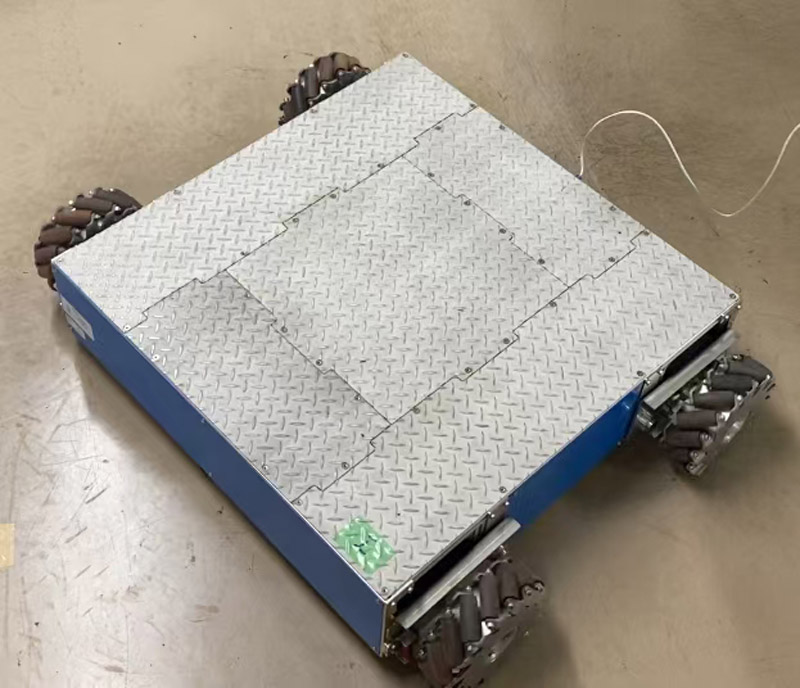
Mecanum-wheeled robot used in study
- [1] M. Nakamura and K. Hoshino, “Experimental discussion about the influence of the proficiency in Tankendo in the foot posture,” Humanities & Social Sciences Reviews, Vol.7, No.5, pp. 296-305, 2019.
- [2] K. Hoshino, Y. Ozone, and C. Zhao, “A Tankendo robot that defends itself from opponent attacks by moving immediately before a valid strike or thrust: A Tankendo robot defends from opponent attacks,” Proc. of the 2021 3rd Int. Conf. on Image, Video and Signal Processing (IVSP’21), pp. 115-121, 2021. https://doi.org/10.1145/3459212.3459230
- [3] K. Hoshino, Y. Noguchi, Y. Nakai, Y. Ozone, and M. Nakamura, “Predicting the types of striking and thrusting motions by using deep learning,” 2019 6th Int. Conf. on Biomedical and Bioinformatics Engineering (ICBBE’19), pp. 199-202, 2019. https://doi.org/10.1145/3375923.3375954
- [4] Y. Ozone, C. Zhao, and K. Hoshino, “Introducing swordsman robot defensing,” 2020 3rd Int. Conf. on Digital Medicine and Image Processing (DMIP’20), pp. 33-39, 2020. https://doi.org/10.1145/3441369.3441375
- [5] H. Mitsuhashi, T. Kodama, and T. Itami, “Real-time stair angle estimation based on 3D dynamic analysis for an omnidirectional autonomous electric wheelchair realizing illuminance-independent multiple obstacle detection and stair climbing,” J. Robot. Mechatron., Vol.37, No.6, pp. 1602-1618, 2025. https://doi.org/10.20965/jrm.2025.p1602
- [6] R. Miura, S. Tozaki, I. Mikado, T. Takei, S. Ogake, K. Kobayashi, S. Mitsui, T. Satake, and N. Igo, “Development of a decommissioning robot with a simple structure capable of traversing steps using two different drive systems,” J. Robot. Mechatron., Vol.36, No.1, pp. 95-106, 2024. https://doi.org/10.20965/jrm.2024.p0095
- [7] G. Cao, X. Zhao, C. Ye, S. Yu, B. Li, and C. Jiang, “Fuzzy adaptive PID control method for multi-Mecanum-wheeled mobile robot,” J. of Mechanical Science and Technology, Vol.36, pp. 2019-2029, 2022. https://doi.org/10.1007/s12206-022-0337-x
- [8] C. Tezel and G. Bayar, “Theoretical and experimental investigation of variable contact forces on the rollers of a Mecanum wheeled mobile robot,” The Int. J. of Robotics Research, Vol.43, No.8, pp. 1208-1227, 2024. https://doi.org/10.1177/02783649241228607
- [9] M. Szeremeta and M. Szuster, “Neural tracking control of a four-wheeled mobile robot with Mecanum wheels,” Applied Sciences, Vol.12, No.11, Article No.5322, 2022. https://doi.org/10.3390/app12115322
- [10] Y. Nakagawa, N. Igo, and K. Hoshino, “Controlling a Mecanum-wheeled robot with multiple Swivel axes controlled by three commands,” Sensors, Vol.25, No.3, Article No.709, 2025. https://doi.org/10.3390/s25030709
- [11] L. Ljung, “System identification: Theory for the user (2nd ed.),” pp. 8-14, Prentice Hall, 1999.
- [12] H. Masood, A. Zafar, M. U. Ali, T. Hussain, M. A. Khan, U. Tariq, and R. Damaševičius, “Tracking of a fixed-shape moving object based on the gradient descent method,” Sensors, Vol.22, No.3, Article No.1098, 2022. https://doi.org/10.3390/s22031098
- [13] J. Wang, Q. Hou, Z. Zhuo, H. Jia, and N. Zhang, “Voltage stability constrained economic dispatch for multi-infeed HVDC power systems,” IEEE Trans. on Power Systems, Vol.39, No.2, pp. 2598-2610, 2024. https://doi.org/10.1109/tpwrs.2023.3277213
- [14] Y. Tian, Y. Zhang, and H. Zhang, “Recent advances in stochastic gradient descent in deep learning,” Mathematics, Vol.11, No.3, Article No.682, 2023. https://doi.org/10.3390/math11030682
- [15] F. Le and S. Dong, “Performance improvements in natural gradient descent method,” 2024 7th Int. Conf. on Advanced Algorithms and Control Engineering (ICAACE), pp. 1089-1092, 2024. https://doi.org/10.1109/icaace61206.2024.10549159
- [16] R. Chen, X. Tang, and X. Li, “Adaptive stochastic gradient descent method for convex and non-convex optimization,” Fractal and Fractional, Vol.6, No.12, Article No.709, 2022. https://doi.org/10.3390/fractalfract6120709
- [17] S. H. Haji and A. M. Abdulazeez, “Comparison of optimization techniques based on gradient descent algorithm: A review,” PalArch’s J. of Archaeology of Egypt/Egyptology, Vol.18, No.4, pp. 2715-2743, 2021.
- [18] C. Zhao, T. Shibuya, N. Igo, and K. Hoshino, “Method of controlling a Tankendo robot using a Mecanum wheel trolley robot,” 2022 7th Int. Conf. on Intelligent Information Technology (ICIIT 2022), pp. 126-130, 2022. https://doi.org/10.1145/3524889.3524910
- [19] H. Taheri, B. Qiao, and N. Ghaeminezhad, “Kinematic model of a four Mecanum wheeled mobile robot,” Int. J. of Computer Applications, Vol.113, No.3, pp. 6-9, 2015. https://doi.org/10.5120/19804-1586
- [20] M. Hamaguchi, “Damping and transport control of a spherical pendulum on an omnidirectional wheeled robot during manual operation,” J. Robot. Mechatron., Vol.37, No.6, pp. 1410-1419, 2025. https://doi.org/10.20965/jrm.2025.p1410
- [21] M. Kuczmann, “Review of DC motor modeling and linear control: Theory with laboratory tests,” Electronics, Vol.13, No.11, Article No.2225, 2024. https://doi.org/10.3390/electronics13112225
- [22] C. L. Phillips and T. Nagle, “Digital control system analysis and design (3rd ed.),” pp. 234-239, Prentice Hall, 1995.
- [23] S. Boyd and L. Vandenberghe, “Convex optimization,” pp. 215-231, Cambridge University Press, 2004. https://doi.org/10.1017/cbo9780511804441
- [24] Y. Nesterov, “Introductory lectures on convex optimization: A basic course (1st ed.),” pp. 22-26, Kluwer Academic Publishers, 2004.
- [25] H. H. Bauschke and P. L. Combettes, “Convex analysis and monotone operator theory in Hilbert spaces (1st ed.),” pp. 43-52, Springer, 2011. https://doi.org/10.1007/978-1-4419-9467-7
This article is published under a Creative Commons Attribution-NoDerivatives 4.0 Internationa License.