
Paper:
Study of a Three-Claw Type Docking Mechanism with Automatic Enclosing Function for Deep Space Rendezvous and Docking
Hiroki Nakanishi*
 , Akihiro Tokuyasu**, Tomoharu Tanaka*, and Hideo Yoshida*
*Institute of Science Tokyo
2-12-2 Ookayama, Meguro-ku, Tokyo 152-8552, Japan
**Tokyo Institute of Technology
2-12-2 Ookayama, Meguro-ku, Tokyo 152-8552, Japan

In recent years, sample returns from celestial bodies have remarkably developed as important elements of space exploration. The targets are becoming increasingly distant celestial bodies. Improving mission flexibility and reducing risk are important in deep-space exploration. The deep-space orbital transfer vehicle concept, which separates the sampled child spacecraft from the parent spacecraft that navigates between celestial bodies, has been proposed as a solution. The key technology of such a system is the autonomous docking in deep space. The docking mechanism must have low resource requirement, high success rate, and low guidance control requirements. The authors propose a novel docking mechanism with high capacity for positional errors. The mechanism has claws that can cage a grapple fixture, after the initial contact, using spring force and then fix it by driving a motor. This paper presents the concepts, requirements, and design of such a docking mechanism. Subsequently, evaluation using a prototype model is discussed.
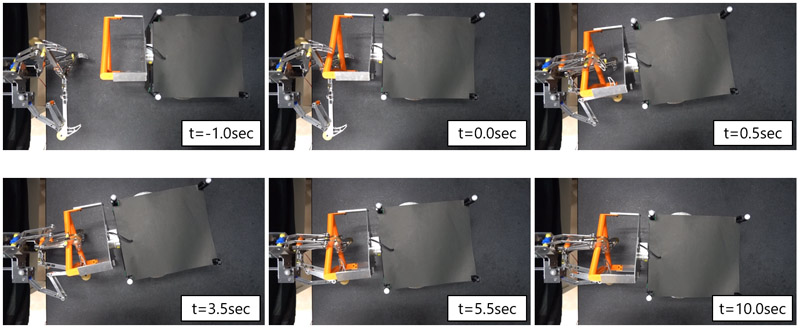
Docking motion of automatic enclosing claw-type mechanism (AECM)
- [1] S. Abe et al., “Mass and local topography measurements of Itokawa by Hayabusa,” Science, Vol.312, No.5778, pp. 1344-1347, 2006. https://doi.org/10.1126/science.1126272
- [2] T. Yada et al., “Preliminary analysis of the Hayabusa2 samples returned from C-type asteroid Ryugu,” Nat. Astron., Vol.6, No.2, pp. 214-220, 2022. https://doi.org/10.1038/s41550-021-01550-6
- [3] D. S. Leuretta et al., “OSIRIS-REx: Sample return from asteroid (101955) Bennu,” Space Sci. Rev., Vol.212, Nos.1-2, pp. 925-884, 2017. https://doi.org/10.1007/s11214-017-0405-1
- [4] Z. Cui et al., “A sample of the Moon’s far side retrieved by Chang’e-6 contains 2.83-billion-year-old basalt,” Science, Vol.386, No.6728, pp. 1395-1399, 2024. https://doi.org/10.1126/science.adt1093
- [5] B. K. Muirhead, A. K. Nicholas, J. Umland, O. Sutherland, and S. Vijendran, “Mars sample return campaign concept status,” Acta Astronaut., Vol.176, pp. 131-138, 2020. https://doi.org/10.1016/j.actaastro.2020.06.026
- [6] K. Kuramoto et al., “Martian moons exploration MMX: Sample return mission to Phobos elucidating formation processes of habitable planets,” Earth Planets Space, Vol.74, Article No.12, 2022. https://doi.org/10.1186/s40623-021-01545-7
- [7] Y. Tsuda, T. Saiki, F. Terui, S. Nakazawa, M. Yoshikawa, and S. Watanabe, “Hayabusa2 mission status: Landing, roving and cratering on asteroid Ryugu,” Acta Astronaut., Vol.171, pp. 42-54, 2020. https://doi.org/10.1016/j.actaastro.2020.02.035
- [8] B. Sarli et al., “NASA’s capture, containment, and return system: Bringing Mars samples to Earth,” Acta Astronaut., Vol.223, pp. 270-303, 2024. https://doi.org/10.1016/j.actaastro.2024.05.048
- [9] Y. Takei et al., “The deep space orbital transfer vehicle inspired by the Hayabusa2 technology,” J. Evol. Space Act., Vol.1, Article No.40, 2023. https://doi.org/10.57350/jesa.40
- [10] T. Saiki et al., “Mission concept of Japanese comet sample return exploration in the 2030s,” Acta Astronaut., Vol.235, pp. 120-128, 2025. https://doi.org/10.1016/j.actaastro.2025.05.048, 2025.
- [11] J. Cook, V. Aksamentov, T. Hoffman, and W. Bruner, “ISS interface mechanisms and their heritage,” AIAA SPACE 2011 Conf. Expo., 2011. https://doi.org/10.2514/6.2011-7150
- [12] M. Kunugi, H. Koyama, T. Okanuma, T. Nakamura, M. Mokuno, I. Kawano, H. Horiguchi, and K. Kibe, “Guidance, navigation and control system in Engineering Test Satellite VII rendez-vous and docking experiment,” Autom. Control Aerosp. 1994, pp. 303-308, 1995. https://doi.org/10.1016/B978-0-08-042238-1.50051-3
- [13] S. Christiansen and T. Nilson, “Docking system mechanism utilized on orbital express program,” Proc. 39th Aerosp. Mech. Symp., pp. 207-220, 2008.
- [14] A. Boesso and A. Francesconi, “ARCADE small-scale docking mechanism for micro-satellites,” Acta Astronaut., Vol.86, pp. 77-87, 2013. https://doi.org/10.1016/j.actaastro.2013.01.006
- [15] F. Branz, L. Olivieri, F. Sansone, and A. Francesconi, “Miniature docking mechanism for CubeSats,” Acta Astronaut., Vol.176, pp. 510-519, 2020. https://doi.org/10.1016/j.actaastro.2020.06.042
- [16] X. Zhang, Q. Liu, X. Ma, W. Gong, and W. Wang, “Design and analysis of a large tolerance docking mechanism,” Acta Astronaut., Vol.221, pp. 121-141, 2024. https://doi.org/10.1016/j.actaastro.2024.05.014
- [17] R. G. Daniell and S. S. Sachdev, “The design and development of an end effector for the shuttle remote manipulator system,” Proc. 16th Aerosp. Mech. Symp., pp. 45-61, 1982.
- [18] N. Kubota, R. Sakata, M. Mokuno, and I. Kawano, “Docking mechanisms for ETS-VII rendezvous-docking,” J. Soc. Instrum. Control Eng., Vol.38, No.11, pp. 691-694, 1999 (in Japanese). https://doi.org/https://doi.org/10.11499/sicejl1962.38.691
- [19] M. Mokuno, I. Kawano, and T. Suzuki, “In-orbit demonstration of rendezvous laser radar for unmanned autonomous rendezvous docking,” IEEE Trans. Aerosp. Electron. Syst., Vol.40, No.2, pp. 617-626, 2004. https://doi.org/10.1109/TAES.2004.1310009
- [20] K. Taga, H. Nakanishi, and M. Oda, “Development of a retractable twine gripper for debris-capture,” 31st Int. Symp. Space Technol. Sci., 2017.
- [21] N. Kawaguchi and H. Nakanishi, “Development of a truss structure grasping end-effector for on-orbit servicing,” 33rd Int. Symp. Space Technol. Sci., 2022.
This article is published under a Creative Commons Attribution-NoDerivatives 4.0 Internationa License.