
Paper:
Embedding a Haptic Display in a Computer Mouse for Texture Discrimination During Active Tracing
Asahi Kurokawa
 , Masaharu Shimizu, Mitsuhito Ando
, and Haruo Noma
, Masaharu Shimizu, Mitsuhito Ando
, and Haruo Noma
Graduate School of Information Science and Engineering, Ritsumeikan University
2-150 Iwakura-cho, Ibaraki, Osaka 567-8570, Japan

The objective of this research was to realize human tactile exploration in a VR environment. For example, this capability would allow users to check the surface texture of products before purchasing them through online shopping or enhance the immersion of VR experiences. Therefore, this paper proposes a device that enables users to move their hands to trace virtual objects. This device provides tactile perception by tracing an image displayed on a screen using a cursor. We propose a soft vibration actuator mouse (SVA-M) that incorporates a haptic display into a computer mouse. The haptic display employs a soft vibration actuator (SVA). An SVA is a compact actuator that vibrates at high density, has a wide frequency range, and is capable of presenting high-resolution haptic feedback to the fingertip. We conducted a perception test to evaluate the spatial resolution of the haptic textures that the device could present. We investigate the spatial resolution of the haptic textures perceivable by humans by having participants trace six different haptic textures using the device. The results indicate that, under the reduced tracing speed imposed by device operation in a standard 60 Hz display environment, textures with haptic changes corresponding to hand movements of 0.16 mm or more can be reliably discriminated, establishing a criterion for haptic texture design in mouse-type haptic displays intended for everyday use.
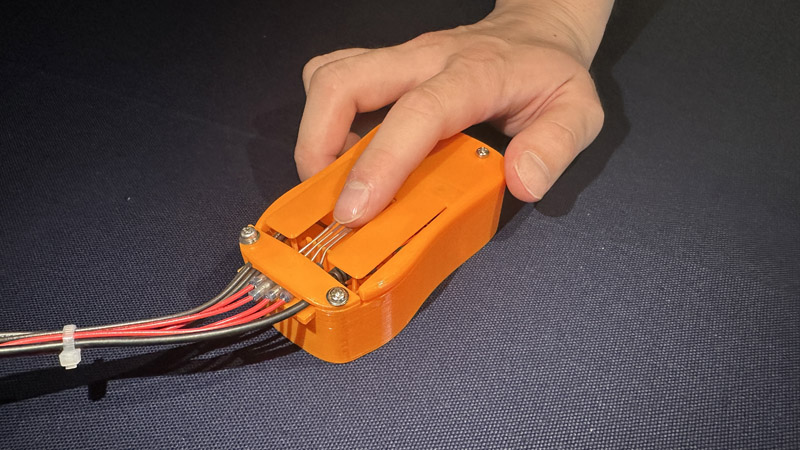
Tactile perception through the SVA-M
- [1] R. L. Klatzky, S. J. Lederman, and C. Reed, “There’s more to touch than meets the eye: The salience of object attributes for haptics with and without vision,” J. Exp. Psychol. Gen., Vol.116, No.4, pp. 356-369, 1987. https://doi.org/10.1037/0096-3445.116.4.356
- [2] J. J. Gibson, “Observations on active touch,” Psychol. Rev., Vol.69, No.6, pp. 477-491, 1962. https://doi.org/10.1037/h0046962
- [3] S. J. Lederman and R. L. Klatzky, “Hand movements: A window into haptic object recognition,” Cogn. Psychol., Vol.19, No.3, pp. 342-368, 1987. https://doi.org/10.1016/0010-0285(87)90008-9
- [4] T. Takano, A. Ikeda, I. Abe, and T. Kikuchi, “Improvement of Haptic Interface for Teleoperation Endoscopic Surgery Simulators Using Magnetorheological Fluid Devices,” J. Robot. Mechatron., Vol.34, No.6, pp. 1268-1276, 2022. https://doi.org/10.20965/jrm.2022.p1268
- [5] Y. Tanaka, S. Shiraki, K. Katayama, K. Minamizawa, and D. Prattichizzo, “Bilaterally Shared Haptic Perception for Human-Robot Collaboration in Grasping Operation,” J. Robot. Mechatron., Vol.33, No.5, pp. 1104-1116, 2021. https://doi.org/10.20965/jrm.2021.p1104
- [6] M. Hollins, S. J. Bensmaïa, and E. A. Roy, “Vibrotaction and texture perception,” Behav. Brain Res., Vol.135, Nos.1-2, pp. 51-56, 2002. https://doi.org/10.1016/S0166-4328(02)00154-7
- [7] V. Shen, T. Rae-Grant, J. Mullenbach, C. Harrison, and C. Shultz, “Fluid reality: High-resolution, untethered haptic gloves using electroosmotic pump arrays,” Proc. 36th Annu. ACM Symp. User Interface Softw. Technol. (UIST ’23), Article No.8, 2023. https://doi.org/10.1145/3586183.3606771
- [8] S. Suzuki, S. Inoue, M. Fujiwara, Y. Makino, and H. Shinoda, “AUTD3: Scalable airborne ultrasound tactile display,” IEEE Trans. Haptics, Vol.14, No.4, pp. 740-749, 2021. https://doi.org/10.1109/TOH.2021.3069976
- [9] K. Fujino and M. Niitsuma, “Effects of Presenting People Flow Information by Vibrotactile Stimulation for Visually Impaired People on Behavior Decision,” J. Robot. Mechatron., Vol.33, No.1, pp. 97-107, 2021. https://doi.org/10.20965/jrm.2021.p0097
- [10] B. L. Kodak and Y. Vardar, “FeelPen: A Haptic Stylus Displaying Multimodal Texture Feels on Touchscreens,” IEEE/ASME Trans. on Mechatronics, Vol.28, No.5, pp. 2930-2940, 2023. https://doi.org/10.1109/TMECH.2023.3264787
- [11] M. Akamatsu and S. Sato, “A multi-modal mouse with tactile and force feedback,” Int. J. Hum.-Comput. Stud., Vol.40, No.3, pp. 443-453, 1994. https://doi.org/10.1006/ijhc.1994.1020
- [12] M. Shimizu, M. Ando, and H. Noma, “High-resolution tactile display with soft vibration actuator for reproducing fine tactile perception on the fingertip,” Trans. Virtual Reality Soc. Jpn., Vol.29, No.4, pp. 293-301, 2024 (in Japanese). https://doi.org/10.18974/tvrsj.29.4_293
- [13] T. C. Brown and G. L. Peterson, “An Enquiry into the Method of Paired Comparison: Reliability, Scaling, and Thurstone’s Law of Comparative Judgment,” U.S. Department of Agriculture, Forest Service, Rocky Mountain Research Station, Article No.RMRS-GTR-216, 2009. https://doi.org/10.2737/rmrs-gtr-216
- [14] F. Mosteller, “Remarks on the Method of Paired Comparisons: III. A Test of Significance for Paired Comparisons when Equal Standard Deviations and Equal Correlations are Assumed,” Psychometrika, Vol.16, No.2, pp. 207-218, 1951. https://doi.org/10.1007/BF02289116
- [15] T. Callier, H. P. Saal, E. C. Davis-Berg, and S. J. Bensmaia, “Kinematics of unconstrained tactile texture exploration,” J. Neurophysiol., Vol.113, No.7, pp. 3013-3020, 2015. https://doi.org/10.1152/jn.00703.2014
- [16] Y. Tanaka, W. M. Bergmann Tiest, A. M. L. Kappers, and A. Sano, “Contact force and scanning velocity during active roughness perception,” PLOS ONE, Vol.9, No.3, Article No.e93363, 2014. https://doi.org/10.1371/journal.pone.0093363
This article is published under a Creative Commons Attribution-NoDerivatives 4.0 Internationa License.