
Research Paper:
An Electric Vehicle Optimization Scheduling Strategy Based on TSM-NSGA-III Algorithm
Yun Wu*, Ziyi Wang*,†, Yan Du**, Jieming Yang*, and Kai Yang*
*School of Computer Science, Northeast Electric Power University
No.169 Changchun Road, Chuanying District, Jilin, Jilin 132012, China
†Corresponding author
**Jilin Meteorological Observation and Protection Center, Jilin Meteorological Service
No.176 Suizhong Road, Lvyuan District, Changchun, Jilin 130000, China

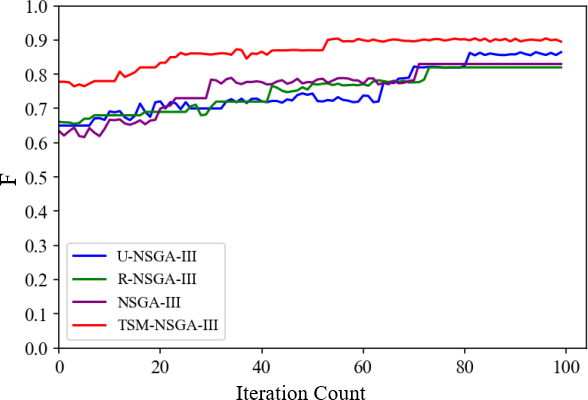
Aiming to address the problems of interest conflict between charging stations and electric vehicle (EV) owners, as well as severe load fluctuations caused by disorderly EV charging, this paper proposes a multi-objective optimal scheduling model based on an improved NSGA-III algorithm (TSM-NSGA-III). The model utilizes dynamic electricity price as a decision variable instead of a fixed time-of-use price, with optimization objectives set to maximize charging station profit, maximize EV owner satisfaction, and minimize the load peak-valley difference rate. The TSM-NSGA-III algorithm enhances the original NSGA-III through three key improvements: (1) chaotic reverse learning to improve initial population quality, (2) the sparrow search algorithm to avoid local optima, and (3) Manhattan distance to preserve population diversity and discover potential optimal solutions. Experimental results demonstrate that the proposed method achieves a 26% faster convergence and a 9.9% higher average solution quality compared to NSGA-III. Furthermore, it obtains superior Pareto frontiers with significantly better performance in both charging station revenue and user satisfaction, effectively overcoming the algorithm’s tendencies toward premature convergence and neglect of diverse optimal solutions.
Pareto frontiers of EV scheduling solved by various algorithms
- [1] Z. T. Zhao and B. Gu, “Research on charging and discharging price and time period based on electric vehicle load aggregator under demand response,” J. of Northeast Electric Power University, Vol.43, No.6, pp. 79-86, 2023.
- [2] B. Xiao, J. X. Zhu, X. Liu, and M. X Jiao, “Bi-level planning of electric vehicle charging stations based on CRITIC method and non-cooperative game,” J. of Northeast Electric Power University, Vol.42, No.4, pp. 35-49, 2022.
- [3] X. F. Jiang, “Research on electric vehicle charging scheduling strategy based on the multiobjective algorithm,” Mathematical Problems in Engineering, 2022. https://doi.org/10.1155/2022/1959511
- [4] Y. L. Lou, C. X. Wu, Z. Z. Shi, and R. Yang, “Evaluation of EV penetration level limit in distribution system applying charging and scheduling strategies,” Sustainable Energy, Grids and Networks, Vol.32, Article No.100922, 2022. https://doi.org/10.1016/j.segan.2022.100922
- [5] D. X. Yan, C. B. Ma, and Y. Chen, “Distributed Coordination of Charging Stations Considering Aggregate EV power flexibility,” IEEE Trans. on Sustainable Energy, Vol.14, pp. 356-370, 2023. https://doi.org/10.1109/TSTE.2022.3213173
- [6] Z. F. Liang, F. R. Qi, G. Y. Wang, and X. W. Wang, “Review of Optimization Strategies for Orderly Charging of Electric Vehicles,” New Type Power Systems, Vol.1, No.3, pp. 256-271, 2023.
- [7] H. X. Xie, and S. Gao, “Optimal scheduling of electric vehicles charging and discharging strategy based on real-time price considering multi-party interest,” IEEJ Trans. on Electrical and Electronic Engineering, Vol.18, pp. 1111-1119, 2023. https://doi.org/10.1002/tee.23819
- [8] Z. Weng, J. Zhou, X. Song, and L. Jing, “Research on orderly charging strategy for electric vehicles based on electricity price guidance and reliability evaluation of microgrid,” Electronics, Vol.12, No.23, Article No.4876, 2023. https://doi.org/10.3390/electronics12234876
- [9] B. Wang, “Research on Optimization of Electric Vehicle Charging Scheduling Under Multi-Scenario Resource Constraints,” Chongqing Jiaotong University, 2025.
- [10] Y. L. Chen, Z. P. Lv, and S. Zhou, “Multi-objective optimal scheduling of electric vehicles based on cloud edge end cooperation,” Distribution & Utilization, Vol.39, No.4, pp. 17-24, 2022.
- [11] Y. L. Luo, “Research on the prediction method of charging power based on the behavior of electric vehicle owners,” Xi’an Technological University, 2022.
- [12] W. C. Dai, A. D. Liu, X. Shen, H. J. Ma, and H. Zhang, “Online optimization of charging and discharging behavior of household electric vehicle cluster based on MADDPG algorithm,” J. of Northeast Electric Power University, Vol.41, No.5, pp. 80-89, 2021.
- [13] L. J. Geng, “Research on V2G-based electric vehicle scheduling strategy,” Qing Dao University, 2016.
- [14] X. Y. Yu, Y. P. Zhang, Y. Zhang, L. Yang, W. D. Gao, and Y. Guo, “Mobile network scheduling and operation information sharing method based on chaos reverse learning improved grey wolf algorithm,” Telecommunications Science, Vol.39, No.8, pp. 82-99, 2023.
- [15] H. Cai, X. Y. Lin, Z. L. Cai, Y. W. Zhong, and F. L. Zhong, “Optimization of carbon peak path in Fujian Province based on sparrow search algorithm,” Energy Environmental Protection, pp. 1-11, 2024.
- [16] Z. Y. Liu, J. Zhou, L. Zhang, J. X. Zhang, Q. Zhang, and R. Sha, “Research on TSP Problem based on crossover and mutation combination,” Jisuanji Yu Xiandaihua, No.3, pp. 54-59, 2018.
- [17] W. J. Li, G. Li, and Z. G. Nie, “Polynomial variance and adaptive weight optimization for aquila algorithm,” Computer Technology and Development, Vol.34, No.2, pp. 163-170, 2024.
- [18] X. M. Sun, W. Wang, S. Su, J. C. Jiang, L. J. Xu, and X. H. He, “Coordinated charging strategy for electric vehicles based on time-of-use price,” Automation of Electric Power Systems, Vol.37, No.1, pp. 191-195, 2013.
- [19] Z. H. Liu, B. L. Dong, B. B. Wang, L. P. Lian, and C. Cheng, “Model for conventional missile firepower distribution based on R-NSGA-III,” Electronic Design Engineering, Vol.30, No.23, pp. 169-173, 2022.
- [20] K. Sumetpipat and D. Baowan, “Stable configurations of DOXH interacting with graphene: Heuristic algorithm approach using NSGA-II and U-NSGA-III,” Nanomaterials, Vol.12, No.22, Article No.4097, 2022. https://doi.org/10.3390/nano12224097
This article is published under a Creative Commons Attribution-NoDerivatives 4.0 Internationa License.