
Research Paper:
An Electric Vehicle Optimization Scheduling Strategy Based on TSM-NSGA-III Algorithm
Yun Wu*, Ziyi Wang*,†, Yan Du**, Jieming Yang*, and Kai Yang*
*School of Computer Science, Northeast Electric Power University
No.169 Changchun Road, Chuanying District, Jilin, Jilin 132012, China
†Corresponding author
**Jilin Meteorological Observation and Protection Center, Jilin Meteorological Service
No.176 Suizhong Road, Lvyuan District, Changchun, Jilin 130000, China

Aiming to address the problems of interest conflict between charging stations and electric vehicle (EV) owners, as well as severe load fluctuations caused by disorderly EV charging, this paper proposes a multi-objective optimal scheduling model based on an improved NSGA-III algorithm (TSM-NSGA-III). The model utilizes dynamic electricity price as a decision variable instead of a fixed time-of-use price, with optimization objectives set to maximize charging station profit, maximize EV owner satisfaction, and minimize the load peak-valley difference rate. The TSM-NSGA-III algorithm enhances the original NSGA-III through three key improvements: (1) chaotic reverse learning to improve initial population quality, (2) the sparrow search algorithm to avoid local optima, and (3) Manhattan distance to preserve population diversity and discover potential optimal solutions. Experimental results demonstrate that the proposed method achieves a 26% faster convergence and a 9.9% higher average solution quality compared to NSGA-III. Furthermore, it obtains superior Pareto frontiers with significantly better performance in both charging station revenue and user satisfaction, effectively overcoming the algorithm’s tendencies toward premature convergence and neglect of diverse optimal solutions.
Pareto frontiers of EV scheduling solved by various algorithms
1. Introduction
As one of the important means to achieve the goal of “dual carbon,” electric vehicles (EVs) are gradually replacing traditional fuel vehicles with their advantages of low carbon environmental protection and high energy efficiency. However, large-scale centralized charging of EVs will cause problems such as imbalance between supply and demand, low satisfaction of vehicle owners and sharp load fluctuations, which will bring challenges to the operation control and economic benefits of charging stations 1,2. In order to meet this challenge, orderly control of the charging mode of EVs has become particularly important. By orderly controlling the charging mode of EVs, the charging behavior of EVs can be effectively adjusted, so that it is more in line with the load characteristics and operation requirements of the power system, so as to improve the economy and security of the power grid.
Orderly control EV charging methods can be divided into two main types: direct control and indirect control. Direct control refers to the direct management and scheduling of the charging and discharging behavior of EVs through the central control system, focusing on maximizing the benefits of the grid, including slowing load fluctuations, and thus achieving energy peak reduction and balancing the acceptance capacity of new energy. Jiang 3 established an EV charging scheduling model based on particle swarm optimization with the goal of minimizing the peak load of the power grid and minimizing the peak-valley difference and load fluctuation. Lou et al. 4 scheduled EVs according to the time-of-use (TOU) price, and adopted the method of calculating the number of EVs accessible to the distribution network by continuous power flow to suppress the peak load of the grid and stabilize the voltage. Yan et al. 5 proposed a two-stage EV scheduling scheme and developed a distributed coordination mechanism with a clear physical explanation. Although hierarchical control of EV charging stations can provide a way of decentralized decision-making and management, different levels may pursue local optimization at the expense of benefits, leading to suboptimal system performance, resource waste, and reduced efficiency 6.
Unlike direct control, indirect control does not involve the direct management of vehicle charging by the central control system, but guides the owner to respond positively by adjusting the electricity market price or the reward and punishment mechanism, so that the owner can voluntarily change the inherent charging habits to achieve the demand response and optimization of the power grid. Xie et al. 7 proposed a real-time price based on load rate changes, and established a multi-objective optimization model of orderly charge and discharge involving distribution network operators, charging station operators, and EV owners. Weng et al. 8 used electricity price to guide EVs to carry out orderly charging, effectively reducing the load peak-valley difference rate and charging cost of owners, and optimizing the reliability level of microgrid. The advantage of the price incentive response is that it is relatively simple and easy to implement, and it can use the market mechanism to guide the behavior of the car owner and promote the smarter use of electricity resources.
Based on the above analysis, this paper proposes an EV scheduling model based on TSM-NSGA-III. The optimal EV scheduling model is established to consider the maximum satisfaction of the owner, the maximum benefit of the charging station, and the minimum peak-valley difference of the EV load. The key innovations of TSM-NSGA-III are:
-
Tent chaotic mapping is applied to enhance the quality and diversity of the initial population, thereby preventing premature convergence and increasing the probability of locating the global Pareto frontier.
-
Sparrow search algorithm (SSA) is embedded to guide the crossover and mutation operations, thereby enhancing the algorithm’s ability to escape local optima.
-
Manhattan distance is utilized to quantify the similarity between candidate solutions, effectively preserving population diversity and discovering potential optima.
2. EV Scheduling Model
In this paper, a multi-objective EV charging and discharging scheduling model is constructed by considering the economy of charging station, load fluctuation of EVs, and interest demand of EV owners.
2.1. Charging Station Income
The EV charging station establishes a model with the goal of maximizing revenue, and its mathematical expression is shown as Eq. 1 9.
2.2. Owners Satisfaction
In this paper, the owner’s satisfaction model is constructed by considering the owner’s own interests, the owner’s travel needs, and the battery loss degree. Car owners’ travel demand satisfaction is directly related to the state of charge, as shown in Eq. 2 10.
Battery charge and discharge conversion causes loss. When the owner participates in the charge and discharge scheduling process, the satisfaction degree of battery loss is shown as Eq. 3.
The satisfaction model of EV owners was established with the goal of maximizing their satisfaction with charging demand and battery loss, as shown in Eq. 4.
2.3. Load Fluctuation of EVs
Charge/discharge scheduling is intended to use the energy storage characteristics of EVs to return electric energy to the grid to alleviate the new load peak caused by disorderly charging 11,12. Therefore, in order to improve the reliability and stability of the power grid, a model is established with the goal of minimizing the peak-to-valley difference rate of charge and discharge load, as shown in Eq. 5.
Combining the objective functions proposed above, the optimal scheduling model for EVs is shown as Eq. 6.
2.4. Constraints
These constraints are established to ensure the feasibility and safety of the EV scheduling model. They include limits on the battery state of charge, operational exclusivity, and the valid scheduling time window.
2.4.1. Constraints of State of Charge
Excessive discharge causes loss of EV battery, so its constraint is shown in Eq. 7 13.
2.4.2. Constraints of State of EVs
EVs can only be in one state at each period, that is, charging, discharging, and neither charging nor discharging. The constraint of EV state is shown in Eq. 8.
2.4.3. Constraints of Charge and Discharge Dispatching Time
The dispatching time period of EVs should be between arriving at the charging station and leaving the charging station, as shown in Eq. 9.
Collectively, these constraints ensure that the generated scheduling strategy is not only economically optimal but also physically feasible, safe for battery operation, and executable within the vehicle’s available connection window.
3. TSM-NSGA-III Algorithm
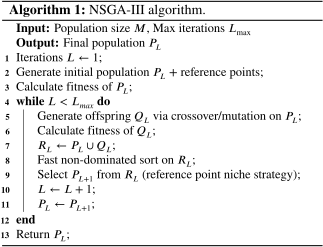
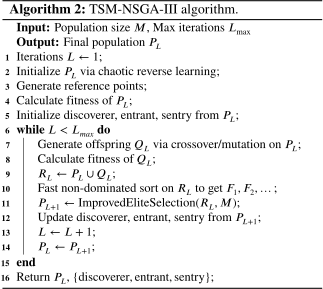
In this paper, the traditional NSGA-III algorithm solves the multi-variable, multi-objective, and high-dimensional optimization model, and the initial population cannot adapt to the dynamic characteristics of EVs in the network, it is easy to fall into the local optimal solution, and the population diversity is poor. TSM-NSGA-III algorithm is proposed based on chaotic reverse learning strategy, SSA and improved elite selection strategy to solve these problems. The procedure of NSGA-III and TSM-NSGA-III algorithm is shown as Algorithms 1 and 2, respectively.
3.1. Solution Representation and Population Encoding
In the proposed TSM-NSGA-III algorithm, each individual in the population represents a complete EV charging/discharging schedule. Since the primary decision variable is the dynamic electricity price for each time period, an individual is encoded as a real-valued vector of length \(T\), where \(T\) is the total number of scheduling periods. The \(t\)-th gene in the vector corresponds to the dynamic electricity price \(C_{(t)}\) for period \(t\). The encoding method is shown in Fig. 1.
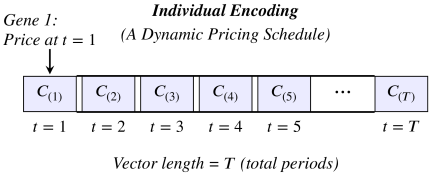
Fig. 1. Population encoding scheme.
3.2. Initialize the Population by Chaotic Reverse Learning
In order to ensure the dispersivity of the population in the search space, the original NSGA-III algorithm adopts a random generation strategy in the initialization. Although it helps to increase the exploration scope of the solution space, the quality of the initial population cannot be guaranteed and the diversity is easy to be lost. The individuals in the initial population may be concentrated in some specific areas, resulting in the deterioration of the distribution of Pareto frontier. The algorithm converges locally in the solution space and misses the potential global optimal solution. Therefore, this paper proposes to apply the chaotic reverse learning strategy to the initialization of NSGA-III algorithm to improve the quality of the initial solution and increase the probability of finding the global optimal solution 14.
First, the population is initialized using Tent chaotic mapping, as shown in Eq. 10.
The sequence is mapped to the original solution space to obtain the chaotic initialization population, and the resulting chaotic initialization population is reversely learned, as shown in Eq. 11.
The population after Tent chaos mapping is combined with the population after reverse learning, the fitness values of the individuals are calculated, and the better individuals are selected as the initial population.
3.3. Optimization of NSGA-III Algorithm After Initialization
NSGA-III algorithm combines the initial parent population with the offspring generated through crossover and mutation operations to form a new population, and performs a series of operations on the new population, such as non-dominated sorting and reference point selection. V2G scheduling of EVs is a multi-objective and high-dimensional problem. In order to reduce the complexity of search and computational overhead, and improve the convergence of the algorithm, NSGA-III is discretized by combining SSA algorithm, and the specific operations of crossover and mutation are as follows.
3.3.1. Initializes Discoverer, Entrant, and Sentry
Using the idea of SSA 15, an individual is selected from the first three Pareto levels of the initial population \(P\) to be initialized as discoverer, entrant, and sentry, and it is considered that these three individuals are three different optimal dynamic electricity prices at present.
3.3.2. Crossover and Mutation Operations
Individuals participating in the crossover are probabilistically selected from the three candidate roles: discoverer, entrant, and sentry. Specifically, let \(r \sim U(0,1)\) be a uniformly distributed random number. Then the selected individual \(W\) is determined as Eq. 12:
The crossover operator here is sequential crossover 16, that is, the starting and ending positions of the two parent chromosomes are randomly selected, the genes in the region of the parent chromosome 1 are copied to the same position of the child 1, and then the missing genes in the child 1 are sequentially filled in on the parent chromosome 2. The mutation operation adopts polynomial method 17, as shown in Fig. 2.
3.4. Improved Elite Selection Strategy
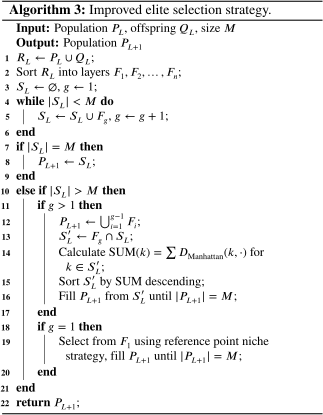
To enhance population diversity and prevent premature convergence, an improved elite selection strategy is proposed, as shown in Algorithm 3. This strategy ensures a well-distributed Pareto frontier and mitigates the risk of local optima.
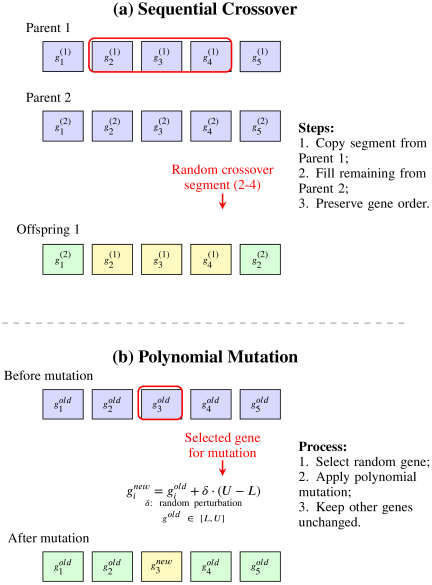
Fig. 2. Visualization of genetic operations in TSM-NSGA-III: (a) sequential crossover; (b) polynomial mutation.
3.5. Updating
After each iteration completes, the algorithm updates the roles of discoverer, entrant, and sentry. Each individual in the newly generated population \(P_{L+1}\) is compared with the current discoverer, entrant, and sentry. If an individual dominates any of these three roles, the dominated role is updated to that individual; if no dominance relationship exists, the role remains unchanged. This update mechanism ensures that the three roles always represent the current best dynamic electricity prices, maintaining the algorithm’s search direction toward high-quality solutions.
4. Experimental Analysis
4.1. Experimental Setup
All experiments were conducted on a standard workstation equipped with an Intel Core i7-12700K processor (3.6 GHz, 12 cores), 32 GB of RAM, and the Windows 11 operating system.
4.2. Parameters of Simulation
This paper selects the data collected by charging stations in a certain region of northern China, covering the two main types of charging stations in the park and the surrounding residential areas, and the charging station in the park occupies the main part.
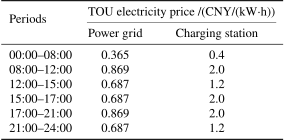
The dataset contains 2931 EV charging records. According to the common EVs in the market, the parameters are set as follows: the battery capacity is 82 kW\(\cdot\)h, the conventional charging power is 7 kW, the charging efficiency is 0.9, and the power consumption for 100 km is 20.5 kW\(\cdot\)h. The (TOU) price adopted is shown in Table 1 18. The charging station service fee is charged in a \(5:3:1\) mode according to the TOU price of the grid.
Table 1. TOU electricity price schedule.
4.3. Algorithm Performance Analysis
In this paper, the original NSGA-III algorithm, R-NSGA-III 19 algorithm, U-NSGA-III 20 algorithm, and TSM-NSGA-III algorithm (the algorithm in this paper) are selected to optimize and solve the optimal scheduling model of EVs.
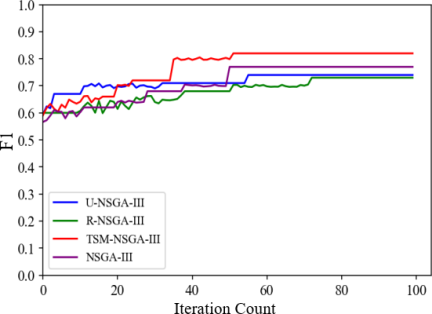
Fig. 3. Pareto frontier comparison of different algorithms (\(F_{1}\)).
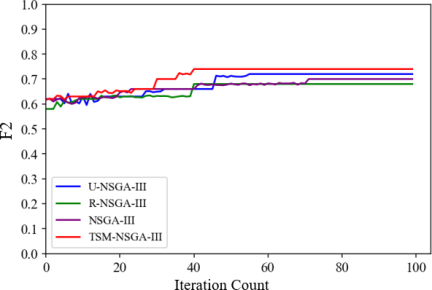
Fig. 4. Pareto frontier comparison of different algorithms (\(F_{2}\)).
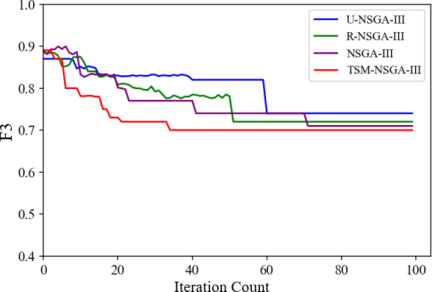
Fig. 5. Pareto frontier comparison of different algorithms (\(F_{3}\)).
As can be seen from Fig. 3, TSM-NSGA-III algorithm’s charging station returns are higher than other algorithms, and the optimal solution is found around the 52nd time on average. As can be seen in Fig. 4, TSM-NSGA-III algorithm finds the optimal solution at the 43rd iteration on average, indicating that TSM-NSGA-III algorithm has stronger stability, higher satisfaction of car owners than other algorithms, and better Pareto solution. U-NSGA-III found the average optimal solution at the 52nd iteration, but the effect was limited. NSGA-III finds the optimal solution at the average 73rd iteration, and although the convergence speed is fast, it is easy to fall into the local optimal solution. R-NSGA-III curve is almost horizontal at the bottom of the image, although it has strong convergence ability, but the ability to jump out of the local optimal is insufficient. In Fig. 5, the TSM-NSGA-III algorithm converges faster than the traditional NSGA-III algorithm, finding the average optimal solution at about the 37th iteration.
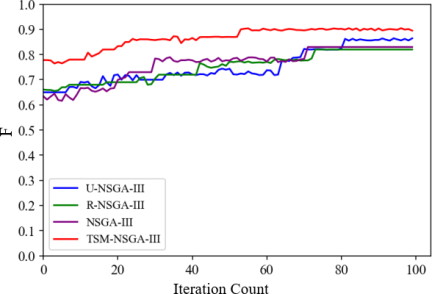
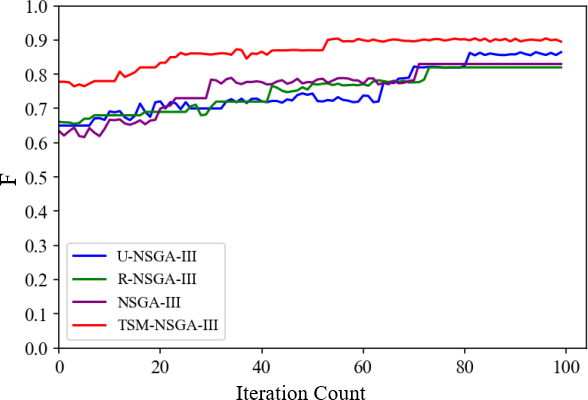
Fig. 6. Pareto frontier comparison of different algorithms (\(F\)).
Figure 6 shows the Pareto frontier generated when different algorithms are used to solve the optimal scheduling model of EVs. It can be seen that TSM-NSGA-III algorithm uses chaotic reverse learning to initialize the population, which makes the initial population quality better than other algorithms. In addition, the Pareto solution obtained by TSM-NSGA-III algorithm is obviously superior to other algorithms.
Table 2. Comparison of performance indicators of different algorithms.
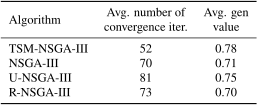
As can be seen from Table 2, the convergence iterations required by TSM-NSGA-III algorithm are at least 52 times, and the average generation value of TSM-NSGA-III is at a maximum of 0.78, indicating the superiority of TSM-NSGA-III algorithm in solving the scheduling strategy problem of EV charging stations.
4.4. Analysis of Dynamic Pricing and Scenario Comparison
4.4.1. Dynamic Pricing Pattern
Figure 7 illustrates the 24‑hour dynamic pricing curve obtained by the TSM‑NSGA‑III algorithm. The overall trend shows that 06:00–07:00 and 13:00–16:00 are the lowest valley value periods of prices, which is due to the fact that in order to meet travel needs of EV owners before work and improve user satisfaction, EVs are guided to start charging by reducing dynamic electricity prices. At 02:00–6:00, the staff in the park have not yet started to go to work, and these hours are mainly for the EVs of surrounding residents, and the charging station chooses to increase the dynamic electricity price in order to improve its own interests. It maintains a high dynamic electricity price between 7:00 and 13:00, guides EVs to discharge at this time, feeds to the distribution network, and disperses the charging demand. 16:00–17:00 is the highest charging peak before work, which is to guide the EV to discharge at this time, avoid the severe load fluctuation caused by concentration, feed to the distribution network, and disperse the charging demand. 17:00–19:00 is the electricity price valley period, which is because in order to meet the travel needs of EV owners before leaving work and improve user satisfaction, the dynamic electricity price is guided to start charging by reducing the dynamic electricity price. As employees in the park get off work and surrounding residents access EVs, the dynamic electricity price gradually increases. With the access of a small number of residential EVs, the electricity price is appropriately raised from 19:00 to 20:00 to curb the centralized charging of EVs in the surrounding residential areas. 20:00–2:00 guides EV charging by reducing dynamic electricity price.
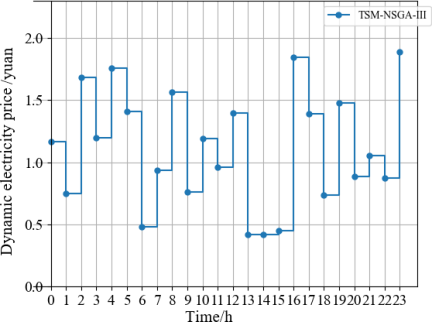
Fig. 7. Dynamic electricity price diagram of charging station at each time.
4.4.2. Scenario Comparison
To quantify the performance of the proposed scheduling model, three operational scenarios are evaluated:
-
Scenario 1 (Uncontrolled): Immediate charging upon arrival without any optimization.
-
Scenario 2 (TOU‑based): Scheduling guided by a fixed time‑of‑use tariff (Table 1).
-
Scenario 3 (Dynamic pricing): Scheduling guided by the dynamic pricing strategy developed in this paper.
All scenarios optimize the same three objectives: charging‑station revenue (\(F_1\)), owner satisfaction (\(F_2\)), and load peak‑valley difference rate (\(F_3\)). The comparative results are summarized in Table 3.
Table 3. Performance comparison across scenarios (Sat.: satisfaction; Rev.: revenue; PV rate: peak‑valley difference rate).
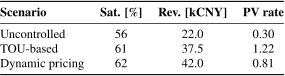
Table 3 compares the key performance indicators across the three scenarios. The proposed dynamic pricing strategy (Scenario 3) achieves superior balance among all objectives: it increases charging station revenue by 4,500 CNY (12%) compared to the TOU-based scenario (Scenario 2), improves owner satisfaction by 1 percentage point, and reduces the load peak‑valley (PV) difference rate by 0.41. The results demonstrate that under dynamic electricity pricing, the proposed method can effectively motivate vehicle owners to actively participate in charging/discharging scheduling, alleviate sharp load fluctuations, enhance user satisfaction, and simultaneously increase the revenue of charging stations, thereby achieving a mutually beneficial outcome for all stakeholders.
5. Conclusion
In order to alleviate the conflict of interest between EV charging stations and owners and prevent severe load fluctuations, this paper constructs an EV scheduling model with the optimization objectives of maximizing the benefits of EV charging stations, maximizing the satisfaction of owners, and minimizing the load peak-valley difference rate, and adopts the TSM-NSGA-III algorithm to solve the problem. Simulation results show that the proposed method can meet the travel needs of car owners, improve the economic benefits of charging stations, improve car owners’ satisfaction, reduce load fluctuations, and achieve a win-win situation. When establishing the multi-objective model, this paper only considers the optimization objectives of the benefits of charging stations, the satisfaction of car owners, and the peak-valley difference of charging station load. In future studies, the multi-agent benefits can be studied in combination with the aspects of power grid flow, voltage fluctuation, and weather, so as to improve the comprehensiveness of the charging and discharging strategy recommendation for EVs.
Acknowledgments
This work was supported by the Scientific Research Project of the Education Department of Jilin Province (JJKH20250880KJ).
- [1] Z. T. Zhao and B. Gu, “Research on charging and discharging price and time period based on electric vehicle load aggregator under demand response,” J. of Northeast Electric Power University, Vol.43, No.6, pp. 79-86, 2023.
- [2] B. Xiao, J. X. Zhu, X. Liu, and M. X Jiao, “Bi-level planning of electric vehicle charging stations based on CRITIC method and non-cooperative game,” J. of Northeast Electric Power University, Vol.42, No.4, pp. 35-49, 2022.
- [3] X. F. Jiang, “Research on electric vehicle charging scheduling strategy based on the multiobjective algorithm,” Mathematical Problems in Engineering, 2022. https://doi.org/10.1155/2022/1959511
- [4] Y. L. Lou, C. X. Wu, Z. Z. Shi, and R. Yang, “Evaluation of EV penetration level limit in distribution system applying charging and scheduling strategies,” Sustainable Energy, Grids and Networks, Vol.32, Article No.100922, 2022. https://doi.org/10.1016/j.segan.2022.100922
- [5] D. X. Yan, C. B. Ma, and Y. Chen, “Distributed Coordination of Charging Stations Considering Aggregate EV power flexibility,” IEEE Trans. on Sustainable Energy, Vol.14, pp. 356-370, 2023. https://doi.org/10.1109/TSTE.2022.3213173
- [6] Z. F. Liang, F. R. Qi, G. Y. Wang, and X. W. Wang, “Review of Optimization Strategies for Orderly Charging of Electric Vehicles,” New Type Power Systems, Vol.1, No.3, pp. 256-271, 2023.
- [7] H. X. Xie, and S. Gao, “Optimal scheduling of electric vehicles charging and discharging strategy based on real-time price considering multi-party interest,” IEEJ Trans. on Electrical and Electronic Engineering, Vol.18, pp. 1111-1119, 2023. https://doi.org/10.1002/tee.23819
- [8] Z. Weng, J. Zhou, X. Song, and L. Jing, “Research on orderly charging strategy for electric vehicles based on electricity price guidance and reliability evaluation of microgrid,” Electronics, Vol.12, No.23, Article No.4876, 2023. https://doi.org/10.3390/electronics12234876
- [9] B. Wang, “Research on Optimization of Electric Vehicle Charging Scheduling Under Multi-Scenario Resource Constraints,” Chongqing Jiaotong University, 2025.
- [10] Y. L. Chen, Z. P. Lv, and S. Zhou, “Multi-objective optimal scheduling of electric vehicles based on cloud edge end cooperation,” Distribution & Utilization, Vol.39, No.4, pp. 17-24, 2022.
- [11] Y. L. Luo, “Research on the prediction method of charging power based on the behavior of electric vehicle owners,” Xi’an Technological University, 2022.
- [12] W. C. Dai, A. D. Liu, X. Shen, H. J. Ma, and H. Zhang, “Online optimization of charging and discharging behavior of household electric vehicle cluster based on MADDPG algorithm,” J. of Northeast Electric Power University, Vol.41, No.5, pp. 80-89, 2021.
- [13] L. J. Geng, “Research on V2G-based electric vehicle scheduling strategy,” Qing Dao University, 2016.
- [14] X. Y. Yu, Y. P. Zhang, Y. Zhang, L. Yang, W. D. Gao, and Y. Guo, “Mobile network scheduling and operation information sharing method based on chaos reverse learning improved grey wolf algorithm,” Telecommunications Science, Vol.39, No.8, pp. 82-99, 2023.
- [15] H. Cai, X. Y. Lin, Z. L. Cai, Y. W. Zhong, and F. L. Zhong, “Optimization of carbon peak path in Fujian Province based on sparrow search algorithm,” Energy Environmental Protection, pp. 1-11, 2024.
- [16] Z. Y. Liu, J. Zhou, L. Zhang, J. X. Zhang, Q. Zhang, and R. Sha, “Research on TSP Problem based on crossover and mutation combination,” Jisuanji Yu Xiandaihua, No.3, pp. 54-59, 2018.
- [17] W. J. Li, G. Li, and Z. G. Nie, “Polynomial variance and adaptive weight optimization for aquila algorithm,” Computer Technology and Development, Vol.34, No.2, pp. 163-170, 2024.
- [18] X. M. Sun, W. Wang, S. Su, J. C. Jiang, L. J. Xu, and X. H. He, “Coordinated charging strategy for electric vehicles based on time-of-use price,” Automation of Electric Power Systems, Vol.37, No.1, pp. 191-195, 2013.
- [19] Z. H. Liu, B. L. Dong, B. B. Wang, L. P. Lian, and C. Cheng, “Model for conventional missile firepower distribution based on R-NSGA-III,” Electronic Design Engineering, Vol.30, No.23, pp. 169-173, 2022.
- [20] K. Sumetpipat and D. Baowan, “Stable configurations of DOXH interacting with graphene: Heuristic algorithm approach using NSGA-II and U-NSGA-III,” Nanomaterials, Vol.12, No.22, Article No.4097, 2022. https://doi.org/10.3390/nano12224097
This article is published under a Creative Commons Attribution-NoDerivatives 4.0 Internationa License.