
Research Paper:
Enterprise Digital Maturity Assessment Driven by Multi-Source Data: Based on the Entropy Weight Method and Skyline Algorithm
Hongqin Tang*,**
 , Yang Shen*,**,†
, and Jianping Zhu*,**
, Yang Shen*,**,†
, and Jianping Zhu*,**
*School of Management, Xiamen University
No.422 Siming South Road, Siming District, Xiamen, Fujian 361005, China
**Data Mining Research Center, Xiamen University
No.422 Siming South Road, Siming District, Xiamen, Fujian 361005, China
†Corresponding author

The rapid advancement of digitalization is reshaping multiple aspects of firms and transforming the nature of innovation and entrepreneurship. However, a mature solution to accurately measure the digitalization maturity of enterprises is lacking. To help firms better understand their digitalization competitiveness, this study examined Chinese listed companies and, drawing on publicly available multi-dimensional heterogeneous data, employed the skyline algorithm and entropy weight method to construct a scientific measure and evaluation of digitalization maturity. To assess the reliability and practical feasibility of the measurement, this study further conducted heterogeneity analyses across industries and regions in China based on the evaluation results. The findings indicated that firms with superior digitalization maturity were predominantly concentrated in industries that were highly sensitive to digital technologies, as well as in regions characterized by stronger resource endowments and more frequent knowledge exchanges. In contrast, the digital transformation of traditional industries, such as the real estate sector, and of the regions where these industries are concentrated remained relatively weak and required further strengthening. These findings provide significant implications for both policymakers and industry stakeholders.
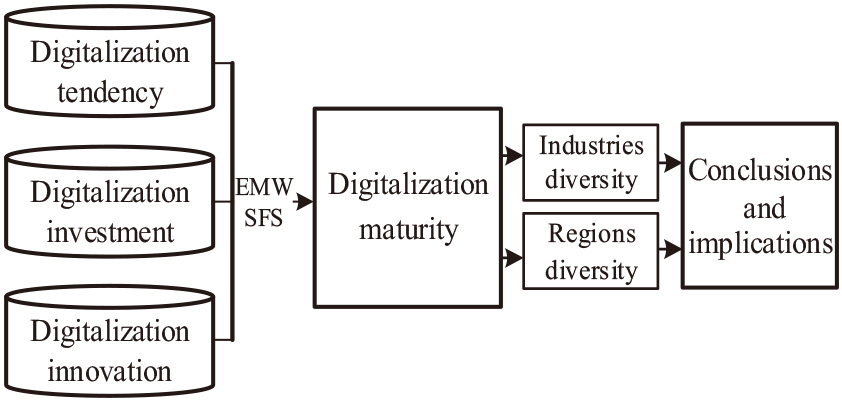
Technical framework
- [1] A. Meier, R. Eller, and M. Peters, “Creating competitiveness in incumbent small- and medium-sized enterprises: A revised perspective on digital transformation,” J. of Business Research, Vol.186, Article No.115028, 2025. https://doi.org/10.1016/j.jbusres.2024.115028
- [2] S. A. Taylor, G. L. Hunter, A. H. Zadeh, D. Delpechitre, and J. H. Lim, “Value propositions in a digitally transformed world,” Industrial Marketing Management, Vol.87, pp. 256-263, 2020. https://doi.org/10.1016/j.indmarman.2019.10.004
- [3] J. J. M. Ferreira, C. I. Fernandes, and F. A. F. Ferreira, “To be or not to be digital, that is the question: Firm innovation and performance,” J. of Business Research, Vol.101, pp. 583-590, 2019. https://doi.org/10.1016/j.jbusres.2018.11.013
- [4] Y. Qi, K. Hou, M. Zhang, T. Pu, and H. Guo, “Digitalization and financial performance: A supply chain perspective,” Information & Management, Vol.62, No.7, Article No.104199, 2025. https://doi.org/10.1016/j.im.2025.104199
- [5] N. Coviello, L. Kano, and P. W. Liesch, “Adapting the Uppsala model to a modern world: Macro-context and microfoundations,” J. of Int. Business Studies, Vol.48, No.9, pp. 1151-1164, 2017. https://doi.org/10.1057/s41267-017-0120-x
- [6] H. Tang, J. Zhu, N. Li, and W. Wu, “Impact of enterprise supply chain digitalization on cost of debt: A four-flows perspective analysis using explainable machine learning methodology,” Sustainability, Vol.16, No.19, Article No.8702, 2024. https://doi.org/10.3390/su16198702
- [7] H. Tang, Y. Zhao, N. Li, and J. Zhu, “Enhancing crowdfunding financing speed through image-text integration strategies: Insights from information processing theory and explainable machine learning methodology,” Technology in Society, Vol.84, Article No.103136, 2026. https://doi.org/10.1016/j.techsoc.2025.103136
- [8] D. Tang and J. Wei, “Prediction and characteristic analysis of enterprise digital transformation integrating XGBoost and SHAP,” J. Adv. Comput. Intell. Intell. Inform., Vol.27, No.5, pp. 780-789, 2023. https://doi.org/10.20965/jaciii.2023.p0780
- [9] J. Wei and Y. Shen, “Impact and mechanism of digital transformation on performance in manufacturing firms,” Innovation and Green Development, Vol.4, No.1, Article No.100205, 2025. https://doi.org/10.1016/j.igd.2025.100205
- [10] T. Hout and P. Ghemawat, “China vs the world: Whose technology is it?,” Harvard Business Review, Vol.88, No.12, 2010. https://hbr.org/2010/12/china-vs-the-world-whose-technology-is-it [Accessed December 20, 2025]
- [11] M. Gradillas and L. D. W. Thomas, “Distinguishing digitization and digitalization: A systematic review and conceptual framework,” J. of Product Innovation Management, Vol.42, No.1, pp. 112-143, 2025. https://doi.org/10.1111/jpim.12690
- [12] T. Ritter and C. L. Pedersen, “Digitization capability and the digitalization of business models in business-to-business firms: Past, present, and future,” Industrial Marketing Management, Vol.86, pp. 180-190, 2020. https://doi.org/10.1016/j.indmarman.2019.11.019
- [13] C. Legner et al., “Digitalization: Opportunity and challenge for the business and information systems engineering community,” Business & Information Systems Engineering, Vol.59, No.4, pp. 301-308, 2017. https://doi.org/10.1007/s12599-017-0484-2
- [14] C. Hsu, “Scaling with digital connection: Services innovation,” 2007 IEEE Int. Conf. on Systems, Man and Cybernetics, pp. 4057-4061, 2007. https://doi.org/10.1109/ICSMC.2007.4414260
- [15] W. Coreynen, P. Matthyssens, and W. Van Bockhaven, “Boosting servitization through digitization: Pathways and dynamic resource configurations for manufacturers,” Industrial Marketing Management, Vol.60, pp. 42-53, 2017. https://doi.org/10.1016/j.indmarman.2016.04.012
- [16] R. G. Fichman, B. L. Dos Santos, and Z. E. Zheng, “Digital innovation as a fundamental and powerful concept in the information systems curriculum,” MIS Quarterly, Vol.38, No.2, pp. 329-354, 2014. https://doi.org/10.25300/MISQ/2014/38.2.01
- [17] E. Autio, S. Nambisan, L. D. W. Thomas, and M. Wright, “Digital affordances, spatial affordances, and the genesis of entrepreneurial ecosystems,” Strategic Entrepreneurship J., Vol.12, No.1, pp. 72-95, 2018. https://doi.org/10.1002/sej.1266
- [18] S. G. Gavrila and A. de Lucas Ancillo, “Spanish SMEs’ digitalization enablers: E-receipt applications to the offline retail market,” Technological Forecasting and Social Change, Vol.162, Article No.120381, 2021. https://doi.org/10.1016/j.techfore.2020.120381
- [19] K. S. R. Warner and M. Wäger, “Building dynamic capabilities for digital transformation: An ongoing process of strategic renewal,” Long Range Planning, Vol.52, No.3, pp. 326-349, 2019. https://doi.org/10.1016/j.lrp.2018.12.001
- [20] A. Fleury, M. T. L. Fleury, L. Oliveira, and P. Leao, “Going digital EMNEs: The role of digital maturity capability,” Int. Business Review, Vol.33, No.4, Article No.102271, 2024. https://doi.org/10.1016/j.ibusrev.2024.102271
- [21] G. Garechana, R. Río-Belver, I. Bildosola, and M. R. Salvador, “Effects of innovation management system standardization on firms: Evidence from text mining annual reports,” Scientometrics, Vol.111, No.3, pp. 1987-1999, 2017. https://doi.org/10.1007/s11192-017-2345-7
- [22] H. Wen, Q. Zhong, and C.-C. Lee, “Digitalization, competition strategy and corporate innovation: Evidence from Chinese manufacturing listed companies,” Int. Review of Financial Analysis, Vol.82, Article No.102166, 2022. https://doi.org/10.1016/j.irfa.2022.102166
- [23] F. Wagner, “Determinants of conventional and digital investment advisory decisions: A systematic literature review,” Financial Innovation, Vol.10, Article No.18, 2024. https://doi.org/10.1186/s40854-023-00538-7
- [24] A. Chen, C. Xu, and H. Zhang, “The influence of digitalisation on the three-stage innovation efficiency of high-tech industry,” Technology Analysis & Strategic Management, 2025. https://doi.org/10.1080/09537325.2025.2543442
- [25] V. W. Fang, X. Tian, and S. Tice, “Does stock liquidity enhance or impede firm innovation?,” The J. of Finance, Vol.69, No.5, pp. 2085-2125, 2014. https://doi.org/10.1111/jofi.12187
- [26] A. Aizawa, “An information-theoretic perspective of TF–IDF measures,” Information Processing & Management, Vol.39, No.1, pp. 45-65, 2003. https://doi.org/10.1016/S0306-4573(02)00021-3
- [27] I. Paik and H. Mizugai, “Recommendation system using weighted TF–IDF and Naive Bayes classifiers on RSS contents,” J. Adv. Comput. Intell. Intell. Inform., Vol.14, No.6, pp. 631-637, 2010. https://doi.org/10.20965/jaciii.2010.p0631
- [28] J. Chomicki, P. Godfrey, J. Gryz, and D. Liang, “Skyline with presorting: Theory and optimizations,” Intelligent Information Processing and Web Mining (Proc. of the Int. IIS:IIPWM’05 Conf.), pp. 595-604, 2005. https://doi.org/10.1007/3-540-32392-9_72
- [29] A. Sidiropoulos, A. Gogoglou, D. Katsaros, and Y. Manolopoulos, “Gazing at the skyline for star scientists,” J. of Informetrics, Vol.10, No.3, pp. 789-813, 2016. https://doi.org/10.1016/j.joi.2016.04.009
- [30] China Securities Regulatory Commission, “Guidelines for the industry classification of listed companies (2012 revision),” 2012. http://www.csrc.gov.cn/pub/newsite/flb/flfg/bmgf/zh/gfxwjtj/201310/t20131016_236281.html [Accessed December 20, 2025]
- [31] National Bureau of Statistics of China, “Eastern, Central, Western and Northeastern region division method,” 2011. http://www.stats.gov.cn/ztjc/zthd/sjtjr/dejtjkfr/tjkp/201106/t20110613_71947.htm [Accessed December 20, 2025]
- [32] Y. Shen, X. Zhang, and X. Wang, “Innovation-driven sustainable development: Analysing the impact of digital technology on synergistic governance of pollution and carbon reduction,” Vol.14, Article No.100978, 2026. https://doi.org/10.1016/j.jik.2026.100978
This article is published under a Creative Commons Attribution-NoDerivatives 4.0 Internationa License.