
Research Paper:
Stochastic Multi-Objective Sales and Operations Planning with Plan Stability Objectives and Supply Order Allocation Using Simulation–Optimization
Yigedeb Abay†
 , Toshiya Kaihara
, and Daisuke Kokuryo
, Toshiya Kaihara
, and Daisuke Kokuryo
Graduate School of System Informatics, Kobe University
1-1 Rokkodai-cho, Nada-ku, Kobe, Hyogo 657-8501, Japan
†Corresponding author

Sales and operations planning (S&OP), despite its importance in balancing demand and supply, faces significant challenges due to system complexity, uncertainty, and conflicting objectives. While previous research has primarily examined the effects of integration, flexibility, and inventory control on cost and customer service level under demand uncertainty, it has often overlooked the simultaneous consideration of plan stability, procurement time uncertainty, and supplier capacity constraints. This study addresses these gaps by developing a multi-objective S&OP simulation–optimization model that jointly considers plan stability objectives and capacity-constrained supply order allocation under both demand and procurement time uncertainty. Computational results from an automotive industry case study show that frozen horizon length has a more significant impact on customer service, delivery time, and plan stability than on total profit. A bi-sourcing policy proved more advantageous than single sourcing even under unlimited capacity and lower unit costs, while moderate procurement lead-time uncertainty outperformed deterministic lead times under long supply intervals. This reveals counterintuitive temporal supply dynamics in which lead-time overlaps and order crossings yield favorable logistics cost trade-offs. The results also indicate that sourcing policies, supply intervals and lead-time uncertainty influence plan stability even when frozen horizon length is fixed. These findings provide manufacturers with insights to balance flexibility and stability in S&OP, while managing multiple uncertainty sources and multi-sourcing strategies in dynamic supply chain environments.
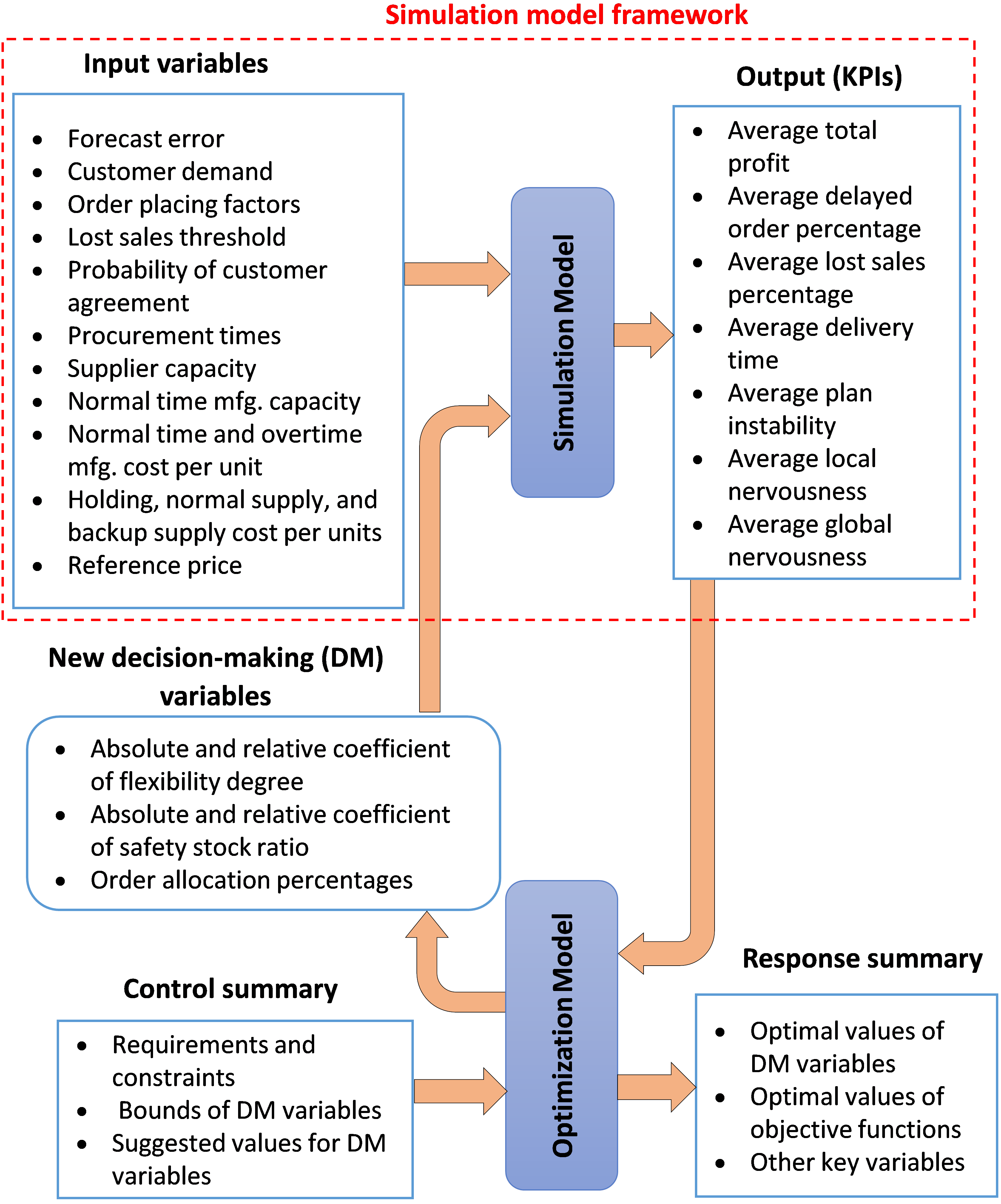
S&OP simulation-optimization framework
- [1] D. F. Pereira et al., “Tactical sales and operations planning: A holistic framework and a literature review of decision-making models,” Int. J. of Production Economics, Vol.228, Article No.107695, 2020. https://doi.org/10.1016/j.ijpe.2020.107695
- [2] S. C. Graves, “Uncertainty and production planning,” K. Kempf, P. Keskinocak, and R. Uzsoy (Eds.), “Planning Production and Inventories in the Extended Enterprise,” pp. 83-101, Springer, 2011. https://doi.org/10.1007/978-1-4419-6485-4_5
- [3] M. Yao and S. Minner, “Review of multi-supplier inventory models in supply chain management: An update,” SSRN, Article No.2995134, 2017. https://doi.org/10.2139/ssrn.2995134
- [4] Y. Feng et al., “Simulation and performance evaluation of partially and fully integrated sales and operations planning,” Int. J. Prod. of Production Research, Vol.48, No.19, pp. 5859-5883, 2010. https://doi.org/10.1080/00207540903232789
- [5] Y. Nemati et al., “The effect of sales and operations planning (S&OP) on supply chain’s total performance: A case study in an Iranian dairy company,” Computers and Chemical Engineering, Vol.104, pp. 323-338, 2017. https://doi.org/10.1016/j.compchemeng.2017.05.002
- [6] L. L. Lim et al., “Reconciling sales and operation management with distant suppliers in the automotive industry: A simulation model approach,” Int. J. of Production Economics, Vol.151, pp. 20-36, 2014. https://doi.org/10.1016/j.ijpe.2014.01.011
- [7] L. L. Lim et al., “A simulation-optimization approach for sales and operations planning in build-to-order industries with distant sourcing: Focus on the automotive industry,” Comput. Ind. Eng., Vol.112, pp. 469-482, 2017. https://doi.org/10.1016/j.cie.2016.12.002
- [8] R. Aiassi et al., “Designing a stochastic multi-objective simulation-based optimization model for sales and operation planning in built to order environment with uncertain distant outsourcing,” Simulation Modelling Practice and Theory, Vol.104, Article No.102103, 2020. https://doi.org/10.1016/j.simpat.2020.102103
- [9] Y. Abay et al., “A discrete-event simulation study of multi-objective sales and operation planning under demand uncertainty: A case of the Ethiopian automotive industry,” Int. J. Automation Technol., Vol.18, No.1, pp. 135-145, 2024. https://doi.org/10.20965/ijat.2024.p0135
- [10] R. L. LaForge et al., “Schedule stability,” P. M. Swamidass (Ed.), “Encyclopedia of Production and Manufacturing Management,” pp. 665-668, 2000. https://doi.org/10.1007/1-4020-0612-8_846
- [11] A. Thomas et al., “Mathematical programming approaches for stable tactical and operational planning in supply chain and APS context,” J. of Decision Systems, Vol.17, No.3, pp. 425-455, 2008. https://doi.org/10.3166/jds.17.425-455
- [12] S. Belmokhtar et al., “A general approach for hierarchical production planning considering stability,” Proc. 3rd Int. Conf. Inf. on Information Systems, Logistics and Supply Chain, Article No.hal-00542217, 2010.
- [13] R. P. Burrows III, “Demand-driven S&OP: A sharp departure from the traditional ERP approach,” J. of Business Forecasting, Vol.26, No.3, p. 4, 2007.
- [14] F. Sahin et al., “Rolling horizon planning in supply chains: Review, implications, and directions for future research,” Int. J. Prod. of Production Research, Vol.51, No.18, pp. 5413-5436, 2013.
- [15] B. Kandemir et al., “Redesign, smart and digital enablement of sales and operations planning processes: A study of white goods manufacturing,” C. Kahraman and E. Haktanır (Eds.), “Intelligent Systems in Digital Transformation,” pp. 221-238, Springer, 2023. https://doi.org/10.1007/978-3-031-16598-6_10
- [16] C. Kalla et al., “Integrating supply chain risk management activities into sales and operations planning,” Review of Managerial Science, Vol.19, pp. 467-497, 2025. https://doi.org/10.1007/s11846-024-00756-y
- [17] J. Mula et al., “Models for production planning under uncertainty: A review,” Int. J. of Production Economics, Vol.103, No.1, pp. 271-285, 2006. https://doi.org/10.1016/j.ijpe.2005.09.001
- [18] P. Jonsson and J. Holmström, “Future of supply chain planning closing the gaps between practice and promise,” Int. J. of Physical Distribution and Logistics Management, Vol.46, No.1, pp. 62-81, 2016. https://doi.org/10.1108/IJPDLM-05-2015-0137
- [19] E. M. Frazzon et al., “Hybrid approach for the integrated scheduling of production and transport processes along supply chains,” Int. J. Prod. of Production Research, Vol.56, No.5, pp. 2019-2035, 2018. https://doi.org/10.1080/00207543.2017.1355118
- [20] H. Babaei et al., “Future trends and challenges in sales and operations planning (S&OP): A systematic literature review,” J. of Systems Management, Vol.11, No.3, pp. 19-39, 2025.
- [21] V. Sridharan et al., “Freezing the master production under rolling planning horizons,” Management Science, Vol.13, No.9, 1987.
- [22] V. Sridharan et al., “Measuring master production schedule instability under rolling planning horizons,” Decision Sciences, Vol.19, No.1, pp. 147-166, 1988.
- [23] X. Zhao and T. S. Lee, “Freezing the master production schedule for material requirements planning systems under demand uncertainty,” J. of Operations Management, Vol.11, No.2, pp. 185-205, 1993. https://doi.org/10.1016/0272-6963(93)90022-H
- [24] J. Xie et al., “Freezing the master production schedule under single resource constraint and demand uncertainty,” Int. J. of Production Economics, Vol.83, No.1, pp. 65-84, 2003. https://doi.org/10.1016/S0925-5273(02)00262-1
- [25] N. P. Lin et al., “The effects of environmental factors on the design of master production scheduling systems,” J. of Operations Management, Vol.11, No.4, pp. 367-384, 1994.
- [26] C. Herrera et al., “A reactive decision-making approach to reduce instability in a master production schedule,” Int. J. Prod. of Production Research, Vol.54, No.8, pp. 2394-2404, 2016. https://doi.org/10.1080/00207543.2015.1078516
- [27] S. N. Atadeniz and S. V. Sridharan, “Effectiveness of nervousness reduction policies when capacity is constrained,” Int. J. Prod. of Production Research, Vol.58, No.13, pp. 4121-4137, 2020. https://doi.org/10.1080/00207543.2019.1643513
- [28] N. Pujawan and A. U. Smart, “Factors affecting schedule instability in manufacturing companies,” Int. J. Prod. of Production Research, Vol.50, No.8, pp. 2252-2266, 2012. https://doi.org/10.1080/00207543.2011.575095
- [29] A. M. Sanchez and M. P. Perez, “Supply chain flexibility and firm performance: A conceptual model and empirical study in the automotive industry,” Int. J. of Operations and Production Management, Vol.25, No.7, pp. 681-700, 2005.
- [30] N. Pujawan et al., “Uncertainty and schedule instability in the supply chain: Insights from case studies,” Int. J. of Services and Operations Management, Vol.19, No.4, 2014.
- [31] E. C. Özelkan et al., “Bi-objective aggregate production planning for managing plan stability,” Comput. Ind. Eng., Vol.178, Article No.109105, 2023. https://doi.org/10.1016/j.cie.2023.109105
- [32] V. Di Pasquale et al., “Order allocation in purchasing management: A review of state-of-the-art studies from a supply chain perspective,” Int. J. Prod. of Production Research, Vol.58, No.15, pp. 4741-4766, 2020. https://doi.org/10.1080/00207543.2020.1751338
- [33] M. A. Naqvi and S. H. Amin, “Supplier selection and order allocation: A literature review,” J. of Data, Information and Management, Vol.3, No.2, pp. 125-139, 2021. https://doi.org/10.1007/s42488-021-00049-z
- [34] D. F. Jones et al., “Multi-objective metaheuristics: An overview of the current state-of-the-art,” European J. of Operational Research, Vol.137, No.1, pp. 1-9, 2002. https://doi.org/10.1016/S0377-2217(01)00123-0
- [35] E. Shadkam and M. Bijari, “Multi-objective simulation optimization for selection and determination of order quantity in supplier selection problem under uncertainty and quality criteria,” Int. J. of Advanced Manufacturing Technology, Vol.93, pp. 161-173, 2017. https://doi.org/10.1007/s00170-015-7986-1
- [36] M. Bijvank and I. F. A. Vis, “Lost-sales inventory theory: A review,” European J. of Operational Research, Vol.215, No.1, pp. 1-13, 2011. https://doi.org/10.1016/j.ejor.2011.02.004
- [37] J. Branke et al., “Multi-objective optimization: Interactive and evolutionary approaches,” Springer, 2008.
- [38] F. Glover et al., “New advances and applications of combining simulation and optimization,” Proc. 28th Winter Simulation Conference (WSC’96), pp. 144-152, 1996. https://doi.org/10.1145/256562.256595
- [39] H. Rashidi, “Discrete simulation software: A survey on taxonomies,” J. of Simulation, Vol.11, pp. 174-184, 2017. https://doi.org/10.1057/JOS.2016.4
- [40] M. C. Fu et al., “Simulation optimization: A review, new developments, and applications,” Proc. 37th of the Winter Simulation Conference (WSC’05), pp. 83-95, 2005. https://doi.org/10.1109/WSC.2005.1574242
- [41] P. Kelle and P. A. Miller, “Stockout risk and order splitting,” Int. J. of Production Economics, Vol.71, pp. 407-415, 2001. https://doi.org/10.1016/S0925-5273(00)00137-7
This article is published under a Creative Commons Attribution-NoDerivatives 4.0 Internationa License.