
Development Report:
Development of a Hammer-Knife Type Mower
Hiroto Tanaka and Hiroshi Kobayashi
Department of Mechanical Engineering, Graduate School of Engineering, Tokyo University of Science
6-3-1 Niijuku, Katsushika-ku, Tokyo 125-8585, Japan

Regular mowing operations are required on ridge paths; however, ridge paths are often narrow and sloped, making mechanization necessary from the perspectives of work efficiency and safety. In this study, the performance of currently available commercial mowers was first organized and analyzed, and a conceptual design of a mower specialized for ridge-path operations was proposed. First, a remote-control operation system was adopted to reduce the operator’s workload. Next, a hybrid drive system was employed in which an engine generates electricity to drive electric motors. In addition, a hammer-knife mechanism, which provides high durability and excellent mowing performance, was adopted as the mowing mechanism. Furthermore, in order to enable operation in narrow environments such as ridge paths, the machine width was set to approximately 600 mm. To evaluate the performance of the developed machine, traveling tests, mowing performance tests, and fuel consumption tests were conducted. In the mowing performance tests, evaluations were carried out under different cutting-height conditions, and a high mowing performance of over 96% on average was confirmed under the cutting height condition of 80 mm. In contrast, under the cutting height condition of 180 mm, grass was pressed down beneath the machine body during traveling and did not reach the cutting blades, resulting in a tendency for approximately 15% of the grass to remain uncut on average. In addition, turning tests under slope conditions were conducted on both asphalt and grass surfaces. The results showed that although sufficient performance was not obtained on the asphalt surface under the slope angle condition of 20°, stable traveling and turning performance were confirmed on the grass surface, which simulates actual ridge-path environments. Furthermore, the evaluation of fuel consumption characteristics demonstrated that the developed machine is capable of long-duration continuous operation. From these results, it was confirmed that the developed machine has sufficient adaptability to narrow environments such as ridge paths and exhibits good traveling and mowing performance.
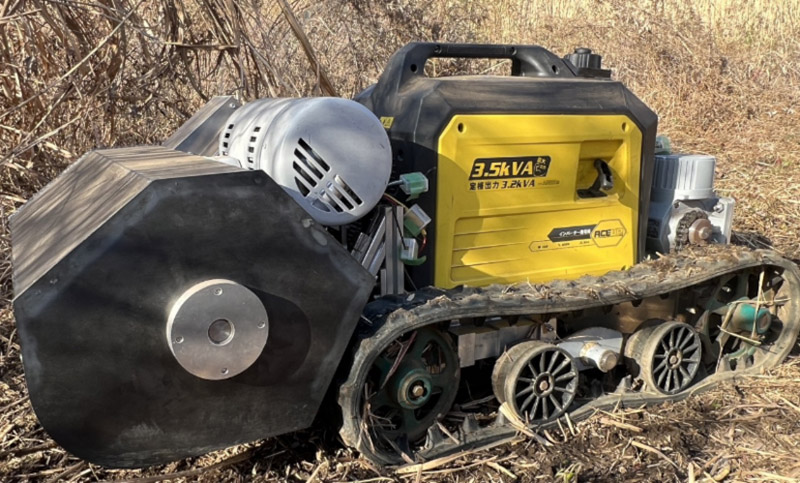
Mower designed for narrow-width operation
- [1] C. R. Tuck, M. J. O’Dogherty, D. E. Baker, and G. E. Gale, “Laboratory studies of the performance characteristics of mowing mechanisms,” J. of Agricultural Engineering Research, Vol.50, pp. 61-80, 1991. https://doi.org/10.1016/S0021-8634(05)80006-X
- [2] Y. Iwano, A. Tanaka, and K. Iizuka, “Development of a flail-type mowing system,” J. Robot. Mechatron., Vol.37, No.3, pp. 555-562, 2025. https://doi.org/10.20965/jrm.2025.p0555
- [3] Y. Nishimura and T. Yamaguchi, “Grass cutting robot for inclined surfaces in hilly and mountainous areas,” Sensors, Vol.23, No.1, Article No.528, 2023. https://doi.org/10.3390/s23010528
- [4] H. Sori, H. Inoue, H. Hatta, and Y. Ando, “Effect for a paddy weeding robot in wet rice culture,” J. Robot. Mechatron., Vol.30, No.2, pp. 198-205, 2018. https://doi.org/10.20965/jrm.2018.p0198
- [5] R. Kikuchi, R. Okuno, T. Sato, and M. Kamei, “Development of a small mowing robot for steep slopes,” Japanese J. of Farm Work Research, Vol.55, No.3, pp. 155-162, 2020 (in Japanese). https://doi.org/10.4035/jsfwr.55.155
- [6] Y. Iwano and A. Kobayashi, “Development of a trimmer-type mowing robot,” 2012 Int. Conf. on Advanced Mechatronic Systems, pp. 397-401, 2012.
- [7] Y. Iwano, T. Hasegawa, A. Tanaka, and K. Iizuka, “Development of the trimmer-type mowing system against a slope,” 2016 Int. Conf. on Advanced Mechatronic Systems, pp. 23-28, 2016. https://doi.org/10.1109/ICAMechS.2016.7813415
- [8] M. Dohi and H. Yokoyama, “Mowing robot of weed on agricultural field border,” Proc. of 2009 JSME Annual Conf. on Robotics and Mechatronics, Session No.1A2-B13, 2009. https://doi.org/10.1299/jsmermd.2009._1A2-B13_1
- [9] T. Fukukawa, K. Sekiyama, Y. Hasegawa, and T. Fukuda, “Vision-based mowing boundary detection algorithm for an autonomous lawn mower,” J. Adv. Comput. Intell. Intell. Inform., Vol.20, No.1, pp. 49-56, 2016. https://doi.org/10.20965/jaciii.2016.p0049
- [10] H. Kurita, M. Oku, T. Nakamura, T. Yoshida, and T. Fukao, “Localization method using camera and LiDAR and its application to autonomous mowing in orchards,” J. Robot. Mechatron., Vol.34, No.4, pp. 877-886, 2022. https://doi.org/10.20965/jrm.2022.p0877
- [11] T. Fukukawa, K. Sekiyama, Y. Hasegawa, and T. Fukuda, “Vision-based mowing boundary detection algorithm for an autonomous lawn mower,” J. Adv. Comput. Intell. Intell. Inform., Vol.20, No.1, pp. 49-56, 2016. https://doi.org/10.20965/jaciii.2016.p0049
- [12] T. Suzuki, Y. Funabora, S. Doki, K. Doki, and M. Yamazumi, “DSFS: Dynamic sensor fusion system for robust localization with diverse sensing information,” J. Robot. Mechatron., Vol.37, No.5, pp. 1127-1136, 2025. https://doi.org/10.20965/jrm.2025.p1127
- [13] K. Funato, R. Tasaki, H. Sakurai, and K. Terashima, “Development and experimental verification of a person tracking system of mobile robots using sensor fusion of inertial measurement unit and laser range finder for occlusion avoidance,” J. Robot. Mechatron., Vol.33, No.1, pp. 33-43, 2021. https://doi.org/10.20965/jrm.2021.p0033
- [14] J. Han, X. Li, and Q. Qin, “Design of two-wheeled self-balancing robot based on sensor fusion algorithm,” Int. J. Automation Technol., Vol.8, No.2, pp. 216-221, 2014. https://doi.org/10.20965/ijat.2014.p0216
- [15] M. Kristou, A. Ohya, and S. Yuta, “Target person identification and following based on omnidirectional camera and LRF sensor fusion from a moving robot,” J. Robot. Mechatron., Vol.23, No.1, pp. 163-172, 2011. https://doi.org/10.20965/jrm.2011.p0163
- [16] J. Potgieter, O. Diegel, F. Noble, and M. Pike, “Additive manufacturing in the context of hybrid flexible manufacturing systems,” Int. J. Automation Technol., Vol.6, No.5, pp. 627-632, 2012. https://doi.org/10.20965/ijat.2012.p0627
- [17] H. Ishikawa, Y. Takeda, S. Ashizawa, and T. Oomichi, “Efficiency improvement of electric generating engine system based on internal combustion engine: Energy simulation of new engine operation with electric generator and motor,” J. Robot. Mechatron., Vol.24, No.3, pp. 487-497, 2012. https://doi.org/10.20965/jrm.2012.p0487
- [18] Y. Xu et al., “A short-term load forecasting method based on a hybrid model for industrial boiler generator sets,” J. Adv. Comput. Intell. Intell. Inform., Vol.29, No.5, pp. 1145-1152, 2025. https://doi.org/10.20965/jaciii.2025.p1145
- [19] Y. Nishimura and T. Yamaguchi, “Fundamental study on locomotion ability of a mobile robot on steep slopes,” Proc. of 2020 JSME Annual Conf. on Robotics and Mechatronics, Session No.1A1-H06, 2020 (in Japanese). https://doi.org/10.1299/jsmermd.2020.1A1-H06
- [20] S. Hara, T. Shimizu, M. Konishi, R. Yamamura, and S. Ikemoto, “Autonomous mobile robot for outdoor slope using 2D LiDAR with uniaxial gimbal mechanism,” J. Robot. Mechatron., Vol.32, No.6, pp. 1173-1182, 2020. https://doi.org/10.20965/jrm.2020.p1173
- [21] K. Ootsubo, D. Kato, T. Kawamura, and H. Yamada, “Support system for slope shaping based on a teleoperated construction robot,” J. Robot. Mechatron., Vol.28, No.2, pp. 149-157, 2016. https://doi.org/10.20965/jrm.2016.p0149
- [22] A. Koshiyama and K. Yamafuji, “Development and motion control of the all-direction steering-type mobile robot (1st report: Analyses and experiments on postural stability and ascent/descent on a slope),” J. Robot. Mechatron., Vol.5, No.2, pp. 141-149, 1993. https://doi.org/10.20965/jrm.1993.p0141
- [23] K. Yamafuji, “Inverted pendulum type locomotive robot which ascends a slope of maximum inclination angle of 30 degrees,” J. Robot. Mechatron., Vol.1, No.1, p. 81, 1989. https://doi.org/10.20965/jrm.1989.p0081
- [24] J. S. Pérez de Corcho Fuentes, F. Garbati Pegna, C. Iglesias Coronel, F. García Reina, and P. Spugnoli, “Power demand of a flail shredder during the harvest of pineapple fields,” Ciencia e Investigación Agraria, Vol.36, No.1, pp. 59-68, 2009. https://doi.org/10.4067/S0718-16202009000100005
- [25] J. Wang et al., “Design and experiment of an inter-plant obstacle-avoiding oscillating mower for closed-canopy orchards,” Agronomy, Vol.15, No.12, Article No.2893, 2025. https://doi.org/10.3390/agronomy15122893
- [26] P. C. Johnson, “Energy requirements and productivity of machinery used to harvest herbaceous energy crops,” M.S. thesis, University of Illinois at Urbana-Champaign, 2012.
- [27] Y. Yang, Y. He, Z. Tang, and H. Zhang, “Design and experiment of obstacle avoidance mower in Orchard,” Agriculture, Vol.14, No.12, Article No.2099, 2024. https://doi.org/10.3390/agriculture14122099
- [28] S. Shen et al., “Development of an orchard mowing and sweeping device based on an ADAMS–EDEM simulation,” Agriculture, Vol.13, No.12, Article No.2276, 2023. https://doi.org/10.3390/agriculture13122276
- [29] W. White and T. A. Lasky, “Evaluation of remote control mowers for roadside management,” Report No.CA20-2730, 2019.
- [30] I. Inano, K. Ishii, and T. Kaneko, “Evaluation on weeding machines for a sloping area,” Bulletin of Hokkaido Research Organization Agricultural Experiment Stations, No.109, pp. 23-29, 2025 (in Japanese).
- [31] A. Ino, “Evaluation of grass cutting technologies applicable to steep slope surfaces,” Kensetsu Kikai Seko, Vol.76, No.11, pp. 111-115, 2024 (in Japanese).
- [32] N. Wang et al., “Traversability analysis and path planning for autonomous wheeled vehicles on rigid terrains,” Drones, Vol.8, No.9, Article No.419, 2024. https://doi.org/10.3390/drones8090419
- [33] G. Sakayori and G. Ishigami, “Modeling of slip rate-dependent traversability for path planning of wheeled mobile robot in sandy terrain,” Frontiers in Robotics and AI, Vol.11, Article No.1320261, 2024. https://doi.org/10.3389/frobt.2024.1320261
- [34] Haige Corporation, “Instruction manual, first edition HG-M139H,” (in Japanese). https://shop.haige.jp/wp/pdf/a/2024/07/HG-M139H_web.pdf [Accessed September 30, 2025]
- [35] Maruyama MFG., Co., Inc., “Self-propelled mower,” (in Japanese). https://www.maruyama.co.jp/products/18/pdf/J-06-N17-037.pdf [Accessed October 2, 2025]
- [36] Haige Corporation, “Instruction manual, revised edition (1) HG-RMA501,” (in Japanese). https://shop.haige.jp/wp/pdf/a/2023/05/HG-RMA501_RMA1001_web.pdf [Accessed September 30, 2025]
- [37] Plow, “Robot lawn mower instruction manual AGC180,” (in Japanese). https://plow-power.com/wp-content/themes/plowpower/img/page/manual/agc180_manual_2405_02_partsless_hp.pdf [Accessed October 3, 2025]
- [38] Husqvarna Zenoah Co., Ltd., “Instruction manual and support for radio-controlled mower WM510RC,” (in Japanese). https://www.zenoah.com/jp/document-search/weed-mowers/razikoncao-yi-ji-wm510rc/ [Accessed September 28, 2025]
- [39] Atex Co., Ltd., “Radio-controlled mower instruction manual,” (in Japanese). https://atexnet.co.jp/wp-content/uploads/2022/12/rj705.pdf [Accessed September 28, 2025]
- [40] Chikusui Canycom, Inc., “Mower vehicle CG271 instruction manual,” (in Japanese). https://canycom.jp/wp-content/uploads/2024/04/5121-5101-000-04.pdf [Accessed October 3, 2025]
- [41] OREC Co., Ltd., “RCSP530A product catalog,” (in Japanese). https://www.orec.co.jp/product/wp-content/uploads/sites/2/2025/02/RCSP.pdf [Accessed October 3, 2025]
- [42] Kubota Corporation, “Kubota comprehensive mower catalog,” (in Japanese). https://agriculture.kubota.co.jp/img_sys/catalog/7-00-2-0023-02.pdf [Accessed September 30, 2025]
- [43] Yamabiko Corporation, “RCM600 product catalog,” (in Japanese). https://www.yamabiko-corp.co.jp/files/topics/13747_ext_45_0.pdf?v=1678757131 [Accessed September 30, 2025]
- [44] Haige Corporation, “Instruction manual, revised edition (1) HG-RCGC501,” (in Japanese). https://shop.haige.jp/wp/pdf/a/2024/05/HG-RCGC501_web.pdf [Accessed September 30, 2025]
- [45] Okanetsu Industry Co., Ltd., “AIRAVO brochure,” (in Japanese). https://okanetsu.co.jp/product/pdf/airavo.pdf [Accessed October 3, 2025]
This article is published under a Creative Commons Attribution-NoDerivatives 4.0 Internationa License.