
Paper:
Two-Stage Spraying with Leaf-Turning Mechanism for Enhanced Coverage and Reduced Chemical Use
Hirofumi Ukai*, Kazuaki Hirasawa*, Soichiro Ikegami*, and Shuichi Nakagawa**
*Dynamics Group, Fundamental Technology Research Center, Research & Development Center, Innovation & Technology Division, Yanmar Holdings Co., Ltd.
2481 Umegahara, Maibara, Shiga 521-8511, Japan
**Research & Development Center, Innovation & Technology Division, Yanmar Holdings Co., Ltd.
2481 Umegahara, Maibara, Shiga 521-8511, Japan

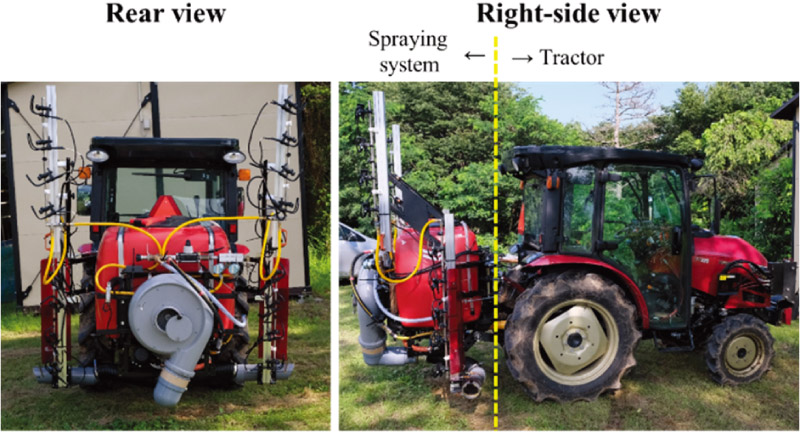
Spraying agricultural chemicals is vital for maintaining crop yield and quality; however, it comes with its own set of challenges such as spray drift and rising costs. Despite advancements in autonomous vehicles that reduce the reliance on manual labor, issues related to pesticide spray volume and spray drift persist in robotic application systems. Hence, efficient spraying technology is essential for the uniform application of pesticides, especially in hedge-trained crops where dense canopies limit access to abaxial surfaces. Although conventional air-assisted spraying systems enhance coverage through high-velocity airflow and spray pressure, there is a practical limit to the spray volume reduction as insufficient spray volume can reduce penetration into dense and complex canopies. In this study, we propose a novel tractor-mounted two-stage spraying system with a leaf-turning mechanism designed for hedge-trained crops, targeting both adaxial and abaxial surfaces. Experiments were conducted under controlled laboratory conditions and real vineyard conditions, and the results showed that the proposed spraying system used only 60% of the spray volume compared with a conventional air-assisted spraying system, while achieving equivalent coverage on adaxial surfaces and a 6% improvement in coverage on abaxial surfaces. These findings suggest that the proposed spraying system can reduce spray drift while maintaining or improving spraying performance, primarily due to the reduced spray volume, minimized air–pesticide-droplet interactions, lower operating pressure, and limited air assistance range.
Two-stage spraying with leaf-turning mechanism
- [1] Ministry of Agriculture, Forestry and Fisheries, “Pesticide drift control technology manual,” 2010 (in Japanese).
- [2] F. P. Terra, G. H. do Nascimento, G. A. Duarte, and P. L. J. Drews-Jr., “Autonomous agricultural sprayer using machine vision and nozzle control,” J. of Intelligent & Robotic Systems, Vol.105, pp. 123-134, 2022.
- [3] Bank of Japan, “Pesticide Price Index,” 2023 (in Japanese).
- [4] G. Pergher and R. Gubiani, “The effect of spray application rate and airflow rate on foliar deposition in a hedgerow vineyard,” J. of Agricultural Engineering Research, Vol.61, No.3, pp. 205-216, 1995. https://doi.org/10.1006/jaer.1995.1048
- [5] A. Duga, K. Ruysen, D. Dekeyser, D. Nuyttens, D. Bylemans, B. Nicolai, and P. Verboven, “Spray deposition profiles in pome fruit trees: Effects of sprayer design, training system and tree canopy characteristics,” Crop Protection, Vol.67, pp. 200-213, 2015. https://doi.org/10.1016/j.cropro.2014.10.016
- [6] F. Brewer, “Low-volume air-blast spraying in British Columbia,” Canada Department of Agriculture Publication, 1963.
- [7] P. Miller and M. Ellis, “Effects of formulation on spray nozzle performance for applications from ground-based boom sprayers,” Crop Protection, Vol.19, Nos.8-10, pp. 609-615, 2000. https://doi.org/10.1016/S0261-2194(00)00080-6
- [8] Y. Zhang, L. Wang, and H. Liu, “Study on utility improvement of air-assisted electrostatic sprayer,” J. of Agricultural Engineering, Vol.45, pp. 123-130, 2021 (in Japanese).
- [9] M. Tanaka, S. Yamada, and T. Suzuki, “Effect of airflow angle on abaxial surface deposition in air-assisted spraying,” Agricultural Sciences, Vol.12, pp. 45-52, 2020.
- [10] R. Smith, J. Doe, and A. Johnson, “Understanding effective citrus spray application through computer simulations,” J. of Horticultural Science, Vol.78, pp. 67-75, 2022.
- [11] Q. Ye, B. Shen, O. Tiedje, T. Bauernhansl, and J. Domnick, “Numerical and experimental study of spray coating using air-assisted high-pressure atomizers,” J. of Coatings Technology and Research, Vol.17, pp. 935-944, 2020.
- [12] P. C. H. Miller et al., “Developing strategies to reduce spray drift in pneumatic spraying in orchards,” Science of The Total Environment, Vol.736, Article No.139238, 2020.
- [13] K. Brown, L. Green, and P. White, “Spray drift from three airblast sprayer technologies in a modern orchard work environment,” J. of Pesticide Science, Vol.39, pp. 89-97, 2023.
- [14] T. Miller, J. Davis, and R. Thompson, “Effects of sprayer speed, spray distance, and nozzle arrangement angle on low-flow air-assisted spray deposition,” Precision Agriculture, Vol.15, pp. 201-210, 2021.
- [15] A. Wilson, B. Taylor, and C. Harris, “Canopy spray application technology in specialty crops: A slowly evolving landscape,” Crop Science, Vol.62, pp. 345-356, 2022.
- [16] A. Richardson, D. Richardson, T. van den Heuvel, P. Franz, and R. Butler, “Meeting droplet size specifications for aerial herbicide application to control invasive wilding conifers in New Zealand,” New Zealand Plant Protection, Vol.73, pp. 13-23, 2020. https://doi.org/10.30843/nzpp.2020.73.11712
- [17] Y. Kubota, “Development of image processing software for simple and high-precision measurement of coverage rate of chemical droplet stains on water-sensitive paper,” J. of Agricultural Information Research, Vol.19, No.2, pp. 16-22, 2010 (in Japanese). https://doi.org/10.3173/air.19.16
- [18] D. Maski and D. Durairaj, “Effects of charging voltage, application speed, target height, and orientation upon charged spray deposition on leaf abaxial and adaxial surfaces,” Crop Protection, Vol.29, pp. 134-141, 2010. https://doi.org/10.1016/j.cropro.2009.10.006
- [19] M. Tanaka, S. Yamada, and T. Suzuki, “The role of electrostatic forces in pesticide application efficiency,” Agricultural Sciences, Vol.12, pp. 67-75, 2022.
- [20] J. Douzals, “EvaSprayViti: A new tool for sprayer’s agro-environmental performance assessment,” 12th Workshop on Spray Application Techniques in Fruit Growing, 2013.
- [21] S. Verges, B. Ruelle, O. Hébrard, J. Magnier, P. Montegano, and X. Ribeyrolles, “EvaSprayViti: Une vigne artificielle pour l’optimisation agro-environnementale de la pulvérisation en viticulture,” Innovations Agronomiques, 2015 (in French).
- [22] S. Pope, “Turbulent Jets,” Cambridge University Press, 2000.
- [23] N. Rajaratnam, “Turbulent Jets,” Elsevier, 1976.
This article is published under a Creative Commons Attribution-NoDerivatives 4.0 Internationa License.