
Paper:
Predictive Modeling of Crop Growth Using a Smart Agriculture Measurement Module Composed of Multipoint Soil Moisture Sensor and Environmental Sensors
Katsushi Ogawa
 , Wakana Ono, and Seonghee Jeong
Osaka Electro-Communication University
18-8 Hatsucho, Neyagawa-shi, Osaka 572-8530, Japan

In this study, we addressed agricultural labor shortages by developing a smart farming sensor module that integrated low-cost environmental sensors with a multipoint soil moisture sensor to predict broccoli growth, plant height (PH), and leaf count (Ln). Multivariable regression confirmed that integrated solar radiation (S) was the most dominant factor, although broccoli growth involved a complex interplay of solar radiation, optimal temperature, humidity, and soil moisture. More importantly, the analysis revealed that the middle layer soil moisture (um) exhibited the strongest positive contribution to PH. This finding indicated that water availability in the main root zone was essential for vertical growth and highlighted the indispensability of multipoint sensing over conventional single-depth measurements to accurately model the intricate relationship between soil moisture and crop development. Moving forward, we aim to leverage the superiority of multipoint data to construct a sophisticated growth prediction model, thereby contributing to the optimization of irrigation and temperature management in smart farming systems.
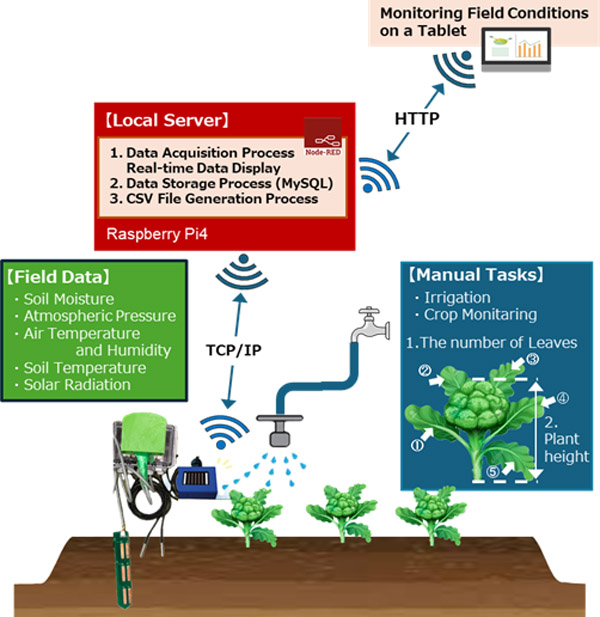
Conceptual diagram of the environmental monitoring system for broccoli growth in the field
- [1] United Nations, Department of Economic and Social Affairs, “Population Division,” 2019.
- [2] E. Playán and L. Mateos, “Modernization and optimization of irrigation systems to increase water productivity,” Agricultural Water Management, Vol.80, pp. 100-116, 2006. https://doi.org/10.1016/j.agwat.2005.07.007
- [3] M. H. Ali and M. S. U Talukder, “Increasing water productivity in crop production – A synthesis,” Agricultural Water Management, Vol.95, pp. 1201-1213, 2008. https://doi.org/10.1016/j.agwat.2008.06.008
- [4] P. Debaeke and A. Aboudrare, “Adaptation of crop management to water-limited environments,” European J. of Agronomy, Vol.21, No.4, pp. 433-446, 2004. https://doi.org/10.1016/j.eja.2004.07.006
- [5] Z. Ahmed, D. Gui, G. Murtaza, L. Yunfei, and S. Ali, “An Overview of Smart Irrigation Management for Improving Water Productivity under Climate Change in Drylands,” Agronomy, Vol.13, Article No.2113, 2023. https://doi.org/10.3390/agronomy13082113
- [6] I. Tornese, A. Matera, M. Rashvand, and F. Genovese, “Use of Probes and Sensors in Agriculture-Current Trends and Future Prospects on Intelligent Monitoring of Soil Moisture and Nutrients,” AgriEngineering, Vol.6, No.4, pp. 4154-4181, 2024. https://doi.org/10.3390/agriengineering6040234
- [7] I. Lephondo, A. Telukdarie, I. Munien, U. Onkonkwo, and A. Vermeulen, “The Outcomes of Smart Irrigation System using Machine Learning to minimize water usage within the Agriculture Sector,” Procedia Computer Science, Vol.237, pp. 525-532, 2024. https://doi.org/10.1016/j.procs.2024.05.136
- [8] H. M. A. E. Baki, H. Fujimaki, I. Tokumoto, and T. Saito, “Optimization of irrigation scheduling using crop-water simulation, water pricing, and quantitative weather forecasts,” Frontiers in Agronomy, Vol.6, Article No.1376231, 2024. https://doi.org/10.3389/fagro.2024.1376231
- [9] B. Nsoh, A. Katimbo, H. Guo, D. M. Heeren, H. N. Nakabuye, X. Qiao, Y. Ge, D. R. Rudnick, J. Wanyama, E. Bwambale, and S. Kiraga, “Internet of Things-Based Automated Solutions Utilizing Machine Learning for Smart and Real-Time Irrigation Management: A Review,” Sensors, Vol.24, No.23, Article No.7480, 2024. https://doi.org/10.3390/s24237480
- [10] Y. Zhao, G. Li, S. Li, Y. Luo, and Y. Bai, “A Review on the Optimization of Irrigation Schedules for Farmlands Based on a Simulation-Optimization Model,” Water, Vol.16, No.17, Article No.2545, 2024. https://doi.org/10.3390/w16172545
- [11] M. Ohishi, M. Takahashi, M. Fukuda, and F. Sato, “Developing a Growth Model to Predict Dry Matter Production in Broccoli (Brassica oleracea L. var. italica) ‘Ohayou’,” The Horticulture J., Vol.92, No.1, pp. 77-87, 2023. https://doi.org/10.2503/hortj.QH-022
- [12] S. Yamazaki, Y. Kiriiwa, and M. Aono, “Estimation Evaluation of Strawberry Harvest Based on Regression Analysis with Integrated and Different Values,” The Institute of Electronics, Information and Communication Engineers,” Vol.J101-D, No.10, pp. 1466-1470, 2018.
- [13] B. Petrović, R. Bumbálek, T. Zoubek, R. Kuneš, L. Smutný, and P. Bartoš, “Application of precision agriculture technologies in Central Europe-review,” J. of Agriculture and Food Research, Vol.15, Article No.101048, 2024. https://doi.org/10.1016/j.jafr.2024.101048
- [14] M. Raj and M. Prahadeeswaran, “Revolutionizing agriculture: a review of smart farming technologies for a sustainable future,” Discover Applied Sciences, Vol.7, Article No.937, 2025. https://doi.org/10.1007/s42452-025-07561-6
- [15] C. J. Bryant, G. D. Spencer, D. M. Gholson, M. T. Plumblee, D. M. Dodds, G. R. Oakley, D. Z. Reynolds, and L. J. Krutz, “Development of a soil moisture sensor-based irrigation scheduling program for the Midsouthern United States,” Crop Forage Turfgrass Management, Vol.9, No.1, Article No.e20217, 2023. https://doi.org/10.1002/cft2.20217
- [16] V. Kumar, K. V. Sharma, N. Kedam, A. Patel, T. R. Kate, and U. Rathnayake, “A comprehensive review on smart and sustainable agriculture using IoT technologies,” Smart Agricultural Technology, Vol.8, Article No.100487, 2024. https://doi.org/10.1016/j.atech.2024.100487
- [17] T. Okayama, “Recommendation for Promoting Smart Agriculture Using Low-Cost Open Source Hardware,” Japanese J. of Farm Work Research, Vol.55, No.3, pp. 169-172, 2020. https://doi.org/10.4035/jsfwr.55.169
- [18] J. van de Gevel, J. van Etten, and S. Deterding, “Citizen science breathes new life into participatory agricultural research. A review,” Agronomy for Sustainable Development, Vol.40, Article No.35, 2020. https://doi.org/10.1007/s13593-020-00636-1
- [19] A. Z. Bayih, J. Morales, Y. Assabie, and R. A. de By, “Utilization of Internet of Things and Wireless Sensor Networks for Sustainable Smallholder Agriculture,” Sensors, Vol.22, No.9, Article No.3273, 2022. https://doi.org/10.3390/s22093273
- [20] C. Corbari, N. Paciolla, I. B. Charfi, D. Skokovic, J. A. Sobrino, and M. Woods, “Citizen science supporting agricultural monitoring with hundreds of low-cost sensors in comparison to remote sensing data,” European J. of Remote Sensing, Vol.55, No.1, pp. 388-408, 2022. https://doi.org/10.1080/22797254.2022.2084643
- [21] P. Taechatanasat and L. Armstrong, “Decision Support System Data for Farmer Decision Making,” Proc. of Asian Federation for Information Technology in Agriculture, pp. 472-486, 2014.
- [22] D. C. Rose and T. J. A. Bruce, “Finding the right connection: what makes a successful decision support system?,” Food Energy Secur., Vol.7, No.1, 2017. https://doi.org/10.1002/fes3.123
- [23] K. Momii, J. Nozaka, and T. Yano, “Comparison of root water uptake models,” J. of Japan Society of Hydrology and Water Resources, Vol.5, No.3, pp. 13-21, 1992. https://doi.org/10.3178/jjshwr.5.3_13
- [24] D. M. El-Shikha, P. Waller, D. Hunsaker, T. Clarke, and E. Barnes, “Ground-based remote sensing for assessing water and nitrogen status of broccoli,” Agricultural Water Management, Vol.92, No.3, pp. 183-193, 2007. https://doi.org/10.1016/j.agwat.2007.05.020
- [25] S. Yamazaki, Y. Kiriiwa, Nonmember, and M. Aono, “Estimation Evaluation of Strawberry Harvest Based on Regression Analysis with Integrated and Different Values,” IEICE Trans. on Information and Systems, Vol.J101-D, No.10, pp. 1466-1470, 2018.
- [26] J. Fan, B. McConkey, H. Wang, and H. Janzen, “Root distribution by depth for temperate agricultural crops,” Field Crops Research, Vol.189, pp. 68-74, 2016. https://doi.org/10.1016/j.fcr.2016.02.013
- [27] Y. Müllers, J. A. Postma, H. Poorter, J. Kochs, D. Pflugfelder, U. Schurr, and D. van Dusschoten, “Shallow roots of different crops have greater water uptake rates per unit length than deep roots in well‑watered soil,” Plant and Soil, Vol.481, pp. 475-493, 2022. https://doi.org/10.1007/s11104-022-05650-8
- [28] G.-R. Yu, J. Zhuang, K. Nakayama, and Y. Jin, “Root water uptake and profile soil water as affected by vertical root distribution,” Plant Ecology, Vol.189, No.1, pp. 15-30, 2007. https://doi.org/10.1007/s11258-006-9163-y
- [29] P. Gherbin, V. Miccolis, and V. Candido, “Root length density and yield traits of broccoli (Brassica oleracea L. var. italica Plenck) as affected by different techniques of seedling growing and transplanting,” Acta Horticulturae, Vol.1005, No.1005, pp. 427-434, 2013. https://doi.org/10.17660/ActaHortic.2013.1005.51
- [30] N. Li, T. H. Skaggs, P. Ellegaard, A. Bernal, and E. Scudiero, “Relationships among soil moisture at various depths under diverse climate, land cover and soil texture,” Science of the Total Environment, Vol.947, Article No.174583, 2024. https://doi.org/10.1016/j.scitotenv.2024.174583
- [31] Ministry of Agriculture, Forestry and Fisheries, “Smart Agriculture.” https://www.maff.go.jp/e/policies/tech_res/smaagri/robot.html [Accessed October 4, 2025]
- [32] WAGRI. https://wagri.naro.go.jp/ [Accessed October 4, 2025]
- [33] IPM Decisions (Integrated Pest Management). https://www.ipmdecisions.net/ [Accessed October 4, 2025]
- [34] Farm Cloud. https://farmcloud.eu/en/farmportal [Accessed October 4, 2025]
This article is published under a Creative Commons Attribution-NoDerivatives 4.0 Internationa License.