
Review:
Advancement of Research on Earthquake Phenomena Research Group in 2019–2023
Takashi Iidaka*,**,†
*Center for Integrated Disaster Information Research Interfaculty Initiative in Information Studies, The University of Tokyo
1-1-1 Yayoi, Bunkyo, Tokyo 113-0032, Japan
**Earthquake Research Institute, The University of Tokyo
Tokyo, Japan
†Corresponding author

Japan has experienced many destructive earthquakes. The prevention and mitigation of disasters are important aspects of seismology. Earthquakes have been elucidated through multiple studies, providing significant information for earthquake prediction. We review the new results obtained through the “Second Earthquake and Volcano Hazards Observation and Research Program.” The project advanced understanding in several key areas. GNSS-A observations were performed in the southern part of the Kuril subduction zone, the Japan Trench, and the Nankai Trough, revealing accurate data regarding movement at the plate boundary. GNSS-A observations in the Kuril subduction zone were successfully conducted. The data from the Japan Trench and the Nankai Trough showed that temporal changes and regional variations in crustal movement could be detected, enabling the monitoring of plate interface displacement. This knowledge will be valuable in evaluating the risk of plate boundary earthquakes. The technological advances in this project have significantly contributed to the acquisition of stable data. For instance, knowledge of the mechanism of intraslab earthquakes has improved. The fluids and fissures existing within the plate were found to be closely related to the cause of intraplate earthquakes. Earthquakes occurring on active faults cause severe disasters, making risk mitigation crucial. This project identified numerous cases in which earthquakes were associated with crustal fluids. A comprehensive understanding of these cases will help elucidate the phenomenon of earthquakes caused by active faults. Seismic experiments were conducted in a laboratory to understand fault slips and the mechanisms driving these earthquakes.
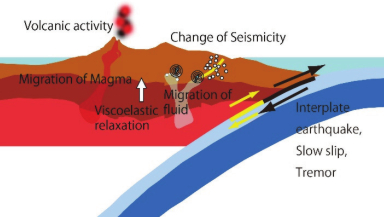
This study reviews a project in Japan
- [1] F. Tomita, M. Kido, T. Iinuma, Y. Ohta, R. Hino, M. Ohzono, H. Takahashi, R. Plata-Martínez, T. No, K. Nakahigashi, and K. Nakamura, “GNSS-Acoustic seafloor geodetic observations and their results along the Japan-Kuril trench,” Abstract of the Fall Meeting of Seismological Society of Japan, Article No.S03-05, 2023 (in Japanese).
- [2] F. Tomita and M. Kido, “An approximate travel time calculation and a robust GNSS-acoustic positioning method using an MCMC technique,” Earth Planets Space, Vol.74, Article No.176, 2022. https://doi.org/10.1186/s40623-022-01740-0
- [3] S. Ozawa, T. Nishimura, H. Suito, T. Kobayashi, M. Tobita, and T. Imakiire, “Coseismic and postseismic slip of the 2011 magnitude-9 Tohoku-Oki earthquake,” Nature, Vol.475, Issue 7356, pp.373-376, 2011. https://doi.org/10.1038/nature10227
- [4] M. Sato, T. Ishikawa, N. Ujihara, S. Yoshida, M. Fujita, M. Mochizuki, and A. Asada, “Displacement above the hypocenter of the 2011 Tohoku-Oki Earthquake,” Science, Vol.332, Issue 6036 Article No.1207401, 2011. https://doi.org/10.1126/science.1207401
- [5] https://cais.gsi.go.jp/YOCHIREN/report/kaihou109/03_03.pdf [Accessed November 18, 2024]
- [6] H. Takahashi, R. Hino, N. Uchida, T. Matsuzawa, Y. Ohta, S. Suzuki, and M. Shinohara, “Tectonic tremors immediately after the 2011 Tohoku-Oki earthquake detected by near-trench seafloor seismic observations,” Prog. Earth Planet. Sci., Vol.9, No.1, Article No.66, 2022. https://doi.org/10.1186/s40645-022-00525-z
- [7] L. Yamaya, K. Mochizuki, T. Akuhara, S. Takemura, M. Shinohara, and T. Yamada, “CMT inversion for small-to-moderate earthquakes applying to dense short-period OBS array at off Ibaraki region,” Earth Planets Space, Vol.74, Article No.164, 2022. https://doi.org/10.1186/s40623-022-01721-3
- [8] M. Shinohara, T. Yamada, T. Akuhara, K. Mochizuki, and S. Sakai, “Performance of seismic observation by distributed acoustic sensing technology using a seafloor cable off Sanriku, Japan,” Front. Mar. Sci., Vol.9, Article No.844506, 2022. https://doi.org/10.3389/fmars.2022.844506
- [9] S. Fukushima, M. Shinohara, K. Nishida, A. Takeo, T. Yamada, and K. Yomogida, “Detailed S-wave velocity structure of sediment and crust off Sanriku, Japan by a new analysis method for distributed acoustic sensing data using a seafloor cable and seismic interferometry,” Earth Planets Space, Vol.74, Article No.92, 2022. https://doi.org/10.1186/s40623-022-01652-z
- [10] R. Hino, T. Kubota, N. Y. Chikasada, Y. Ohta, and H. Otsuka, “Assessment of S-net seafloor pressure data quality in view of seafloor geodesy,” Prog. Earth Planet. Sci., Vol.9, Article No.73, 2022. https://doi.org/10.1186/s40645-022-00526-y
- [11] https://cais.gsi.go.jp/YOCHIREN/report/kaihou109/08_05.pdf [Accessed November 18, 2024]
- [12] S. Watanabe, T. Ishikawa, Y. Nakamura, and Y. Yokota, “Full-Bayes GNSS-A solution for precise seafloor positioning with single uniform sound speed gradient layer assumption,” J. Geod., Vol.97, Article No.89, 2023. https://doi.org/10.1007/s00190-023-01774-6
- [13] T. Shibutani, M. Teraishi, S. Komatsu, K. Yamazaki, Y. Yamashita, T. Ohkura, S. Yoshikawa, M. Iguchi, T. Tameguri, and T. Sonoda, “Estimation of the structure of the Philippine Sea Slab and its surrounding area beneath southern Kyushu by seismological methods,” DPRI Annu., Vol.62-B, pp. 280-287, 2019.
- [14] Y. Nakamura et al., “Structural anomaly at the boundary between strong and weak plate coupling in the central-western Nankai Trough,” Geophys. Res. Lett., Vol.49, Issue 10, Article No.e2022GL098180, 2022. https://doi.org/10.1029/2022GL098180
- [15] K. Shiraishi et al., “Seismogenic zone structures revealed by improved 3-D seismic images in the Nankai Trough off Kumano,” Geochem. Geophys. Geosyst., Vol.20, pp. 2252-2271, 2019. https://doi.org/10.1029/2018GC008173
- [16] S. Takenouchi et al., “Identification of active faults and tectonic features through heat flow distribution in the Nankai Trough, Japan,” Earth Planets Space, Vol.75, Article No.147, 2023. https://doi.org/10.1186/s40623-023-01890-9
- [17] Y. Yamashita et al., “Shallow tectonic tremor activities in Hyuga-nada,” Earth Planets Space, Vol.73, Article No.196, 2021. https://doi.org/10.1186/s40623-021-01533-x
- [18] T. Akuhara et al., “Shallow low-velocity layer in the Hyuga-Nada accretionary prism,” J. Geophys. Res. Solid Earth, Vol.128, Issue 4, Article No.e2022JB026298, 2023. https://doi.org/10.1029/2022JB026298
- [19] S. Baba et al., “Spatial variation in shallow slow earthquake activity in Hyuga-nada,” Geophys. J. Int., Vol.237, pp. 271-287, 2024. https://doi.org/10.1093/gji/ggae039
- [20] S. Takemura et al., “Detectability analysis of very low frequency earthquakes,” Geophys. J. Int., Vol.237, pp. 49-63, 2024. https://doi.org/10.1093/gji/ggae033
- [21] V. M. Cruz-Atienza et al., “Short-term interaction between silent and devastating earthquakes in Mexico,” Nat. Commun., Vol.12, pp. 49-63, 2021. https://doi.org/10.1038/s41467-021-22326-6
- [22] K. Mochizuki et al., “Seismicity and velocity structure in the vicinity of repeating slow slip earthquakes,” Earth Planet. Sci. Lett., Vol.563, Article No.116887, 2021. https://doi.org/10.1016/j.epsl.2021.116887
- [23] Y. Iwasaki et al., “Continuous tremor activity with stable polarization direction,” J. Geophys. Res. Solid Earth, Vol.127, Issue 2, Article No.e2021JB022161, 2022. https://doi.org/10.1029/2021JB022161
- [24] D. Bassett et al., “Crustal structure of the Hikurangi Margin from SHIRE seismic data,” Geophys. Res. Lett., Vol.49, Issue 2, Article No.e2021GL096960, 2022. https://doi.org/10.1029/2021GL096960
- [25] Z. W. Wang et al., “Fine structure of the subducting slab and the 2022 M7.4 Fukushima-Oki earthquake,” Seismol. Res. Lett., Vol.94, pp. 17-25, 2023. https://doi.org/10.1785/0220220234
- [26] E. Jamali Hondori et al., “Full-waveform inversion for imaging faulted structures,” Pure Appl. Geophys., Vol.178, pp. 1609-1630, 2021. https://doi.org/10.1007/s00024-021-02727-w
- [27] E. J. Hondori and J.-O. Park, “Connection between high pore-fluid pressure and frictional instability,” Sci. Rep., Vol.12, Article No.12556, 2022. https://doi.org/10.1038/s41598-022-16578-5
- [28] J.-O. Park et al., “Mantle-derived helium released through the Japan trench bend-faults,” Sci. Rep., Vol.11, Article No.12026, 2021. https://doi.org/10.1038/s41598-021-91523-6
- [29] A. Hasegawa et al., “Plate subduction and generation of earthquakes and magmas in Japan,” Gondwana Res., Vol.16, Issues 3-4, pp. 370-400, 2009. https://doi.org/10.1016/j.gr.2009.03.007
- [30] Y. Yuasa and S. Matsumoto, “Anelastic deformation in the lower crust,” Tectonophysics, Vol.846, Article No.229674, 2023. https://doi.org/10.1016/j.tecto.2022.229674
- [31] Y. Usuda et al., “Imaging of S wave reflection boundaries,” Zisin (J. Seismol. Soc. Jpn.), Vol.75, pp. 125-143, 2022 (in Japanese). https://doi.org/10.4294/zisin.2021-13
- [32] K. Yoshida, “Studies about the impacts of upward fluid migration,” Zisin (J. Seismol. Soc. Jpn.), Vol.74, pp. 95-116, 2021 (in Japanese). https://doi.org/10.4294/zisin.2020-20
- [33] K. Aizawa et al., “Electrical conductive fluid-rich zones,” Earth Planets Space, Vol.73, Article No.12, 2021. https://doi.org/10.1186/s40623-020-01340-w
- [34] Y. Iio et al., “Stress relaxation arrested the mainshock rupture,” Commun. Earth Environ., Vol.2, Issue 1, Article No.156 2021. https://doi.org/10.1038/s43247-021-00231-6
- [35] Y. Iio et al., “Spatial change in differential stress magnitudes,” Geophys. J. Int., Vol.233, pp. 1279-1295, 2023. https://doi.org/10.1093/gji/ggac521
- [36] K. Yoshida et al., “Updip fluid flow in the crust of the northeastern Noto peninsula,” Geophys. Res. Lett., Vol.50, Issue 21, Article No.e2023GL106023, 2023. https://doi.org/10.1029/2023GL106023
- [37] Y. Yamanaka and M. Kikuchi, “Asperity map along the subduction zone,” J. Geophys. Res. Solid Earth, Vol.109, Issue B7, Article No.B07307, 2004. https://doi.org/10.1029/2003JB002683
- [38] S. Ide, “Frequent observations of identical onsets of large and small earthquakes,” Nature, Vol.575, Isssue 7772, pp. 112-116, 2019. https://doi.org/10.1038/s41586-019-1508-5
- [39] K. Hirauchi et al., “The role of metasomatic alteration on frictional properties,” Earth Planet. Sci. Lett., Vol.531, Article No.115967, 2020. https://doi.org/10.1016/j.epsl.2019.115967
- [40] K. Hirauchi et al., “Cataclastic and crystal-plastic deformation,” Earth Planet. Sci. Lett., Vol.572, Article No.117232, 2021. https://doi.org/10.1016/j.epsl.2021.117232
- [41] M. Semba et al., “Effects of hydrothermal alteration on shear localization,” Tectonophysics, Vol.868, Article No.230081, 2023. https://doi.org/10.1016/j.tecto.2023.230081
- [42] Y. Huang et al., “Saline aqueous fluid circulation in mantle wedge,” Nat. Commun., Vol.10, Article No.5557, 2019. https://doi.org/10.1038/s41467-019-13513-7
- [43] Crustal stress field database. https://gbank.gsj.jp/crstress/ [Accessed November 28, 2025]
This article is published under a Creative Commons Attribution-NoDerivatives 4.0 Internationa License.