
Paper:
Examination of Continuation Factors of Regional Disaster Prevention Activities
Keisuke Hinoda*,†
 and Kensuke Takenouchi**
*Graduate School of Science for Creative Emergence, Kagawa University
2217-20 Hayashi-cho, Takamatsu, Kagawa 761-0396, Japan
†Corresponding author
**Faculty of Engineering and Design, Kagawa University
Takamatsu, Japan

As disasters become increasingly frequent and severe, sustaining community-based disaster prevention faces challenges such as personnel shortages and an aging population. This study examined disaster prevention activities in the Tsuruuchi Community of Takamatsu City, Japan, where such efforts have been maintained for over 10 years. Nine members of the Disaster Prevention Committee were interviewed using a semi-structured approach, and the data were analyzed with the steps for coding and theorization (SCAT) to explore participants’ thoughts, behaviors, and influencing factors utilizing a novel approach integrating both individual and community perspectives. At the individual level, positive reinterpretation of challenges and intrinsic redefinition of the meaning of activities were found to support ongoing engagement in disaster prevention. At the community level, the open structure of the Disaster Prevention Committee led to collaboration among diverse stakeholders and feedback on activities, while psychological safety allowed for the free expression of opinions and trial-and-error, contributing to the formation of participants’ intrinsic motivation. Furthermore, factors including the involvement of local government and social momentum influenced participation. These findings suggest that sustaining community-based disaster prevention activities may require fostering meaning-making, facilitating participants’ internal reinterpretation of motivations, and developing supportive policies that consider both individual and community dynamics.
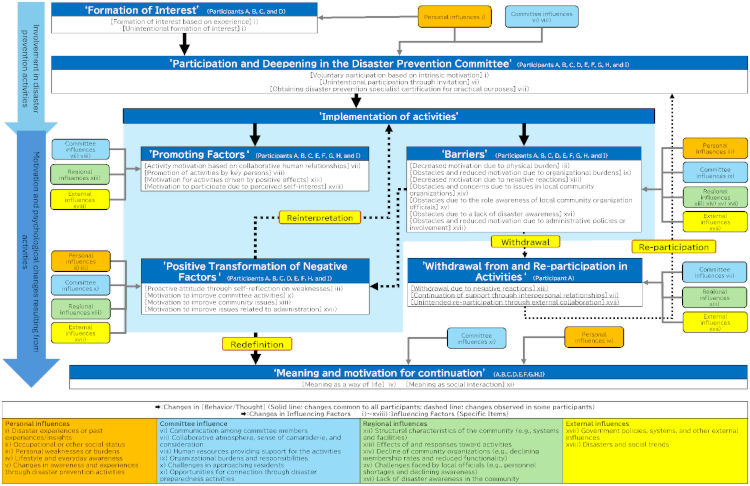
Model of continuous community DRR activities
- [1] Cabinet Office, Government of Japan, “White Paper on Disaster Management 2014,” 2014 (in Japanese). https://www.bousai.go.jp/kaigirep/hakusho/h26/honbun/index.html [Accessed April 4, 2025]
- [2] Cabinet Office, Government of Japan, “Promoting gender equality for sustainable neighborhood association activities,” 2017. https://www.gender.go.jp/kaigi/kento/chiiki/index.html [Accessed April 4, 2025]
- [3] A. Muranaka, G. Tanibata, T. Nakaya, K. Hanaoka, and Y. Shiraishi, “Behavioral determinants of participation in a workshop on making ‘safety and security map’ with resident participation – An analysis of the safe community activity in Kameoka City, Kyoto, Japan,” J. City Plan. Inst. Jpn., No.45-3, pp. 325-330, 2010 (in Japanese). https://doi.org/10.11361/journalcpij.45.3.325
- [4] K. Misaka and T. Koike, “Psychological processes toward flood control and river environments and their regional characteristics,” Doboku Gakkai Ronbunshuu B, Vol.62, No.1, pp. 16-26, 2006 (in Japanese). https://doi.org/10.2208/jscejb.62.16
- [5] T. Hashimoto, K. Karasawa, K. Hirayama, M. Wada, and H. Hosaka, “Community proactivity in disaster preparation: Research based on two communities in Japan,” J. Disaster Res., Vol.13, No.4, pp. 755-766, 2018. https://doi.org/10.20965/jdr.2018.p0755
- [6] T. Kumazawa and S. Eguchi, “A structural model of residents’ disaster prevention behavioral intentions regarding local evacuation shelters: A case study of the Toyoda Neighborhood Association in Sakae Ward, Yokohama City,” J. Soc. Saf. Sci., No.43, pp. 305-314, 2023 (in Japanese). https://doi.org/10.11314/jisss.43.305
- [7] T. Motoyoshi, K. Takao, and S. Ikeda, “Determinant factors of community-based disaster preparedness: A case study of flood prone area,” Jpn. J. Psychol., Vol.75, No.1, pp. 72-77, 2004 (in Japanese). https://doi.org/10.4992/jjpsy.75.72
- [8] T. Motoyoshi, K. Takao, and S. Ikeda, “Determinants of household- and community-based disaster preparedness,” Jpn. J. Soc. Psychol., Vol.23, No.3, pp. 209-220, 2008 (in Japanese). https://doi.org/10.14966/jssp.KJ00004896217
- [9] M. Ogane, M. Umemoto, A. Saito, and E. Itoigawa, “Study on the promotion of the working generation’s participation in voluntary disaster prevention activities: Based on the questionnaire in Tokai-mura,” J. Soc. Saf. Sci., No.29, pp. 197-205, 2016 (in Japanese). https://doi.org/10.11314/jisss.29.197
- [10] Y. Masuda and N. Kaida, “Influence of perceived burden of disaster preparedness on actual practices,” J. Jpn. Soc. Civil Eng., Ser. D3 (Infrastruct. Plan. Manag.), Vol.75, No.5, pp. I_109-I_116, 2019 (in Japanese). https://doi.org/10.2208/jscejipm.75.I_109
- [11] M. Matsumoto and R. Yatabe, “Determinants that motivate continuous disaster-prevention activity in disaster-stricken area people,” J. Jpn. Soc. Nat. Disaster Sci., Vol.27, No.3, pp. 319-330, 2008 (in Japanese).
- [12] A. Saito, M. Umemoto and E. Itoigawa, “An attempt to quantitatively evaluate activities of voluntary organizations for disaster prevention focused on their substantiation and durability,” J. Soc. Saf. Sci., No.29, pp. 37-46, 2016 (in Japanese). https://doi.org/10.11314/jisss.29.37
- [13] M. Fujita, K. Shimizu, K. Kimura, and Y. Sato, “Relationship between independent activities for disaster prevention and ordinary activities in neighborhood: The situation of Akita City,” J. City Plan. Inst. Jpn., No.38-3, pp. 19-24, 2003 (in Japanese). https://doi.org/10.11361/journalcpij.38.3.19
- [14] Y. Ueno, M. Yoshida, Y. Kitazono, R. Kakimoto, and K. Hoshide, “Activities of self-support disaster reduction associations and responsible persons,” J. Jpn. Soc. Civil Eng., Ser. D3 (Infrastruct. Plan. Manag.), Vol.72, No.1, pp. 14-24, 2016 (in Japanese). https://doi.org/10.2208/jscejipm.72.14
- [15] R. Kakimoto, “Study on relationship between social capital and disaster response capacity in Mashiki-town,” J. Jpn. Soc. Nat. Disaster Sci., Vol.39, No.S07, pp. 57-70, 2020 (in Japanese). https://doi.org/10.24762/jndsj.39.S07_57
- [16] T. Sato, A. Sakurai, Y. Sadaike, Y. Ouchi, and Y. Sugawara, “Sustainable community development for disaster resilience using the Fukuzumi-machi method and human resources development for disaster risk reduction,” J. Disaster Res., Vol.15 No.7, pp. 919-930, 2020. https://doi.org/10.20965/jdr.2020.p0919
- [17] T. Otani, “SCAT: A qualitative data analysis method by four-step coding: Easy startable and small scale data-applicable process of theorization,” Bull. Grad. Sch. Educ. Hum. Dev. (Educ. Sci.) Nagoya Univ., Vol.54, No.2, pp. 27-44, 2008 (in Japanese). https://doi.org/10.18999/nueduca.54.2.27
- [18] Takamatsu City, “Hazard map,” 2025.
- [19] K. Matsuzaki, “Process of finding the role as Minsei-iin – Analysis by Modified Grounded Theory Approach –,” Yokohama J. Technol. Manag. Stud., Vol.13, pp. 21-33, 2014 (in Japanese).
- [20] Y. Sugihara, “Willingness to continue working as district welfare commissioners in Tokyo: The roles of psychosocial rewards, role strain, and support,” Jpn. J. Public Health, Vol.65, No.5, pp. 233-242, 2018 (in Japanese). https://doi.org/10.11236/jph.65.5_233
- [21] K. Miyamoto, “Factors for continued long-term participation in neighborhood associations – An analysis using the trajectory equifinality approach,” Annu. Rep. Tokai Gakuin Univ., Vol.7, pp. 47-55, 2022 (in Japanese). https://doi.org/10.24478/00003794
- [22] R. Nakao, R. Kawasaki, and K. Sugiyama, “Working motivation of local welfare workers in Nagasaki City,” Health Sci. Res., Vol.20, No.2, pp. 25-29, 2008 (in Japanese).
- [23] Y. Yamaguchi, M. Chosokabe, and K. Tanimoto, “Psychological safety and mutual assistance activities by local community,” J. Jpn. Soc. Civil Eng., Ser. D3 (Infrastruct. Plan. Manag.), Vol.78, No.5, pp. I_63-I_70, 2023 (in Japanese). https://doi.org/10.2208/jscejipm.78.5_I_63
- [24] Cabinet Office, Government of Japan, “Community disaster management plan guidebook” (in Japanese). https://www.bousai.go.jp/kyoiku/chikubousai/index.html [Accessed April 4, 2025]
- [25] S. Imamura, “Appropriate administrative involvement for sustainable community development by inhabitants – A case study of Ono City, Fukui Prefecture –,” J. Jpn. Assoc. Reg. Dev. Vitalization, Vol.19, No.1, pp. 61-69, 2023 (in Japanese). https://doi.org/10.57340/ckg.19.1_61
- [26] R. M. Ryan, and E. L. Deci, “Self-determination theory and the facilitation of intrinsic motivation, social development, and well-being,” Am. Psychol., Vol.55, No.1, pp. 68-78, 2000. https://doi.org/10.1037//0003-066x.55.1.68
This article is published under a Creative Commons Attribution-NoDerivatives 4.0 Internationa License.